Within 1995 Review
Why Vague Accuracy Was Not Enough
A remote-viewing report could sound partly right yet still fail if it lacked the specific details needed for decisions.
On this page
- What intelligence users needed from a report
- Why broad impressions were easy to overmatch
- How actionability became the decisive standard
Page outline Jump by section
Introduction
The central lesson of the 1995 evaluation of the U.S. government’s remote-viewing programme was not simply that many reports were inaccurate. It was that even reports containing occasional correct elements rarely met the much higher standard required for intelligence work: they had to be specific, timely and reliable enough to support real decisions. That distinction explains why the debate over statistical laboratory results did not determine the programme’s fate. Intelligence organisations do not judge information primarily by whether parts of it appear correct in hindsight. They judge whether decision-makers could have acted on it before the outcome was known. The American Institutes for Research (AIR) concluded that the operational record failed that test, making actionability—not isolated accuracy—the decisive criterion.[CIA]cia.govAN EVALUATION OF THE REMOTE VIEWING PROGRAMThe first component was a review of the research program. The second component was a review…

What intelligence users needed from a report
An intelligence report has value only if it reduces uncertainty enough to change a decision. Analysts and operational users typically need information that answers practical questions such as:
- Who or what is the target?
- Where is it located?
- When will an event occur?
- How confident should the reader be?
- Can the information be independently checked before action is taken?
A report that merely suggests broad themes or general descriptions may sound plausible, but it does not tell a commander where to deploy resources, whether to warn policymakers or whether an operation should proceed.
The AIR review found little evidence that remote-viewing reports consistently supplied this level of operational detail. Although some reports contained elements later interpreted as correct, they were frequently mixed with irrelevant, ambiguous or incorrect material. From the perspective of an intelligence customer, separating the useful fragments from the surrounding noise became an additional problem rather than a solution.[CIA]cia.govAN EVALUATION OF THE REMOTE VIEWING PROGRAMThe first component was a review of the research program. The second component was a review…
This distinction mattered because intelligence organisations already possessed many conventional sources—imagery, intercepted communications, human reporting and technical collection—that were evaluated according to established standards of reliability. Any unconventional method had to demonstrate that it added information unavailable elsewhere and did so consistently enough to justify operational use.
Why broad impressions were easy to overmatch
One reason actionability became such a demanding standard is that vague descriptions are surprisingly easy to match after the fact.
[Remote viewing]WikipediaRemote viewingThe program ran from 1975 to 1995 and ended after evaluators concluded that remote viewers consistently failed to produc… ng report might describe:
- a large industrial structure;
- water nearby;
- military activity;
- unusual machinery; or
- heightened security.
Many real-world locations satisfy some or all of these descriptions. Once the actual target becomes known, readers naturally notice similarities while discounting the many statements that did not fit. This process, often called retrospective matching or subjective validation, can make a report appear more successful than it would have been before the outcome was known.
Ray Hyman argued that much of the operational material displayed precisely this pattern. In his assessment, the reports generated large amounts of general information, with a relatively small number of apparent “hits” that could emerge through selective interpretation rather than through uniquely accurate perception. His criticism was not simply that individual statements were wrong, but that the reports lacked the specificity needed to distinguish genuine predictive value from coincidence or flexible interpretation.[UC Irvine Bren School+2ResearchGate]ics.uci.eduShe does not…
From an intelligence perspective, a report stating that “something significant is happening near water” is fundamentally different from identifying a particular submarine base, giving its location and describing activities that can later be independently confirmed.

How actionability became the decisive standard
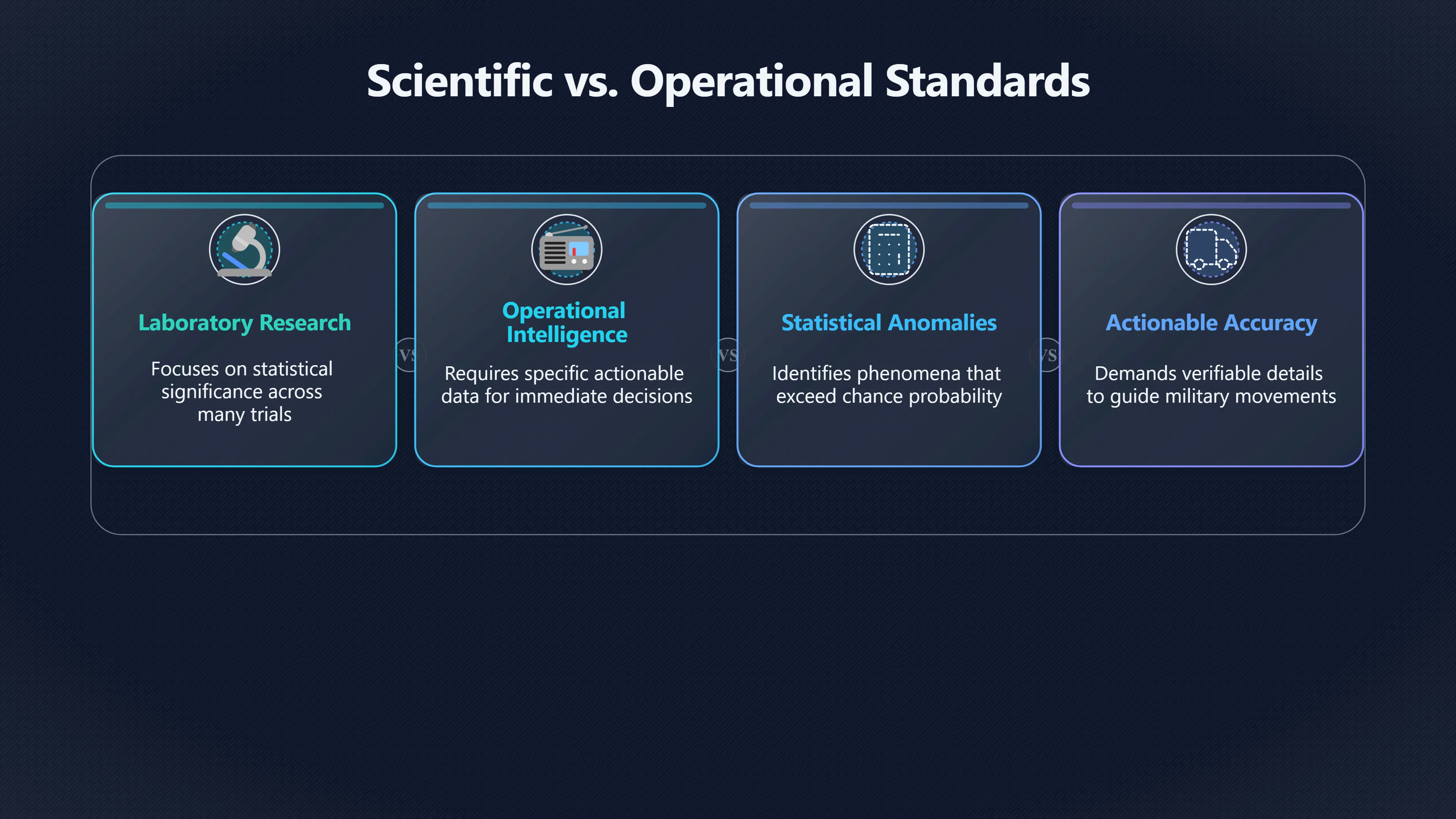
The 1995 review separated two questions that are often merged in popular accounts.
The first asked whether certain laboratory experiments produced statistical results that were difficult to explain by chance alone. Jessica Utts argued that the experimental evidence justified taking the phenomenon seriously as a scientific question.
The second asked whether the operational programme had demonstrated practical intelligence usefulness. Here the evaluation reached a much more negative conclusion. Even if laboratory anomalies deserved further investigation, the available operational record did not show that remote viewing reliably produced intelligence suitable for planning or decision-making.[CIA+2CIA]cia.govAN EVALUATION OF THE REMOTE VIEWING PROGRAMThe first component was a review of the research program. The second component was a review…
This separation explains why the programme could receive mixed scientific assessments while still failing its institutional evaluation. Governments fund intelligence capabilities because they improve decisions, not because they produce statistically interesting results under experimental conditions.
Why occasional successes were insufficient
Supporters of the programme have pointed to individual cases that appeared impressively accurate. The operational question, however, was never whether striking examples existed. It was whether those successes represented a dependable capability.
Intelligence managers must assume that any collection method will occasionally produce correct information by chance or through incomplete but genuine insight. The real test is whether users can know in advance when to trust the information.
The AIR review found little documented evidence that operational customers could consistently distinguish high-value reports from unreliable ones before decisions had to be made. Without a dependable way to identify trustworthy sessions, even genuine successes had limited operational value because decision-makers could not confidently separate them from failures.[CIA]cia.govAN EVALUATION OF THE REMOTE VIEWING PROGRAMThe first component was a review of the research program. The second component was a review…
This is a common challenge in intelligence analysis. A source that is correct only unpredictably may create more risk than benefit if users cannot determine when the information is reliable.
Why intelligence agencies demanded more than partial correctness
Operational intelligence imposes stricter standards than scientific curiosity.
A scientific experiment may ask whether an effect exists on average across hundreds of trials. Intelligence officers instead ask whether today’s report is accurate enough to justify today’s action.
That difference changes the evaluation criteria dramatically:
- Statistical significance does not automatically produce operational usefulness.
- Partial accuracy is less valuable than precise, verifiable information.
- Consistency matters more than occasional spectacular successes.
- Information must arrive early enough to influence decisions rather than merely explain them afterwards.
These requirements explain why the 1995 evaluation placed greater weight on documented operational performance than on debates over laboratory statistics. The review concluded that the programme had not demonstrated sufficient practical value for intelligence operations, regardless of continuing disagreement about the interpretation of experimental findings.[CIA+2CIA]cia.govAN EVALUATION OF THE REMOTE VIEWING PROGRAMThe first component was a review of the research program. The second component was a review…
The lasting significance of the actionability standard
The most enduring conclusion of the 1995 evaluation is therefore not that every remote-viewing report was inaccurate. Instead, it established that intelligence agencies require a higher threshold than occasional correctness.
For a collection method to become an operational capability, it must consistently provide information that is specific enough to guide action, reliable enough to justify confidence and timely enough to influence decisions. According to the AIR evaluation, the remote-viewing programme did not demonstrate that level of performance. That finding, more than the unresolved scientific debate over laboratory anomalies, explains why the programme was ultimately judged unsuitable as an intelligence tool.[CIA]cia.govAN EVALUATION OF THE REMOTE VIEWING PROGRAMThe first component was a review of the research program. The second component was a review…
Amazon book picks
Further Reading
Books and field guides related to Why Vague Accuracy Was Not Enough. Use these as the next step if you want deeper reading beyond the article.

Remote viewing secrets
Discusses intelligence applications from a participant's perspective.

The conscious universe
Contrasts laboratory evidence with practical application questions.
Parapsychology: A Handbook for the 21st Century
Places operational claims within broader scientific research.
eBay marketplace picks
Marketplace Samples
Live-tested eBay searches with available results related to this page.




Endnotes
1.
Source: cia.gov
Link:https://www.cia.gov/readingroom/docs/CIA-RDP96-00791R000200180005-5.pdf
Source snippet
AN EVALUATION OF THE REMOTE VIEWING PROGRAMThe first component was a review of the research program. The second component was a review...
2.
Source: cia.gov
Link:https://www.cia.gov/readingroom/docs/CIA-RDP96-00791R000200180006-4.pdf
Source snippet
of paranormal phenomena; the laboratory experiments...
3.
Source: researchgate.net
Link:https://www.researchgate.net/publication/267978941Evaluation_of_Program_on%27Anomalous_Mental_Phenomena%27
Source snippet
Evaluation of Program on 'Anomalous Mental Phenomena'Jessica Utts and I were commissioned to evaluate the research on remote viewing and...
4.
Source: cia.gov
Link:https://www.cia.gov/readingroom/document/cia-rdp96-00791r000200180006-4
Source snippet
AN EVALUATION OF REMOTE VIEWING: RESEARCH...A remote viewer is asked to visualize a place, location, or object being viewed by a "beacon...
5.
Source: researchgate.net
Link:https://www.researchgate.net/publication/403178755_The_Star_Gate_Archives_Reports_of_the_United_States_Government_Sponsored_Psi_Program_1972-1995_Volume_4_Operational_Remote_Viewing_Memorandums_and_Reports
Source snippet
1995. Volume 4: Operational remote viewing: Memo-. randums and... inaccurate information”. (p. 330). Later, a request from Congressman...
6.
Source: ics.uci.edu
Link:https://www.ics.uci.edu/~jutts/hyman.html
Source snippet
She does not...
7.
Source: Wikipedia
Title: Remote viewing
Link:https://en.wikipedia.org/wiki/Remote_viewing
Source snippet
Remote viewingThe program ran from 1975 to 1995 and ended after evaluators concluded that remote viewers consistently failed to produc...
8.
Source: ciaotest.cc.columbia.edu
Title: sa jan02srm01
Link:https://ciaotest.cc.columbia.edu/olj/sa/sa_jan02srm01.html
Source snippet
Remote Viewing: The US Sponsored Psychic...This book appears to have jolted the US Central Intelligence Agency (CIA) into action, trigge...
9.
Source: skeptics.stackexchange.com
Title: Is this true?Read more
Link:https://skeptics.stackexchange.com/questions/17741/have-remote-viewing-tests-shown-a-positive-effect-5-15-above-chance
Source snippet
remote viewing tests shown a positive effect, 5-15%...14 Sept 2013 — Utts maintained that there had been a statistically significant pos...
Additional References
10.
Source: skepsis.nl
Link:https://skepsis.nl/[stargate
Source snippet
CIA onderzoekt ESP / remote viewingDe skeptische psycholoog Ray Hyman van de Universiteit van Oregon was een van de twee hiervoor benader...
11.
Source: researchprofiles.herts.ac.uk
Title: experiment one of the saic remote viewing program a critical re e
Link:https://researchprofiles.herts.ac.uk/en/publications/experiment-one-of-the-saic-remote-viewing-program-a-critical-re-e
Source snippet
One of the SAIC Remote Viewing Programby R Wiseman · 1999 · Cited by 24 — This paper first outlines xx a key study in the report (referre...
12.
Source: popularmechanics.com
Title: cia psychic espionage secrets revealed
Link:https://www.popularmechanics.com/science/a65932697/cia-psychic-espionage-secrets-revealed/
Source snippet
The CIA Watched Him Bend Reality With Just His Mind...29 Aug 2025 — During the height of the [Cold War]({{ 'cold-war/' | relative_url }}), the CIA ran tests on people with...
13.
Source: Wikipedia
Title: Stargate Project (U.S. Army unit)
Link:https://en.wikipedia.org/wiki/Stargate_Project_%28U.S._Army_unit%29
Source snippet
Stargate Project (U.S. Army unit)According to the AIR review, no remote viewing report ever provided actionable information for any in...
14.
Source: pmc.ncbi.nlm.nih.gov
Link:https://pmc.ncbi.nlm.nih.gov/articles/PMC10275521/
Source snippet
Central Intelligence Agency's (CIA...by Á Escolà‐Gascón · 2023 · Cited by 10 — Since 1972, the U.S. Central Intelligence Agency (CIA) co...
15.
Source: youtube.com
Title: Stargate Project: How Did the CIA Turn the Human Mind into a Weapon?
Link:https://www.youtube.com/watch?v=IDPlEXpzRoQ
Source snippet
2 Practical Applications of Remote Viewing with Joe McMoneagle...
16.
Source: youtube.com
Title: Practical Applications of Remote Viewing with Joe Mc Moneagle
Link:https://www.youtube.com/watch?v=0S8L4ZHGjQE
Source snippet
3 Inside Operation Stargate: The CIA's Psychic Spy Experiment...
17.
Source: scribd.com
Title: Air Report
Link:https://www.scribd.com/doc/92017954/Air-Report
Source snippet
Evaluation of Remote Viewing Program | PDFIn June of 1995, CIA's Office of Research and Development (ORD) then contracted with AIR for th...
18.
Source: youtube.com
Title: Inside Operation Stargate: The CIA’s Psychic Spy Experiment
Link:https://www.youtube.com/watch?v=oasTnsLw_n8
Source snippet
4 Inside The Military's Secret Psychic Unit...
19.
Source: youtube.com
Title: Inside The Military’s Secret Psychic Unit
Link:https://www.youtube.com/watch?v=9nY3hu76SyU
Source snippet
5 Joseph McMoneagle, BA...
Topic Tree