Within Read Files
Why the AIR Review Still Matters
The AIR review helps readers distinguish statistical findings, expert disagreement and operational usefulness in the Star Gate record.
On this page
- What the review was asked to assess
- Research effects versus intelligence value
- How Utts and Hyman frame the dispute
Page outline Jump by section
Introduction
The 1995 American Institutes for Research (AIR) review is the most useful single document for calibrating expectations when reading declassified remote viewing files. Rather than asking whether any individual transcript appears impressive, the review examined two separate questions: whether controlled research showed effects beyond chance, and whether the programme produced intelligence that decision-makers could reliably use. Those questions received different answers. The review concluded that some laboratory findings deserved scientific attention, while also finding no persuasive evidence that the operational programme had produced intelligence of practical value. For readers of the Star Gate archive, that distinction is essential because it discourages treating striking session transcripts as proof that the programme succeeded.[National Security Archive]nsarchive2.gwu.eduNational Security ArchiveAn Evaluation of Remote Viewing: Research and…March 13, 2015 — by MD Mumford · 1995 · Cited by 76 — During St…
What the review was asked to assess
The AIR review was commissioned after responsibility for the Star Gate programme transferred to the CIA in 1995. Instead of reviewing only laboratory experiments or only operational case files, the panel was instructed to examine the programme as a whole. That meant assessing controlled research, interviewing personnel, examining operational records and considering whether the intelligence community had obtained practical value from nearly two decades of work.[National Security Archive]nsarchive2.gwu.eduNational Security ArchiveAn Evaluation of Remote Viewing: Research and…March 13, 2015 — by MD Mumford · 1995 · Cited by 76 — During St…
For readers, this broad remit makes the report especially valuable. It acts as a bridge between the raw archive and later interpretations by asking questions that individual session files cannot answer on their own:
- Did laboratory experiments produce statistically unusual results?
- Were those results convincing evidence of a genuine anomalous process?
- Did operational users receive information that improved intelligence decisions?
- Were there methodological or procedural weaknesses that limited confidence?
Keeping those questions separate prevents a common reading error: assuming that evidence for one proposition automatically proves another.
Research effects versus intelligence value
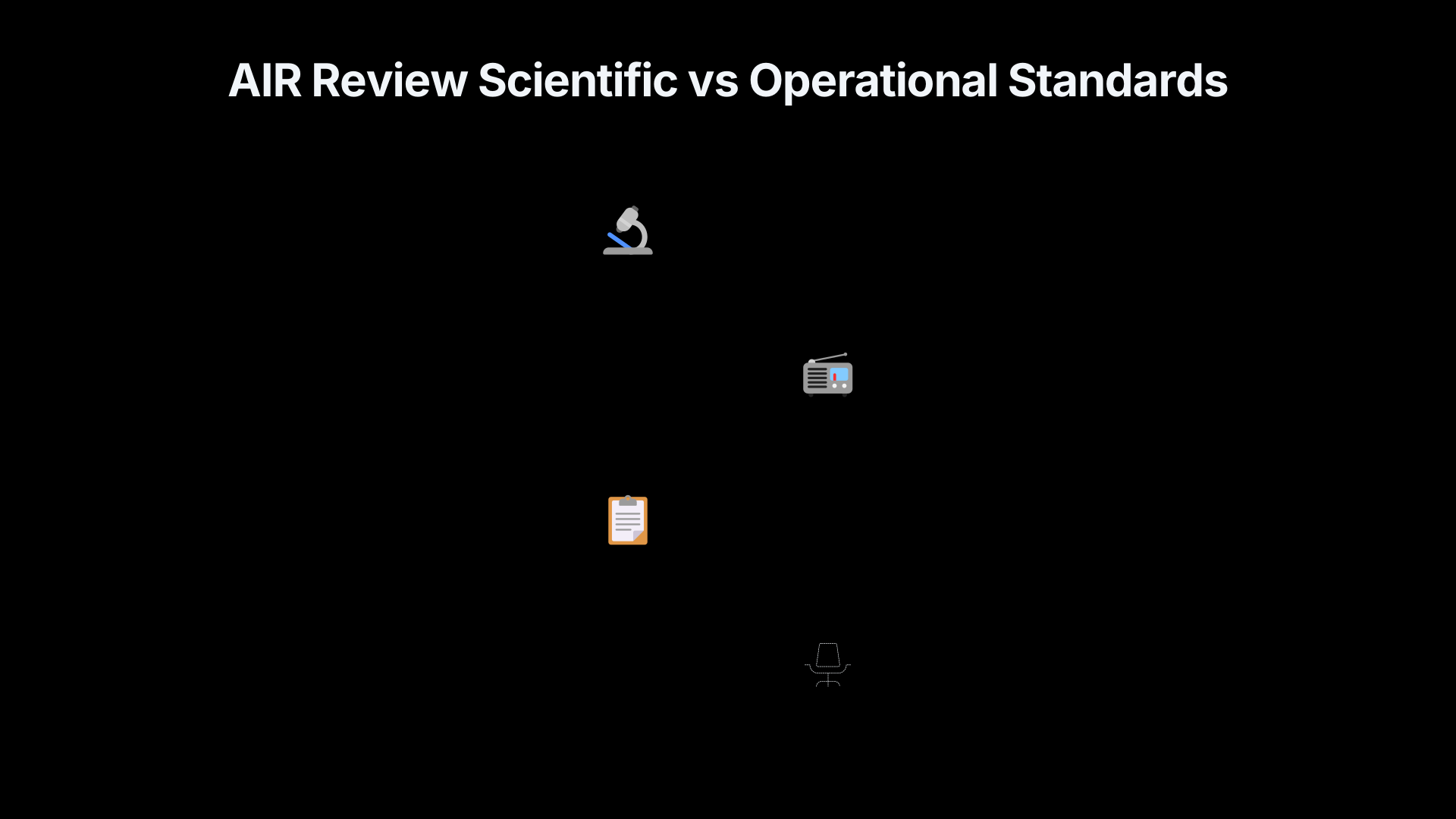
One of the AIR review’s most important contributions is its insistence that scientific effects and operational usefulness are different standards.
The reviewers acknowledged that some laboratory studies reported statistically significant departures from chance under controlled conditions. These findings persuaded some reviewers that further scientific investigation was justified. However, the report also stressed that statistical significance alone does not establish a paranormal explanation, nor does it demonstrate that a method is dependable enough for intelligence work.[National Security Archive]nsarchive2.gwu.eduNational Security ArchiveAn Evaluation of Remote Viewing: Research and…March 13, 2015 — by MD Mumford · 1995 · Cited by 76 — During St…
Operational intelligence demands much more than occasional statistical effects. Intelligence products must be sufficiently specific, timely and reliable to influence real decisions. The AIR evaluation found that the operational record did not meet that threshold. Reported information was frequently vague, incomplete or mixed with incorrect material, making it difficult for analysts to distinguish useful elements from noise before independent confirmation became available. The reviewers therefore concluded that the programme had not demonstrated value as an operational intelligence collection tool.[National Security Archive]nsarchive2.gwu.eduNational Security ArchiveAn Evaluation of Remote Viewing: Research and…March 13, 2015 — by MD Mumford · 1995 · Cited by 76 — During St…
This distinction provides an important reading discipline. A transcript containing several apparently accurate descriptions does not by itself answer the operational question. The relevant question becomes whether those descriptions could have guided analysts before the outcome was already known.
How Utts and Hyman frame the dispute
The AIR review is often remembered because it incorporated two expert assessments that reached different conclusions while examining much of the same evidence.
Jessica Utts: statistical evidence deserved serious consideration
Statistician Jessica Utts argued that the accumulated laboratory evidence was strong enough that chance alone was an implausible explanation. In her assessment, the principal question was no longer whether anomalous effects existed, but how they should be understood scientifically. She maintained that many experiments had produced effects exceeding what conventional statistical analysis would predict by chance.[Wikipedia]WikipediaJessica UttsJessica Utts
Importantly, even this more favourable interpretation did not amount to a claim that the operational programme had clearly succeeded as an intelligence system. The distinction between laboratory research and practical deployment remained relevant.
Ray Hyman: evidence remained methodologically uncertain
Psychologist Ray Hyman accepted that some statistical findings appeared interesting but argued that the evidence fell short of demonstrating paranormal functioning. He questioned whether methodological weaknesses, selective reporting, insufficient independent replication and ordinary psychological processes could account for the observed results. From his perspective, stronger controls and independent confirmation were still necessary before extraordinary conclusions could be justified.[CiteSeerX]citeseerx.ist.psu.eduThe American Institutes for Research Review of the…by C EDWIN · 1996 · Cited by 3 — In 1995, David Goslin assumed responsibil…
Hyman also emphasised that impressive-looking transcript matches can be misleading because readers naturally focus on apparent successes while overlooking vague, incorrect or non-specific statements. That observation remains highly relevant when examining declassified session records.
Why this disagreement improves rather than weakens the review
For modern readers, the value of the AIR review lies less in choosing between Utts and Hyman than in understanding precisely where they agreed and disagreed.
Both accepted that some laboratory experiments produced statistically unusual outcomes.
Both recognised that methodology mattered enormously.
Both distinguished controlled experiments from operational intelligence.
Neither concluded that individual session transcripts should be accepted at face value as proof of successful psychic espionage.[National Security Archive]nsarchive2.gwu.eduNational Security ArchiveAn Evaluation of Remote Viewing: Research and…March 13, 2015 — by MD Mumford · 1995 · Cited by 76 — During St…
Their disagreement concerns the interpretation of laboratory evidence, not the importance of careful evaluation.
Using the AIR review to read declassified files more carefully
The review functions as a practical calibration tool because it encourages readers to resist common cognitive traps.
When encountering a dramatic transcript, ask whether the apparent correspondence is specific enough that it could not reasonably fit many different targets.
Consider whether the document records information produced before feedback or whether later knowledge may have influenced interpretation.
Separate the original statements from later summaries, annotations or success claims.
Remember that operational usefulness depends on whether information could have guided decisions prospectively, not whether similarities can be identified retrospectively.
The AIR reviewers also noted that some operational tasks were undertaken with viewers possessing varying degrees of background knowledge, which complicates simple claims that every accurate detail arose independently. That observation reinforces the need to examine each document’s procedural context rather than relying solely on the apparent quality of the narrative.[National Security Archive]nsarchive2.gwu.eduNational Security ArchiveAn Evaluation of Remote Viewing: Research and…March 13, 2015 — by MD Mumford · 1995 · Cited by 76 — During St…

Why the AIR review still matters
The declassified Star Gate archive contains hundreds of compelling documents, but the archive alone cannot resolve the programme’s overall effectiveness. Individual sessions naturally highlight memorable descriptions, whereas programme evaluation requires looking across successes, failures, ambiguity and practical outcomes.
The AIR review remains the best checkpoint because it applies that broader perspective. It reminds readers that statistically interesting research, unresolved scientific debate and operational usefulness are separate questions requiring separate evidence. Approaching the archive with those distinctions in mind produces a more balanced understanding than either uncritical acceptance or blanket dismissal.[National Security Archive]nsarchive2.gwu.eduNational Security ArchiveAn Evaluation of Remote Viewing: Research and…March 13, 2015 — by MD Mumford · 1995 · Cited by 76 — During St…
Amazon book picks
Further Reading
Books and field guides related to Why the AIR Review Still Matters. Use these as the next step if you want deeper reading beyond the article.
The Men Who Stare At Goats
Rating: 3.5/5 from 11 Google Books ratings
Introduces the culture surrounding military paranormal programs.

Phenomena
From the author of Nuclear War: A Scenario, this is the gripping story of how a select group of scientists, under the watchful eye of the...
Endnotes
1.
Source: cia.gov
Link:https://www.cia.gov/readingroom/docs/CIA-RDP96-00791R000200180005-5.pdf
Source snippet
AN EVALUATION OF THE [REMOTE VIEWING]({{ 'remote-viewing/' | relative_url }}) PROGRAMDuring. Star Gate's history, DIA pursued three basic program objectives: "Operations," usin...
2.
Source: Wikipedia
Title: Jessica Utts
Link:https://en.wikipedia.org/wiki/Jessica_Utts
3.
Source: cia.gov
Link:https://www.cia.gov/readingroom/docs/CIA-RDP96-00791R000200300006-8.pdf
Source snippet
star gate operational tasking and evaluationIn 1994, the DIA Star Gate program office created a methodology for obtaining numerical evalu...
4.
Source: Wikipedia
Title: [Stargate]({{ ‘stargate/’ | relative_url }}) Project (U.S. Army unit)
Link:https://en.wikipedia.org/wiki/Stargate_Project_%28U.S._Army_unit%29
Source snippet
Stargate Project (U.S. Army unit)The Stargate Project was terminated and declassified in 1995 after a commissioned review by the CIA c...
5.
Source: nsarchive2.gwu.edu
Link:https://nsarchive2.gwu.edu/NSAEBB/NSAEBB438/docs/doc_57.pdf
Source snippet
National Security ArchiveAn Evaluation of Remote Viewing: Research and...March 13, 2015 — by MD Mumford · 1995 · Cited by 76 — During St...
Published: March 13, 2015
6. Source: citeseerx.ist.psu.edu
Source snippet
The American Institutes for Research Review of the...by C EDWIN · 1996 · Cited by 3 — In 1995, David Goslin assumed responsibil...
Additional References
7.
Source: researchgate.net
Link:https://www.researchgate.net/publication/403178755_The_Star_Gate_Archives_Reports_of_the_United_States_Government_Sponsored_Psi_Program_1972-1995_Volume_4_Operational_Remote_Viewing_Memorandums_and_Reports
Source snippet
Originally the review was meant to have been conducted. by the NRC. In [hindsight]({{ 'hindsight/' | relative_url }}), it...Read more...
8.
Source: journalofscientificexploration.org
Link:https://journalofscientificexploration.org/index.php/jse/article/view/3865/2573
Source snippet
1972, the CIA provided the initial funding for RV research, and, in 1995, received respon- sibility for what was then known as the Star G...
9.
Source: academia.edu
Title: Volume 4: Operational Remote Viewing: Memorandums and Reports.Read more
Link:https://www.academia.edu/95285973/The_Star_Gate_Operational_Remote_Viewing_Program_A_Human_Intelligence_HUMINT_Collection_Platform
Source snippet
(PDF) The Star Gate Operational Remote Viewing Program...The Star Gate Archives: Reports of the United States Government Sponsored Psi P...
10.
Source: youtube.com
Link:https://www.youtube.com/watch?v=dO6ACuErj9U
Source snippet
An Open-Ended Conversation with Paul H. Smith (4K Reboot)...
11.
Source: youtube.com
Title: EXAMINING THE EVIDENCE FOR PSI PHENOMENA
Link:https://www.youtube.com/watch?v=UbXcCBPHUn0
Source snippet
Remote Viewing Psychology with Charles T. Tart (1937 - 2025) (4K Reboot)...
12.
Source: youtube.com
Title: Stargate Project: How Did the CIA Turn the Human Mind into a Weapon?
Link:https://www.youtube.com/watch?v=IDPlEXpzRoQ
Source snippet
Skepticism About Remote Viewing with Paul H. Smith...
13.
Source: youtube.com
Title: Skepticism About Remote Viewing with Paul H. Smith
Link:https://www.youtube.com/watch?v=gadka2zweUo
Source snippet
EXAMINING THE EVIDENCE FOR PSI PHENOMENA - Dean Radin PHD #40...
14.
Source: go.gale.com
Link:https://go.gale.com/ps/i.do?id=GALE%7CA386410536&issn=00223387&it=r&linkaccess=abs&p=AONE&sid=googleScholar&sw=w&v=2.1
Source snippet
vernment's [psychic spying]({{ 'psychic-spying/' | relative_url }}) program/...by EC May · 2014 · Cited by 5 — The CIA was tasked by Congress in 1995 to conduct a 20-year retro...
15.
Source: youtube.com
Title: An Open-Ended Conversation with Paul H. Smith (4K Reboot)
Link:https://www.youtube.com/watch?v=QhWOt2q_xnU
Topic Tree