Within Targ Puthoff
Why Calling Psychics 'Viewers' Changed the Story
Replacing 'psychic' with 'viewer' made remote viewing feel like a testable skill rather than a rare gift.
On this page
- From clairvoyant talent to testable role
- Why the language appealed to sponsors
- The limits of making ESP sound trainable
Page outline Jump by section
Introduction
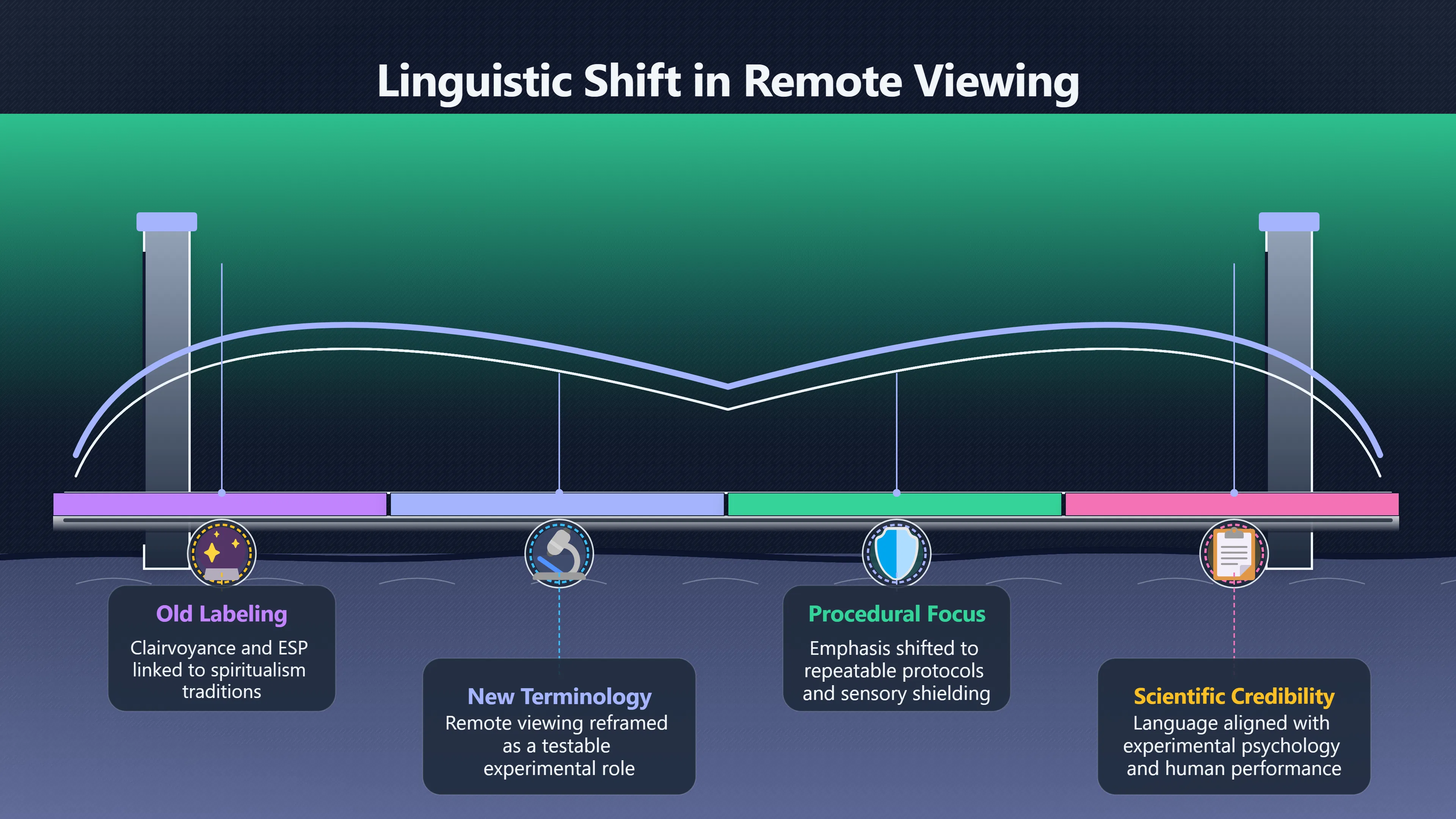
One of the most influential changes introduced by Russell Targ, Harold Puthoff and their collaborators was not a laboratory instrument but a choice of words. By replacing the label “psychic” with “remote viewer”, they reframed an alleged paranormal gift as a defined role within an experimental procedure. That shift mattered because it suggested that success depended less on being a uniquely gifted clairvoyant and more on following a repeatable protocol. For researchers seeking scientific credibility and government funding during the Cold War, this language helped present remote viewing as a testable human performance rather than a supernatural phenomenon. The terminology also supported a second, equally important promise: that at least some aspects of the process might be teachable. Whether that promise was fulfilled remains one of the most disputed parts of the remote-viewing legacy.[CIA]cia.govREMOTE VIEWING OF NATURAL TARGETS. SRI….This paper presents a series of experiments in which a subject is asked to describe a remot…
From clairvoyant talent to a testable role
Before the 1970s, claims of perceiving distant places typically appeared under labels such as clairvoyance, travelling clairvoyance or ESP. Those terms carried strong associations with spiritualism, fortune-telling and exceptional individuals. Targ and Puthoff deliberately adopted the expression remote viewing to distinguish their work from that tradition and to emphasise an experimental task instead of an inherited gift. Their published papers likewise spoke of “information transmission” and “sensory shielding” rather than psychic powers, reinforcing the impression of a measurable laboratory phenomenon.[CIA+2Wikipedia]cia.govREMOTE VIEWING OF NATURAL TARGETS. SRI….This paper presents a series of experiments in which a subject is asked to describe a remot…
The corresponding label, remote viewer, subtly changed expectations. A viewer was not necessarily someone claiming mystical powers. Instead, the role resembled that of a participant carrying out a defined procedure under controlled conditions. This distinction fitted the structure of SRI experiments, in which viewers attempted to describe unknown targets while experimenters tried to minimise ordinary sensory information. The language encouraged observers to judge the protocol rather than the personality of the participant.[CIA]cia.govREMOTE VIEWING OF NATURAL TARGETS. SRI….This paper presents a series of experiments in which a subject is asked to describe a remot…
This linguistic shift also reduced dependence on celebrity psychics. Early work still relied heavily on figures such as Ingo Swann and Pat Price, who were regarded by researchers as unusually successful participants. Yet describing them as “viewers” implied they were examples within a broader category rather than unique mediums whose abilities could never be examined scientifically.[Wikipedia]WikipediaRussell TargRussell Targ
Why the language appealed to sponsors
For intelligence agencies, terminology had practical consequences. A programme described as evaluating “psychics” risked appearing unserious, whereas one investigating trained “remote viewers” performing structured information-gathering tasks sounded closer to experimental psychology or human performance research. Declassified CIA documents consistently use procedural language, referring to viewers, targets, protocols and training rather than occult practices.[CIA+2CIA]cia.govREMOTE VIEWING OF NATURAL TARGETS. SRI….This paper presents a series of experiments in which a subject is asked to describe a remot…
The new vocabulary also aligned with military thinking. Armed forces routinely develop skills through selection, instruction and repeated practice. If remote viewing could be framed as another trainable capability, it became easier to justify investing resources in recruiting candidates, creating manuals and evaluating performance. This did not require sponsors to conclude that paranormal perception had been proven; it only required them to consider whether a structured programme was worth investigating.[CIA+2Intelligence Resource Program]cia.govA SUGGESTED REMOTE VIEWING TRAINING…In FY 1986, SRI began a Novice RV Training program, using nine individuals selected by psycholo…
Another advantage was organisational. Calling participants “viewers” detached the programme from individual charisma. In principle, personnel could be selected, assessed and replaced like members of any specialised unit, making the research appear more scalable than dependence on a handful of famous psychics.
The promise that remote viewing could be taught
The language of viewing naturally led to the idea of training. If viewing was a role rather than an innate identity, then newcomers might learn the procedures even if their performance varied.
This assumption became increasingly important during the evolution of government-funded programmes. Ingo Swann developed what became known as Controlled Remote Viewing (CRV), a structured, stage-based method intended to guide viewers through successive forms of reporting while reducing imagination and analytical guessing. The emphasis shifted from spontaneous inspiration towards disciplined technique. Later military programmes expanded training efforts, producing manuals and experimenting with novice instruction as well as experienced viewers.[Wikipedia+2CIA]WikipediaIngo SwannIngo Swann
The training philosophy rested on several ideas:
- that ordinary people might possess varying degrees of latent ability;
- that disciplined procedures could improve consistency;
- that separating raw impressions from interpretation would reduce error;
- that repeated practice could produce more reliable operational performance.
Whether those assumptions were correct remained an empirical question rather than an established fact, but they shaped nearly every subsequent remote-viewing programme.
The limits of making ESP sound trainable
The promise of training proved much easier to express than to demonstrate. Even researchers sympathetic to remote viewing often acknowledged large differences between participants and considerable variability from one session to another. Training manuals could standardise procedures, but they could not guarantee accurate results.[CIA]cia.govA SUGGESTED REMOTE VIEWING TRAINING…In FY 1986, SRI began a Novice RV Training program, using nine individuals selected by psycholo…
Critics argued that changing the vocabulary did not solve the central scientific problem. Calling someone a “viewer” instead of a psychic did not by itself establish that information was being obtained through paranormal means. Sceptical evaluations continued to focus on experimental controls, possible sensory cues, subjective judging and failures of independent replication rather than on the terminology used. From this perspective, the new language risked making extraordinary claims appear more scientifically established than the evidence justified.[Wikipedia]WikipediaRemote viewingRemote viewing
Government reviews reached similarly cautious conclusions. Although some evaluators considered parts of the research statistically intriguing, the overall operational record was judged insufficiently reliable for intelligence use. If remote viewing could be trained into a dependable professional skill, the available evidence had not convincingly demonstrated that outcome.[CIA]cia.govAN EVALUATION OF THE REMOTE VIEWING PROGRAMTypically, the remote viewers described the results of their experiences in written reports…

A lasting legacy of language
The terminology introduced during the SRI era outlived the original experiments. Today, practitioners almost universally refer to themselves as remote viewers, and many commercial training courses continue to present remote viewing as a learnable methodology rather than a rare psychic gift. That linguistic inheritance reflects one of Targ and Puthoff’s most enduring contributions: they changed the conversation from Who has paranormal powers? to Can a defined protocol produce measurable results?[Wikipedia]WikipediaRussell TargRussell Targ
That reframing helped remote viewing gain a hearing in scientific and intelligence settings that might otherwise have dismissed it immediately. At the same time, it also raised the evidential bar. Once remote viewing was presented as a trainable, testable skill, it became subject to the same expectations of reliability, replication and objective validation that apply to any other claimed human capability. Those expectations remain at the centre of debates over the programme’s scientific and historical legacy.[CIA]cia.govAN EVALUATION OF THE REMOTE VIEWING PROGRAMTypically, the remote viewers described the results of their experiences in written reports…
Amazon book picks
Further Reading
Books and field guides related to Why Calling Psychics 'Viewers' Changed the Story. Use these as the next step if you want deeper reading beyond the article.
The Demon-Haunted World
Balances claims about trainability and scientific language with critical thinking.
Limitless Mind
Discusses remote viewing as a trainable practice rather than a mystical gift.
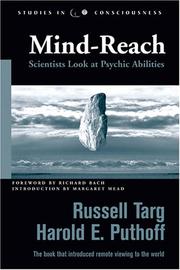
Reading the Enemy's Mind : Inside Star Gate
Shows how the language and training model were used operationally.
eBay marketplace picks
Marketplace Samples
Live-tested eBay searches with available results related to this page.


Endnotes
1.
Source: cia.gov
Link:https://www.cia.gov/readingroom/document/cia-rdp96-00787r000500410001-3
Source snippet
REMOTE VIEWING OF NATURAL TARGETS. SRI....This paper presents a series of experiments in which a subject is asked to describe a remot...
2.
Source: Wikipedia
Title: Russell Targ
Link:https://en.wikipedia.org/wiki/Russell_Targ
3.
Source: Wikipedia
Title: Remote viewing
Link:https://en.wikipedia.org/wiki/Remote_viewing
4.
Source: cia.gov
Link:https://www.cia.gov/readingroom/docs/CIA-RDP96-00791R000200180005-5.pdf
Source snippet
AN EVALUATION OF THE REMOTE VIEWING PROGRAMTypically, the remote viewers described the results of their experiences in written reports...
5.
Source: cia.gov
Link:https://www.cia.gov/readingroom/docs/CIA-RDP96-00789R002800180001-2.pdf
Source snippet
past event description) were explored. (U) Research...Read more...
6.
Source: cia.gov
Link:https://www.cia.gov/readingroom/docs/CIA-RDP96-00789R002200070001-0.pdf
Source snippet
A SUGGESTED REMOTE VIEWING TRAINING...In FY 1986, SRI began a Novice RV Training program, using nine individuals selected by psycholo...
7.
Source: Wikipedia
Title: Ingo Swann
Link:https://en.wikipedia.org/wiki/Ingo_Swann
8.
Source: russell.ca
Link:https://www.russell.ca/en/index.aspx
Source snippet
The Township of Russell is home to extraordinary events, activities, parks, trails, and so much more...
9.
Source: Wikipedia
Title: Russell, Ontario
Link:https://en.wikipedia.org/wiki/Russell%2C_Ontario
Source snippet
Russell, OntarioThe Township of Russell is a municipal township, located south-east of Canada's capital of Ottawa in eastern Ontario...
10.
Source: Wikipedia
Title: [Stargate]({{ ‘stargate/’ | relative_url }}) Project (U.S. Army unit)
Link:https://en.wikipedia.org/wiki/Stargate_Project_%28U.S._Army_unit%29
Source snippet
Stargate Project (U.S. Army unit)... remote viewer, Dames received no formal remote viewing training. After his assignment to the remo...
11.
Source: Wikipedia
Title: Russell, Ontario (community)
Link:https://en.wikipedia.org/wiki/Russell%2C_Ontario_%28community%29
Source snippet
Russell, Ontario (community)Russell is a police village that is part of Russell Township in the United Counties of Prescott and Russel...
12.
Source: youtube.com
Title: Third Eye Spies with Russell Targ
Link:https://www.youtube.com/watch?v=k9AsG1iNAyc
Source snippet
Russell Targ - Remote Viewing & Third Eye Spies...
13.
Source: youtube.com
Title: Russell Targ
Link:https://www.youtube.com/watch?v=E_cLp15CaPE
Source snippet
SSE Talks - Remote viewing the Stock Market - Christopher Carson Smith...
14.
Source: irp.fas.org
Link:https://irp.fas.org/program/collect/stargate.htm
Source snippet
GATE [Controlled Remote Viewing]29 Dec 2005 — An operational unit employed remote viewers to train and perform remote viewing intelligenc...
15.
Source: churchofgnome.org
Title: remote viewing
Link:https://www.churchofgnome.org/post/remote-viewing
Source snippet
The Story of Psychic Spies and How to...Jan 10, 2025 — Physicists like Russell Targ theorize that remote viewing might tap into this qua...
Additional References
16.
Source: avam.org
Link:https://www.avam.org/artists/ingo-swann
Source snippet
Ingo SwannIngo Swann is best known as a pioneer in the field of remote viewing. His high rate of success in this field led him to co-crea...
17.
Source: greydynamics.com
Link:https://greydynamics.com/intelligence-past-the-tangible-world-cias-stargate-project/
Source snippet
Intelligence Past the Tangible World: CIA's Stargate ProjectRemote Viewing (RV) as a tool for intelligence gathering gained footing and t...
18.
Source: sixthsensereader.org
Link:https://sixthsensereader.org/about-the-book/abcderium-index/remote-viewing/
Source snippet
REMOTE VIEWINGby M Mowbray — Ingo Swann sought to describe the planet Jupiter as a remote viewing target immediately prior to the NASA Pi...
19.
Source: medium.com
Link:https://medium.com/remote-viewing-community-magazine/remote-viewing-definition-protocol-and-corollaries-dca159934230
Source snippet
Remote Viewing: definition, protocol, and corollariesRemote viewing is a method created as a way to categorize and standardize innate psy...
20.
Source: reddit.com
Link:https://www.reddit.com/r/remoteviewing/comments/118tzbj/who_inventeddiscovered_remote_viewing/
Source snippet
Who invented/discovered remote viewing?: r/remoteviewingIngo Swann is credited with the actual term "remote viewing". The term was inven...
21.
Source: dokumen.pub
Link:https://dokumen.pub/third-eye-spies-learn-remote-viewing-from-the-masters-9781637480137-163748013x-p-6730612.html
Source snippet
Ingo was a Mobius Society recorder, “This is a remote viewing with Pat Price and Russ Targ.” Russell Targ and Hal...
22.
Source: researchgate.net
Title: 369604750 Remote Viewing a 1974 2022 systematic review and [meta analysis]({{ ‘meta-analysis/’ | relative_url }})
Link:https://www.researchgate.net/publication/369604750_Remote_Viewing_a_1974-2022_systematic_review_and_meta-analysis
Source snippet
(PDF) Remote Viewing: a 1974-2022 systematic review...This is the first meta-analysis of all studies related to remote viewing tasks con...
23.
Source: youtube.com
Link:https://www.youtube.com/watch?v=RJrTddUkplY
Source snippet
The CIA Protocol: How to Train Your Brain for Remote ViewingHow to boost your intuition using neuroscience and self-compassion · S...
24.
Source: reddit.com
Link:https://www.reddit.com/r/consciousness/comments/181s71r/the_cias_experiments_with_remote_viewing_and/
Source snippet
perimentation with Ingo Swann can provide some evidence toward “non-local...Read more...
25.
Source: youtube.com
Title: SSE Talks
Link:https://www.youtube.com/watch?v=K3x5QHD7Ewo
Source snippet
This video features military intelligence officer Paul H. Smith explaining how Ingo Swann and Harold Puthoff structured early remote view...
Topic Tree
Follow this branch
Parent topic
Targ Puthoff The Physicists Behind Remote Viewing's RiseRelated pages 5
- Authority Problem Did Physics Credentials Make Remote Viewing Credible?
- CIA Interest Did CIA Interest Prove Remote Viewing Worked?
- Geller Testing Why Uri Geller Made SRI More Controversial
- Legacy Chain How SRI Became the Remote Viewing Origin Story
- Mind Reach How Mind Reach Sold Remote Viewing to Readers