Within Marks Critique
Were the Judges Really Blind?
The Marks and Kammann critique turned on whether judges were truly blind to session order, target history, and procedural hints.
On this page
- Why judging decided the result
- Where blinding could break down
- How clean judging would need to work
Page outline Jump by section
Introduction
The dispute over blind judging became one of the most important methodological arguments in the controversy surrounding Stanford Research Institute (SRI) remote-viewing experiments. Marks and Kammann’s criticism was not primarily that remote viewing was impossible, but that the evidence depended on judging procedures that might not have been genuinely blind. If judges could identify the order of sessions or infer target identities from procedural clues embedded in transcripts, then apparently impressive target matches might reflect ordinary information rather than paranormal perception. This shifted the debate away from the remote viewers themselves and towards the integrity of the evaluation process. The resulting exchange, which continued for years through published replies and re-analyses, became a classic example of how apparently minor implementation details can determine whether extraordinary claims survive scientific scrutiny.[SciSpace]scispace.cominformation transmission in remote viewing experiments 4jd6pdendvInformation transmission in remote viewing experiments13 Mar 1980 — Marks and Kammann that little target/transcript correlation e…
Why judging decided the result
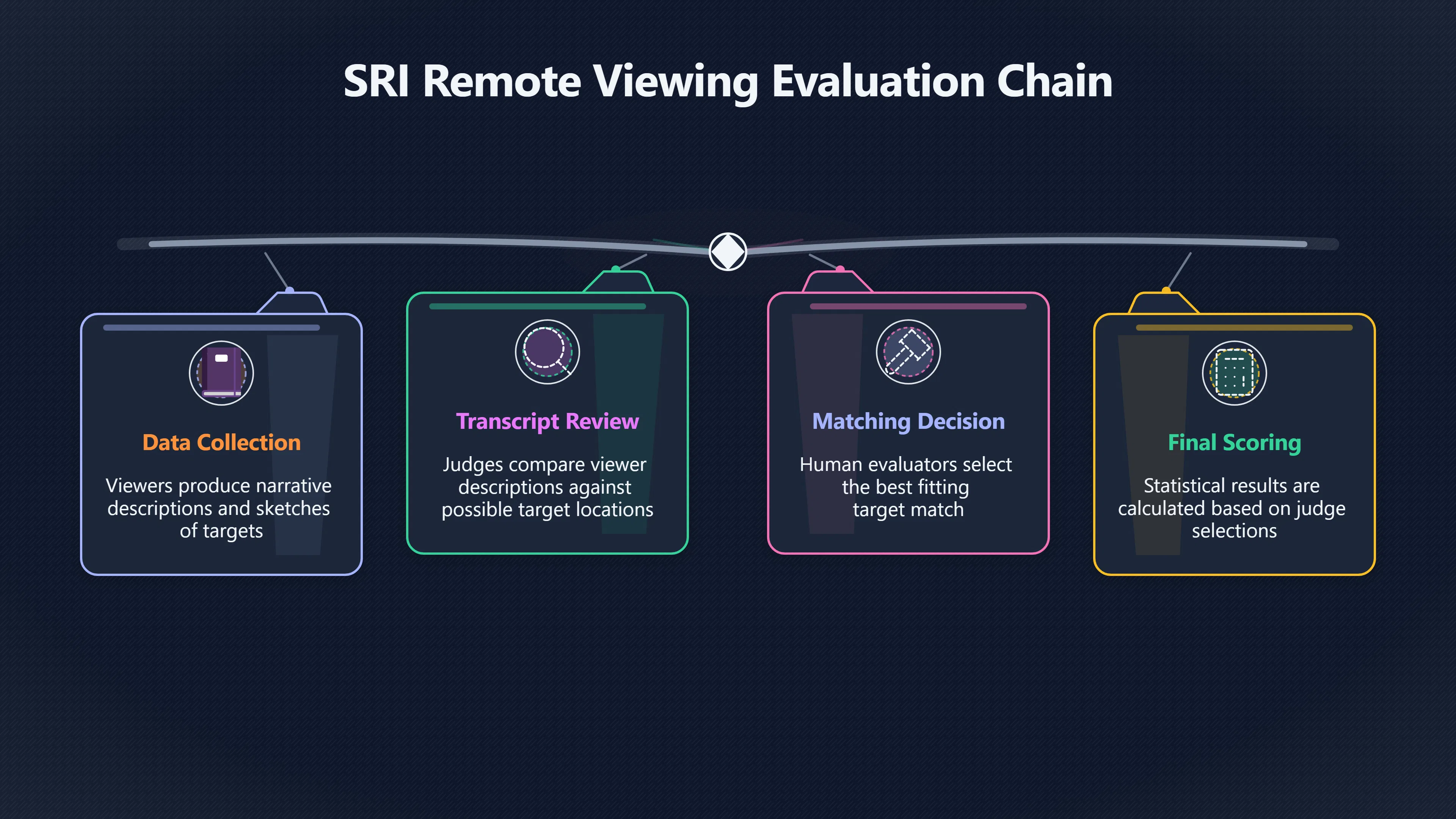
Unlike experiments with simple right-or-wrong answers, the early SRI remote-viewing studies relied on free-response descriptions. Participants produced pages of narrative, sketches and impressions that were later compared with several possible target locations. The final evidence therefore depended heavily on a human judge deciding which transcript best matched which target.
This made the judging stage crucial. Even if viewers had no normal access to the targets, the experiment could still produce misleadingly positive results if judges were given information that unintentionally narrowed the possibilities. Marks and Kammann argued that the published reports concentrated on shielding the viewer from sensory information while paying much less attention to shielding the judge from contextual information. Their criticism therefore addressed a different point in the experimental chain: not data collection but data interpretation.[SciSpace]scispace.cominformation transmission in remote viewing experiments 4jd6pdendvInformation transmission in remote viewing experiments13 Mar 1980 — Marks and Kammann that little target/transcript correlation e…
The distinction was significant because judging is inherently interpretive. Vague statements such as references to water, buildings or open spaces can plausibly fit many locations. Any additional clue—even one unrelated to the claimed psychic information—can disproportionately influence which target appears to fit best.
Where blinding could break down
Marks and Kammann argued that the transcripts from the original SRI experiments contained numerous procedural cues that could allow reconstruction of session order. Their claim was not that every transcript explicitly named its target, but that cumulative hints could make matching substantially easier than chance.
Examples discussed in the controversy included references to:
- previous sessions or earlier targets;
- chronological remarks implying when a session occurred;
- comments linking one transcript to another;
- administrative details left in the records;
- information allowing judges to reconstruct the sequence of target visits.
If target sites themselves were known in chronological order, reconstructing session order could greatly reduce the uncertainty facing a judge. In effect, knowledge about the experiment’s history could substitute for genuine transcript-to-target correspondence. Marks and Kammann argued that this possibility had not been adequately excluded in the published procedures.[Journal of Scientific Exploration]journalofscientificexploration.orgJournal of Scientific ExplorationJSE 324 online.inddcontroversy. Marks and Kammann (1978) discovered that the transcripts contained cues…
Importantly, this was an implementation criticism rather than an accusation of fraud. Information leakage can occur unintentionally whenever records preserve contextual details that later evaluators are not supposed to know.
Why accidental cues matter
The debate illustrated a broader principle in experimental psychology: blinding must extend to everyone whose judgement influences the outcome.
When judging requires subjective interpretation, even seemingly harmless information can bias decisions. Knowing which transcript probably came first, or recognising references to previous sessions, may unconsciously guide a judge towards one target instead of another. The problem is especially acute when multiple targets share broadly similar features and the judging criteria allow considerable flexibility.
For this reason, later experimental disciplines increasingly adopted procedures in which transcripts are stripped of identifying information, randomised independently of target order, and presented to judges who have no access to the experimental chronology.

The rejudging controversy
SRI researchers did not accept Marks and Kammann’s conclusions. In a published response, Charles Tart, Harold Puthoff and Russell Targ described an independent reanalysis of the original Patrick Price transcript series. Charles Tart edited the transcripts to remove phrases identified as possible cues, after which a new judge—unfamiliar with the original experiment—attempted the matching task using randomised transcripts and randomised target lists. They reported that seven of the nine transcripts were still correctly matched, arguing that this outcome contradicted the cueing hypothesis. They also stated that later SRI studies had adopted stronger procedures, including separate randomisation of transcripts and target lists and explicit checking for potential cueing before judging.[SciSpace]scispace.cominformation transmission in remote viewing experiments 4jd6pdendvInformation transmission in remote viewing experiments13 Mar 1980 — Marks and Kammann that little target/transcript correlation e…
Marks remained unconvinced. Years later, after obtaining the edited materials, Marks and Christopher Scott argued that not all potentially informative cues had actually been removed. They maintained that the rejudging therefore did not provide a decisive test of the original criticism because residual contextual information still remained in the judging materials. The disagreement consequently shifted from whether editing had occurred to whether it had been sufficiently thorough to eliminate every plausible source of information leakage.[Journal of Scientific Exploration]journalofscientificexploration.orgJournal of Scientific ExplorationJSE 324 online.inddcontroversy. Marks and Kammann (1978) discovered that the transcripts contained cues…
The dispute illustrates how difficult it can be to resolve methodological disagreements after an experiment has already been completed. Once critics and original investigators disagree about which pieces of information constitute meaningful cues, later reanalysis may itself become contested.
How clean judging would need to work
The controversy helped clarify what rigorous blind judging should require if extraordinary perceptual claims are to be evaluated convincingly.
A robust protocol would typically ensure that:
- transcripts contain no references to dates, sequence, previous sessions or administrative details;
- transcript identifiers are replaced with random codes;
- target lists are independently randomised rather than presented in their original order;
- judges have no contact with experimenters who know the correct answers;
- judging criteria are defined before scoring begins rather than adjusted afterwards;
- all editing rules are documented so independent researchers can verify what information was removed.
These requirements are now recognised more generally as safeguards against expectancy effects, confirmation bias and inadvertent information leakage in experiments involving subjective evaluation.
Lasting significance of the dispute
The blind-judging controversy had consequences beyond the specific SRI experiments. It reinforced the idea that extraordinary claims cannot be evaluated solely by examining how data are collected; researchers must also scrutinise how evidence is interpreted and scored. Even if participants are perfectly isolated from sensory information, weaknesses in the evaluation stage can produce misleading statistical results.
The Marks and Kammann critique therefore became influential because it redirected attention from whether remote viewers believed they perceived distant targets to whether experimental procedures had successfully prevented ordinary information from reaching those responsible for deciding the outcome. Whether one accepts the later SRI responses or the continuing criticisms, the dispute established blind judging as a central methodological issue in remote-viewing research and as an enduring example of how implementation details can shape the credibility of scientific evidence.[SciSpace]scispace.cominformation transmission in remote viewing experiments 4jd6pdendvInformation transmission in remote viewing experiments13 Mar 1980 — Marks and Kammann that little target/transcript correlation e…
Amazon book picks
Further Reading
Books and field guides related to Were the Judges Really Blind?. Use these as the next step if you want deeper reading beyond the article.
The seventh sense
Represents operational claims contrasted with methodological criticism.
eBay marketplace picks
Marketplace Samples
Live-tested eBay searches with available results related to this page.




Endnotes
1.
Source: scispace.com
Title: information transmission in remote viewing experiments 4jd6pdendv
Link:https://scispace.com/pdf/information-transmission-in-remote-viewing-experiments-4jd6pdendv.pdf
Source snippet
Information transmission in remote viewing experiments13 Mar 1980 — Marks and Kammann that little target/transcript correlation e...
2.
Source: journalofscientificexploration.org
Link:https://journalofscientificexploration.org/index.php/jse/article/view/1371/841
Source snippet
Journal of Scientific ExplorationJSE 324 online.inddcontroversy. Marks and Kammann (1978) discovered that the transcripts contained cues...
Additional References
3.
Source: researchgate.net
Link:https://www.researchgate.net/publication/19951599_Blindsight_and_Insight_in_Visuospatial_Neglect
Source snippet
(PDF) Blindsight and Insight in Visuospatial NeglectWe report here an analogous dissociation between overt and covert perception in a cas...
4.
Source: www-jstor-org.ezproxy.baylor.edu
Link:https://www-jstor-org.ezproxy.baylor.edu/stable/462513?seq=1
Source snippet
baylor.edu[https://www-jstor-org.ezproxy.baylor.edu/stable/46...No](https://www-jstor-org.ezproxy.baylor.edu/stable/46...No) information is available for this page...
5.
Source: www-tandfonline-com.libproxy.unibz.it
Link:https://www-tandfonline-com.libproxy.unibz.it/doi/full/10.1080/09669582.2010.517314
Source snippet
unibz.it[https://www-tandfonline-com.libproxy.unibz.it/doi/...No](https://www-tandfonline-com.libproxy.unibz.it/doi/...No) information is available for this page...
6.
Source: paulekman.com
Title: Who Can Catch A Liar
Link:https://www.paulekman.com/wp-content/uploads/2013/07/Who-Can-Catch-A-Liar.pdf
Source snippet
?by P Ekman · Cited by 1840 — Kohnken (1987) found police officers did no better than chance when they judged videotapes of college stude...
7.
Source: dirittoequestionipubbliche.org
Title: i 02 Spellman Quigly
Link:https://www.dirittoequestionipubbliche.org/page/2023_dq-recognise/i-02-Spellman-Quigly.pdf
Source snippet
Reasoning about Forensic Science Evidenceby BA SPELLMAN · 2023 · Cited by 6 — This chapter first addresses how and when flawed reasoning...
8.
Source: youtube.com
Title: Scientific and Spiritual Implications of Psychic Abilities
Link:https://www.youtube.com/watch?v=zgyYms376Mg
Source snippet
[Statistics]({{ 'statistics/' | relative_url }}) in Parapsychology with Jessica Utts...
9.
Source: youtube.com
Title: Remote Viewing: The Evidence (Psychic Spies! Stargate Project!)
Link:https://www.youtube.com/watch?v=Ph-kd1Igwzs
Source snippet
Remote Viewing and Statistical Validation...
10.
Source: youtube.com
Title: Statistics in Parapsychology with Jessica Utts
Link:https://www.youtube.com/watch?v=WmYGtKB9EEA
Source snippet
Remote Viewing: The Evidence (Psychic Spies! Stargate Project!)...
11.
Source: nationalacademies.org
Link:https://www.nationalacademies.org/publications/10973?publication_date%5Bquick%5D=past_10_years
12.
Source: openresearch.nihr.ac.uk
Link:https://openresearch.nihr.ac.uk/my/referee/report/29560
Topic Tree