Within Leakage
The Critique That Changed Remote Viewing
The Marks and Kammann challenge made sensory cueing a central dispute in the legacy of early SRI remote-viewing tests.
On this page
- What the early SRI judging dispute claimed
- Why transcript cues mattered more than disbelief
- How the Nature exchange shaped later controls
Page outline Jump by section
Introduction
The dispute raised by David Marks and Richard Kammann fundamentally changed how researchers evaluated the earliest Stanford Research Institute (SRI) remote-viewing experiments. Rather than arguing primarily about whether extrasensory perception was possible, they focused on a narrower methodological question: could judges have matched remote-viewing transcripts to targets by using ordinary clues embedded in the experimental records? Their critique shifted attention from the apparent quality of the descriptions to the integrity of the judging procedure itself. In doing so, it turned sensory leakage from a secondary concern into one of the central methodological issues in remote-viewing research, influencing both critics and later investigators who attempted to strengthen experimental controls.[Nature]nature.comInformation transmission in remote viewing experimentsby D MARKS · 1978 · Cited by 51 — TARG AND PUTHOFF 1–3 have described investi…
What the early SRI judging dispute claimed
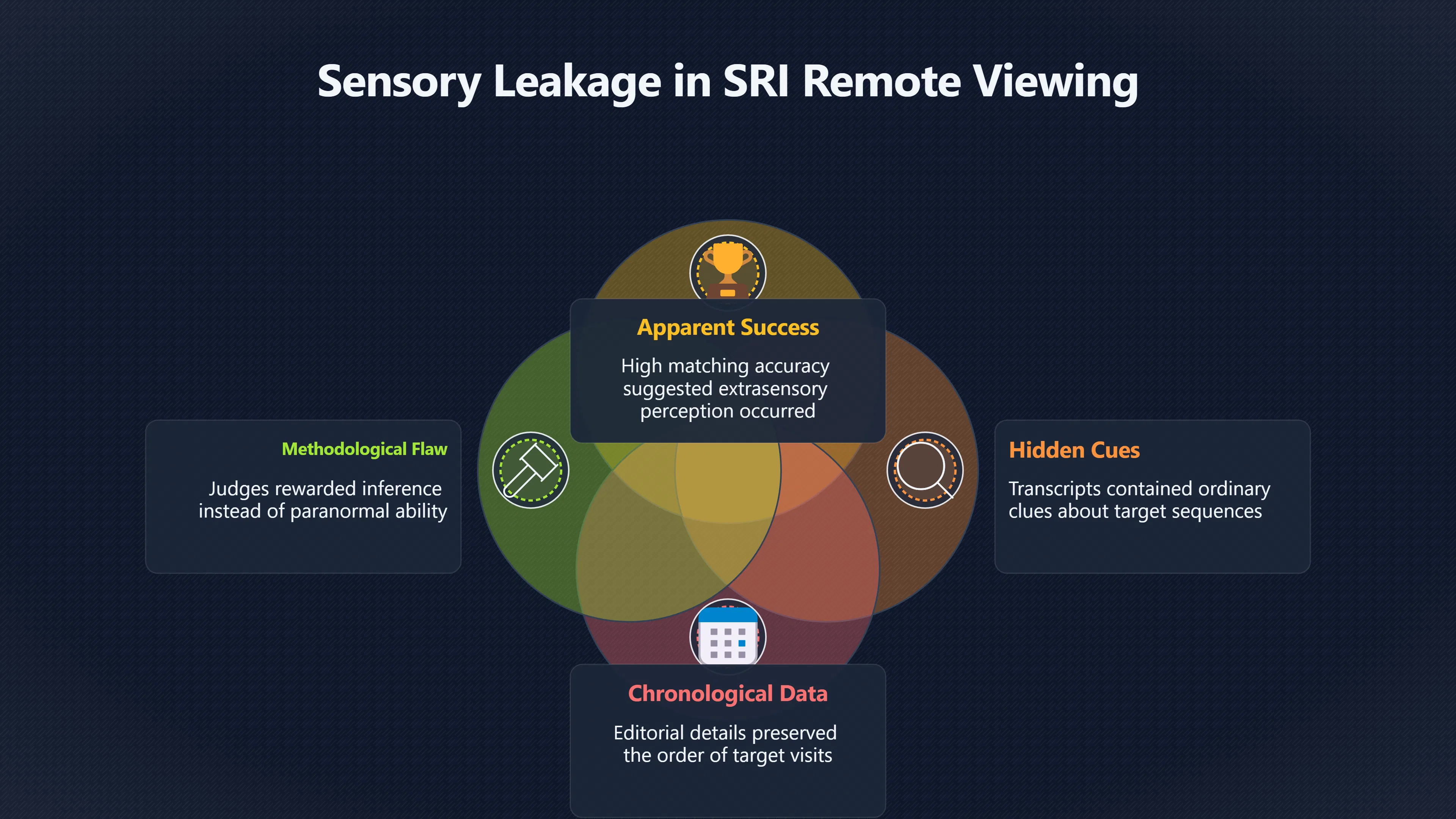
The earliest SRI studies by Russell Targ and Harold Puthoff relied on blind judging. After a participant produced a transcript describing an unknown target location, an independent judge attempted to match that transcript to one of several possible targets. High matching accuracy was presented as evidence that remote viewing had occurred.
Marks and Kammann did not initially argue that the descriptions themselves were necessarily poor. Instead, they questioned whether the judging process had truly been blind. After conducting unsuccessful replication attempts, they examined the original judging materials and concluded that the transcripts contained numerous ordinary cues that could reveal the correct order of the target visits or otherwise help a judge identify the intended target. They argued that these cues provided an alternative explanation for the reported success without invoking paranormal perception.[Nature]nature.comInformation transmission in remote viewing experimentsby D MARKS · 1978 · Cited by 51 — TARG AND PUTHOFF 1–3 have described investi…
Their critique therefore addressed a specific aspect of the experimental design rather than the broader philosophical question of psychic functioning. If judges could solve the matching task using conventional information, then the published hit rates could no longer be treated as direct evidence for remote viewing.
Why transcript cues mattered more than disbelief
The importance of the Marks and Kammann critique lies in the type of evidence they identified. Their argument depended on concrete features of the transcripts rather than scepticism alone.
Examples of the kinds of cues they reported included:
- references to previous sessions, such as comments about “yesterday’s” targets;
- dates or sequence information written on transcripts;
- remarks implying where a session occurred within the experimental series;
- editorial details that unintentionally preserved chronological information.
Individually, such details might appear trivial. Collectively, however, they could allow a careful judge to reconstruct the order of target visits. Once that order became known, matching transcripts to locations became substantially easier even without considering the remote-viewing descriptions themselves.[Nature]nature.comInformation transmission in remote viewing experimentsby D MARKS · 1978 · Cited by 51 — TARG AND PUTHOFF 1–3 have described investi…
Marks argued that he could identify the targets using these transcript cues alone, without having visited the locations. He further reported that when the cues were removed from the judging materials, performance dropped to chance levels. These claims became the centrepiece of the sensory-leakage argument because they suggested that normal information pathways could account for the original findings.[Wikipedia]WikipediaRemote viewingRemote viewing
The broader methodological lesson extended beyond remote viewing. Any experiment that depends on human judges comparing rich, ambiguous descriptions must ensure that every irrelevant clue has been eliminated. Otherwise, judges may unknowingly reward ordinary inference instead of the phenomenon under investigation.

How the Nature exchange shaped later controls
The disagreement quickly became a public scientific debate through a series of exchanges in Nature.
In 1978, Marks and Kammann published a report stating that their own duplicate experiments had failed to reproduce the original SRI results and that the transcript cues offered a plausible explanation for the earlier successes.[Nature]nature.comInformation transmission in remote viewing experimentsby D MARKS · 1978 · Cited by 51 — TARG AND PUTHOFF 1–3 have described investi…
Supporters of the SRI work did not accept this conclusion. Charles Tart, together with Harold Puthoff and Russell Targ, argued that if the allegedly informative passages were removed from the transcripts, successful judging still exceeded chance. They maintained that the critique had not invalidated the original evidence.[Nature]nature.comInformation transmission in remote viewing experimentsby CT TART · 1980 · Cited by 57 — TART, C., PUTHOFF, H. & TARG, R. Informatio…
Marks remained unconvinced. In a subsequent Nature correspondence, he argued that sensory cues had still not been adequately eliminated and that claims of successful rejudging were therefore unreliable. Puthoff and Targ replied once more, defending the experimental procedures and disputing Marks’s interpretation.[Nature]nature.comSensory cues invalidate remote viewing experimentsby D MARKS · 1981 · Cited by 25 — Sensory cues invalidate remote viewing experime…
Although neither side persuaded the other, the exchange had lasting consequences. The debate established that merely describing a judging procedure as “blind” was no longer sufficient. Researchers increasingly recognised that blind judging required documented protection against every plausible route by which chronological information, administrative markings or contextual knowledge could leak into the evaluation.
Lasting significance for the remote-viewing literature
The Marks and Kammann critique continues to be cited because it reframed the discussion from belief versus disbelief to experimental methodology.
For critics, it demonstrated that apparently impressive remote-viewing results could arise from subtle information leakage rather than paranormal perception. Their conclusion was that remote viewing had not been established under conditions that ruled out ordinary cues.[Nature]nature.comInformation transmission in remote viewing experimentsby D MARKS · 1978 · Cited by 51 — TARG AND PUTHOFF 1–3 have described investi…
For researchers interested in continuing remote-viewing experiments, the criticism had a different value. It encouraged stricter procedures, including better transcript editing, improved randomisation, more rigorous blinding of judges, clearer documentation of target handling and independent oversight of judging. Even investigators who disagreed with Marks generally acknowledged that these safeguards strengthened experimental design.[Nature]nature.comT., Puthoff, H. E. & Targ, R. Nature 284, 191 (1980). Article ADS CAS Google Scholar. Marks, D. & Kammann, R. The Psychology of the…Re…
The debate therefore occupies an important place in the history of remote-viewing research. Regardless of one’s position on paranormal claims, it demonstrated that the credibility of free-response experiments depends as much on preventing subtle sensory leakage as on the apparent accuracy of the descriptions themselves.
Amazon book picks
Further Reading
Books and field guides related to The Critique That Changed Remote Viewing. Use these as the next step if you want deeper reading beyond the article.
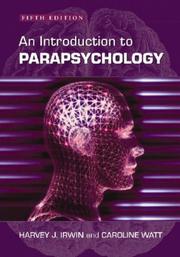
An introduction to parapsychology
Reviews the methodological debate around SRI experiments.
eBay marketplace picks
Marketplace Samples
Live-tested eBay searches with available results related to this page.


Endnotes
1.
Source: nature.com
Link:https://www.nature.com/articles/274680a0
Source snippet
Information transmission in remote viewing experimentsby D MARKS · 1978 · Cited by 51 — TARG AND PUTHOFF 1–3 have described investi...
2.
Source: nature.com
Link:https://www.nature.com/articles/292177a0
Source snippet
Sensory cues invalidate remote viewing experimentsby D MARKS · 1981 · Cited by 25 — Sensory cues invalidate remote viewing experime...
3.
Source: Wikipedia
Title: Remote viewing
Link:https://en.wikipedia.org/wiki/Remote_viewing
4.
Source: nature.com
Link:https://www.nature.com/articles/284191a0
Source snippet
Information transmission in remote viewing experimentsby CT TART · 1980 · Cited by 57 — TART, C., PUTHOFF, H. & TARG, R. Informatio...
5.
Source: nature.com
Link:https://www.nature.com/articles/292388a0
Source snippet
T., Puthoff, H. E. & Targ, R. Nature 284, 191 (1980). Article ADS CAS Google Scholar. Marks, D. & Kammann, R. The Psychology of the...Re...
6.
Source: Wikipedia
Link:https://en.wikipedia.org/wiki/David
Source snippet
DavidDavid is described as a young shepherd and harpist whose heart is devoted to Yahweh, the one true God. He gains fame and becomes...
7.
Source: Wikipedia
Title: David (2025 film)
Link:https://en.wikipedia.org/wiki/David_%282025_film%29
Source snippet
David (2025 film)David is a 2025 animated Biblical film featuring David from the Book of Samuel in the Old Testament. The film stars P...
8.
Source: Wikipedia
Title: Sensory leakage
Link:https://en.wikipedia.org/wiki/Sensory_leakage
Source snippet
Sensory leakage↑ David Marks, Richard Kammann. (1978). Information transmission in remote... Sensory cues invalidate remote viewing e...
9.
Source: Wikipedia
Title: David (name)
Link:https://en.wikipedia.org/wiki/David_%28name%29
Source snippet
David (name)David is a common masculine given name of Hebrew origin. Its popularity derives from the initial oral tradition (Oral Tora...
10.
Source: researchgate.net
Link:https://www.researchgate.net/profile/David-Marks-2/3
Source snippet
David MARKS | Independent | PhD | Research profileView Sensory cues invalidate remote viewing experiments have described investigations o...
11.
Source: pubmed.ncbi.nlm.nih.gov
Link:https://pubmed.ncbi.nlm.nih.gov/7242682/
Source snippet
Nature. 1981 Jul 9;292(5819):177. doi: 10.1038/292177a0. Author. D Marks. PMID: 7242682; DOI: 10.1038...Read more...
12.
Source: pubmed.ncbi.nlm.nih.gov
Link:https://pubmed.ncbi.nlm.nih.gov/7254336/
Source snippet
Nature. 1981 Jul 23;292(5821):388. doi: 10.1038/292388a0. Authors. H Puthoff, R Targ.Read more...
13.
Source: pubmed.ncbi.nlm.nih.gov
Link:https://pubmed.ncbi.nlm.nih.gov/7360248/
14.
Source: scilit.com
Link:https://www.scilit.com/publications/5ed26ba9011b0b4560a9aa5bfcd882c4
Source snippet
Nature, 1980. Information transmission in remote viewing experiments. Nature, 1978. Computed Properties.Read more...
15.
Source: youtube.com
Link:https://www.youtube.com/channel/UCB5_stIeRad4LQtaKHXkbvQ
Additional References
16.
Source: cia.gov
Link:https://www.cia.gov/readingroom/docs/CIA-RDP96-00787R000200090017-5.pdf
Source snippet
INFORMATION TRANSMISSION IN REMOTE VIEWING...Marks and Kammann' examined the transcripts of the first remote- viewing experiment publish...
17.
Source: sixthsensereader.org
Link:https://sixthsensereader.org/about-the-book/abcderium-index/remote-viewing/
Source snippet
REMOTE VIEWINGby M Mowbray — Remote viewing, Targ writes, is “a process in which you quiet your mind and inflow information from anywhere...
18.
Source: chabad.org
Link:https://www.chabad.org/library/article_cdo/aid/520477/jewish/The-Story-of-King-David-in-the-Bible.htm
Source snippet
The Story of King David in the BibleKing David (who ruled from 877 BCE to 837 BCE) is one of the most well-known figures in Jewish histor...
19.
Source: scispace.com
Title: information transmission in remote viewing experiments 4jd6pdendv
Link:https://scispace.com/pdf/information-transmission-in-remote-viewing-experiments-4jd6pdendv.pdf
Source snippet
Information transmission in remote viewing experiments13 Mar 1980 — Marks and Kammann offer criticism of the [SRI experiments]({{ 'sri-tests/' | relative_url }}) in 'remote v...
20.
Source: researchgate.net
Title: Information transmission in remote viewing experiments
Link:https://www.researchgate.net/publication/15839349_Information_transmission_in_remote_viewing_experiments
Source snippet
May 27, 2016 — TARG AND PUTHOFF1-3 have described investigations of an extrasensory remote viewing ability which they claim may be widely...
Published: May 27, 2016
21.
Source: ia600209.us.archive.org
Title: Transcontinental Remote Viewing Jp Volume44 pg301to313
Link:https://ia600209.us.archive.org/19/items/NotesonSpiritualismandPsychicalResearch/TranscontinentalRemoteViewing-JpVolume44_pg301to313.pdf
Source snippet
Volume 44Although there are several free-response procedures in use today, the present study was designed as an attempted replication of...
22.
Source: singularityquest.com
Title: why david marks cues dont debunk remote viewing
Link:https://singularityquest.com/why-david-marks-cues-dont-debunk-remote-viewing/
Source snippet
Why David Marks' Cues Do Not Debunk Remote Viewing4 Jan 2021 — Marks ended up becoming the worlds foremost critic on Remote Viewing; His...
23.
Source: journalofscientificexploration.org
Title: JS E 324 online.indd Marks, D., & Kammann, R
Link:https://journalofscientificexploration.org/index.php/jse/article/view/1371/841
Source snippet
(1978). Information transmission in remote viewing experiments. Nature, 274:680–681. Marks, D., & Scott, C. (1986). Remote viewing...Rea...
24.
Source: pmc.ncbi.nlm.nih.gov
Title: PMCFollow‐up on the U.S
Link:https://pmc.ncbi.nlm.nih.gov/articles/PMC10275521/
Source snippet
Central Intelligence Agency's (CIA...by Á Escolà‐Gascón · 2023 · Cited by 10 — Programs addressed remote viewing (RV), that is, determin...
25.
Source: skepticalinquirer.org
Title: Investigating the Paranormal by David F
Link:https://skepticalinquirer.org/wp-content/uploads/sites/29/uploads/files/Nat120March131986a.pdf
Source snippet
MarksThe late Richard Kammann contributed substantially in the earlier stages of this research. David F. Marks is at the Department of. P...
Topic Tree