Within Targets
Did Photo Targets Make Results Cleaner?
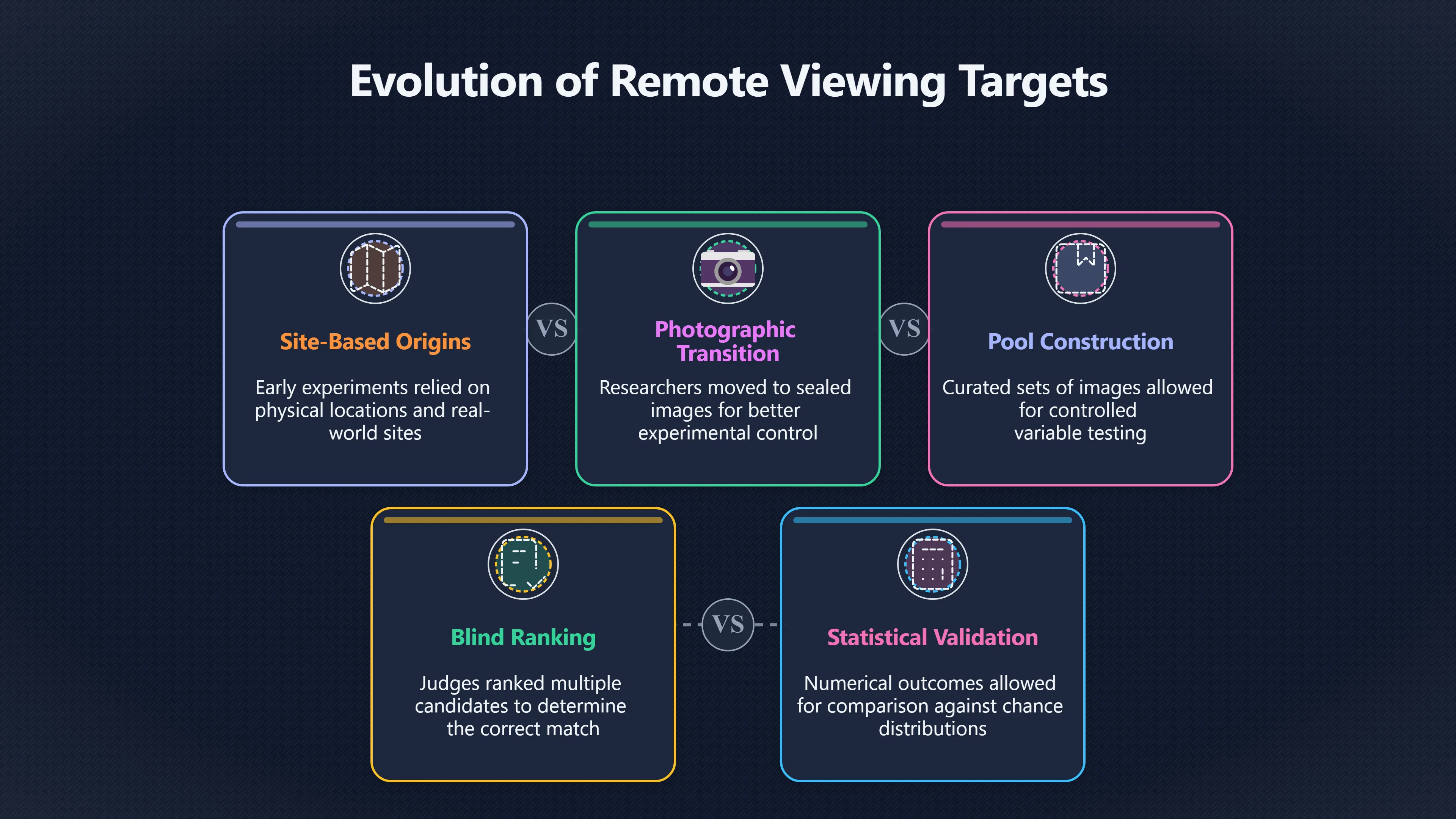
Photograph targets were easier to randomize and archive, but they pushed rich impressions into ranked image matching.
On this page
- Why laboratories used photograph pools
- How blind ranking changed scoring
- What photo targets could not solve
Page outline Jump by section
Introduction
As remote-viewing research moved from visits to real-world locations towards hidden photographs, laboratories gained tighter experimental control but also created a new methodological challenge. Instead of asking whether a written description matched a single place, researchers increasingly asked independent judges to compare one session transcript against several candidate photographs and rank them from best to worst. This approach made targets easier to randomise, archive and present under blind conditions, but it also shifted much of the evidential weight onto the judging procedure itself. The resulting debate was not simply whether viewers described photographs accurately, but whether the combination of photo target pools and forced matching produced a fair and reliable measure of success.
Why laboratories used photograph pools
Photographic targets became attractive because they solved several practical problems associated with outbound-site experiments. A photograph could be sealed, randomly selected by computer, reused in replication studies, and presented to judges in exactly the same form each time. Unlike physical locations, photographs were unaffected by weather, travel logistics or changes to the environment. These features made laboratory protocols easier to standardise and reduced opportunities for accidental information leakage during target selection.[CIA]cia.govAN EVALUATION OF REMOTE VIEWING: RESEARCH…A remote viewer is asked to visualize a place, location, or object being viewed by a "bea…
Researchers also found that photographs simplified archival work. Large collections of images could be organised into target pools with known characteristics, allowing experimenters to control variables such as complexity, emotional content or visual distinctiveness. Later studies extended this idea by building carefully curated pools of photographs showing individual objects, landscapes or unusual scenes rather than relying solely on real locations.[ResearchGate]researchgate.netEffects of Background Context for Objects in Photographic…January 15, 2022 — Results suggest that object background can af…
The move to photographs therefore represented an implementation decision rather than a theoretical claim. It was intended to improve experimental control while preserving the free-response nature of remote-viewing sessions, in which participants still produced sketches and verbal descriptions instead of choosing from predefined answers.
How blind ranking changed scoring
Photograph targets encouraged a different scoring philosophy. Rather than deciding whether a description “fit” a single hidden target, judges commonly received:
- one session transcript containing sketches and written impressions;
- the actual target photograph; and
- several decoy photographs drawn from the same target pool.
Without knowing which image was correct, judges ranked the photographs according to how well each matched the transcript. If the true target consistently received the highest or near-highest rank across many trials, researchers treated this as evidence exceeding chance expectations. This “rank-order” or forced-choice matching approach became one of the defining features of many later remote-viewing protocols.[CIA]cia.govAN EVALUATION OF REMOTE VIEWING: RESEARCH…A remote viewer is asked to visualize a place, location, or object being viewed by a "bea…
The method had several statistical advantages. Every trial produced an objective numerical outcome, allowing straightforward comparison with chance distributions. It also reduced the need for subjective pass-or-fail decisions because all candidate photographs were evaluated under the same conditions.
However, ranking also transferred considerable importance to the composition of the target pool. A transcript mentioning “water”, “open space” or “bright colours” might naturally favour one photograph over others even if none matched closely. Consequently, success depended not only on the quality of the viewing session but also on how distinctive the alternative photographs were.
Why the target pool mattered
The design of the photograph pool became an experimental variable in its own right.
If photographs were too similar—for example, several outdoor landscapes containing water—judges could struggle to discriminate between them even when a transcript contained useful details. Conversely, if one image showed a brightly coloured hot-air balloon while the remaining candidates depicted ordinary buildings, even vague descriptions such as “colourful”, “round” or “floating” might appear unusually accurate.
Researchers therefore tried to construct pools whose members were sufficiently distinct to permit meaningful ranking without making the correct choice obvious through broad thematic differences. This balance proved difficult, and discussions of target-pool design became increasingly prominent in later methodological literature.[ResearchGate]researchgate.netEffects of Background Context for Objects in Photographic…January 15, 2022 — Results suggest that object background can af…
Modern exploratory work has continued to investigate whether characteristics of photographic targets themselves influence outcomes. For example, studies examining photographs of objects presented against different backgrounds found that judging results could change depending on both the visual context of the image and the scoring method employed. Such findings suggest that target construction is not merely administrative but may influence how descriptions are interpreted during matching.[ResearchGate]researchgate.netEffects of Background Context for Objects in Photographic…January 15, 2022 — Results suggest that object background can af…
What photo targets could not solve
Although photographs addressed several weaknesses of earlier site-based experiments, they did not eliminate the central methodological disputes.
First, judging remained partly interpretive. Free-response transcripts typically contain numerous impressions, metaphors and sketches rather than precise statements. Independent judges must decide which features deserve the greatest weight, leaving room for differing interpretations even under blind conditions.[CIA]cia.govAN EVALUATION OF REMOTE VIEWING: RESEARCH…A remote viewer is asked to visualize a place, location, or object being viewed by a "bea…
Second, photograph pools could not entirely prevent generic correspondences. Descriptions such as “structure”, “movement”, “metal”, “light” or “people” occur frequently enough that some level of apparent agreement is expected across many image collections. Critics argued that successful ranking might sometimes reflect flexible interpretation rather than uniquely accurate perception. David Marks and other critics similarly maintained that improvements in blinding and judging were essential because earlier remote-viewing studies had demonstrated how subtle cues could influence matching outcomes.[Wikipedia]WikipediaRemote viewingRemote viewing
Finally, photograph targets did not resolve broader questions about reproducibility. Even supporters of remote-viewing research acknowledged that experimental outcomes varied across studies, target sets and judging procedures, leading continuing debates over which protocols, if any, produced reliable effects. Reviews commissioned during evaluations of the U.S. government programme noted that disagreements increasingly centred on methodology and interpretation rather than simply on the choice between photographs and physical locations.[CIA]cia.govAN EVALUATION OF REMOTE VIEWING: RESEARCH…A remote viewer is asked to visualize a place, location, or object being viewed by a "bea…

What photograph pools changed—and what they did not
The adoption of photographic target pools marked an important methodological shift within remote-viewing research. Laboratories gained better randomisation, easier replication, permanent target archives and stronger blinding than many earlier site-based designs could provide.
At the same time, the emphasis of evaluation moved from direct correspondence with a real location to statistical performance in blind ranking tasks. As a result, the quality of target selection, the distinctiveness of the photo pool and the design of the judging procedure became inseparable from the interpretation of the results. Photograph targets therefore made experiments cleaner in several practical respects, but they also highlighted that the credibility of remote-viewing evidence depended as much on how descriptions were matched as on the descriptions themselves.
Amazon book picks
Further Reading
Books and field guides related to Did Photo Targets Make Results Cleaner?. Use these as the next step if you want deeper reading beyond the article.
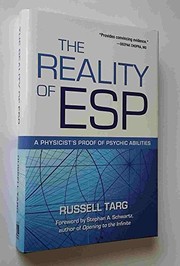
The Reality of ESP: A Physicist's Proof of Psychic Abilities
Reviews evidence including laboratory methodologies.
eBay marketplace picks
Marketplace Samples
Live-tested eBay searches with available results related to this page.
Endnotes
1.
Source: cia.gov
Link:https://www.cia.gov/readingroom/document/cia-rdp96-00791r000200180006-4
Source snippet
AN EVALUATION OF REMOTE VIEWING: RESEARCH...A remote viewer is asked to visualize a place, location, or object being viewed by a "bea...
2.
Source: researchgate.net
Link:https://www.researchgate.net/publication/357904486_Effects_of_Background_Context_for_Objects_in_Photographic_Targets_on_Remote_Viewing_Performance
Source snippet
Effects of Background Context for Objects in Photographic...January 15, 2022 — Results suggest that object background can af...
Published: January 15, 2022
3.
Source: Wikipedia
Title: Remote viewing
Link:https://en.wikipedia.org/wiki/Remote_viewing
4.
Source: Wikipedia
Title: [Stargate]({{ ‘stargate/’ | relative_url }}) Project (U.S. Army unit)
Link:https://en.wikipedia.org/wiki/Stargate_Project_%28U.S._Army_unit%29
5.
Source: researchgate.net
Link:https://www.researchgate.net/publication/327166514_Remote_Viewing_of_Concealed_Target_Pictures_Under_Light_and_Dark_Conditions
Source snippet
Remote Viewing of Concealed Target Pictures Under Light...(2019) found that image targets rated as more numinous by independent judges p...
Additional References
6.
Source: pubmed.ncbi.nlm.nih.gov
Link:https://pubmed.ncbi.nlm.nih.gov/30291000/
Source snippet
Viewing of Concealed Target Pictures Under Light...by S Krippner · 2019 · Cited by 15 — This study explored the differential effect of d...
7.
Source: academia.edu
Title: After applying our inclusion criteria,
Link:https://www.academia.edu/111635854/Remote_Viewing_a_1974_2022_systematic_review_and_meta_analysis
Source snippet
Remote Viewing: a 1974-2022 systematic review and meta...This is the first [meta-analysis]({{ 'meta-analysis/' | relative_url }}) of all studies related to remote-viewing tasks...
8.
Source: jov.arvojournals.org
Link:https://jov.arvojournals.org/article.aspx?articleid=2129259
Source snippet
exact picture of your target guides visual search better than...by N Kenner · 2003 · Cited by 14 — Even in the simplest of visual search...
9.
Source: scribd.com
Title: Katz Associative Remote Viewing
Link:https://www.scribd.com/document/1005021917/KatzAssociativeRemoteViewing
Source snippet
PDF | Parapsychology17 Nov 1986 — This book explores [Associative Remote Viewing (ARV)]({{ 'associative-remote-viewing-arv/' | relative_url }}) as a method for p...
10.
Source: youtube.com
Title: Remote Viewing and Statistical Validation
Link:https://www.youtube.com/watch?v=YrwAiU2g5RU
Source snippet
Researching Anomalous Cognition with Edwin C. May...
11.
Source: youtube.com
Title: Statistics in Parapsychology with Jessica Utts
Link:https://www.youtube.com/watch?v=WmYGtKB9EEA
Source snippet
Remote Viewing and Statistical Validation...
12.
Source: mdpi.com
Link:https://www.mdpi.com/2072-4292/18/5/775
Source snippet
Multimodal Weak Texture Remote Sensing Image...by Q Xiong · 2026 — Although remote sensing images can be accurately matched using these...
13.
Source: youtube.com
Title: [Third Eye Spies]({{ ‘third-eye-spies/’ | relative_url }}) with Russell Targ
Link:https://www.youtube.com/watch?v=3D7A-X1nd3c
Source snippet
Statistics in Parapsychology with Jessica Utts...
14.
Source: youtube.com
Title: Remote Viewing Research with Elizabeth A. Rauscher
Link:https://www.youtube.com/watch?v=Wmk6k57wW7k
Source snippet
Third Eye Spies with Russell Targ...
15.
Source: ojs.aaai.org
Link:https://ojs.aaai.org/index.php/AAAI/article/view/37767/41729
Source snippet
Pseudo-Matched Pairs (PMPs), semantically...Read more...
Topic Tree