Within Remote Viewing
The Cold War Fear Behind Remote Viewing
Cold War fears about Soviet paranormal research helped turn an unlikely idea into a funded intelligence experiment.
On this page
- Soviet Research Concerns
- Why Unlikely Tools Were Tested
- Fear Versus Proof
Page outline Jump by section
Introduction
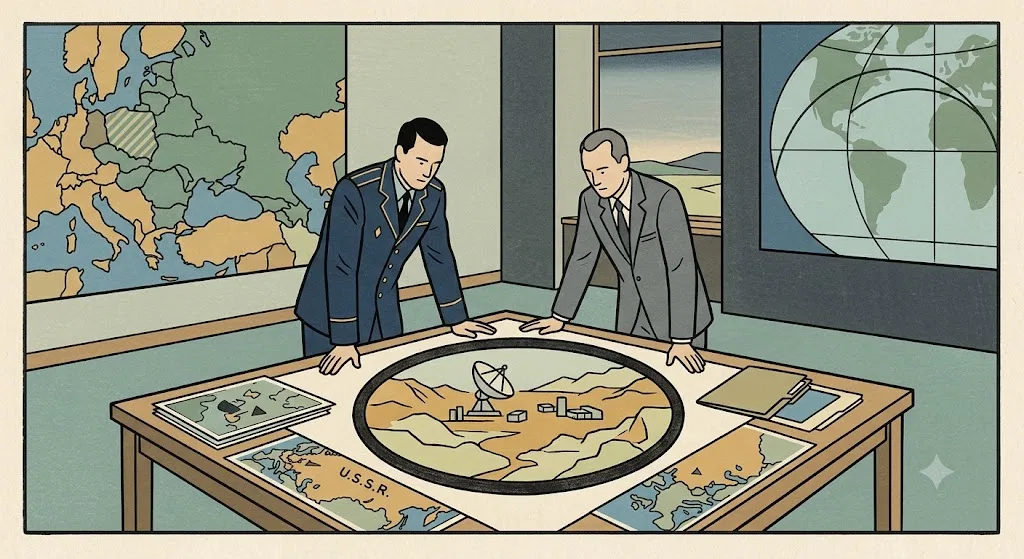
Remote viewing became a funded intelligence experiment because Cold War officials feared being surprised, not because mainstream science had accepted psychic perception. In the 1970s, U.S. agencies saw reports that the Soviet Union and its allies were investigating telepathy, psychokinesis, “psychotronics” and related ideas. In that atmosphere, even a doubtful claim could look like a risk: if the other side was testing psychic methods for intelligence or weapons use, ignoring the field might seem more dangerous than quietly funding a small investigation. Declassified U.S. material later described Star Gate as having three broad strands: foreign assessment, external research and in-house investigations. That structure captures the real story of the Cold War psychic research race: anxiety about Soviet work helped create a U.S. programme that tested remote viewing, but the eventual institutional verdict was that it did not produce reliable intelligence value.[CIA]cia.govSTAR GATE PROJECT: AN OVERVIEW(U). This document provides a broad overview of the three main activity areas, (foreign assessment, exte…
Soviet Research Concerns
The Soviet side of the story was not a single, tidy “psychic spy” programme visible to Western analysts. It was a confusing mix of published parapsychology papers, military-interest rumours, Czechoslovak “psychotronics”, biomedical speculation and intelligence assessments trying to separate real capability from noise. Declassified U.S. records on Soviet and Czechoslovakian parapsychology reported interest in extrasensory perception, telepathy, psychokinesis and so-called psychotronic or bioplasmic energy. Those documents did not prove that the Soviet bloc had a functioning psychic weapon; they show that U.S. analysts believed there was enough activity to track.[CIA]cia.govSOVIET AND CZECHOSLOVAKIAN PARAPSYCHOLOGY…Soviet and Czechoslovakian parapsychologists have reported that paranormal phenomena such…
One reason the issue was hard to evaluate was that Soviet and Eastern European work used different vocabulary from American parapsychology. U.S. documents used terms such as “psychoenergetics” to describe a broad field covering claimed mental effects on information, matter or biological systems. A declassified defence technical intelligence report on Soviet psychoenergetics said it focused on a high-level Soviet commission reviewing research in the USSR, including details of new research activity. In other words, U.S. concern was not based only on tabloid mysticism; it was filtered through intelligence reports, technical literature reviews and the Cold War habit of treating uncertain Soviet research as a possible strategic signal.[CIA]cia.govTHE SOVIET PSYCHOENERGETICS RESEARCH…It focuses on the results of a high level. Soviet commission that reviewed psychoenergetics re…
That uncertainty mattered. During the Cold War, U.S. national security culture often treated Soviet research announcements as warnings rather than curiosities. If Soviet scientists appeared to be examining remote perception, mental influence or unusual human performance, American officials had to ask whether it was propaganda, poor science, a genuine discovery, or a niche capability that might become useful later. The same logic had already shaped conventional arms competition: the danger was not just what the adversary had proven, but what it might be trying to acquire.

Why Unlikely Tools Were Tested
Remote viewing fitted a familiar Cold War pattern: a speculative technology became fundable when it was reframed as an intelligence gap. At Stanford Research Institute, Harold Puthoff and Russell Targ reported experiments on “information transmission under conditions of sensory shielding”, later associated with remote viewing. The premise was simple enough to interest intelligence sponsors: could a person describe a hidden location, object or installation without normal sensory access?[CIA]cia.govOpen source on cia.gov.
The U.S. programme did not begin as a public scientific consensus. It grew as a small, classified response to a perceived foreign challenge. The programme that later became known as Star Gate passed through several names and institutional homes, including CIA, Army and Defence Intelligence Agency involvement. By the mid-1990s, the CIA’s retrospective evaluation described a programme with basic research, operations and foreign assessment components, showing that the work was not just laboratory curiosity but also an attempt to assess whether anomalous mental phenomena could help intelligence collection.[CIA]cia.govOpen source on cia.gov.
The foreign-assessment strand is especially important for understanding the “race” framing. It meant American officials were not merely asking, “Can remote viewing work?” They were also asking, “What are the Soviets and their allies doing, and could we be missing something?” That question lowered the threshold for experimentation. In ordinary science, a claim needs strong evidence before it receives sustained credibility. In intelligence, a low-probability adversary capability can still attract attention if the potential payoff or risk seems large enough.
Several pressures made the research easier to justify:
- Asymmetry of risk: spending modest sums on tests seemed cheaper than discovering later that the Soviet bloc had developed a useful unconventional method.
- Secrecy: classified funding allowed agencies to explore fringe ideas without immediately defending them in mainstream scientific forums.
- Human-performance interest: remote viewing could be filed beside broader attempts to enhance perception, endurance, attention and decision-making rather than treated only as occult belief.
- Operational temptation: if even occasional accurate descriptions of hidden sites were possible, the intelligence value would have been obvious.
This does not mean the U.S. government “believed in psychic spying” as an institution. It means parts of the government treated remote viewing as a low-probability, potentially high-impact claim that was worth testing under Cold War conditions.
The Race Was More About Fear Than Symmetry
Calling it a “psychic arms race” can mislead if it suggests two evenly matched, proven programmes advancing like nuclear arsenals. The better description is a feedback loop of suspicion. Reports of Soviet interest encouraged American investigation; American work then became part of the same atmosphere of classified possibility. The race was psychological as much as technical.
The Soviet bloc had visible parapsychology activity, and U.S. analysts took it seriously enough to produce reports. But the documentary record available in English is uneven: much of what Western agencies knew came from literature reviews, travellers’ reports, translated publications and intelligence summaries rather than transparent access to Soviet laboratories. U.S. documents themselves show the difficulty of assessment, with one search result describing the challenge of adequately judging Soviet and Czechoslovakian parapsychology research.[CIA]cia.govOpen source on cia.gov.
The American side is easier to document because the Star Gate material was later declassified. It shows a programme that tried to turn remote viewing into a disciplined method: tasking viewers with targets, recording impressions, comparing results and exploring whether the output could support intelligence needs. A declassified Star Gate overview described the project’s main activity areas as foreign assessment, external research and in-house investigations. That triad reveals the Cold War logic: watch the adversary, test the phenomenon externally, and see whether it can be used internally.[CIA]cia.govSTAR GATE PROJECT: AN OVERVIEW(U). This document provides a broad overview of the three main activity areas, (foreign assessment, exte…
The asymmetry is important. Soviet activity helped justify American work, but U.S. evidence for reliable practical success remained contested. The existence of a programme is not the same as proof that the claimed ability worked. For remote viewing, the historical evidence is strongest on funding, institutional interest and Cold War motivation; it is much weaker on dependable intelligence performance.
Fear Versus Proof
The later reviews show the divide between “worth testing” and “proved useful”. In 1995, the CIA commissioned the American Institutes for Research to evaluate the remote-viewing programme. The review included statistician Jessica Utts, who was more favourable to the evidence for anomalous effects, and psychologist Ray Hyman, who represented a sceptical position. This was not a simple believer-versus-denier exercise; it was an institutional attempt to assess whether years of research and operations had produced something the intelligence community could use.[CIA]cia.govAN EVALUATION OF THE REMOTE VIEWING PROGRAMTo evaluate the research program, a "blue ribbon" panel was assembled. The panel included t…
Utts argued that some laboratory results were statistically significant and deserved further scientific attention. Hyman argued that the case for paranormal functioning was premature, pointing to methodological problems, lack of independent replication and the danger of interpreting ambiguous data too generously. The disagreement matters because it separates two claims that are often blurred: whether some experiments appeared above chance, and whether remote viewing had demonstrated dependable value for intelligence work.[National Security Archive]nsarchive2.gwu.eduOpen source on gwu.edu.
The institutional conclusion was sceptical on operational value. The AIR/CIA evaluation did not establish remote viewing as a reliable intelligence tool, and the programme was ended. A National Research Council chapter on paranormal phenomena, produced in the broader context of enhancing human performance, also reflected mainstream caution about parapsychological claims rather than acceptance of remote viewing as a validated capability.[National Security Archive]nsarchive2.gwu.eduOpen source on gwu.edu.
That outcome clarifies the historical lesson. Cold War fear could open the door to research that mainstream science doubted, but it could not by itself turn weak or inconsistent results into a dependable collection method. The intelligence community’s tolerance for uncertainty helped remote viewing get tested; the need for useful, repeatable output helped bring the programme to an end.
What the Cold War Race Reveals About Remote Viewing
The Cold War psychic research race explains why remote viewing has such an unusual documentary footprint. It was not merely a private belief system or a laboratory curiosity. It became part of a national-security environment where officials were paid to imagine adversary surprises, including unlikely ones. That is why the same subject can appear in three very different registers: declassified intelligence memoranda, parapsychology research papers and sceptical scientific reviews.
For readers trying to understand remote viewing today, the Cold War context prevents two common mistakes. The first is dismissing the entire subject as invented folklore. The U.S. programmes, contracts, evaluations and foreign-assessment documents were real. The second is treating government interest as proof. Intelligence agencies often investigate possibilities because they are uncertain, not because they are established. In this case, the Cold War made remote viewing fundable before it made it convincing.
The most accurate summary is therefore balanced but firm: fear of Soviet paranormal research helped transform remote viewing from an unlikely claim into a classified American experiment. The programme’s existence shows how seriously Cold War institutions could treat low-probability threats. Its closure shows the limit of that seriousness when evidence failed to become reliable intelligence.
Amazon book picks
Further Reading
Books and field guides related to The Cold War Fear Behind Remote Viewing. Use these as the next step if you want deeper reading beyond the article.
The Men Who Stare At Goats
Rating: 3.5/5 from 11 Google Books ratings
Accessible account of military psychic experiments.

Remote Viewers: The Secret History of America's Psychic Spies
Covers the intelligence context behind remote viewing.
Phenomena
From the author of Nuclear War: A Scenario, this is the gripping story of how a select group of scientists, under the watchful eye of the...
eBay marketplace picks
Marketplace Samples
Live-tested eBay searches with available results related to this page.

Endnotes
1.
Source: cia.gov
Link:https://www.cia.gov/readingroom/docs/CIA-RDP96-00789R002800180001-2.pdf
Source snippet
STAR GATE PROJECT: AN OVERVIEW(U). This document provides a broad overview of the three main activity areas, (foreign assessment, exte...
2.
Source: cia.gov
Link:https://www.cia.gov/readingroom/docs/CIA-RDP96-00791R000200180005-5.pdf
Source snippet
AN EVALUATION OF THE REMOTE VIEWING PROGRAMTo evaluate the research program, a "blue ribbon" panel was assembled. The panel included t...
3.
Source: cia.gov
Link:https://www.cia.gov/readingroom/docs/CIA-RDP96-00792R000600350001-3.pdf
Source snippet
SOVIET AND CZECHOSLOVAKIAN PARAPSYCHOLOGY...Soviet and Czechoslovakian parapsychologists have reported that paranormal phenomena such...
4.
Source: cia.gov
Link:https://www.cia.gov/readingroom/document/cia-rdp96-00792r000600350001-3
Source snippet
(U) Remote viewing has been investigated...Read more...
5.
Source: cia.gov
Link:https://www.cia.gov/readingroom/docs/NSA-RDP96X00790R000100020003-3.pdf
Source snippet
THE SOVIET PSYCHOENERGETICS RESEARCH...It focuses on the results of a high level. Soviet commission that reviewed psychoenergetics re...
6.
Source: cia.gov
Link:https://www.cia.gov/readingroom/document/nsa-rdp96x00790r000100020003-3
7.
Source: cia.gov
Link:https://www.cia.gov/readingroom/document/cia-rdp96-00787r000100220001-8
8.
Source: cia.gov
Link:https://www.cia.gov/readingroom/document/cia-rdp96-00791r000200180005-5
9.
Source: cia.gov
Link:https://www.cia.gov/readingroom/docs/CIA-RDP96-00787R000500250012-9.pdf
10.
Source: cia.gov
Link:https://www.cia.gov/readingroom/docs/NSA-RDP96X00790R000100010041-2.pdf
11.
Source: cia.gov
Link:https://www.cia.gov/readingroom/docs/CIA-RDP96-00791R000200230003-9.pdf
12.
Source: cia.gov
Link:https://www.cia.gov/readingroom/docs/CIA-RDP96-00788R001200050009-6.pdf
13.
Source: cia.gov
Link:https://www.cia.gov/readingroom/document/cia-rdp96-00792r000500730003-0
14.
Source: cia.gov
Link:https://www.cia.gov/readingroom/docs/CIA-RDP96-00789R002100230001-3.pdf
15.
Source: cia.gov
Link:https://www.cia.gov/readingroom/docs/CIA-RDP96-00792R000500210001-9.pdf
16.
Source: cia.gov
Link:https://www.cia.gov/readingroom/docs/CIA-RDP96-00792R000600350002-2.pdf
17.
Source: cia.gov
Link:https://www.cia.gov/readingroom/docs/CIA-RDP96-00789R001001420001-3.pdf
18.
Source: cia.gov
Link:https://www.cia.gov/readingroom/docs/CIA-RDP96-00792R000500730003-0.pdf
19.
Source: cia.gov
Link:https://www.cia.gov/readingroom/docs/CIA-RDP96-00789R002600320004-5.pdf
20.
Source: cia.gov
Link:https://www.cia.gov/readingroom/document/cia-rdp96-00791r000200230003-9
21.
Source: cia.gov
Link:https://www.cia.gov/readingroom/docs/CIA-RDP96-00791R000200230012-9.pdf
22.
Source: cia.gov
Link:https://www.cia.gov/readingroom/docs/CIA-RDP96-00788R002000140004-2.pdf
23.
Source: cia.gov
Link:https://www.cia.gov/readingroom/docs/CIA-RDP96-00791R000200230002-0.pdf
24.
Source: cia.gov
Link:https://www.cia.gov/readingroom/docs/CIA-RDP96-00791R000200230018-3.pdf
25.
Source: cia.gov
Link:https://www.cia.gov/readingroom/docs/CIA-RDP96-00787R000500070002-0.pdf
26.
Source: cia.gov
Link:https://www.cia.gov/readingroom/docs/CIA-RDP96-00792R000500400002-7.pdf
27.
Source: cia.gov
Link:https://www.cia.gov/readingroom/docs/CIA-RDP96-00791R000200230011-0.pdf
28.
Source: cia.gov
Link:https://www.cia.gov/readingroom/docs/CIA-RDP96-00788R001700340002-6.pdf
29.
Source: cia.gov
Link:https://www.cia.gov/readingroom/document/cia-rdp96-00792r000500400001-8
30.
Source: cia.gov
Link:https://www.cia.gov/readingroom/docs/CIA-RDP96-00789R002200440001-9.pdf
31.
Source: cia.gov
Link:https://www.cia.gov/readingroom/docs/CIA-RDP96-00791R000200230031-8.pdf
32.
Source: cia.gov
Link:https://www.cia.gov/readingroom/docs/CIA-RDP96-00788R001800060001-7.pdf
33.
Source: cia.gov
Link:https://www.cia.gov/readingroom/document/cia-rdp96-00787r000500410001-3
34.
Source: reason.com
Link:https://reason.com/2026/05/31/psychic-soldiers-mind-readers-and-dolphin-drones-the-cold-wars-weird-paranormal-history/
35.
Source: archive.org
Link:https://archive.org/stream/CIA-RDP96-00787R000500420001-2/CIA-RDP96-00787R000500420001-2_djvu.txt
36.
Source: nsarchive2.gwu.edu
Link:https://nsarchive2.gwu.edu/NSAEBB/NSAEBB438/docs/doc_57.pdf
37.
Source: nationalacademies.org
Link:https://www.nationalacademies.org/read/1025/chapter/13
38.
Source: Wikipedia
Title: Remote viewing
Link:https://en.wikipedia.org/wiki/Remote_viewing
39.
Source: sixthsensereader.org
Title: remote viewing
Link:https://sixthsensereader.org/about-the-book/abcderium-index/remote-viewing/
40.
Source: studocu.com
Title: remote viewing
Link:https://www.studocu.com/en-us/document/veritas-baptist-college/bachelor-of-science-in-information-technology-ii/remote-viewing/52763018
Additional References
41.
Source: youtube.com
Title: [Stargate]({{ ‘stargate/’ | relative_url }}) Project: How Did the CIA Turn the Human Mind into a Weapon?
Link:https://www.youtube.com/watch?v=IDPlEXpzRoQ
Source snippet
Uncovering the CIA's Secret Weapon: Psychic Spies...
42.
Source: youtube.com
Title: Inside The Secret CIA Psychic Program That Lasted Over 20 Years
Link:https://www.youtube.com/watch?v=tJNU5Y35_wI
Source snippet
Did the CIA Train Psychic Spies? | Stargate Project...
43.
Source: youtube.com
Title: Uncovering the CIA’s Secret Weapon: Psychic Spies
Link:https://www.youtube.com/watch?v=cNJwV3Ksxa8
Source snippet
The CIA MEDITATION Experiment That Went Horribly Wrong...
44.
Source: researchgate.net
Link:https://www.researchgate.net/publication/342064592_Book_Review_The_Star_Gate_Archives_Reports_of_the_United_States_Government_Sponsored_Psi_Program_1972-1995_Volume_3_Psychokinesis_compiled_and_edited_by_Edwin_C_May_and_Sonali_Bhatt_Marwaha
45.
Source: researchgate.net
Link:https://www.researchgate.net/publication/342061969_What_Do_We_Know_About_Psi_The_First_Decade_of_Remote_Viewing_Research_and_Operations_at_Stanford_Research_Institute
46.
Source: researchgate.net
Link:https://www.researchgate.net/publication/403178755_The_Star_Gate_Archives_Reports_of_the_United_States_Government_Sponsored_Psi_Program_1972-1995_Volume_4_Operational_Remote_Viewing_Memorandums_and_Reports
47.
Source: instagram.com
Link:https://www.instagram.com/reel/DRCzW6KAqyq/?hl=en
48.
Source: reddit.com
Link:https://www.reddit.com/r/AskHistorians/comments/1fzyb8y/did_the_soviets_ever_do_any_research_into_the/
49.
Source: facebook.com
Link:https://www.facebook.com/100090372200308/posts/during-the-cold-war-the-cia-funded-research-into-what-they-called-remote-viewing/937678002587931/
50.
Source: researchgate.net
Link:https://www.researchgate.net/publication/267978941Evaluation_of_Program_on%27Anomalous_Mental_Phenomena%27
Topic Tree