Within Sketches
How Decoys Tested Remote Viewing Sketches
Photo-target trials show how free-response sketches were compared against real targets and plausible decoys.
On this page
- Why photographs suited free response judging
- How ranking against decoys worked
- What photo targets still could not settle
Page outline Jump by section
Introduction
National Geographic photograph targets became one of the best-known judging materials in laboratory remote-viewing research because they offered rich, complex scenes that could be compared against equally plausible alternatives. Instead of asking whether a viewer could identify a single symbol or word, researchers asked blind judges to compare a viewer’s written impressions and sketches with several photographs, only one of which was the true target. The key question was not whether every detail matched, but whether the genuine target consistently ranked above carefully chosen decoys. This ranking approach became an important attempt to reduce subjective interpretation while preserving the free-response nature of remote-viewing experiments. At the same time, it also highlighted enduring disagreements about whether successful rankings reflected genuine anomalous perception or subtle methodological weaknesses.[National Security Archive]nsarchive2.gwu.eduNational Security ArchiveAn Evaluation of Remote Viewing: Research and…March 13, 2015 — by MD Mumford · 1995 · Cited by 76 — This is i…
Why photographs suited free-response judging
Early remote-viewing experiments found that participants rarely produced neat, literal descriptions. Instead, they generated fragments such as “water”, “high structure”, “circular”, “bright”, or simple sketches suggesting shapes and spatial relationships. Complex photographs were therefore attractive targets because they contained multiple visual features that could potentially correspond to these partial impressions.
National Geographic images were especially useful because they covered a broad range of landscapes, architecture, wildlife, industrial sites and cultural scenes. Unlike simple geometric targets, they allowed judges to evaluate whether an entire pattern of impressions fitted a scene rather than relying on a single guessed object. Researchers argued that this better matched the way remote-viewing transcripts naturally developed as collections of sensory and spatial fragments rather than explicit identifications.[National Security Archive]nsarchive2.gwu.eduNational Security ArchiveAn Evaluation of Remote Viewing: Research and…March 13, 2015 — by MD Mumford · 1995 · Cited by 76 — This is i…
Another practical advantage was standardisation. The same pool of photographs could be reused across many experiments while still being randomly assigned as targets. Because viewers eventually saw feedback after each session, experienced participants gradually became familiar with the overall collection, creating an additional methodological issue that later researchers had to consider when designing judging procedures.[National Security Archive]nsarchive2.gwu.eduNational Security ArchiveAn Evaluation of Remote Viewing: Research and…March 13, 2015 — by MD Mumford · 1995 · Cited by 76 — This is i…
How ranking against decoys worked
The defining feature of these experiments was not the photographs themselves but the judging method.
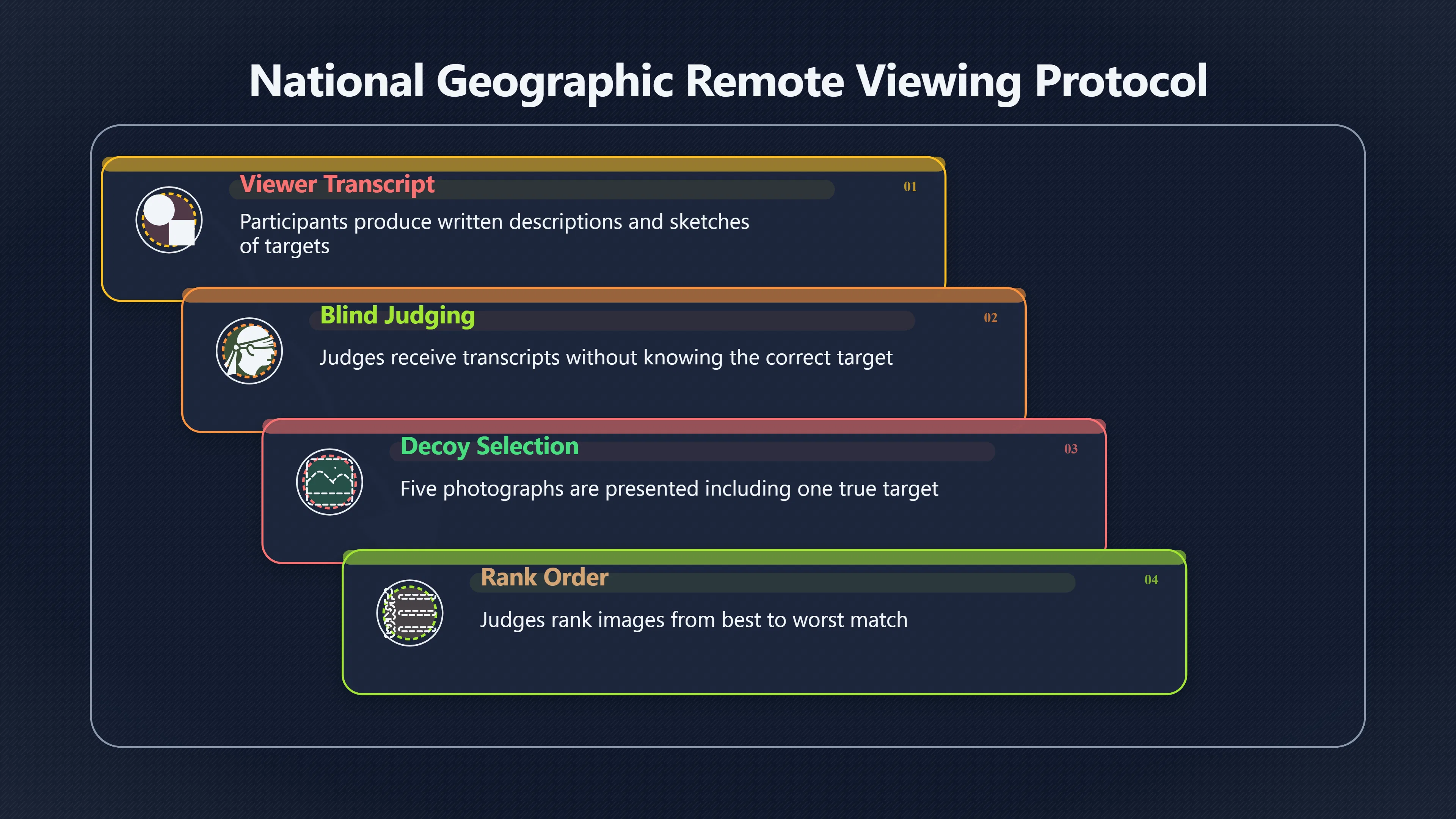
After a remote-viewing session:(#endnote-2 “Endnote 2”)[Wikipedia]WikipediaRemote viewingRemote viewing
- The viewer produced a transcript consisting of written descriptions and sketches.
- A blind judge, who did not know the correct target, received the transcript together with a small set of photographs—typically five.
- One photograph was the actual target while the remaining images served as decoys.
- The judge ranked the photographs from best to worst match.
This transformed an open-ended description into a measurable outcome. If judging were entirely random, the correct photograph would average third place in a five-picture set. Consistently obtaining first or second place across many trials would produce an average rank better than chance expectations.[National Security Archive]nsarchive2.gwu.eduNational Security ArchiveAn Evaluation of Remote Viewing: Research and…March 13, 2015 — by MD Mumford · 1995 · Cited by 76 — This is i…
Importantly, the ranking method deliberately avoided rewarding dramatic descriptions more heavily than modestly accurate ones. A transcript that almost perfectly described a target still received the same score—a first-place ranking—as one that merely contained enough information to distinguish the true photograph from its decoys. Researchers considered this conservative because it measured discrimination rather than narrative quality.[National Security Archive]nsarchive2.gwu.eduNational Security ArchiveAn Evaluation of Remote Viewing: Research and…March 13, 2015 — by MD Mumford · 1995 · Cited by 76 — This is i…
Why decoys mattered
Decoys were intended to answer one of the hardest questions in free-response research: could a sketch appear convincing simply because people naturally find similarities after learning the answer?
Using multiple plausible alternatives forced judges to compare competing interpretations rather than asking whether one photograph merely looked “close enough”. For example, a sketch containing vertical lines, curved forms and water could potentially resemble a bridge, a waterfall, a harbour or an industrial structure. Ranking required the judge to decide which candidate matched best before knowing which was correct.
This design attempted to reduce hindsight bias by making every session a competition among visually similar possibilities instead of a simple hit-or-miss judgement. The more convincing the decoys, the stronger the argument that a successful first-place ranking reflected information in the transcript rather than generous interpretation.[National Security Archive]nsarchive2.gwu.eduNational Security ArchiveAn Evaluation of Remote Viewing: Research and…March 13, 2015 — by MD Mumford · 1995 · Cited by 76 — This is i…
What the National Geographic target set revealed
Later reviews of the Stanford Research Institute (SRI) and Science Applications International Corporation (SAIC) programmes regarded the rank-order procedure as one of the stronger methodological features of later remote-viewing experiments. Government reviewers noted that using blind judges and numerical rankings provided a clearer statistical framework than anecdotal success stories.[National Security Archive]nsarchive2.gwu.eduNational Security ArchiveAn Evaluation of Remote Viewing: Research and…March 13, 2015 — by MD Mumford · 1995 · Cited by 76 — This is i…
However, reviewers also observed important limitations.
One issue was familiarity. Because many later experiments reused the same large collection of National Geographic photographs, experienced viewers eventually became acquainted with the kinds of scenes likely to appear, even if they did not know which specific photograph had been selected for any individual trial. The ranking procedure remained statistically valid under those conditions, but researchers recognised that repeated exposure complicated interpretation and motivated continued refinement of target pools.[National Security Archive]nsarchive2.gwu.eduNational Security ArchiveAn Evaluation of Remote Viewing: Research and…March 13, 2015 — by MD Mumford · 1995 · Cited by 76 — This is i…
Another issue concerned judge psychology. Even with blind judging, people naturally search for meaningful patterns. Rich photographs containing mountains, rivers, temples or unusual structures provide many opportunities for matching isolated features from a sketch. As a result, the quality of the decoy selection became almost as important as the target itself.
What photo targets still could not settle
The National Geographic photograph protocol addressed several criticisms of earlier remote-viewing work, but it did not resolve every dispute.
Supporters argued that repeated above-chance rankings across many trials suggested that transcripts contained genuine information not easily explained by guessing alone. Later statistical reviews highlighted the consistency of the ranking methodology and regarded it as an improvement over earlier, less structured judging approaches.[National Security Archive]nsarchive2.gwu.eduNational Security ArchiveAn Evaluation of Remote Viewing: Research and…March 13, 2015 — by MD Mumford · 1995 · Cited by 76 — This is i…
Critics responded that even sophisticated ranking systems cannot compensate for flaws elsewhere in an experimental design. Earlier remote-viewing research had already been criticised for possible sensory cues, inadvertent information leakage and transcript characteristics that could help judges identify targets by ordinary means. David Marks and Richard Kammann argued that when such cues were eliminated, the apparent effects disappeared, making rigorous control procedures more important than the particular choice of photographs or ranking statistics.[ResearchGate+2Wikipedia]researchgate.netResearch Gate Information transmission in remote viewing experimentsInformation transmission in remote viewing experimentsApril 1, 1980 — 27 May 2016 — TARG AND PUTHOFF1-3 have described invest…
Consequently, National Geographic photo targets became significant less because they proved or disproved remote viewing than because they illustrated an important methodological shift. The evidential weight increasingly rested not on an impressive sketch by itself, but on whether that sketch could repeatedly outperform carefully chosen decoys under genuinely blind, well-controlled judging conditions.
Amazon book picks
Further Reading
Books and field guides related to How Decoys Tested Remote-Viewing Sketches. Use these as the next step if you want deeper reading beyond the article.
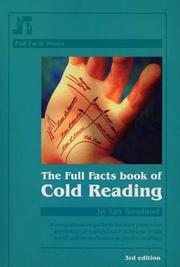
The Full Facts book of Cold Reading
Illustrates how ambiguous matches can appear convincing.
Parapsychology: A Handbook for the 21st Century
Provides broader context for laboratory psi experiments.
eBay marketplace picks
Marketplace Samples
Live-tested eBay searches with available results related to this page.


Endnotes
1.
Source: researchgate.net
Title: Research Gate Information transmission in remote viewing experiments
Link:https://www.researchgate.net/publication/15839349_Information_transmission_in_remote_viewing_experiments
Source snippet
Information transmission in remote viewing experimentsApril 1, 1980 — 27 May 2016 — TARG AND PUTHOFF1-3 have described invest...
Published: April 1, 1980
2.
Source: Wikipedia
Title: Remote viewing
Link:https://en.wikipedia.org/wiki/Remote_viewing
3.
Source: Wikipedia
Title: Harold E. Puthoff
Link:https://en.wikipedia.org/wiki/Harold_E._Puthoff
4.
Source: nsarchive2.gwu.edu
Link:https://nsarchive2.gwu.edu/NSAEBB/NSAEBB438/docs/doc_57.pdf
Source snippet
National Security ArchiveAn Evaluation of Remote Viewing: Research and...March 13, 2015 — by MD Mumford · 1995 · Cited by 76 — This is i...
Published: March 13, 2015
Additional References
5.
Source: skepticalinquirer.org
Link:https://skepticalinquirer.org/wp-content/uploads/sites/29/2019/03/Issue-02-18.pdf
Source snippet
CARL SAGANThe targets were usually pictures taken from the National Geographic. During the sending period the viewer would describe and d...
6.
Source: cia.gov
Link:https://www.cia.gov/readingroom/docs/CIA-RDP96-00791R000200070001-9.pdf
Source snippet
blind judge) is shown the response and five potential targets, one...Read more...
7.
Source: academia.edu
Title: Remote Viewing a 1974 2022 systematic review and [meta analysis]({{ ‘meta-analysis/’ | relative_url }})
Link:https://www.academia.edu/111635854/Remote_Viewing_a_1974_2022_systematic_review_and_meta_analysis
Source snippet
Remote Viewing: a 1974-2022 systematic review and meta...While Project Scanate used National Geographic photographs as feedback for the...
8.
Source: scribd.com
Title: RVMeta Analysis Tressoldi Katz
Link:https://www.scribd.com/document/859542014/RVMeta-Analysis-Tressoldi-Katz
Source snippet
Remote Viewing: 1974-2022 Review | PDFThis document presents a systematic review and meta-analysis of remote viewing studies conducted fr...
9.
Source: acadintuition.com
Link:https://acadintuition.com/wp-content/uploads/2018/07/Statisticienne.pdf
Source snippet
An Assessment of the Evidence for Psychic Functioningby J UTTS · 1996 · Cited by 207 — The results reported by Puthoff and Targ (1975) in...
10.
Source: youtube.com
Link:https://www.youtube.com/watch?v=KDYkNjPy6_4
Source snippet
REMOTE VIEWING SECRETS with Russell Targ | The Richard Dolan Show...
11.
Source: academia.edu
Link:https://www.academia.edu/36243450/REMOTE_VIEWING_OF_NATURAL_TARGETS_SRI_RUSSELL_TARG_AND_HAROLD_PUTHOFF
Source snippet
age. Remote viewing of natural targets...
12.
Source: youtube.com
Title: Remote Viewing From the Inside Out with Russell Targ
Link:https://www.youtube.com/watch?v=V6Pn6WGahYI
Source snippet
Russell Targ teaches Remote Viewing in one simple lesson - New Course 2025...
13.
Source: youtube.com
Title: REMOTE VIEWING SECRETS with Russell Targ | The Richard Dolan Show
Link:https://www.youtube.com/watch?v=-2kwiNw–nI
Source snippet
Remote Viewing From the Inside Out with Russell Targ...
14.
Source: youtube.com
Title: How To Do a Simple Remote Viewing
Link:https://www.youtube.com/watch?v=BIE2BClEok0
Source snippet
Remote Viewing target pool judging SRI Remote Viewing Exercise Target Number K82155 Holistic Mystic D...
Topic Tree