Within Read Files
Released Is Not the Same as Proven
A released CIA file shows that a record existed in the archive, not that the agency accepted the claim inside it as true.
On this page
- What archive release actually means
- Why programme files include weak and disputed material
- How to avoid treating custody as validation
Page outline Jump by section
Introduction
A declassified remote viewing document shows that a government agency preserved and later released a historical record. It does not show that the agency accepted the document’s claims as accurate, scientifically established or operationally reliable. This distinction is one of the most important principles for reading the Star Gate archive responsibly.
The CIA Reading Room contains raw session transcripts, internal memoranda, research proposals, critiques, evaluations and administrative records from programmes that evolved over many years. Some documents reflect enthusiastic investigators, others record sceptical reviews, and some simply preserve what participants reported without reaching any conclusion. Reading any single file as an official endorsement misunderstands both how archives work and why governments declassify records. The final programme evaluation commissioned by the CIA itself illustrates this point: although reviewers found some laboratory findings worthy of discussion, they concluded that the operational programme had not demonstrated intelligence value sufficient for continued use.[CIA]cia.govAN EVALUATION OF THE REMOTE VIEWING PROGRAMResearch on psychic functioning, conducted over a two decade period, is examined to determi…
What archive release actually means
Government archives exist to preserve records, not to certify their contents.
When classified material is declassified, the decision usually reflects changes in national security sensitivity, legal obligations, or archival policy. It does not convert the underlying claims into verified facts. Intelligence agencies routinely release documents containing rumours, preliminary hypotheses, mistaken assessments, contradictory opinions and abandoned ideas because those records are part of the historical record.
The CIA’s electronic Reading Room includes collections on many controversial or unsuccessful programmes alongside routine intelligence files. Their presence demonstrates that the agency created or received the documents and later determined they could be released publicly. It does not indicate institutional agreement with every sentence they contain.[CIA]cia.govAN EVALUATION OF THE REMOTE VIEWING PROGRAMResearch on psychic functioning, conducted over a two decade period, is examined to determi…
This distinction is particularly important for remote viewing because many widely shared internet claims rely on a simple but incorrect chain of reasoning:
- The CIA possessed a document.
- Therefore the CIA believed it.
- Therefore the claim is true.
Each step goes beyond what the archival evidence actually supports.
Why programme files include weak and disputed material
Remote viewing records accumulated over more than two decades across several related programmes. Like any long-running research effort, they contain both positive and negative material.
Individual session transcripts were generally intended to capture what a viewer reported during a session. Recording an impression—even one that later proved inaccurate—was part of maintaining an experimental or operational record. Omitting unsuccessful sessions would have distorted later evaluation.
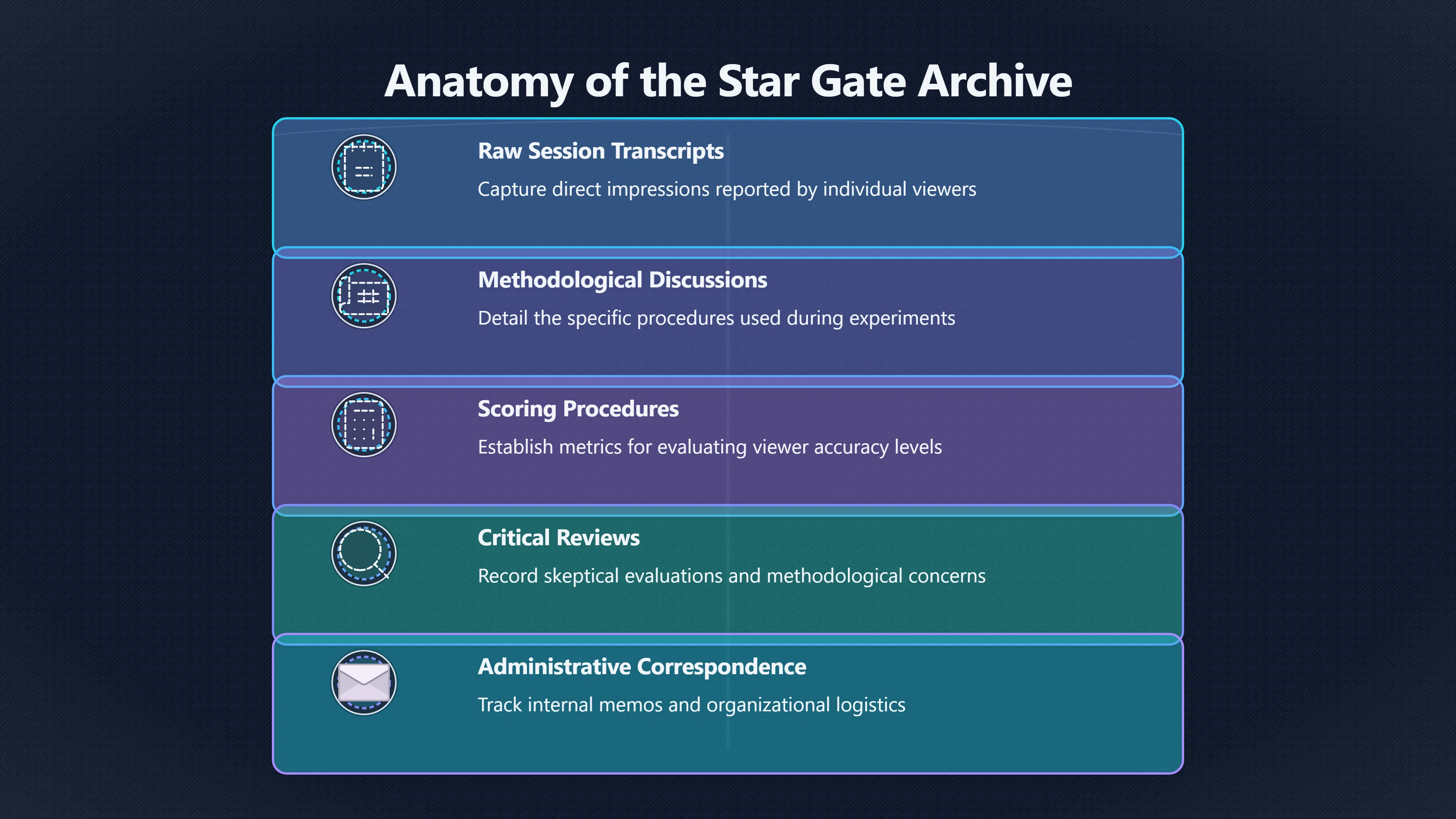
The archive therefore includes:
- raw viewing transcripts;
- methodological discussions;
- scoring procedures;
- operational summaries;
- critical reviews;
- external evaluations; and
- administrative correspondence.
Taken together, these documents reveal disagreement rather than unanimity. Researchers involved with the programme sometimes interpreted results optimistically, while independent reviewers raised methodological concerns and questioned whether the information produced was useful for intelligence purposes. The coexistence of these conflicting viewpoints is exactly what readers should expect in a complete historical archive.[CIA]cia.govAN EVALUATION OF THE REMOTE VIEWING PROGRAMResearch on psychic functioning, conducted over a two decade period, is examined to determi…
The 1995 American Institutes for Research review, commissioned after the programme was transferred to CIA oversight, illustrates this diversity. The review acknowledged statistically interesting laboratory findings but concluded that the evidence did not establish remote viewing as an operationally useful intelligence capability and that the reported intelligence value was not sufficient to justify continued funding.[CIA]cia.govAN EVALUATION OF THE REMOTE VIEWING PROGRAMResearch on psychic functioning, conducted over a two decade period, is examined to determi…
Why custody is not validation
One of the easiest mistakes is confusing custody with verification.
An archive establishes that a document existed within an organisation’s records. It does not establish that every factual claim inside the document was checked, accepted or acted upon.
The same principle applies throughout intelligence history. Agencies preserve intercepted communications, informant reports, battlefield rumours and preliminary analyses precisely because they document what was received at a given time. Many later prove incomplete or incorrect, yet they remain valuable historical records.
Remote viewing documents should be approached in the same way. A transcript stating that a viewer perceived a hidden facility, object or event tells the reader what the participant reported. It does not demonstrate that the reported perception corresponded to reality.
The distinction becomes even more important when later commentary is added to a document. Marginal notes, summaries or retrospective descriptions may reflect subsequent interpretation rather than the original session itself. Separating these layers helps prevent hindsight from being mistaken for contemporaneous evidence.
How to avoid treating custody as validation
Readers can reduce common errors by asking a few straightforward questions whenever they encounter a declassified remote viewing document.
Who is speaking? Determine whether the text represents a viewer’s impressions, an experimenter’s interpretation, an evaluator’s judgement or an administrative memorandum.
What type of document is it? A raw transcript serves a different purpose from a final programme review or scientific evaluation.
Was the claim independently verified? Look for follow-up documentation rather than assuming the transcript settled the matter.
Are dissenting documents available? The Star Gate archive contains critical assessments alongside supportive material. Reading both provides a more accurate picture than relying on a single dramatic example.[CIA]cia.govAN EVALUATION OF THE REMOTE VIEWING PROGRAMResearch on psychic functioning, conducted over a two decade period, is examined to determi…
Did the programme’s later evaluations agree? When later reviews reach different conclusions from earlier investigators, both should be considered before drawing historical or scientific conclusions.
The practical takeaway for readers
For anyone learning how to read declassified remote viewing documents, the safest rule is simple: release indicates authenticity of the record, not authenticity of the claim.
A declassified transcript may be historically significant because it documents what researchers attempted, what participants reported or how intelligence organisations evaluated unconventional ideas during the Cold War. Those are important historical facts regardless of whether the reported perceptions were accurate.
Treating every released document as institutional endorsement strips away the context that archives are meant to preserve. Reading the complete record—including supportive research, critical reviews and final programme evaluations—provides a far more reliable understanding than any single declassified file viewed in isolation.
Amazon book picks
Further Reading
Books and field guides related to Released Is Not the Same as Proven. Use these as the next step if you want deeper reading beyond the article.
Phenomena: The Secret History of the U.S. Government's Invest...
Explains the context behind declassified government files.
The Men Who Stare At Goats
Rating: 3.5/5 from 11 Google Books ratings
Helps readers understand the historical program environment.

Paranormality: Why We See What Isn't There
Covers interpretation errors and belief formation.
Endnotes
1.
Source: cia.gov
Link:https://www.cia.gov/readingroom/docs/CIA-RDP96-00791R000200180005-5.pdf
Source snippet
AN EVALUATION OF THE REMOTE VIEWING PROGRAMResearch on psychic functioning, conducted over a two decade period, is examined to determi...
2.
Source: cia.gov
Link:https://www.cia.gov/readingroom/docs/CIA-RDP96-00789R002800180001-2.pdf
Source snippet
STAR GATE PROJECT: AN OVERVIEW(U). This document provides a broad overview of the three main activity areas, ([foreign assessment]({{ 'foreign-watch/' | relative_url }}), externa...
Additional References
3.
Source: researchgate.net
Link:https://www.researchgate.net/publication/3662154129_Aprile_1984_e_StarGate_Project-Psi-unit_e%27Remote_Viewing%27_nei_documenti_segreti_dell%27intelligence_USA
Source snippet
(PDF) 9 Aprile 1984 e StarGate Project - Psi-unit e 'Remote...13 Dec 2022 — Il lavoro ricostruisce l'accaduto dal punto di vista storico...
4.
Source: medium.com
Link:https://medium.com/the-peculiar-truth/the-peculiar-truth-about-the-cias-project-stargate-61ac0534d2f4
Source snippet
The Peculiar Truth about the CIA's Project StargateFifty years ago, Project Stargate employed people who supposedly possessed extra senso...
5.
Source: pmc.ncbi.nlm.nih.gov
Title: PMCFollow‐up on the U.S
Link:https://pmc.ncbi.nlm.nih.gov/articles/PMC10275521/
Source snippet
Central Intelligence Agency's (CIA...by Á Escolà‐Gascón · 2023 · Cited by 10 — Programs addressed remote viewing (RV), that is, determin...
6.
Source: reddit.com
Link:https://www.reddit.com/r/consciousness/comments/181s71r/the_cias_experiments_with_remote_viewing_and/
Source snippet
curios about it to try it themselves. Try the RV Tournament App...
7.
Source: Wikipedia
Title: Stargate Project (U.S. Army unit)
Link:https://en.wikipedia.org/wiki/Stargate_Project_%28U.S._Army_unit%29
Source snippet
Stargate Project (U.S. Army unit)The Stargate Project's work primarily involved remote viewing, the purported ability to psychically "...
8.
Source: youtube.com
Title: Joe Mc Moneagle
Link:https://www.youtube.com/watch?v=XRTon6qgVws
Source snippet
Cia reading room remote viewing declassified documents archive CIA Declassified: Vatican Archives & Stargate (1972) (3/6) The Truth They...
9.
Source: youtube.com
Link:https://www.youtube.com/shorts/0nrD5z-V1IA
Source snippet
now declassified. Run by the CIA, it trained psychic soldiers...
10.
Source: johnathanbi.com
Title: science cant explain why this worked
Link:https://www.johnathanbi.com/p/science-cant-explain-why-this-worked
Source snippet
Project Stargate is a program that lasted over two decades which used remote viewing to gain military intelligence...
11.
Source: youtube.com
Link:https://www.youtube.com/watch?v=tZ1dy7dG0M4
Source snippet
Uncovering the CIA's Secret Weapon: Psychic Spies...
12.
Source: youtube.com
Title: CIA Project Stargate & Other Declassified Secrets
Link:https://www.youtube.com/watch?v=xDf7OUKpyvs
Source snippet
The 1995 Report That Ended the CIA Psychic Debate...
Topic Tree