Within Stargate
Why Lab Success Was Hard to Use
Matching hidden photographs in a lab was easier to score than answering messy real-world intelligence questions.
On this page
- How target photographs made judging possible
- Why real intelligence targets are messier
- The gap between a match and a decision
Page outline Jump by section
Introduction
One of the recurring features of remote-viewing research associated with the Stargate programme was the use of concealed photographs as experimental targets. This was not an arbitrary choice. Hidden photographs provided a practical way to test whether a participant’s descriptions could later be compared with a known answer under controlled conditions. In a laboratory, researchers could ask whether a drawing or verbal description resembled one photograph more than several alternatives. That made experiments easier to score and repeat than real intelligence missions, where the “correct” answer might remain unknown for months or years.[CIA]cia.govAN EVALUATION OF THE REMOTE VIEWING PROGRAMIn the typical remote viewing experiment in the laboratory, a remote viewer is asked to vis…

The problem was that success with photograph targets did not automatically translate into useful intelligence. Intelligence analysts need specific, timely and actionable information about complex, changing situations. A description that appears to resemble a static photograph is very different from identifying the location of a mobile missile launcher, predicting military intentions or locating a hostage. This mismatch became one of the central reasons why laboratory findings, even when regarded as statistically interesting by some researchers, failed to convince reviewers that remote viewing had operational value.[CIA]cia.govAN EVALUATION OF THE REMOTE VIEWING PROGRAMIn the typical remote viewing experiment in the laboratory, a remote viewer is asked to vis…
How Target Photographs Made Judging Possible
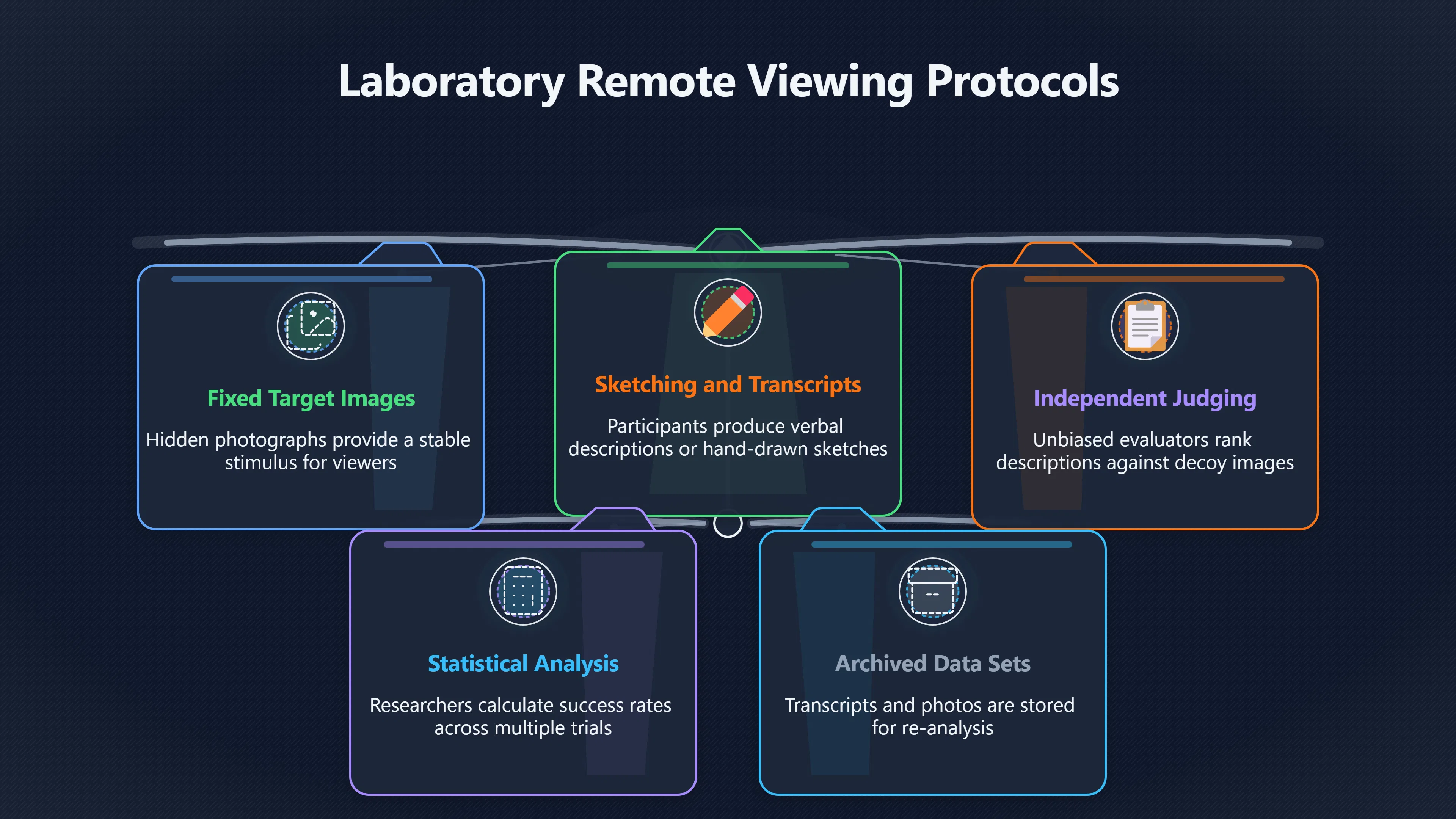
Laboratory remote-viewing experiments faced an immediate methodological challenge: how could researchers determine whether a session was a “hit” or a “miss”? Hidden photographs offered an answer because they created a fixed target that did not change during the experiment.
Typically, a viewer would produce sketches or verbal impressions without seeing the target. Afterwards, independent judges would compare those descriptions against the actual photograph and several decoys, ranking which image appeared to match best. Researchers preferred this design because it reduced reliance on simple yes-or-no judgments and allowed statistical analysis across many trials.[CIA]cia.govAN EVALUATION OF THE REMOTE VIEWING PROGRAMIn the typical remote viewing experiment in the laboratory, a remote viewer is asked to vis…
Photographic targets also had practical advantages:
- Every participant could be tested against the same well-defined stimulus.
- Researchers could archive transcripts and photographs for later re-analysis.
- Independent judges could score sessions without knowing which target had been assigned.
- Experiments could be repeated under similar conditions, improving consistency compared with unpredictable field operations.[CIA]cia.govAN EVALUATION OF THE REMOTE VIEWING PROGRAMIn the typical remote viewing experiment in the laboratory, a remote viewer is asked to vis…
These features helped create experiments that looked more like conventional psychological research than anecdotal psychic demonstrations.
Why Real Intelligence Targets Are Much Messier
The characteristics that made photographs attractive in the laboratory also made them poor models of intelligence work.
A photograph represents a single, frozen moment with known boundaries. Intelligence questions rarely do. Decision-makers typically want information about ongoing activities, hidden intentions or future developments rather than descriptions of static scenes.
For example, an operational task might ask:
- Where is a missing aircraft now?
- Which building contains a particular research programme?
- What will an adversary do next week?
- Is a reported facility genuine or a deception?
These questions have no neatly packaged reference image waiting in an envelope. The target may be moving, incomplete or partly unknown even to the agency asking the question. Analysts often combine satellite imagery, intercepted communications, human reporting and other sources because no single source provides the complete picture. Remote-viewing transcripts therefore entered an environment fundamentally different from laboratory matching exercises.[CIA]cia.govAN EVALUATION OF THE REMOTE VIEWING PROGRAMIn the typical remote viewing experiment in the laboratory, a remote viewer is asked to vis…
The American Institutes for Research review noted that operational intelligence required information that was sufficiently specific, reliable and independently verifiable to support real decisions. Laboratory protocols did not demonstrate that such performance could be achieved consistently.[CIA]cia.govAN EVALUATION OF THE REMOTE VIEWING PROGRAMIn the typical remote viewing experiment in the laboratory, a remote viewer is asked to vis…
The Gap Between a Match and a Decision
A recurring criticism in later evaluations was that recognising similarities between a transcript and a photograph is not the same as producing actionable intelligence.
Human judges naturally look for correspondences. A transcript mentioning “water”, “metal structures” and “bright light” might seem to fit a harbour, a bridge or an industrial facility depending on which image is available. Because remote-viewing descriptions often contained numerous broad impressions, different readers could emphasise different elements when deciding whether a match existed. Critics argued that this subjective interpretation increased the risk of finding apparent successes after the fact.[UC Irvine Bren School]ics.uci.eduUC Irvine Bren SchoolEvaluation of Program on Anomalous Mental PhenomenaThe ultimate assessment of the potential utility of remote viewin…
Operational intelligence reverses this problem. Instead of choosing which photograph best matches a transcript, analysts must determine whether a report justifies action before the answer is known. An ambiguous description cannot easily support decisions involving military operations, diplomatic responses or expensive surveillance missions.
This distinction helps explain why reviewers separated questions about laboratory statistics from questions about intelligence usefulness. Even if some experimental results exceeded chance expectations, the operational challenge remained unresolved.[CIA]cia.govAN EVALUATION OF THE REMOTE VIEWING PROGRAMIn the typical remote viewing experiment in the laboratory, a remote viewer is asked to vis…
Why Controlled Success Did Not Generalise
Several practical differences prevented laboratory procedures from transferring smoothly into intelligence work.
Known scoring versus unknown outcomes. Laboratory experiments always had an answer available for later comparison. Intelligence targets often lacked immediate verification, making it impossible to know whether a report was accurate when decisions had to be made.
Single targets versus complex environments. A photograph isolates one location or object. Intelligence problems usually involve multiple actors, changing conditions and incomplete information.
Judging after the event versus acting beforehand. Experimental judges evaluated transcripts with the benefit of hindsight. Intelligence officers needed reports that were sufficiently precise before independent confirmation existed.
Statistical performance versus individual reliability. A modest overall statistical effect across many trials would still leave numerous individual sessions inaccurate. Intelligence operations cannot rely on average success rates if any single report could influence high-stakes decisions.[CIA]cia.govAN EVALUATION OF THE REMOTE VIEWING PROGRAMIn the typical remote viewing experiment in the laboratory, a remote viewer is asked to vis…
These implementation differences explain why favourable laboratory findings, where claimed, did not automatically establish operational usefulness.
What the Stargate Review Concluded
The 1995 evaluation commissioned after the Stargate programme’s transfer to the CIA drew a clear distinction between experimental research and intelligence application. Reviewers acknowledged that laboratory research had generated ongoing scientific debate, but concluded that the operational material did not provide information of sufficient clarity, consistency or reliability to justify intelligence use.[CIA]cia.govAN EVALUATION OF THE REMOTE VIEWING PROGRAMIn the typical remote viewing experiment in the laboratory, a remote viewer is asked to vis…
In practice, photograph-based experiments had solved one important research problem: they made controlled scoring possible. They did not solve the larger problem that mattered to intelligence agencies—producing dependable information about complex real-world situations in time to support consequential decisions. That gap between laboratory matching and operational decision-making remained one of the defining limitations of the Stargate programme.[CIA]cia.govAN EVALUATION OF THE REMOTE VIEWING PROGRAMIn the typical remote viewing experiment in the laboratory, a remote viewer is asked to vis…
Amazon book picks
Further Reading
Books and field guides related to Why Lab Success Was Hard to Use. Use these as the next step if you want deeper reading beyond the article.
The Men Who Stare At Goats
Rating: 3.5/5 from 11 Google Books ratings
Provides accessible background.

Remote Viewers: The Secret History of America's Psychic Spies
Discusses laboratory and operational testing.

eBay marketplace picks
Marketplace Samples
Live-tested eBay searches with available results related to this page.

Endnotes
1.
Source: cia.gov
Link:https://www.cia.gov/readingroom/docs/CIA-RDP96-00791R000200180005-5.pdf
Source snippet
AN EVALUATION OF THE REMOTE VIEWING PROGRAMIn the typical remote viewing experiment in the laboratory, a remote viewer is asked to vis...
2.
Source: ics.uci.edu
Link:https://www.ics.uci.edu/~jutts/hyman.html
Source snippet
UC Irvine Bren SchoolEvaluation of Program on Anomalous Mental PhenomenaThe ultimate assessment of the potential utility of remote viewin...
Additional References
3.
Source: facebook.com
Link:https://www.facebook.com/historyoasis/posts/from-1972-to-1995-the-united-states-military-invested-over-20-million-in-one-of-/790173214116954/
Source snippet
Army and intelligence initiative, primarily focused on exploring remote viewing—the supposed psychic...Read more...
4.
Source: researchgate.net
Link:https://www.researchgate.net/publication/369604750Remote_Viewing_a_1974-2022_systematic_review_and[meta-analysis
Source snippet
(PDF) Remote Viewing: a 1974-2022 systematic review...Photographic images of physical objects are common targets in remote viewing proje...
5.
Source: scribd.com
Link:https://www.scribd.com/doc/92017954/Air-Report
Source snippet
phenomena, primarily "remote viewing," for intelligence...Read more...
6.
Source: Wikipedia
Title: Stargate Project (U.S. Army unit)
Link:https://en.wikipedia.org/wiki/Stargate_Project_%28U.S._Army_unit%29
Source snippet
Stargate Project (U.S. Army unit)The Stargate Project's work primarily involved remote viewing, the purported ability to psychically "...
7.
Source: academia.edu
Link:https://www.academia.edu/38286031/Remote_Viewing_of_Concealed_Target_Pictures_Under_Light_and_Dark_Conditions
Source snippet
The study involved 19 sessions...Read more...
8.
Source: pmc.ncbi.nlm.nih.gov
Link:https://pmc.ncbi.nlm.nih.gov/articles/PMC10275521/
Source snippet
Central Intelligence Agency's (CIA...by Á Escolà‐Gascón · 2023 · Cited by 10 — Since 1972, the U.S. Central Intelligence Agency (CIA) co...
9.
Source: ciaotest.cc.columbia.edu
Title: sa jan02srm01
Link:https://ciaotest.cc.columbia.edu/olj/sa/sa_jan02srm01.html
Source snippet
Remote Viewing: The US Sponsored Psychic...This paper deals with experiments conducted in USA in which certain individuals were trained...
10.
Source: youtube.com
Title: Practical Applications of Remote Viewing with Joe Mc Moneagle
Link:https://www.youtube.com/watch?v=J1TaXs9i8c4
Source snippet
Statistics in Parapsychology with Jessica Utts...
11.
Source: youtube.com
Title: Joe Mc Moneagle
Link:https://www.youtube.com/watch?v=XRTon6qgVws
Source snippet
The History of Remote Viewing with Paul H. Smith (4K Reboot)...
12.
Source: youtube.com
Title: Remote Viewing and Statistical Validation
Link:https://www.youtube.com/watch?v=YrwAiU2g5RU
Source snippet
Joe McMoneagle - CIA's Project Stargate | SRS #95...
Topic Tree