Within Fair Test
Lock the Rules Before the Reveal
A preregistered protocol makes the scoring rule, stopping point, missing-data plan, and primary outcome visible before results are known.
On this page
- What a fair protocol must specify in advance
- How preregistration limits analysis shopping
- Why registered reports are useful for disputed claims
Page outline Jump by section
Introduction
A fair remote viewing test should not only prevent information leakage during the experiment; it should also prevent researchers from changing the rules after seeing the results. That is the purpose of preregistration and Registered Reports. In controversial fields, where both supporters and critics closely scrutinise methodology, publicly documenting the study protocol before data collection makes it easier to judge whether apparent successes reflect the original hypothesis or post hoc interpretation. Preregistration does not determine whether remote viewing exists, but it substantially improves the credibility of whatever outcome is obtained by reducing opportunities for selective reporting, flexible analyses and undisclosed changes to the experimental plan.[Wikipedia]WikipediaPreregistration (sciencePreregistration (science
Within the broader task of designing a fair remote viewing test, preregistration acts as a governance mechanism. It locks in the primary outcome, scoring procedures, stopping rules and handling of missing data before anyone knows whether the experiment will appear successful. Registered Reports go one step further by obtaining peer review of the protocol before the study begins, with publication decided largely on the quality of the design rather than on whether the findings are positive or negative.[Wikipedia]WikipediaPreregistration (sciencePreregistration (science
Lock the Rules Before the Reveal
Controversial experiments often generate disagreement not because the raw observations differ, but because researchers disagree over which analyses should count. A remote viewing session can contain sketches, words, metaphors and partial descriptions that may be interpreted in several ways. If decisions about scoring are made after the target is known, unconscious bias can influence the outcome.
A preregistered protocol therefore specifies, before any testing begins:
- the primary hypothesis;
- the target pool and randomisation method;
- eligibility criteria for participants;
- the exact scoring system;
- the number of trials or participants to be collected;
- the primary statistical analysis;
- procedures for missing or unusable sessions;
- criteria for excluding data;
- how exploratory analyses will be labelled.
These details transform subjective methodological choices into transparent commitments that readers can verify against the final publication. Deviations remain possible, but they are expected to be documented rather than hidden.[Wikipedia]WikipediaPreregistration (sciencePreregistration (science
For remote viewing, this means that disagreements about judging procedures or statistical treatment can be separated from disagreements about the underlying phenomenon itself. Readers know which conclusions were genuinely predicted and which emerged only after examining the data.
What a Fair Protocol Must Specify in Advance
Remote viewing experiments have historically varied in judging methods, target pools and statistical evaluation. Those choices can materially affect the reported outcome, making advance specification particularly important.
A robust preregistration would normally define:
Primary outcome. Whether success is measured by rank-order judging, binary target identification, similarity ratings or another predetermined metric.
Stopping rule. Whether the study ends after a fixed number of sessions, after recruiting a specified sample size or according to a predefined sequential analysis. Optional stopping—continuing until significance appears—can inflate false-positive rates if not accounted for in advance.[Wikipedia]WikipediaPreregistration (sciencePreregistration (science
Handling incomplete sessions. Participants sometimes terminate early, technical failures occur or transcripts become unusable. The protocol should explain whether such trials are excluded, repeated or analysed separately.
Exclusion criteria. Rules for removing participants or sessions should be established before examining performance. Excluding poor performers after seeing results introduces substantial bias.
Statistical threshold. The analysis plan should specify significance tests, confidence intervals, Bayesian methods where applicable and any planned corrections for multiple comparisons.
The practical effect is that the experiment becomes auditable. Independent researchers can compare the published paper with the preregistered protocol and determine whether important methodological changes occurred.
How Preregistration Limits Analysis Shopping
One of the principal motivations for preregistration across psychology and related sciences is reducing “researcher degrees of freedom”—the many legitimate-looking analytical choices that become available once data are visible. These include trying multiple scoring systems, changing exclusion rules, redefining success criteria or highlighting only favourable subsets of the data.[Wikipedia]WikipediaPreregistration (sciencePreregistration (science
In remote viewing, examples of analysis shopping might include:
- switching from one judging method to another after inspecting the data;
- reporting only experienced viewers when novices performed poorly;
- redefining which descriptive elements count as matches;
- introducing alternative statistical tests because the planned analysis was not significant;
- presenting exploratory findings as though they had been predicted from the beginning.
Preregistration does not prevent exploratory analyses. Instead, it separates them from confirmatory tests. Exploratory discoveries may generate valuable new hypotheses, but readers can distinguish between evidence that genuinely tested a prediction and evidence that emerged through subsequent exploration. This distinction is central to modern open-science practice.[Wikipedia]WikipediaPreregistration (sciencePreregistration (science
Why Registered Reports Are Especially Useful for Disputed Claims
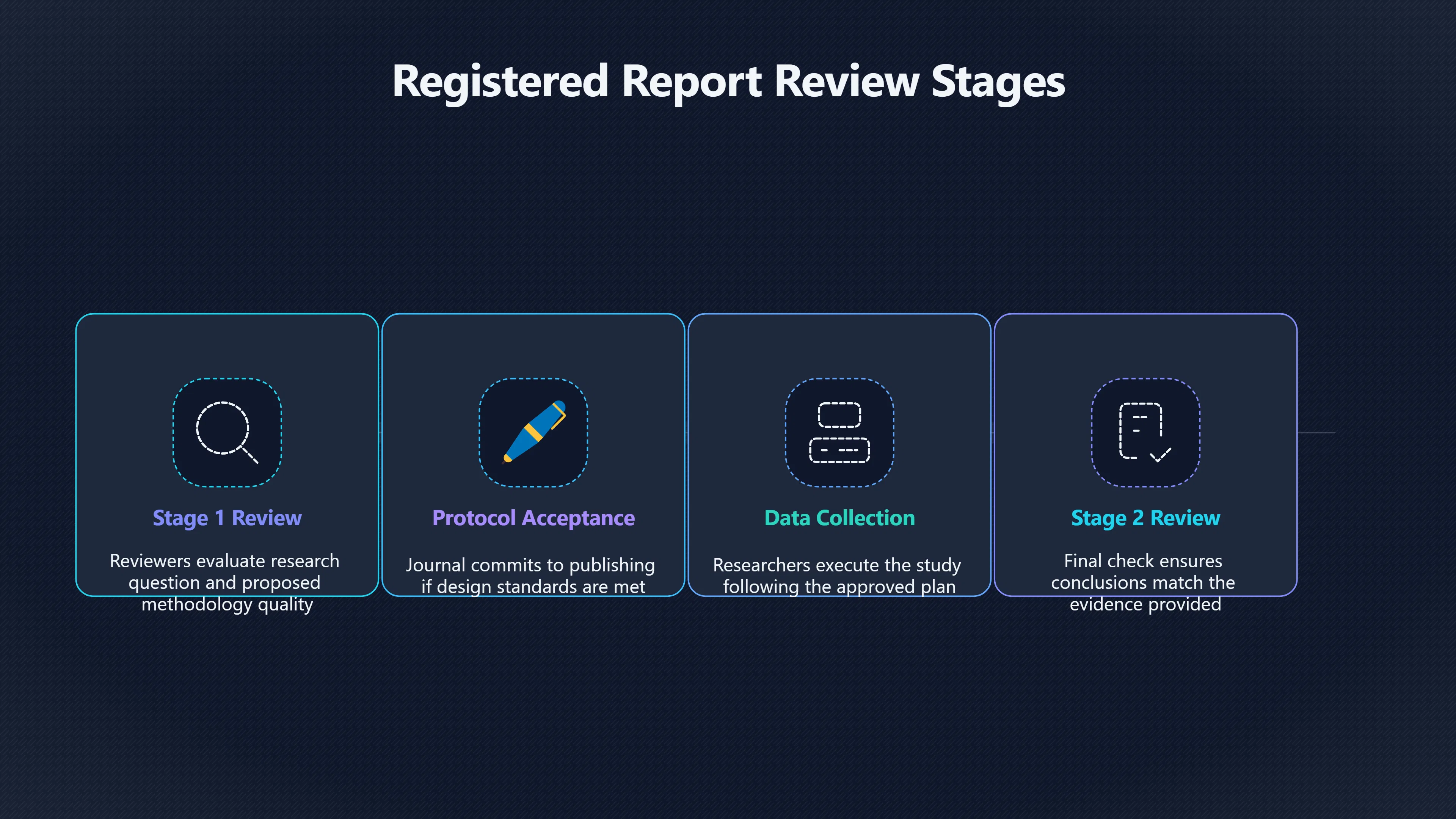
Registered Reports extend preregistration by introducing peer review before data collection. During Stage 1, reviewers evaluate whether the research question is worthwhile and whether the proposed methodology adequately tests it. If accepted in principle, the journal commits to publishing the completed study provided the approved protocol is followed and reporting standards are met. Stage 2 review then checks compliance with the protocol and whether the conclusions match the evidence.[Wikipedia]WikipediaRegistered reportRegistered report
For disputed subjects such as remote viewing, this offers several advantages.
First, publication no longer depends primarily on obtaining statistically significant results. Negative findings become publishable if the study was well designed, reducing publication bias.
Second, methodological criticisms can be addressed before expensive data collection begins. Reviewers may recommend stronger blinding, clearer scoring rules or improved randomisation while changes are still possible.
Third, both advocates and sceptics gain confidence that the protocol was not tailored after observing the outcome. The debate shifts towards whether the original design was appropriate rather than whether researchers altered the analysis after the fact.
Lessons from Controversial Psi Research
Parapsychology has increasingly adopted practices associated with the broader open-science movement, including study registries, preregistration and confirmatory replication projects. Some recent psi investigations explicitly distinguish exploratory from confirmatory analyses or employ transparent preregistered protocols intended to minimise confirmation bias and selective reporting.[PLOS]journals.plos.orgThe source…
These developments have not resolved the scientific disagreement over remote viewing or other psi claims. Critics continue to question whether observed effects survive independent replication, while proponents argue that stronger protocols improve the quality of evidence. Nevertheless, there is broad agreement across methodological perspectives that transparent protocols make disputes easier to evaluate because disagreements become focused on predefined methods rather than undocumented analytical flexibility.[PLOS+2royalsocietypublishing.org]journals.plos.orgThe source…
Preregistration Improves Credibility Without Guaranteeing Correctness
Preregistration is a procedural safeguard rather than proof of validity. A poorly designed study can be preregistered, and an incorrect hypothesis can be tested transparently. Likewise, researchers may legitimately deviate from their protocol when unforeseen problems arise, provided those deviations are clearly documented and justified.[Wikipedia]WikipediaPreregistration (sciencePreregistration (science
The value of preregistration lies in making those changes visible. Readers can distinguish between planned confirmatory analyses and later exploratory work, judge whether deviations were reasonable and assess how much confidence the reported findings deserve.
For remote viewing, where methodological criticism has historically been at least as important as the reported results themselves, locking the rules before the first session is one of the strongest available safeguards against disputes driven by hindsight rather than evidence.
Amazon book picks
Further Reading
Books and field guides related to Lock the Rules Before the Reveal. Use these as the next step if you want deeper reading beyond the article.
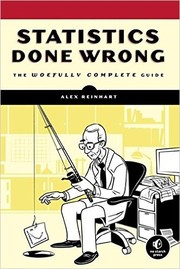
Statistics Done Wrong
Discusses practices that preregistration is designed to prevent.

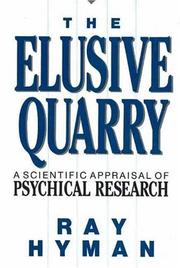
The elusive quarry
First published 1989. Subjects: Book reviews, Controversial literature, Parapsychology, Psychical research.
The Skeptic's Guide to the Universe
Encourages rigorous testing over post hoc interpretation.
eBay marketplace picks
Marketplace Samples
Live-tested eBay searches with available results related to this page.



Endnotes
1.
Source: Wikipedia
Title: Preregistration (science)
Link:https://en.wikipedia.org/wiki/Preregistration_%28science%29
2.
Source: royalsocietypublishing.org
Link:https://royalsocietypublishing.org/rsos/article/10/2/191375/91837/Raising-the-value-of-research-studies-in
Source snippet
psychological science...by Z Kekecs · 2023 · Cited by 75 — The only other preregistered replication study that we are aware of was condu...
3.
Source: Wikipedia
Title: Registered report
Link:https://en.wikipedia.org/wiki/Registered_report
4.
Source: journals.plos.org
Link:https://journals.plos.org/plosone/article?id=10.1371%2Fjournal.pone.0335330
Source snippet
The source...
5.
Source: Wikipedia
Title: Remote viewing
Link:https://en.wikipedia.org/wiki/Remote_viewing
Source snippet
Remote viewingRemote viewing (RV) is the practice of seeking impressions about a distant or unseen subject, purportedly sensing with t...
6.
Source: psi-encyclopedia.spr.ac.uk
Title: spr.ac.uk Remote Viewing
Link:https://psi-encyclopedia.spr.ac.uk/articles/remote-viewing/
Source snippet
Viewing - Psi Encyclopedia13 Jan 2017 — Remote viewing is an experimental form of ESP that emerged in the late 1960s, in which a suitably...
Additional References
7.
Source: researchgate.net
Link:https://www.researchgate.net/publication/340914519Performance_at_a_Precognitive_Remote_Viewing_Task_with_and_without[Ganzfeld
Source snippet
(PDF) Performance at a Precognitive Remote Viewing Task...Performance at a Precognitive Remote Viewing Task, with and without Ganzfeld S...
8.
Source: researchgate.net
Link:https://www.researchgate.net/publication/342062124_Tricking_the_Trickster_Evidence_for_Predicted_Sequential_Structure_in_a_19-Year_Online_Psi_Experiment
Source snippet
Tricking the Trickster: Evidence for Predicted Sequential...6 May 2026 — This is because of ample evidence that pre-screened and trained...
Published: May 2026
9.
Source: reddit.com
Link:https://www.reddit.com/r/remoteviewing/comments/1dazs09/creation_of_study_on_statistical_evidence_of/
Source snippet
Creation of study on statistical evidence of remote viewingThis paper shows what has been repeated many times, that when you pre-select s...
10.
Source: researchprofiles.herts.ac.uk
Title: experiment one of the saic remote viewing program a critical re e
Link:https://researchprofiles.herts.ac.uk/en/publications/experiment-one-of-the-saic-remote-viewing-program-a-critical-re-e
Source snippet
One of the SAIC Remote Viewing Programby R Wiseman · 1999 · Cited by 24 — This paper first outlines xx a key study in the report (referre...
11.
Source: cia.gov
Link:https://www.cia.gov/readingroom/document/cia-rdp96-00788r001300090002-8
Source snippet
remote viewing experiment. The subject was told only that we were located somewhere between New York City and California and that shortly...
12.
Source: sciencedirect.com
Link:https://www.sciencedirect.com/science/article/pii/S1053811926002521
Source snippet
free-response designs may offer greater ecological validity for...
13.
Source: davidfmarks.net
Link:https://davidfmarks.net/the-non-existence-of-laboratory-psi-looks-ever-more-certain-from-recent-confirmatory-research-in-parapsychology/
Source snippet
wing analysis of recent confirmatory research in Parapsychology...
14.
Source: researchonline.ljmu.ac.uk
Title: ljmu.ac.uk Follow‐up on the U.S
Link:https://researchonline.ljmu.ac.uk/id/eprint/23584/1/Follow-up%20on%20the%20U.S.%20Central%20Intelligence%20Agency%27s%20%28CIA%29%20remote%20viewing%20experiments%E2%98%86.pdf
Source snippet
Central Intelligence Agency's (CIA)...by Á Escolà-Gascón · 2023 · Cited by 10 — Objectives: Since 1972, the U.S. Central Intelligence Ag...
15.
Source: repository.mmu.ac.uk
Title: mmu.ac.uk Follow-up on the U.S
Link:https://repository.mmu.ac.uk/articles/journal_contribution/Follow-up_on_the_U_S_Central_Intelligence_Agency_s_CIA_remote_viewing_experiments/32473284
Source snippet
Central Intelligence Agency's (CIA)...Objectives: Since 1972, the U.S. Central Intelligence Agency (CIA) commissioned several research p...
16.
Source: youtube.com
Title: The Replication Crisis: Why Studies Fail and How Psychology Is Fixing Itself
Link:https://www.youtube.com/watch?v=YpizifCQ96Y
Source snippet
Feeling The Future: Is ESP real (according to science)?...
Topic Tree