Within Intel Value
When Psychic Impressions Failed the Action Test
Remote viewing often produced intriguing descriptions, but intelligence value depended on whether they could change a real decision.
On this page
- What makes intelligence actionable
- Why interesting matches were not enough
- How decision value was judged
Page outline Jump by section
Introduction
The central question for the U.S. government’s remote-viewing programme was never whether a session occasionally produced an intriguing description. It was whether those descriptions could reliably improve real intelligence decisions. Intelligence agencies routinely work with incomplete information, but they still require reporting that is specific enough to direct surveillance, prioritise targets, allocate resources or warn of imminent threats. A report that appears impressive only after the target is revealed has little operational value if it could not have influenced a decision beforehand. The 1995 American Institutes for Research (AIR) evaluation concluded that this was the programme’s decisive weakness: even where some reports appeared to contain potentially accurate elements, they did not provide information reliable or concrete enough to support intelligence operations.[CIA]cia.govAN EVALUATION OF THE REMOTE VIEWING PROGRAMRemote viewing failed to produce actionable intelligence. Conclusions research The foregoin…

This distinction between interesting and actionable information became one of the defining reasons the Star Gate programme was ultimately judged unsuccessful as an operational intelligence capability.
What Makes Intelligence Actionable?
In intelligence work, information becomes actionable when it reduces uncertainty enough to justify a decision. Absolute certainty is rarely available, but decision-makers must understand both the likely accuracy of a report and the consequences of acting upon it.
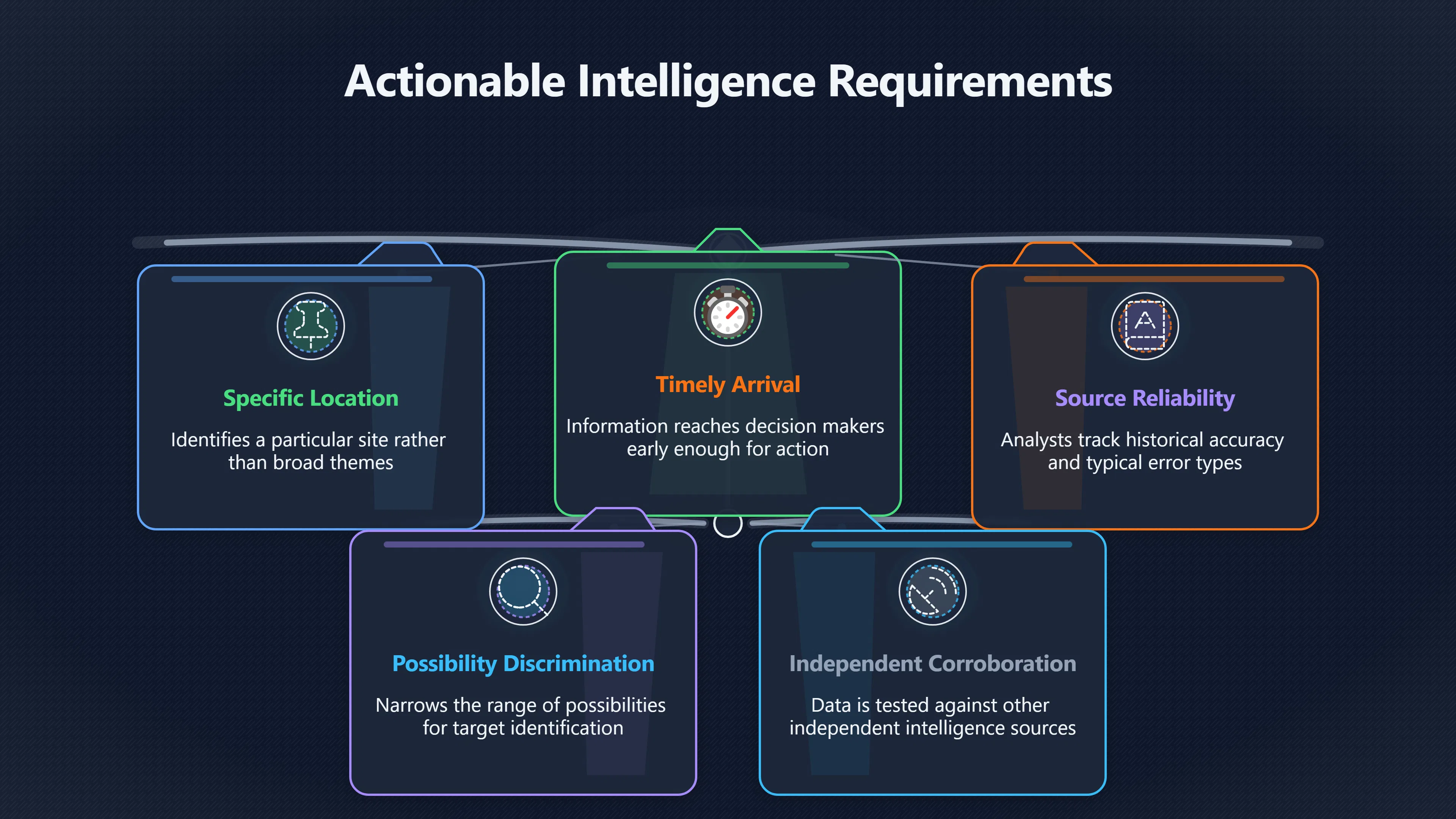
For a report to be operationally useful, it generally needs several characteristics:
- Specificity: It identifies a particular location, object, person or event rather than broad themes.
- Timeliness: It arrives early enough for action to be taken.
- Reliability: Analysts have evidence showing how often the source is correct and what kinds of errors it typically makes.
- Discrimination: It narrows the range of possibilities instead of describing features common to many targets.
- Corroboration: It can be tested against other intelligence sources rather than standing alone.
Traditional intelligence disciplines such as imagery, intercepted communications or human sources are imperfect, but analysts develop confidence by comparing their historical performance and combining them with independent evidence. The AIR reviewers found that remote-viewing reports lacked this predictable reliability profile. Users could not know in advance which details, if any, deserved confidence.[CIA]cia.govAN EVALUATION OF THE REMOTE VIEWING PROGRAMRemote viewing failed to produce actionable intelligence. Conclusions research The foregoin…
Why Interesting Matches Were Not Enough
The most persistent problem was that remote-viewing reports often contained descriptions broad enough to invite multiple interpretations.
Descriptions such as references to water, mountains, industrial structures, metallic objects or movement might appear meaningful after investigators already knew the target. Before identification, however, those same descriptions rarely narrowed the search sufficiently to influence operational choices.
This illustrates an important difference between retrospective recognition and prospective prediction.
- Retrospective matching asks whether parts of a report resemble a known target.
- Operational intelligence asks whether the report identifies the target before anyone else can.
The AIR review noted that many reports seemed strongest when describing general background characteristics rather than concrete operational details. While these broad impressions sometimes appeared plausible, they seldom answered the questions intelligence officers actually needed resolved, such as exactly where to search, which individual to monitor or whether an imminent event justified immediate action.[CIA]cia.govAN EVALUATION OF THE REMOTE VIEWING PROGRAMRemote viewing failed to produce actionable intelligence. Conclusions research The foregoin…
Psychologists have long recognised that humans are highly skilled at recognising partial similarities after outcomes become known. In intelligence work, however, success must be measured before confirmation, because decisions must be made under uncertainty rather than hindsight.[Center for Inquiry]cdn.centerforinquiry.orgake them consistent with known background cues…
How Decision Value Was Judged
The Star Gate evaluation distinguished between two related but separate questions:
- Were there indications of anomalous effects under experimental conditions?
- Did those effects translate into useful intelligence?
The review panel deliberately separated scientific debate over laboratory findings from operational usefulness. Statistician Jessica Utts argued that the research data showed evidence deserving further scientific investigation, while psychologist Ray Hyman remained unconvinced that the evidence established paranormal functioning. Despite these disagreements, the broader operational assessment reached a more consistent conclusion: regardless of the underlying mechanism, the programme had not demonstrated intelligence value.[CIA]cia.govAN EVALUATION OF THE REMOTE VIEWING PROGRAMRemote viewing failed to produce actionable intelligence. Conclusions research The foregoin…
The operational reviewers examined actual users of the programme rather than laboratory scoring alone. Their findings showed that:
- reports frequently required substantial interpretation;
- correct elements were mixed with incorrect or irrelevant material;
- confidence levels could not be estimated consistently;
- intelligence customers rarely regarded the reports as sufficient for operational planning.
Consequently, the evaluation concluded that no documented case showed remote-viewing reports serving as the basis for an intelligence operation.[CIA]cia.govAN EVALUATION OF THE REMOTE VIEWING PROGRAMRemote viewing failed to produce actionable intelligence. Conclusions research The foregoin…

The Cost of Acting on Ambiguous Information
An intelligence report does not merely describe reality; it influences choices that consume time, personnel and money.
Suppose a report vaguely suggested that a missing object was “near water beside a large industrial structure”. Such a description could fit hundreds of locations. Launching searches at every possible site would waste resources and potentially distract investigators from stronger leads.
False positives carry real costs:
- surveillance teams may be deployed unnecessarily;
- analysts spend time evaluating misleading leads;
- military or law-enforcement resources may be diverted;
- genuinely valuable intelligence can receive less attention.
Unlike laboratory experiments, intelligence agencies cannot simply count occasional successes without considering the cost of failures. A source that produces many attractive but non-specific leads may reduce rather than improve decision quality.
This practical decision framework explains why agencies judge collection methods by their contribution to successful operations rather than by isolated impressive anecdotes.
Why Anecdotal Successes Did Not Settle the Question
Supporters of remote viewing have highlighted individual sessions that appear remarkably accurate, and former programme participants have argued that certain missions produced valuable insights. Some have also maintained that remote viewing was typically used only after conventional collection methods had already failed, making success difficult to measure by ordinary standards.[CIAO]ciaotest.cc.columbia.eduls were trained to acquire such 'Remote Viewing' capabilities for collecting…Read more…
The AIR evaluation did not dismiss every reported success outright. Instead, it argued that intelligence programmes must be judged systematically rather than through memorable examples.
Several factors complicated interpretation of apparent “hits”:
- incomplete records of unsuccessful sessions;
- subjective interpretation of symbolic descriptions;
- uncertainty about what background information viewers may already have possessed;
- selective attention to correct details while overlooking incorrect ones;
- lack of consistent procedures for measuring operational impact.
Because intelligence decisions require dependable performance across many cases, isolated successes could not compensate for an overall inability to demonstrate reliable decision support.[CIA]cia.govAN EVALUATION OF THE REMOTE VIEWING PROGRAMRemote viewing failed to produce actionable intelligence. Conclusions research The foregoin…
The Practical Lesson
The Star Gate programme illustrates an important principle extending beyond remote viewing itself: intelligence is ultimately evaluated by the quality of decisions it enables.
An observation can be fascinating, statistically unusual or superficially persuasive while still failing the operational test. Intelligence organisations require information that changes what decision-makers do, not merely how surprising a report appears after events unfold.
That distinction explains why the programme’s final assessment focused less on whether unusual phenomena might deserve further scientific study and more on whether the reporting consistently produced concrete, timely and verifiable guidance. According to the 1995 evaluation, it did not, and that failure to convert intriguing impressions into actionable intelligence became one of the principal reasons the programme was discontinued.[CIA]cia.govAN EVALUATION OF THE REMOTE VIEWING PROGRAMRemote viewing failed to produce actionable intelligence. Conclusions research The foregoin…
Amazon book picks
Further Reading
Books and field guides related to When Psychic Impressions Failed the Action Test. Use these as the next step if you want deeper reading beyond the article.

Parapsychology: A Handbook for the 21st Century
Places intelligence claims in research context.
eBay marketplace picks
Marketplace Samples
Live-tested eBay searches with available results related to this page.



Endnotes
1.
Source: cia.gov
Link:https://www.cia.gov/readingroom/docs/CIA-RDP96-00791R000200180005-5.pdf
Source snippet
AN EVALUATION OF THE REMOTE VIEWING PROGRAMRemote viewing failed to produce actionable intelligence. Conclusions research The foregoin...
2.
Source: ciaotest.cc.columbia.edu
Link:https://ciaotest.cc.columbia.edu/olj/sa/sa_jan02srm01.html
Source snippet
ls were trained to acquire such 'Remote Viewing' capabilities for collecting...Read more...
3.
Source: cdn.centerforinquiry.org
Link:https://cdn.centerforinquiry.org/wp-content/uploads/sites/29/1996/03/22165045/p27.pdf
Source snippet
ake them consistent with known background cues...
4.
Source: Wikipedia
Title: Remote viewing
Link:https://en.wikipedia.org/wiki/Remote_viewing
Source snippet
Remote viewingThe program ran from 1975 to 1995 and ended after evaluators concluded that remote viewers consistently failed to produc...
Additional References
5.
Source: greydynamics.com
Link:https://greydynamics.com/intelligence-past-the-tangible-world-cias-[stargate
Source snippet
Intelligence Past the Tangible World: CIA's Stargate ProjectThe Stargate Project is one of the most interesting and enigmatic intelligenc...
6.
Source: academia.edu
Link:https://www.academia.edu/95285973/The_Star_Gate_Operational_Remote_Viewing_Program_A_Human_Intelligence_HUMINT_Collection_Platform
Source snippet
In early 1995, a Congressionally Directed Action required the DIA to transfer the Star Gate program to the CIA. Evaluation: High...
7.
Source: journalofscientificexploration.org
Link:https://journalofscientificexploration.org/index.php/jse/article/view/3865/2573
Source snippet
D., Rose, A. M., & Goslin, D. A. (1995). An evaluation of remote viewing: Research and applications. American Institutes for Research. Mö...
8.
Source: facebook.com
Title: During the [Cold War]({{ ‘cold-war/’ | relative_url }}), the CIA funded research into what
Link:https://www.facebook.com/100090372200308/posts/during-the-cold-war-the-cia-funded-research-into-what-they-called-remote-viewing/937678002587931/
Source snippet
AIR, which performed a review of the project, no remote viewing report ever provided actionable information for any intelligence operatio...
9.
Source: pmc.ncbi.nlm.nih.gov
Title: PMCFollow‐up on the U.S
Link:https://pmc.ncbi.nlm.nih.gov/articles/PMC10275521/
Source snippet
Central Intelligence Agency's (CIA...by Á Escolà‐Gascón · 2023 · Cited by 10 — Scientific reviews and conclusions after the CIA declassi...
10.
Source: youtube.com
Title: Stargate’s Gatekeeper: DIA & Remote Viewing with Dale E. Graff
Link:https://www.youtube.com/watch?v=VRAsTmT_nQo
Source snippet
Stargate Project: How Did the CIA Turn the Human Mind into a Weapon?...
11.
Source: youtube.com
Title: Stargate Project: How Did the CIA Turn the Human Mind into a Weapon?
Link:https://www.youtube.com/watch?v=IDPlEXpzRoQ
Source snippet
Inside The Military's Secret Psychic Unit...
12.
Source: youtube.com
Title: Inside Operation Stargate: The CIA’s Psychic Spy Experiment
Link:https://www.youtube.com/watch?v=oasTnsLw_n8
Source snippet
Joe McMoneagle - CIA's Project Stargate | SRS #95...
13.
Source: youtube.com
Title: Joe Mc Moneagle
Link:https://www.youtube.com/watch?v=XRTon6qgVws
Source snippet
Stargate's Gatekeeper: DIA & Remote Viewing with Dale E. Graff...
14.
Source: youtube.com
Title: Inside The Military’s Secret Psychic Unit
Link:https://www.youtube.com/watch?v=9nY3hu76SyU
Topic Tree