Within Lab vs Real
The Problem With No Feedback
Without timely feedback, viewers and users struggle to learn which impressions were useful and which were noise.
On this page
- How feedback supports laboratory scoring
- Why intelligence targets often lack feedback
- What delayed feedback does to confidence
Page outline Jump by section
Introduction
One of the largest differences between laboratory remote-viewing studies and operational use is the availability of feedback. In controlled experiments, researchers usually know the target and can compare a viewer’s description with reality shortly after the session. That immediate comparison allows scoring, error correction and, in some theories, may even be considered part of the process being tested. Operational intelligence rarely offers the same luxury. The true target may remain unknown for months, be only partially verified, or never be confirmed at all. This creates a feedback gap that affects both claims of accuracy and the practical usefulness of remote viewing. Even researchers who argue that laboratory studies show above-chance statistical results acknowledge that operational environments differ substantially from laboratory conditions, while the principal independent review of the US government’s programme identified the lack of feedback as one reason laboratory findings did not translate into actionable intelligence.[National Security Archive]nsarchive2.gwu.eduEvaluation of.Read moreNational Security ArchiveAn Evaluation of Remote Viewing: Research and…March 13, 2015 — by MD Mumford · 1995 · Cited by 76 — The secon…

How Feedback Supports Laboratory Scoring
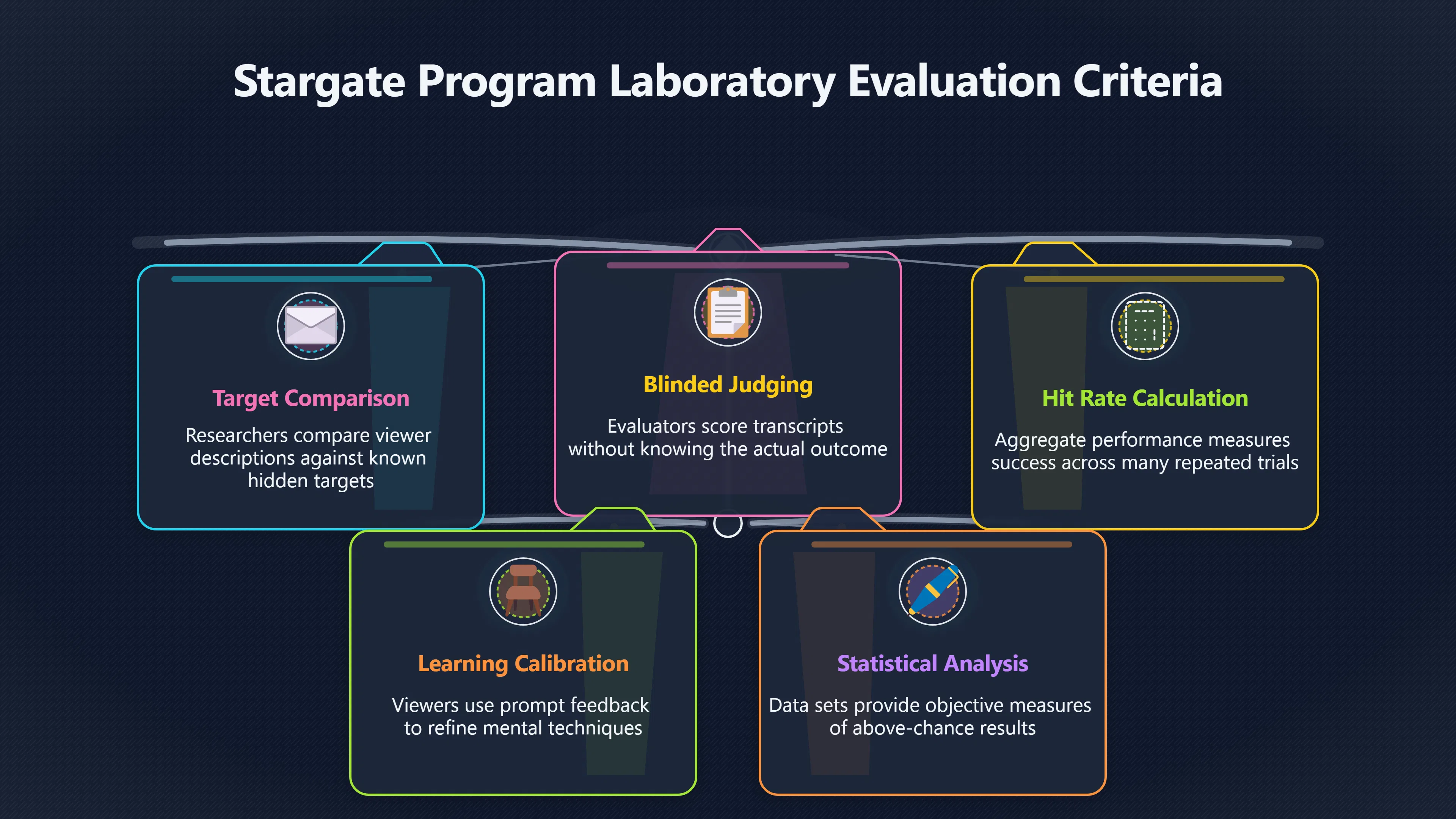
In laboratory remote-viewing research, feedback serves several functions simultaneously. First, it allows investigators to determine whether a session produced information that corresponds with a known target. Second, it provides a basis for statistical analysis by comparing transcripts or sketches against predefined targets under blinded judging procedures. Third, it enables viewers to see which impressions were accurate and which were not, creating opportunities for learning and calibration over repeated sessions.[National Security Archive]nsarchive2.gwu.eduEvaluation of.Read moreNational Security ArchiveAn Evaluation of Remote Viewing: Research and…March 13, 2015 — by MD Mumford · 1995 · Cited by 76 — The secon…
This structure makes laboratory evaluation relatively straightforward because every trial eventually reaches a known outcome. Researchers can calculate hit rates, ranking scores or other measures across many sessions, even if individual sessions vary widely in quality. The emphasis is therefore on aggregate performance rather than on whether any single session would justify an operational decision.[National Security Archive]nsarchive2.gwu.eduEvaluation of.Read moreNational Security ArchiveAn Evaluation of Remote Viewing: Research and…March 13, 2015 — by MD Mumford · 1995 · Cited by 76 — The secon…
Some proponents of remote viewing have also suggested that feedback may be more than a training aid. Certain theoretical interpretations propose that viewers are effectively responding to information they themselves will later encounter when the target is revealed, making future feedback part of the mechanism rather than merely an evaluation tool. This interpretation remains speculative and is not accepted within mainstream science, but it illustrates how central feedback has become in some remote-viewing models.[National Security Archive]nsarchive2.gwu.eduEvaluation of.Read moreNational Security ArchiveAn Evaluation of Remote Viewing: Research and…March 13, 2015 — by MD Mumford · 1995 · Cited by 76 — The secon…
Why Intelligence Targets Often Lack Feedback
Operational intelligence presents a fundamentally different problem. Many intelligence questions concern activities inside closed organisations, future events, missing information or adversaries whose actions cannot immediately be verified. Sometimes there is never a definitive answer.
Examples include questions such as:
- whether a weapons programme exists at a particular site;
- where a missing individual may have travelled;
- what another government intends to do next; or
- whether a covert operation is underway.
Unlike a laboratory photograph hidden in an envelope, these targets often have no prompt, objective resolution. Information may emerge gradually through multiple intelligence sources, or the question may simply remain unanswered.
The 1995 American Institutes for Research evaluation of the US government’s Stargate programme highlighted this distinction directly. The reviewers concluded that operational conditions differ from laboratory conditions because viewers often cannot receive the kind of feedback available in experiments, and many operational targets do not possess the characteristics associated with successful laboratory trials.[National Security Archive]nsarchive2.gwu.eduEvaluation of.Read moreNational Security ArchiveAn Evaluation of Remote Viewing: Research and…March 13, 2015 — by MD Mumford · 1995 · Cited by 76 — The secon…
Without reliable confirmation, neither the viewer nor the intelligence customer can confidently distinguish genuinely informative impressions from guesses, coincidence or interpretation.

What Delayed Feedback Does to Confidence
Delayed or incomplete feedback affects confidence in several ways.
For viewers, the absence of prompt verification makes it difficult to refine technique. When feedback arrives months later, memories of the original mental impressions may have faded, reducing its value as a learning tool. If confirmation never arrives, viewers receive no objective indication of whether they interpreted their impressions correctly.
For analysts and decision-makers, uncertainty creates a different problem. Intelligence work requires estimates of reliability before action is taken. If reports cannot be verified within a useful timeframe, confidence ratings become largely subjective. Analysts may remember striking apparent successes while overlooking inaccurate sessions, especially when outcomes remain ambiguous.
The AIR operational review found that end users generally reported broad similarities in some cases but judged the reports to be inconsistent, lacking in specific accuracy and requiring substantial subjective interpretation. According to the review, these characteristics prevented the reports from becoming actionable intelligence.[National Security Archive]nsarchive2.gwu.eduEvaluation of.Read moreNational Security ArchiveAn Evaluation of Remote Viewing: Research and…March 13, 2015 — by MD Mumford · 1995 · Cited by 76 — The secon…
Why Missing Feedback Makes Evaluation Difficult
The feedback gap also complicates scientific evaluation outside the laboratory.
When every experimental target is eventually revealed, researchers can calculate objective statistics across complete datasets. Operational archives rarely provide such clean comparisons because many reports concern questions that were never conclusively resolved. As a result, assessing success becomes vulnerable to several problems:
- Selective confirmation: only memorable apparent successes receive attention while unresolved or unsuccessful cases fade from view.
- Partial verification: a few correct-looking details may be highlighted even though most of the report remains untested.
- Retrospective interpretation: vague statements can appear meaningful once later events become known.
- Incomplete datasets: without final target information, failure rates cannot be measured accurately.
These difficulties reduce the ability to determine whether operational performance differs meaningfully from chance or from conventional analytical inference. The absence of comprehensive feedback therefore affects both practical decision-making and claims about operational effectiveness.[National Security Archive]nsarchive2.gwu.eduEvaluation of.Read moreNational Security ArchiveAn Evaluation of Remote Viewing: Research and…March 13, 2015 — by MD Mumford · 1995 · Cited by 76 — The secon…
The Feedback Gap as a Bridge Between Laboratory and Operational Results
The feedback problem helps explain why laboratory findings and operational outcomes are often discussed differently. Laboratory studies are deliberately designed so that every session ends with a known answer and can be incorporated into statistical analysis. Operational intelligence is designed to solve uncertain real-world problems, many of which never receive definitive resolution.
This difference means that a laboratory protocol demonstrating statistically unusual scoring does not automatically establish that the same approach can support intelligence decisions. Without timely, objective feedback, viewers cannot systematically improve, analysts cannot reliably calibrate confidence, and organisations cannot accurately determine which reports were genuinely informative and which reflected coincidence or noise.
For this reason, the AIR review treated the absence of operational feedback not as a minor procedural inconvenience but as one of the mechanisms limiting the transfer of laboratory remote-viewing research into practical intelligence use.[National Security Archive]nsarchive2.gwu.eduEvaluation of.Read moreNational Security ArchiveAn Evaluation of Remote Viewing: Research and…March 13, 2015 — by MD Mumford · 1995 · Cited by 76 — The secon…
Amazon book picks
Further Reading
Books and field guides related to The Problem With No Feedback. Use these as the next step if you want deeper reading beyond the article.
The Demon-Haunted World: Science as a Candle in the Dark
Highlights why verification matters in evaluating claims.


eBay marketplace picks
Marketplace Samples
Live-tested eBay searches with available results related to this page.




Endnotes
1.
Source: nsarchive2.gwu.edu
Title: Evaluation of.Read more
Link:https://nsarchive2.gwu.edu/NSAEBB/NSAEBB438/docs/doc_57.pdf
Source snippet
National Security ArchiveAn Evaluation of Remote Viewing: Research and...March 13, 2015 — by MD Mumford · 1995 · Cited by 76 — The secon...
Published: March 13, 2015
2.
Source: journalofscientificexploration.org
Link:https://journalofscientificexploration.org/index.php/jse/article/view/3687/2559
Source snippet
Experts' Remote Viewing Guidelines26 Mar 2026 — Feedback comes in two forms: (1) in operational ses- sions, feedback that may confirm or...
3.
Source: Wikipedia
Title: Remote viewing
Link:https://en.wikipedia.org/wiki/Remote_viewing
Source snippet
Remote viewingRemote viewing (RV) is the practice of seeking impressions about a distant or unseen subject, purportedly sensing with t...
4.
Source: ics.uci.edu
Link:https://www.ics.uci.edu/~jutts/may.pdf
Source snippet
review of the departmentby C EDwIN · 1996 — As a way of officially ignor- ing AC's positive contributions to intelligence, only a small f...
Additional References
5.
Source: cia.gov
Link:https://www.cia.gov/readingroom/docs/CIA-RDP96-00791R000200180005-5.pdf
Source snippet
AN EVALUATION OF THE REMOTE VIEWING PROGRAMThe second component was a review of the operational application of the remote viewing phenome...
6.
Source: researchgate.net
Title: 374881423 Remote Viewing A 1974 2022 Systematic Review and [Meta Analysis]({{ ‘meta-analysis/’ | relative_url }})
Link:https://www.researchgate.net/publication/374881423_Remote_Viewing_A_1974-2022_Systematic_Review_and_Meta-Analysis
Source snippet
(PDF) Remote Viewing: A 1974-2022 Systematic Review...26 Oct 2023 — This is the first meta-analysis of all studies related to remote-vie...
7.
Source: cia.gov
Link:https://www.cia.gov/readingroom/docs/CIA-RDP96-00791R000200180006-4.pdf
Source snippet
n intelligence gathering situations. For example.Read more...
8.
Source: slideshare.net
Link:https://www.slideshare.net/slideshow/an-evaluation-of-remote-viewing-research-and-applications-air1995pdf/257460594
Source snippet
iews with those involved in intelligence gathering operations using...Read more...
9.
Source: academia.edu
Link:https://www.academia.edu/108445581/Remote_Viewing_A_1974_2022_Systematic_Review_and_Meta_Analysis
Source snippet
Remote Viewing: A 1974- 2022 Systematic Review and...Remote viewing shows statistically significant effect sizes, outperforming other ex...
10.
Source: youtube.com
Title: Practical Applications of Remote Viewing with Joe Mc Moneagle
Link:https://www.youtube.com/watch?v=0S8L4ZHGjQE
Source snippet
CIA Physicist Who Ran STARGATE Reveals the Truth About Remote Viewing | Dale E. Graff...
11.
Source: youtube.com
Link:https://www.youtube.com/watch?v=erECzy-Ta8k
Source snippet
Statistics in Parapsychology with Jessica Utts...
12.
Source: youtube.com
Title: How the CIA Fooled Us to Believe in Remote Viewing: SCAM Exposed! | Jeremy Rys
Link:https://www.youtube.com/watch?v=QbY6rT4sFk0
Source snippet
John Herlosky | Remote Viewing | Special Edition #8...
13.
Source: youtube.com
Title: Statistics in Parapsychology with Jessica Utts
Link:https://www.youtube.com/watch?v=WmYGtKB9EEA
Source snippet
How the CIA Fooled Us to Believe in Remote Viewing: SCAM Exposed! | Jeremy Rys...
14.
Source: youtube.com
Title: John Herlosky | Remote Viewing | Special Edition #8
Link:https://www.youtube.com/watch?v=Wp6h_JLsMEk
Topic Tree