Within Sketches
Why First Impressions Can Beat Confident Labels
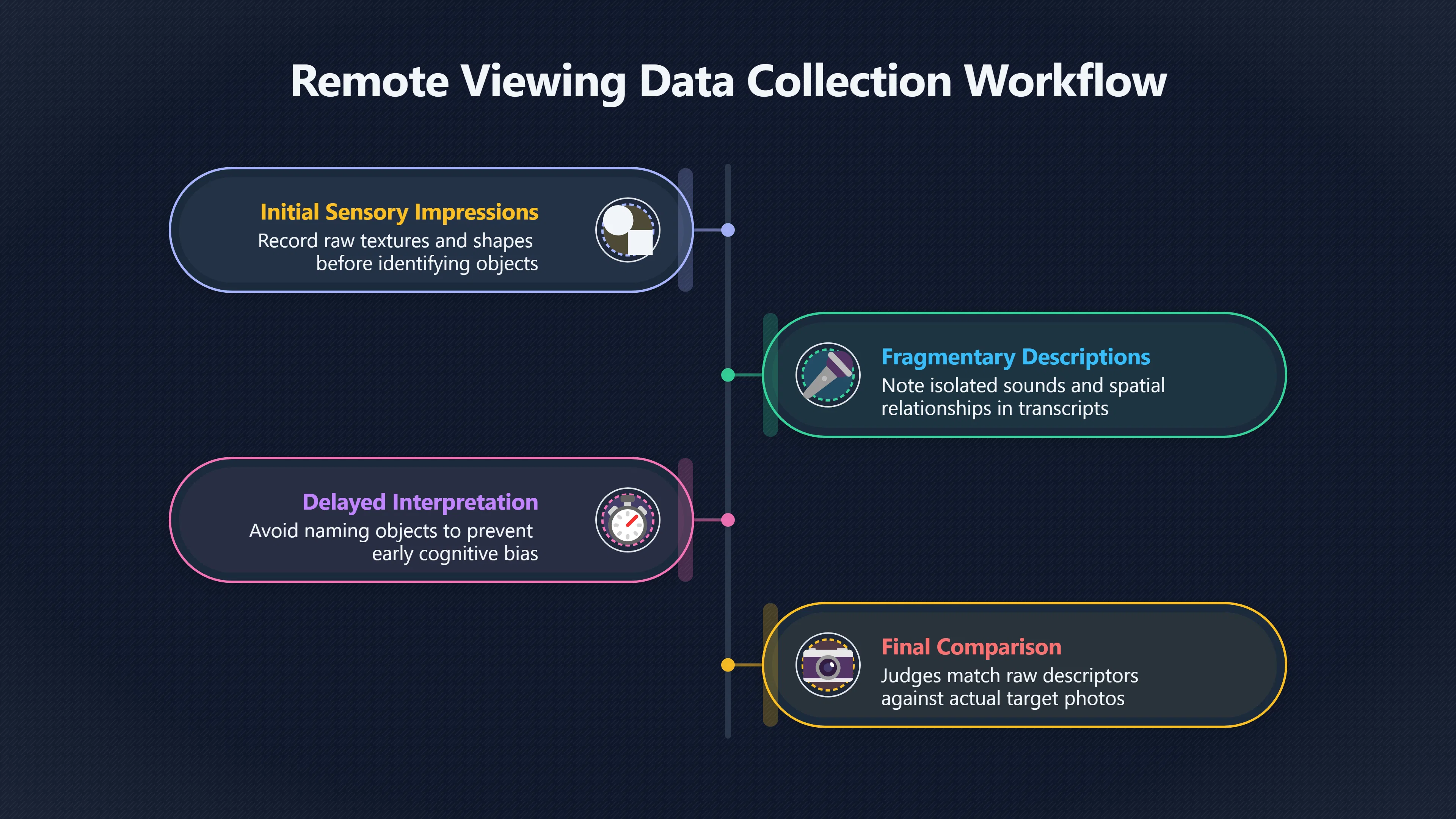
Remote-viewing notes become more useful when sensory fragments are separated from confident labels that may be wrong.
On this page
- Sensory fragments versus named conclusions
- How analytic overlay changes a session record
- What judges can and cannot safely infer
Page outline Jump by section
Introduction
In remote-viewing practice, one of the most persistent pieces of advice is to write down the first sensory impressions before trying to identify what they represent. The reason is straightforward: an initial impression such as “cold”, “curved”, “metallic”, “echoing” or a quick sketch of a tall vertical form preserves the original observation, whereas a confident label such as “lighthouse”, “factory” or “submarine” may be an interpretation that turns out to be wrong. Whether one believes remote viewing reflects a genuine anomalous ability or ordinary psychological processes, separating observations from interpretations makes a session record more informative and easier to evaluate. It allows later judges to compare what was actually reported with the target instead of untangling what came from perception and what came from inference.[CIA+2National Security Archive]cia.govAN EVALUATION OF THE REMOTE VIEWING PROGRAMTypically, the remote viewers described the results of their experiences in written reports…
Sensory Fragments Versus Named Conclusions
Remote-viewing sessions are usually recorded as free responses rather than multiple-choice answers. Participants are encouraged to note isolated impressions, textures, shapes, emotions, sounds and spatial relationships before attempting to explain them. This produces transcripts containing brief words, sketches and partial descriptions instead of polished narratives.[CIA]cia.govAN EVALUATION OF THE REMOTE VIEWING PROGRAMTypically, the remote viewers described the results of their experiences in written reports…
The distinction matters because raw descriptors remain useful even when the viewer’s interpretation fails. Consider the difference between these two records:
Raw impressionLater interpretationTall, narrow, white, cylindricalLighthouseCircular with water nearbyFountainMetallic, loud, vibratingAircraftBroad flat surface, repeating linesSolar farm
If the target later proves to be a radio mast rather than a lighthouse, the sensory description may still correspond well to the scene, while the named object is incorrect. Conversely, if attention focuses only on the dramatic noun, the potentially informative underlying observations may be overlooked.
For this reason, many remote-viewing training systems encourage participants to delay naming objects for as long as possible and instead expand the pool of descriptive information. This practice is presented as a way of preserving whatever the original source of information may have been before ordinary reasoning begins to organise it into familiar categories.[CIA]cia.govAN EVALUATION OF THE REMOTE VIEWING PROGRAMTypically, the remote viewers described the results of their experiences in written reports…
How Analytic Overlay Changes a Session Record
Within remote-viewing literature, the tendency to replace uncertain impressions with confident explanations is commonly called analytic overlay. The idea is that once the mind recognises a familiar pattern, it rapidly fills in missing details and produces a coherent story, regardless of whether that story matches the target. CIA training documents associated with Coordinate Remote Viewing explicitly discuss analytic overlay as subjective interpretation that can intrude upon raw data collection.[CIA]cia.govAN EVALUATION OF THE REMOTE VIEWING PROGRAMTypically, the remote viewers described the results of their experiences in written reports…
The proposed mechanism resembles well-known cognitive processes studied in psychology. Humans routinely interpret incomplete sensory information by drawing on memory, expectation and pattern recognition. A few disconnected observations can quickly become “it’s probably a bridge” or “this feels like an airport”. Those guesses may occasionally be correct, but they also introduce information that was never present in the original impressions.
In practice, analytic overlay changes a session record in several ways:
- It replaces uncertainty with confidence.
- It introduces details that were not directly observed.
- It makes later evaluation more subjective because judges must decide whether a guessed object is “close enough”.
- It can obscure genuine correspondences that existed at a lower descriptive level.
A transcript that simply reports “hard”, “bright”, “open”, “angular”, “wind”, accompanied by a sketch, leaves room for objective comparison. A transcript declaring “wind turbine maintenance platform” commits to a specific interpretation that is much easier to falsify but may also discard useful partial matches.

Why Raw Notes Help Blind Judging
Separating impressions from interpretations has practical value regardless of whether one accepts claims about remote viewing itself.
In many remote-viewing experiments, judges compare anonymous transcripts against several possible targets. Their task is not to determine whether every word is literally correct but to assess which target best fits the overall collection of descriptions and sketches. Written descriptors and drawings provide more independent points of comparison than a single confident label.[CIA]cia.govAN EVALUATION OF THE REMOTE VIEWING PROGRAMTypically, the remote viewers described the results of their experiences in written reports…
For example, suppose a transcript contains:
- large open space
- water nearby
- repeated vertical elements
- wind
- rough sketch of evenly spaced tall structures
Even if the viewer never names the target, judges may later find that these combined features fit a wind farm better than the alternative photographs presented during blind judging. By contrast, if the viewer simply wrote “bridge”, much of the descriptive richness would be lost.
This explains why many published remote-viewing protocols preserve complete transcripts rather than reducing them to a final answer. The intermediate observations are often considered more valuable than the concluding guess.[CIA]cia.govAN EVALUATION OF THE REMOTE VIEWING PROGRAMTypically, the remote viewers described the results of their experiences in written reports…
What Judges Can and Cannot Safely Infer
The value of raw impressions also has clear limits.
Judges can reasonably examine whether recorded descriptors correspond with observable features of candidate targets. They can compare shapes, layouts, textures, colours and spatial relationships recorded before feedback was available.
They cannot safely infer that every partial similarity demonstrates paranormal perception. Free-response material naturally allows multiple possible interpretations, and critics have argued that vague descriptions, flexible matching and confirmation bias can make ordinary correspondences appear stronger than they really are. Reviews of the Stargate programme likewise concluded that although some experimental findings appeared statistically interesting, the resulting information was generally too inconsistent and ambiguous for dependable intelligence use.[National Security Archive+2CIA]nsarchive2.gwu.edudoc 57National Security ArchiveAn Evaluation of Remote Viewing: Research and…by MD Mumford · 1995 · Cited by 76 — During Star Gate's history…
Similarly, sceptical analyses of early remote-viewing experiments have highlighted problems including sensory cueing, inadequate blinding and subjective judging procedures. These criticisms reinforce the importance of preserving the original session record rather than edited summaries, because independent reviewers need access to the raw material to determine whether apparent matches depend on selective interpretation.[Wikipedia]WikipediaRemote viewingRemote viewing
Why First Impressions Often Outlast Confident Labels
The practical lesson is less about proving remote viewing than about preserving evidence. A transcript that clearly distinguishes observation from interpretation allows later readers to evaluate both separately.
Raw impressions:
- preserve uncertainty rather than hiding it;
- retain descriptive information even if the final guess is wrong;
- reduce the risk that later editing reshapes the record;
- support more transparent blind judging.
Named conclusions have value as hypotheses, but they are strongest when treated as provisional rather than definitive. Within remote-viewing methodology, this distinction explains why experienced practitioners often regard the earliest sensory fragments and sketches as the most diagnostically useful part of the entire session record, while treating confident object names as the point where interpretation has begun to overtake observation.[CIA+2PMC]cia.govAN EVALUATION OF THE REMOTE VIEWING PROGRAMTypically, the remote viewers described the results of their experiences in written reports…
Amazon book picks
Further Reading
Books and field guides related to Why First Impressions Can Beat Confident Labels. Use these as the next step if you want deeper reading beyond the article.
Drawing on the right side of the brain
First published 1979. Subjects: Technique, Drawing, Visual perception, Cerebral dominance, Long Now Manual for Civilization.
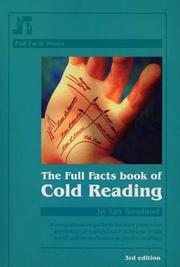
The Full Facts book of Cold Reading
First published 2008. Subjects: Psychic readings, Palmistry.
eBay marketplace picks
Marketplace Samples
Live-tested eBay searches with available results related to this page.

Endnotes
1.
Source: cia.gov
Link:https://www.cia.gov/readingroom/docs/CIA-RDP96-00791R000200180005-5.pdf
Source snippet
AN EVALUATION OF THE REMOTE VIEWING PROGRAMTypically, the remote viewers described the results of their experiences in written reports...
2.
Source: pmc.ncbi.nlm.nih.gov
Title: PMCFollow‐up on the U.S
Link:https://pmc.ncbi.nlm.nih.gov/articles/PMC10275521/
Source snippet
Central Intelligence Agency's (CIA...by Á Escolà‐Gascón · 2023 · Cited by 10 — Programs addressed remote viewing (RV), that is, determin...
3.
Source: Wikipedia
Title: Remote viewing
Link:https://en.wikipedia.org/wiki/Remote_viewing
4.
Source: nsarchive2.gwu.edu
Title: doc 57
Link:https://nsarchive2.gwu.edu/NSAEBB/NSAEBB438/docs/doc_57.pdf
Source snippet
National Security ArchiveAn Evaluation of Remote Viewing: Research and...by MD Mumford · 1995 · Cited by 76 — During [Star Gate]({{ 'star-gate/' | relative_url }})'s history...
Additional References
5.
Source: researchgate.net
Title: 369604750 Remote Viewing a 1974 2022 systematic review and meta analysis
Link:https://www.researchgate.net/publication/369604750_Remote_Viewing_a_1974-2022_systematic_review_and_meta-analysis
Source snippet
(PDF) Remote Viewing: a 1974-2022 systematic review...This is the first meta-analysis of all studies related to remote viewing tasks con...
6.
Source: reddit.com
Link:https://www.reddit.com/r/consciousness/comments/181s71r/the_cias_experiments_with_remote_viewing_and/
Source snippet
perimentation with Ingo Swann can provide some evidence toward “non-local...Read more...
7.
Source: facebook.com
Link:https://www.facebook.com/100090372200308/posts/during-the-[cold-war
Source snippet
ing,” the idea that some individuals might be able to perceive...Read more...
8.
Source: facebook.com
Link:https://www.facebook.com/AskImtinan/posts/project-stargate-the-cias-search-for-tabut-e-sakinahin-1972-the-cia-secretly-fun/1575907587435890/
Source snippet
ran for over two decades and cost millions of dollars in taxpayer...Read more...
9.
Source: youtube.com
Title: Remote Viewing Training, Part One: The Initial Phases, with Paul H. Smith
Link:https://www.youtube.com/watch?v=Y2Ryc196s0I
Source snippet
Remote Viewing Training, Part Two: The Advanced Phases, with Paul H. Smith...
10.
Source: youtube.com
Title: 1 Brain Athlete in America Performs Remote Viewing on Camera | Nelson Dellis
Link:https://www.youtube.com/watch?v=4-WMC5lhnis
Source snippet
Remote Viewing Explained: How the Mind Sees Without Eyes...
11.
Source: youtube.com
Title: Remote Viewing Training, Part Two: The Advanced Phases, with Paul H. Smith
Link:https://www.youtube.com/watch?v=t4uS_7q-hnE
Source snippet
Beginners Remote Viewing Template + Guide (Free Download)...
12.
Source: youtube.com
Title: Beginners Remote Viewing Template + Guide (Free Download)
Link:https://www.youtube.com/watch?v=GnK6289Eau0
Source snippet
1 Brain Athlete in America Performs Remote Viewing on Camera | Nelson Dellis...
13.
Source: ciaotest.cc.columbia.edu
Title: sa jan02srm01
Link:https://ciaotest.cc.columbia.edu/olj/sa/sa_jan02srm01.html
Source snippet
Remote Viewing: The US Sponsored Psychic...This paper deals with experiments conducted in USA in which certain individuals were trained...
14.
Source: youtube.com
Title: Remote Viewing Explained: How the Mind Sees Without Eyes
Link:https://www.youtube.com/watch?v=whpZzUwrUNU
Topic Tree