Within Cold War
Was There Really a Psychic Arms Race?
The so-called psychic arms race was less a balanced contest than a feedback loop of suspicion, rumour and limited evidence.
On this page
- Why the arms race phrase is misleading
- What the documentary record actually supports
- How suspicion created its own momentum
Page outline Jump by section
Introduction
The phrase “psychic arms race” suggests a symmetrical Cold War competition in which the United States and the Soviet Union raced to develop operational psychic capabilities in much the same way they competed over nuclear weapons or space technology. The documentary record does not support that picture. Instead, declassified intelligence files, programme reviews and later evaluations point to something more complicated: a cycle in which incomplete information about Soviet research encouraged limited American investigations, while those investigations in turn reinforced the belief that the subject deserved continued attention. The result was not a balanced race between proven capabilities, but a feedback loop driven by uncertainty, strategic caution and the intelligence community’s reluctance to ignore even highly improbable possibilities.[CIA]cia.govAN EVALUATION OF THE REMOTE VIEWING PROGRAMUtts has published articles that view paranormal interpretations positively, while Dr. Hyma…
Why the arms-race phrase is misleading
The strongest evidence for a Cold War psychic competition is that both blocs showed some level of interest in subjects such as telepathy, psychokinesis and remote perception. That is not the same as demonstrating a sustained race to field usable psychic intelligence systems.
Popular accounts often compress decades of scattered research into a simple narrative: the Soviet Union supposedly developed psychic weapons, forcing the United States to respond with Project Star Gate. Declassified material instead shows a much looser pattern. American intelligence agencies monitored reports of Soviet and Eastern European work, commissioned translations of scientific literature, collected rumours from intelligence channels and funded relatively small research programmes to determine whether extraordinary claims deserved further attention. The concern was often about avoiding strategic surprise rather than matching an established Soviet capability.[CIA]cia.govAN EVALUATION OF REMOTE VIEWINGIn 1995, the CIA declassified its past parapsychology program efforts in order to facilitate a new, ext…
Unlike the nuclear or missile competitions, there is no documentary evidence of a sustained, measurable contest in which each side repeatedly demonstrated operational psychic breakthroughs that forced the other to escalate. Instead, intelligence officials repeatedly faced the same question: could an apparently unlikely line of research become important if the adversary discovered something unexpected?
This distinction matters because Cold War intelligence organisations routinely investigated unconventional technologies without assuming they worked. Monitoring an adversary’s research was itself considered prudent intelligence work.
What the documentary record actually supports
Declassified American documents support several conclusions with reasonable confidence.
First, Soviet research into parapsychology and related subjects genuinely existed. Intelligence reports from the 1970s and 1980s describe Soviet and Eastern European investigations into telepathy, psychophysiology and so-called psychoenergetics. However, these reports generally catalogue research activity rather than demonstrate verified military success.[CIA]cia.govAN EVALUATION OF REMOTE VIEWINGIn 1995, the CIA declassified its past parapsychology program efforts in order to facilitate a new, ext…
Second, concern about Soviet activity influenced American funding decisions. The early remote-viewing programme at Stanford Research Institute and its successors received intelligence support partly because officials believed ignoring a potentially important development carried its own risks. Even a low probability of success could justify relatively modest research expenditure during the Cold War.[National Security Archive]nsarchive2.gwu.eduIn addition, CIA workedNational Security ArchiveAn Evaluation of Remote Viewing: Research and…by MD Mumford · 1995 · Cited by 76 — In 1995, the CIA declassif…
Third, after more than two decades of experimentation under various programme names, the official assessment was considerably less dramatic than later popular mythology. The 1995 American Institutes for Research review, commissioned after the CIA inherited the programme, concluded that although some experimental findings remained statistically interesting and scientifically disputed, there was no persuasive evidence that remote viewing had produced intelligence of sufficient reliability or operational value.[CIA]cia.govAN EVALUATION OF THE REMOTE VIEWING PROGRAMUtts has published articles that view paranormal interpretations positively, while Dr. Hyma…
This final point is often overlooked. The official judgement was not that every experiment produced null results, but that the programme failed its practical intelligence test.
How suspicion created its own momentum
The most revealing mechanism was psychological rather than paranormal.
Cold War intelligence planning rewarded caution. If analysts believed there was even a small possibility that an adversary was exploring an unconventional capability, failing to investigate could appear irresponsible. This logic created a self-reinforcing cycle.
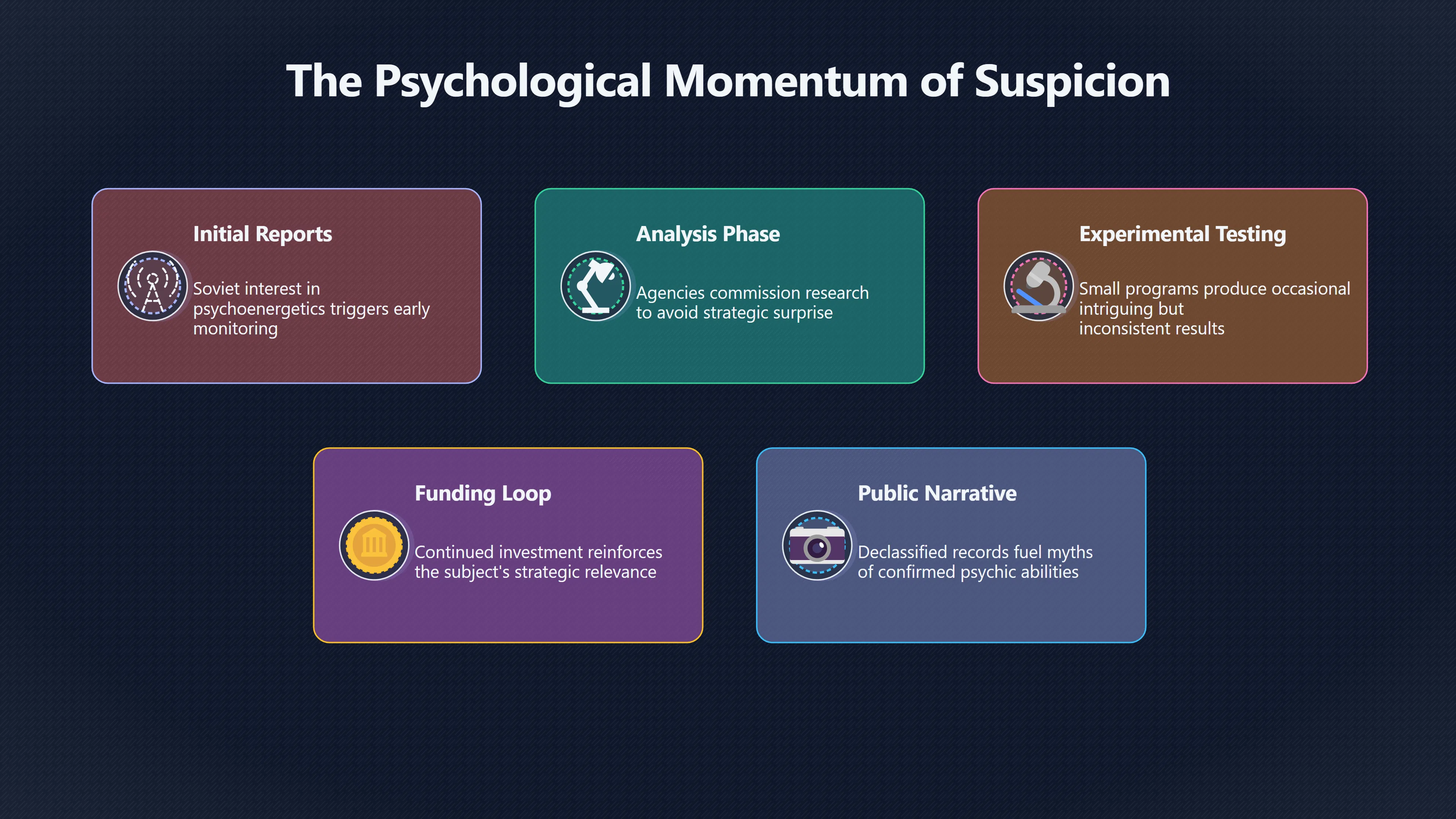
The cycle worked roughly as follows:
- Reports emerged describing Soviet interest in psychic or psychoenergetic research.
- Intelligence agencies commissioned further analysis because the reports could not be confidently dismissed.
- Limited American experiments produced occasional intriguing but inconsistent results.
- Continued funding itself became evidence that the subject remained strategically relevant.
- Public reporting later interpreted the existence of classified programmes as proof that governments had confirmed psychic phenomena.
Each step made the next appear more reasonable despite the absence of decisive evidence that operational psychic intelligence actually existed.
This pattern resembles other Cold War technology scares in which uncertainty, rather than confirmed capability, drove investment. Intelligence organisations were often managing ignorance rather than responding to established facts.

The gap between intelligence precaution and scientific proof
One reason the myth persists is that intelligence standards and scientific standards answer different questions.
Scientific research asks whether a phenomenon can be demonstrated reliably under controlled conditions and independently replicated.
Intelligence organisations ask a different question: what is the cost of ignoring a capability that might exist?
Those different incentives explain why agencies could continue funding remote-viewing research despite widespread scientific scepticism. Small research budgets were viewed as insurance against strategic surprise rather than endorsements of paranormal claims.
The later external review reflected this distinction. Jessica Utts argued that some experimental results deserved further scientific attention, while Ray Hyman concluded that methodological limitations prevented strong claims about psychic functioning. Despite their disagreement over the experiments themselves, both reviews left unresolved the much narrower intelligence question of operational usefulness, and the overall programme evaluation concluded that the information generated had not proved reliable enough for intelligence operations.[CIA+2PhilPapers]cia.govAN EVALUATION OF THE REMOTE VIEWING PROGRAMUtts has published articles that view paranormal interpretations positively, while Dr. Hyma…
Why the myth survived after the Cold War
The “psychic arms race” narrative endured because it offers a cleaner story than the historical record.
Declassified documents confirmed that classified programmes existed, which many readers interpreted as official validation of psychic abilities. In reality, intelligence agencies frequently investigate speculative subjects precisely because uncertainty makes them difficult to dismiss in advance.
Books, documentaries and fictional portrayals also tend to emphasise striking individual remote-viewing anecdotes while giving less attention to the programme’s inconsistent performance across many sessions. Dramatic apparent successes are memorable, whereas repeated failures, ambiguous results and methodological disputes are less compelling narratives.
The release of Star Gate records in the 1990s therefore fuelled renewed public fascination, but the accompanying official evaluation pointed in the opposite direction: after decades of research, the programme had not demonstrated dependable intelligence value sufficient to justify continued operational use.[CIA]cia.govAN EVALUATION OF THE REMOTE VIEWING PROGRAMUtts has published articles that view paranormal interpretations positively, while Dr. Hyma…
A more accurate way to understand the Cold War
The historical record supports a more restrained interpretation than the familiar arms-race metaphor.
There was genuine Soviet interest in parapsychological research, genuine American concern about being technologically surprised and genuine government funding for remote-viewing experiments. What is missing is evidence for a sustained competition between two proven psychic intelligence capabilities.
Rather than a psychic equivalent of the nuclear arms race, the Cold War episode is better understood as an example of how strategic uncertainty can generate real programmes around speculative ideas. Suspicion, incomplete information and institutional caution created momentum that outlasted the evidence for operational success, illustrating how intelligence organisations sometimes investigate extraordinary possibilities not because they have been proven, but because the consequences of overlooking them appear difficult to quantify.[CIA+2CIA]cia.govAN EVALUATION OF REMOTE VIEWINGIn 1995, the CIA declassified its past parapsychology program efforts in order to facilitate a new, ext…
Amazon book picks
Further Reading
Books and field guides related to Was There Really a Psychic Arms Race?. Use these as the next step if you want deeper reading beyond the article.
eBay marketplace picks
Marketplace Samples
Live-tested eBay searches with available results related to this page.



Endnotes
1.
Source: cia.gov
Link:https://www.cia.gov/readingroom/docs/CIA-RDP96-00791R000200180005-5.pdf
Source snippet
AN EVALUATION OF THE REMOTE VIEWING PROGRAMUtts has published articles that view paranormal interpretations positively, while Dr. Hyma...
2.
Source: cia.gov
Link:https://www.cia.gov/readingroom/docs/CIA-RDP96-00791R000200180006-4.pdf
Source snippet
AN EVALUATION OF REMOTE VIEWINGIn 1995, the CIA declassified its past parapsychology program efforts in order to facilitate a new, ext...
3.
Source: philpapers.org
Link:https://philpapers.org/rec/HYMEOP
Source snippet
Evaluation of Program on Anomalous Mental Phenomena.by R Hyman · Cited by 74 — Professor Jessica Utts and I were given the task of evalua...
4.
Source: cia.gov
Link:https://www.cia.gov/legacy/cia-history/
Source snippet
of CIAThe Central Intelligence Agency. The National Security Act of 1947 established CIA as an independent, civilian intelligence...
5.
Source: nsarchive2.gwu.edu
Title: In addition, CIA worked
Link:https://nsarchive2.gwu.edu/NSAEBB/NSAEBB438/docs/doc_57.pdf
Source snippet
National Security ArchiveAn Evaluation of Remote Viewing: Research and...by MD Mumford · 1995 · Cited by 76 — In 1995, the CIA declassif...
6.
Source: Wikipedia
Title: Remote viewing
Link:https://en.wikipedia.org/wiki/Remote_viewing
Source snippet
Remote viewingIn 1995, the CIA hired the American Institutes for Research (AIR) to perform a retrospective evaluation of the results g...
Additional References
7.
Source: reddit.com
Link:https://www.reddit.com/r/HighStrangeness/comments/14x6pu0/the_cias_remote_viewing_documents_are_confusing/
Source snippet
The CIAs remote viewing documents are confusing as hellThe [Stargate]({{ 'stargate/' | relative_url }}) project produced zero evidence of remote viewing and that it's not re...
8.
Source: researchgate.net
Link:https://www.researchgate.net/publication/333228024_An_Assessment_of_the_Evidence_for_Psychic_Functioning
9.
Source: ucdavis.edu
Title: psychic spying research produces credible evidence
Link:https://www.ucdavis.edu/news/psychic-spying-research-produces-credible-evidence
Source snippet
'Psychic Spying' Research Produces Credible Evidence28 Nov 1995 — " Utts and Hyman evaluated a 20-year, $20 million basic research progra...
10.
Source: researchgate.net
Link:https://www.researchgate.net/publication/267978941Evaluation_of_Program_on%27Anomalous_Mental_Phenomena%27
Source snippet
g and related phenomena which was carried out at Stanford Re-search...
11.
Source: Wikipedia
Title: Stargate Project (U.S. Army unit)
Link:https://en.wikipedia.org/wiki/Stargate_Project_%28U.S._Army_unit%29
Source snippet
Stargate Project (U.S. Army unit)The Stargate Project was terminated and declassified in 1995 after a commissioned review by the CIA c...
12.
Source: researchonline.ljmu.ac.uk
Title: ljmu.ac.uk Follow‐up on the U.S
Link:https://researchonline.ljmu.ac.uk/id/eprint/23584/1/Follow-up%20on%20the%20U.S.%20Central%20Intelligence%20Agency%27s%20%28CIA%29%20remote%20viewing%20experiments%E2%98%86.pdf
Source snippet
Central Intelligence Agency's (CIA)...by Á Escolà-Gascón · 2023 · Cited by 10 — Reports on the declassified SRI and [SAIC experiments]({{ 'saic-tests/' | relative_url }}) wer...
13.
Source: youtube.com
Link:https://www.youtube.com/watch?v=5NHQBoEmYBo
Source snippet
Remote viewing, CIA psychic spies, and Project Stargate - Jimmy Akin's Mysterious World...
14.
Source: ciaotest.cc.columbia.edu
Title: Since then, several research
Link:https://ciaotest.cc.columbia.edu/olj/sa/sa_jan02srm01.html
Source snippet
Remote Viewing: The US Sponsored Psychic...Information regarding this top-secret programme was partly declassified by the CIA in July 19...
15.
Source: Wikipedia
Title: Central Intelligence Agency
Link:https://en.wikipedia.org/wiki/Central_Intelligence_Agency
Source snippet
Central Intelligence AgencyThe Central Intelligence Agency (CIA) /ˌsiː.aɪˈeɪ/ is a civilian foreign intelligence service of the federa...
16.
Source: youtube.com
Title: Stargate Project: How Did the CIA Turn the Human Mind into a Weapon?
Link:https://www.youtube.com/watch?v=IDPlEXpzRoQ
Source snippet
CIA Stargate figure says psychic was 'murdered' | Reality Check with Ross Coulthart...
Topic Tree