Within Marks Critique
Why Replication Changed the Argument
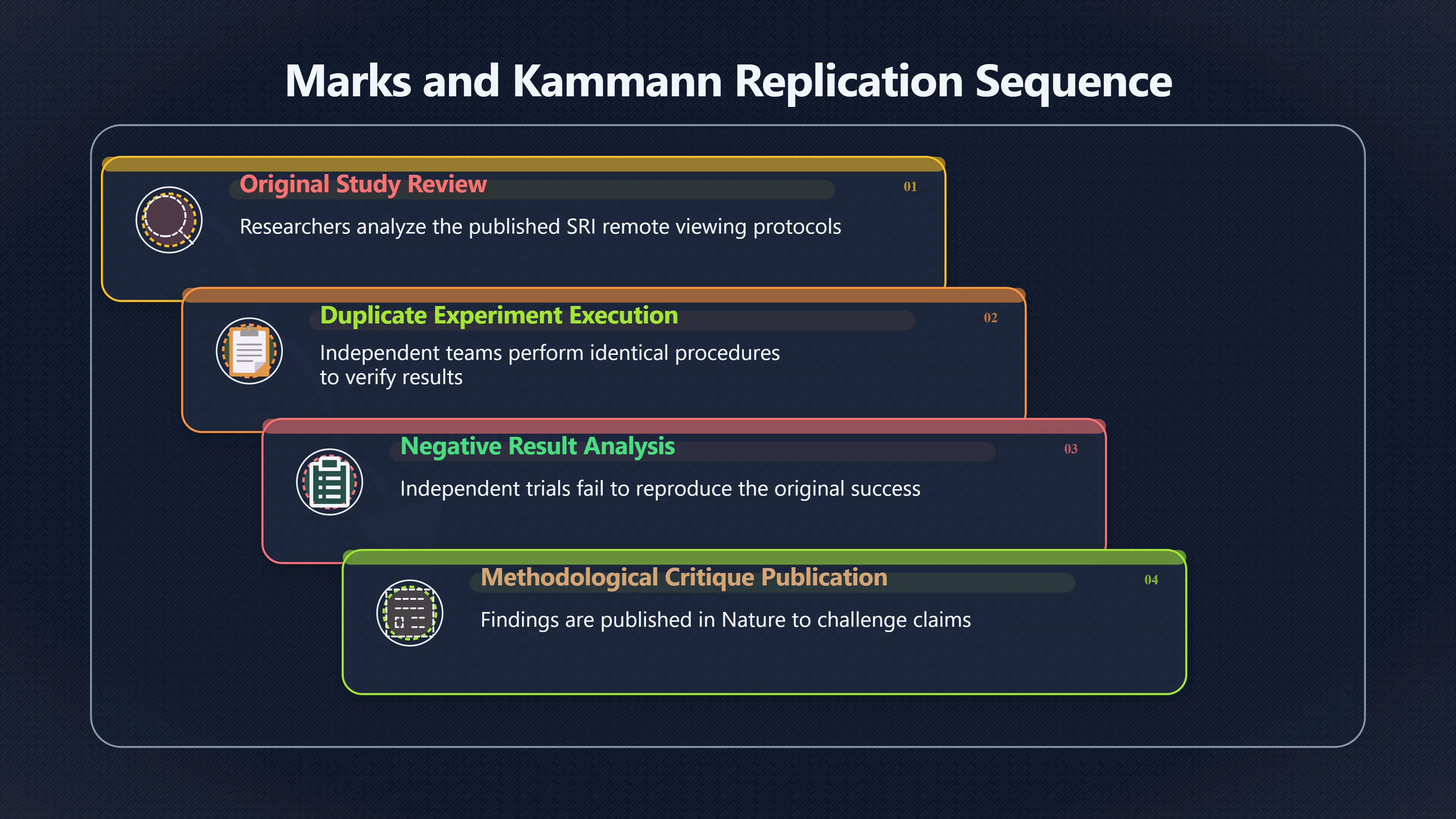
Their 1978 Nature letter mattered because it reported duplicate experiments that did not verify Targ and Puthoff's conclusions.
On this page
- What the duplicate experiments challenged
- Why negative results raised the burden of proof
- How replication and cueing became linked
Page outline Jump by section
Introduction
Marks and Kammann’s failed duplication claim became one of the most influential challenges to the early scientific case for remote viewing because it combined a negative replication with a specific methodological explanation. In a 1978 Nature letter, psychologists David Marks and Richard Kammann reported that they had carried out duplicate experiments based on the published Stanford Research Institute (SRI) procedures but did not obtain results that confirmed Russell Targ and Harold Puthoff’s conclusions. Rather than arguing simply that remote viewing was impossible, they argued that the published evidence had failed to exclude ordinary sources of information that could influence judging.[Nature]nature.comInformation transmission in remote viewing experimentsby D MARKS · 1978 · Cited by 50 — We have carried out duplicate experiments…
This distinction mattered. Scientific claims become stronger when independent researchers can reproduce them under comparable conditions. Marks and Kammann’s inability to do so shifted attention away from impressive individual demonstrations and towards the reliability of the experimental design itself. Their replication attempt became closely linked with a broader debate over whether apparently successful remote-viewing results could instead be explained by inadvertent cueing.
What the Duplicate Experiments Challenged
The 1978 publication was brief but direct. Targ and Puthoff had argued that remote viewing represented the transfer of information under conditions designed to prevent normal sensory communication. Marks and Kammann stated that they had conducted duplicate experiments yet “did not verify” those conclusions.[Nature]nature.comInformation transmission in remote viewing experimentsby D MARKS · 1978 · Cited by 50 — We have carried out duplicate experiments…
The importance of this finding lay less in the negative outcome than in what it implied about scientific evidence. A single positive experiment can attract attention, but if comparable procedures fail when repeated by independent investigators, confidence in the original claim necessarily decreases. In this case, the failed duplication suggested that the reported effect might depend on features of the original experimental setting rather than on a robust paranormal phenomenon.[Nature]nature.comInformation transmission in remote viewing experimentsby D MARKS · 1978 · Cited by 50 — We have carried out duplicate experiments…
Their criticism therefore addressed three connected questions:
- Could independent researchers reproduce the reported success?
- Were the published procedures sufficiently detailed and controlled to permit faithful replication?
- If replication failed, what ordinary factors might account for the earlier positive results?
These questions became central to later discussions of remote-viewing methodology.
Why Negative Results Raised the Burden of Proof
Negative replications do not automatically disprove a scientific claim. Experiments may differ in participants, procedures or execution. However, when an extraordinary claim depends on subtle statistical effects, unsuccessful independent replications substantially increase the level of evidence required before the claim can be accepted.
Marks and Kammann argued that this was exactly the situation facing remote viewing. If the phenomenon genuinely reflected an unknown channel of information transfer, it should continue to appear when comparable protocols were repeated independently. Their inability to reproduce the reported success therefore weakened confidence that the original findings reflected a stable effect.[Nature]nature.comInformation transmission in remote viewing experimentsby D MARKS · 1978 · Cited by 50 — We have carried out duplicate experiments…
The debate also highlighted an important principle in experimental science: failure to replicate becomes especially significant when accompanied by a plausible alternative explanation. Rather than offering only scepticism, Marks and Kammann proposed a concrete mechanism—ordinary information leakage during judging—that could account for the earlier successes without invoking paranormal perception.
How Replication and Cueing Became Linked
The failed duplication did not remain an isolated negative result. Marks and Kammann examined the judging materials used in the SRI experiments and argued that they contained cues unrelated to any claimed psychic ability. These included dates, references to previous sessions and other details that could allow judges to reconstruct the sequence of target visits.[Nature]nature.comInformation transmission in remote viewing experimentsby D MARKS · 1978 · Cited by 50 — We have carried out duplicate experiments…
This shifted the debate from a simple question of replication to a methodological question:
- If judges had access to accidental clues, successful matching no longer demonstrated remote viewing alone.
- A failed replication became more informative because it occurred alongside a specific hypothesis explaining why earlier experiments may have appeared successful.
- Future experiments therefore needed not only successful outcomes but convincing evidence that every possible source of ordinary cueing had been eliminated.
The cueing explanation proved influential because it addressed the mechanics of the experiments rather than the plausibility of paranormal abilities themselves.
Responses and Continuing Disagreement
Supporters of the SRI research did not accept Marks and Kammann’s interpretation. Charles Tart, Harold Puthoff and Russell Targ replied in Nature that rejudging one of the original experiments still produced above-chance results, arguing that the findings remained compatible with genuine remote viewing.[CIA]cia.govINFORMATION TRANSMISSION IN REMOTE VIEWING…Marks and Kammann in a recent letter to Nature. 1 report failure in. #1 their attempt to…
Marks maintained that the issue had not been resolved because the judging materials still contained sensory cues. The disagreement continued through subsequent exchanges, culminating in later publications arguing that the transcripts available for reanalysis had not removed the alleged sources of information leakage. Marks and Christopher Scott reiterated in 1986 that, in their view, the experiments demonstrated repeated failures to eliminate sensory cues rather than convincing evidence for remote viewing.[Wikipedia]WikipediaSensory leakageSensory leakage
The persistence of this dispute illustrates that the failed duplication was not interpreted merely as an isolated unsuccessful experiment. It became part of a larger argument over whether the original studies had adequately controlled for conventional explanations.
Why the Failed Duplication Changed the Argument
Marks and Kammann’s failed duplication claim altered the discussion because it reframed the scientific question. Instead of asking whether some remote-viewing sessions appeared impressive, critics increasingly asked whether positive results could survive independent replication under stricter controls.
Its lasting influence came from combining two elements:
- an independent report that similar experiments did not reproduce the original findings; and
- a methodological explanation centred on cueing that offered an ordinary account of the earlier successes.
Whether one accepts or rejects the paranormal interpretation, the episode reinforced a standard principle of experimental science: striking claims require reproducible evidence obtained under procedures that convincingly eliminate alternative explanations. Within the remote-viewing controversy, the failed duplication therefore became one of the key reasons that replication quality and protection against sensory cueing remained central issues in evaluating subsequent research.[Nature+2Wikipedia]nature.comInformation transmission in remote viewing experimentsby D MARKS · 1978 · Cited by 50 — We have carried out duplicate experiments…
Amazon book picks
Further Reading
Books and field guides related to Why Replication Changed the Argument. Use these as the next step if you want deeper reading beyond the article.
eBay marketplace picks
Marketplace Samples
Live-tested eBay searches with available results related to this page.




Endnotes
1.
Source: nature.com
Link:https://www.nature.com/articles/274680a0
Source snippet
Information transmission in remote viewing experimentsby D MARKS · 1978 · Cited by 50 — We have carried out duplicate experiments...
2.
Source: Wikipedia
Title: Sensory leakage
Link:https://en.wikipedia.org/wiki/Sensory_leakage
3.
Source: cia.gov
Link:https://www.cia.gov/readingroom/docs/CIA-RDP96-00787R000200090017-5.pdf
Source snippet
INFORMATION TRANSMISSION IN REMOTE VIEWING...Marks and Kammann in a recent letter to Nature. 1 report failure in. #1 their attempt to...
4.
Source: Wikipedia
Title: David Marks (psychologist)
Link:https://en.wikipedia.org/wiki/David_Marks_%28psychologist%29
5.
Source: Wikipedia
Title: Remote viewing
Link:https://en.wikipedia.org/wiki/Remote_viewing
Source snippet
Remote viewingRemote viewing (RV) is the practice of seeking impressions about a distant or unseen subject, purportedly sensing with t...
Additional References
6.
Source: centerforinquiry.s3.amazonaws.com
Link:https://centerforinquiry.s3.amazonaws.com/wp-content/uploads/sites/29/1982/07/22165420/p20.pdf
Source snippet
Center for InquiryRemote Viewing Revisitedby DF Marks · Cited by 13 — Well-controlled experiments don't find the "RV effect," while poorl...
7.
Source: researchgate.net
Title: Research Gate Logo. Discover the world’s research.Read more
Link:https://www.researchgate.net/publication/15839349_Information_transmission_in_remote_viewing_experiments
Source snippet
Information transmission in remote viewing experiments27 May 2016 — We have carried out duplicate experiments, but our results do not ver...
Published: May 2016
8.
Source: academia.edu
Link:https://www.academia.edu/116341239/Information_transmission_in_remote_viewing_experiments
Source snippet
Information transmission in remote viewing experimentsThe study rejects the Marks-Kammann hypothesis, attributing remote viewing success...
9.
Source: scispace.com
Title: information transmission in remote viewing experiments 4jd6pdendv
Link:https://scispace.com/pdf/information-transmission-in-remote-viewing-experiments-4jd6pdendv.pdf
Source snippet
On reading Marks and Kammann, one of us (C.T.T.), who...Read more...
10.
Source: youtube.com
Link:https://www.youtube.com/watch?v=uQStMAwKNew
Source snippet
Remote Viewing and Statistical Validation...
11.
Source: pmc.ncbi.nlm.nih.gov
Link:https://pmc.ncbi.nlm.nih.gov/articles/PMC10275521/
Source snippet
Central Intelligence Agency's (CIA...by Á Escolà‐Gascón · 2023 · Cited by 10 — Marks, D., & Kammann, R. (1978). Information transmissio...
12.
Source: youtube.com
Link:https://www.youtube.com/watch?v=0l50rg4hsEU
Source snippet
Remote Viewing Magic, Russel Targ: EP 319...
13.
Source: youtube.com
Title: [Statistics]({{ ‘statistics/’ | relative_url }}) in Parapsychology with Jessica Utts
Link:https://www.youtube.com/watch?v=WmYGtKB9EEA
Source snippet
Beyond the Five Senses: Leanne Whitney Interviews Russell Targ in 2005...
14.
Source: ui.adsabs.harvard.edu
Link:https://ui.adsabs.harvard.edu/abs/1978Natur.274..680M/abstract
Source snippet
Astrophysics Data SystemInformation transmission in remote viewing experimentsby D Marks · 1978 · Cited by 50 — We have carried out dupli...
15.
Source: cdn.centerforinquiry.org
Link:https://cdn.centerforinquiry.org/wp-content/uploads/sites/29/1979/01/22165458/p05.pdf
Source snippet
and Commentremote-viewing experiments," con- clude Marks and Kammann, "forces the conclusion that the successful iden- tification of targ...
Topic Tree