Within Replication
Why Does Remote Viewing Fail to Travel?
Remote viewing has produced intriguing results, but repeatability falters when protocols, scoring and independent checks change across labs.
On this page
- What counts as a real replication
- Where remote viewing results lose stability
- Why independent teams change the standard
Page outline Jump by section
Introduction
Remote viewing is often discussed in terms of striking individual successes, but mainstream science evaluates it by a different standard: whether the claimed effect can be reproduced by independent researchers using transparent methods and robust controls. This distinction explains why debate over remote viewing has persisted for decades. Some researchers argue that statistically significant laboratory effects have appeared across multiple studies, while critics counter that the apparent effects become unstable when new teams tighten protocols, alter scoring methods, or eliminate opportunities for subjective interpretation. The central issue is therefore not whether memorable “hits” exist, but why those results have proved difficult to reproduce consistently under the same scientific conditions expected in other fields.[National Security Archive]nsarchive2.gwu.eduUtts and Hyman were asked to prepare independent reports based on their review…Read more…
What counts as a real replication?
A genuine scientific replication is more demanding than repeating an experiment with similar equipment or procedures. It asks whether an independent group can obtain essentially the same result while following a pre-defined protocol and resisting the temptation to adjust methods after seeing the data.
For remote viewing, this generally requires:[cia.gov]cia.goving failed to produce actionable intelligence.Read more…
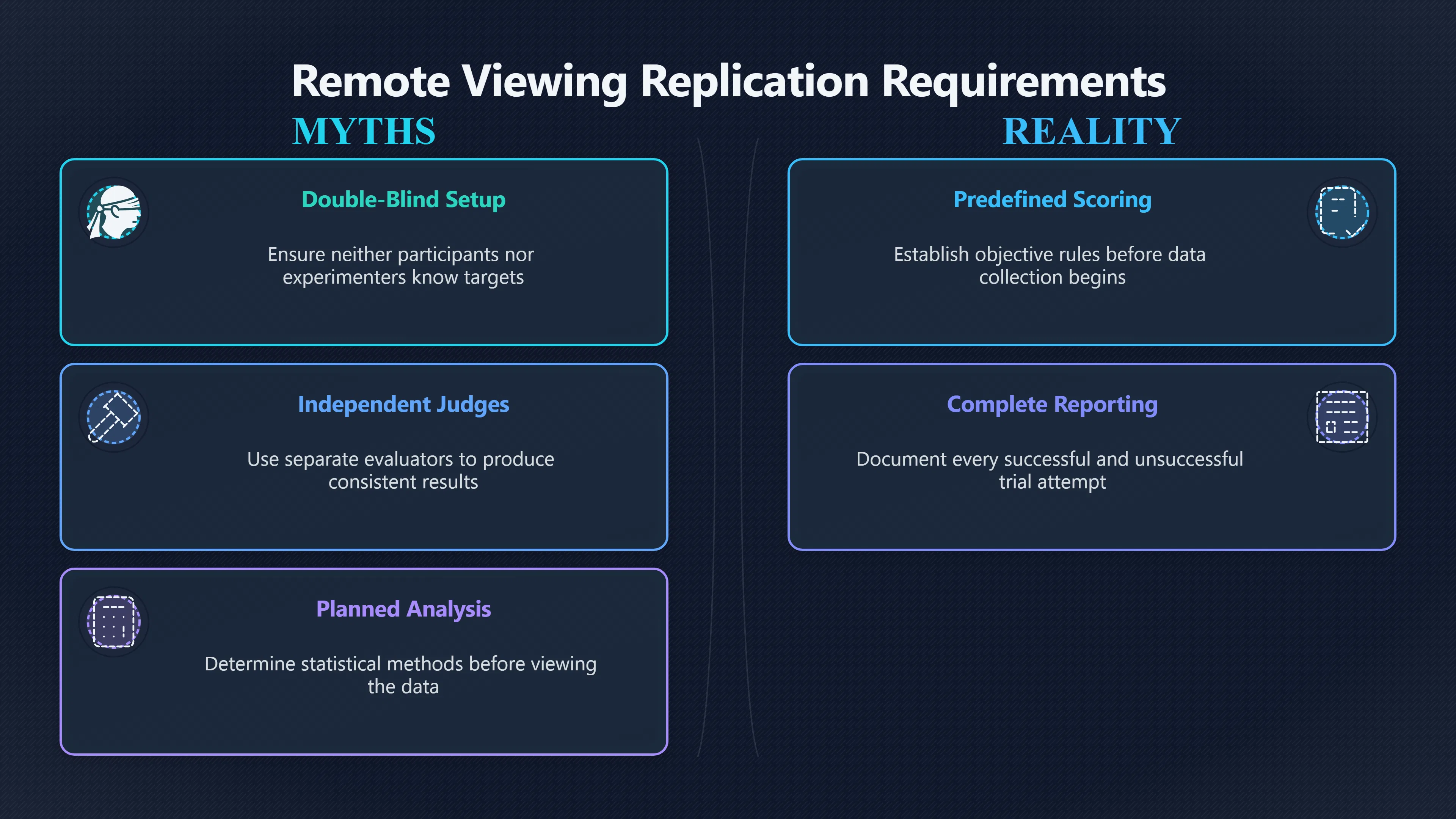
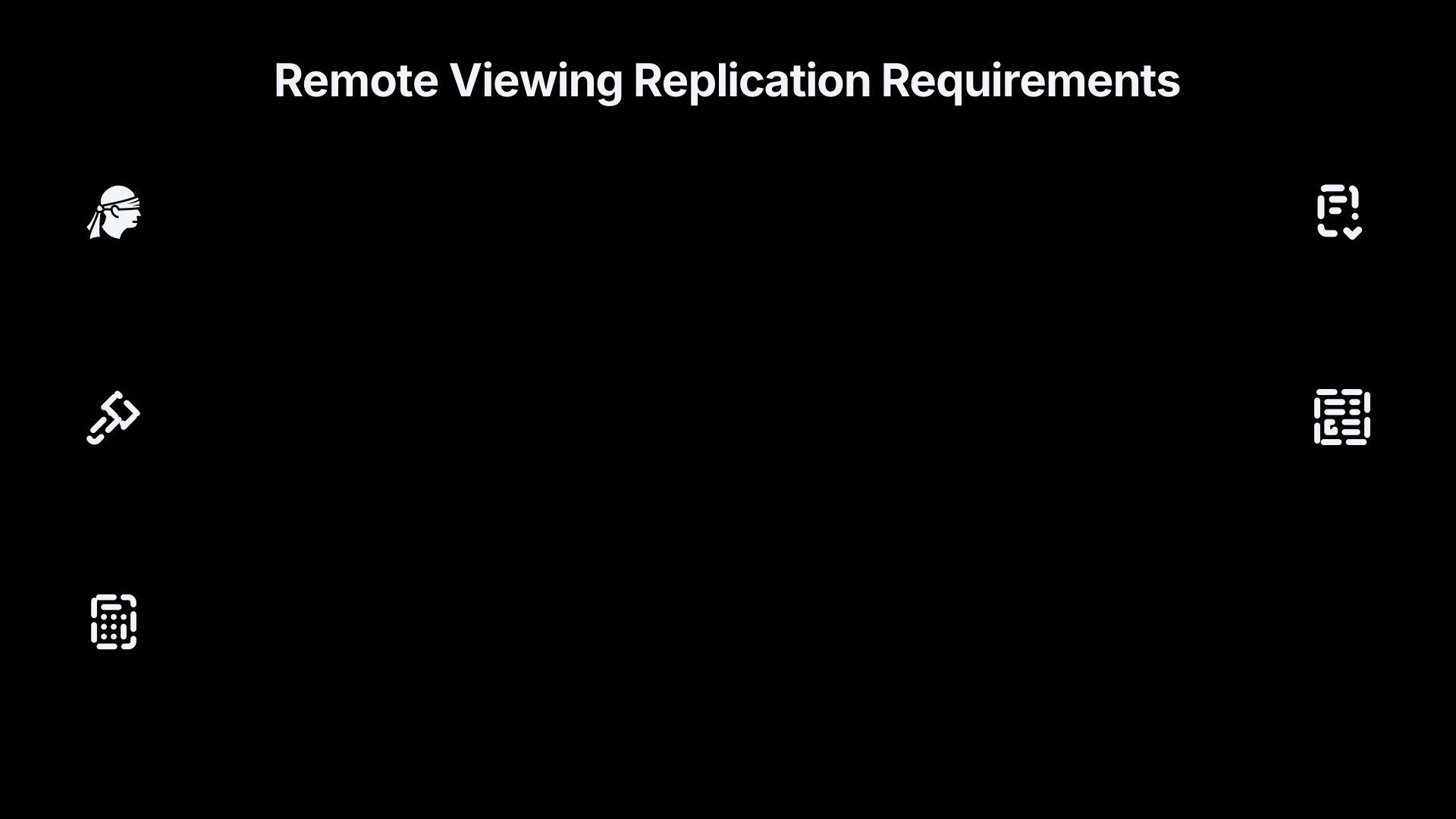
- Double-blind procedures so neither participants nor experimenters know the target.
- Objective scoring rules specified before data collection.
- Independent judges who produce similar evaluations.
- Complete reporting of successful and unsuccessful trials.
- Statistical analyses planned before the experiment rather than selected afterwards.
Supporters of remote viewing have argued that critics sometimes confuse statistical variability with outright failure. Statistician Jessica Utts has noted that an experiment can produce an effect similar in size to an earlier study without reaching conventional statistical significance if the later sample is much smaller. From this perspective, replication should be judged by consistency of effect size rather than by whether every study crosses an arbitrary significance threshold.[UC Irvine Bren School]ics.uci.eduUC Irvine Bren SchoolAn Assessment of the Evidence for Psychic Functioningby J Utts · 1995 · Cited by 103 — If we were simply to focus on…
Critics agree that statistical power matters, but argue that successful replication also requires independent laboratories repeatedly obtaining comparable results under rigorous controls. That broader standard has remained difficult to satisfy.[National Security Archive]nsarchive2.gwu.eduUtts and Hyman were asked to prepare independent reports based on their review…Read more…
Where remote viewing results lose stability
The recurring difficulty is not that every study fails. Rather, positive findings often weaken or become disputed when changes are made that reduce flexibility in the experimental process.
Subjective judging
Many classic remote-viewing experiments depend on matching a participant’s narrative description with one target among several possibilities. Because descriptions are frequently broad or symbolic, different judges may legitimately disagree about which target fits best.
The 1995 American Institutes for Research (AIR) evaluation specifically identified inter-judge reliability as an unresolved methodological issue. If different independent judges cannot consistently agree on matches, apparent successes become difficult to interpret as evidence for a stable phenomenon rather than subjective pattern matching.[National Security Archive]nsarchive2.gwu.eduUtts and Hyman were asked to prepare independent reports based on their review…Read more…
Protocol changes
[Remote viewing]WikipediaRemote viewingThe program ran from 1975 to 1995 and ended after evaluators concluded that remote viewers consistently failed to produc… research has evolved repeatedly:
- target types changed from physical locations to photographs;
- judging procedures were revised;
- statistical methods changed;
- participant selection varied between laboratories.
These modifications often addressed recognised weaknesses, but they also complicated replication. A later experiment may resemble an earlier one while differing enough in important details that supporters describe it as a conceptual replication rather than a direct replication.
This distinction matters because conceptual replication can demonstrate that a broad idea appears under varying circumstances, but it provides weaker evidence that a precisely defined experimental effect is reliable.
Small effects near the limits of detection
Where proponents report positive findings, the effects are generally modest rather than dramatic. Small statistical effects require large numbers of trials to distinguish genuine signals from ordinary variation.
That makes results especially sensitive to:
- sample size,
- analytical decisions,
- participant selection,
- random fluctuation.
Consequently, different laboratories may report noticeably different outcomes despite apparently similar procedures.[UC Irvine Bren School]ics.uci.eduUC Irvine Bren SchoolAn Assessment of the Evidence for Psychic Functioningby J Utts · 1995 · Cited by 103 — If we were simply to focus on…
Why independent teams change the standard
Replication becomes more persuasive when investigators with no connection to the original researchers obtain comparable findings using their own participants and equipment.
Remote-viewing research has often been concentrated within relatively small research communities linked to programmes such as the former Stanford Research Institute, later government-funded projects, and a limited number of parapsychology laboratories. Critics argue that this concentration makes it harder to separate genuinely repeatable effects from laboratory-specific practices or expectations.[National Security Archive]nsarchive2.gwu.eduUtts and Hyman were asked to prepare independent reports based on their review…Read more…
The AIR review highlighted this issue by commissioning separate assessments from Jessica Utts and Ray Hyman, who represented contrasting scientific perspectives. While both accepted that some laboratory studies produced statistically unusual results, they differed sharply on what those results demonstrated. Hyman argued that the findings had not yet achieved the level of independent replication needed to justify claims of paranormal functioning, whereas Utts considered the statistical evidence sufficient to establish that an anomalous effect existed, even if its mechanism remained unknown.[National Security Archive+2UC Davis]nsarchive2.gwu.eduUtts and Hyman were asked to prepare independent reports based on their review…Read more…
This disagreement illustrates that the central debate is less about isolated datasets than about the cumulative strength of independent confirmation.
Tightening controls often changes the outcome
A recurring pattern in controversial scientific fields is that stronger controls remove possible sources of bias but sometimes reduce previously reported effects.
In remote-viewing research, tighter controls have included:[cia.gov]cia.goving failed to produce actionable intelligence.Read more…
- stricter blinding of experimenters;
- automated or computer-assisted target selection;
- more objective scoring systems;
- improved randomisation;
- greater separation between viewers, judges and target information.
Supporters generally view these developments as improvements that refine measurement. Critics note that stronger controls have not produced the kind of robust, routine success expected if remote viewing represented a dependable perceptual ability.
The AIR review acknowledged that later experiments corrected several methodological weaknesses identified in earlier work but concluded that the available evidence still did not establish remote viewing unambiguously as a paranormal phenomenon.[National Security Archive]nsarchive2.gwu.eduUtts and Hyman were asked to prepare independent reports based on their review…Read more…
The difference between statistical significance and scientific acceptance
One reason discussion continues is that statistical significance alone is not enough to establish a new scientific phenomenon.
Mainstream acceptance typically requires several conditions to converge:
- independent replication across multiple laboratories;
- consistent methodology;
- reliable effect sizes;
- plausible exclusion of conventional explanations;
- transparent reporting of unsuccessful studies.
Remote viewing has repeatedly generated arguments over the first four of these conditions. Positive meta-analyses and statistically significant experiments have convinced some researchers that something deserving further investigation exists. Others argue that publication bias, flexible analysis, subjective judging and inconsistent replication remain sufficient alternative explanations for the reported results. National Security Archive+2UC Irvine Bren School[nsarchive2.gwu.edu]nsarchive2.gwu.eduUtts and Hyman were asked to prepare independent reports based on their review…Read more…

Why the replication question remains decisive
Remote viewing’s scientific status depends far less on famous historical experiments than on whether new investigators can repeatedly obtain comparable results under increasingly rigorous conditions.
After reviewing decades of government-sponsored research, the AIR panel concluded that statistically significant laboratory findings did not translate into clear evidence of a paranormal mechanism or into reliable operational performance. It also found that remote-viewing reports were too vague, inconsistent and dependent on interpretation to provide actionable intelligence.[National Security Archive]nsarchive2.gwu.eduUtts and Hyman were asked to prepare independent reports based on their review…Read more…
For that reason, the debate has settled on replication rather than anecdote. Individual successes may continue to attract attention, but until independent laboratories can consistently reproduce the same effect using transparent methods and objective evaluation, repeatability remains the principal obstacle to broader scientific acceptance.
Amazon book picks
Further Reading
Books and field guides related to Why Does Remote Viewing Fail to Travel?. Use these as the next step if you want deeper reading beyond the article.

eBay marketplace picks
Marketplace Samples
Live-tested eBay searches with available results related to this page.




Endnotes
1.
Source: nsarchive2.gwu.edu
Link:https://nsarchive2.gwu.edu/NSAEBB/NSAEBB438/docs/doc_57.pdf
Source snippet
Utts and Hyman were asked to prepare independent reports based on their review...Read more...
2.
Source: ics.uci.edu
Link:https://www.ics.uci.edu/~jutts/air.pdf
Source snippet
UC Irvine Bren SchoolAn Assessment of the Evidence for Psychic Functioningby J Utts · 1995 · Cited by 103 — If we were simply to focus on...
3.
Source: Wikipedia
Title: Ray Hyman
Link:https://en.wikipedia.org/wiki/Ray_Hyman
4.
Source: ucdavis.edu
Title: [psychic spying]({{ ‘psychic-spying/’ | relative_url }}) research produces credible evidence
Link:https://www.ucdavis.edu/news/psychic-spying-research-produces-credible-evidence
Source snippet
'Psychic Spying' Research Produces Credible Evidence28 Nov 1995 — Remote viewing has been conceptually replicated across a number of labo...
5.
Source: cia.gov
Link:https://www.cia.gov/readingroom/docs/CIA-RDP96-00791R000200180006-4.pdf
Source snippet
ing failed to produce actionable intelligence.Read more...
6.
Source: researchgate.net
Link:https://www.researchgate.net/figure/REMOTE-VIEWING-AND-GANZFELD-REPLICATIONS_tbl1_333228024
Source snippet
REMOTE VIEWING AND GANZFELD REPLICATIONSResearch on psychic functioning, conducted over a two-decade period, is examined to determine whe...
7.
Source: Wikipedia
Title: Remote viewing
Link:https://en.wikipedia.org/wiki/Remote_viewing
Source snippet
Remote viewingThe program ran from 1975 to 1995 and ended after evaluators concluded that remote viewers consistently failed to produc...
8.
Source: psi-encyclopedia.spr.ac.uk
Title: spr.ac.uk Remote Viewing
Link:https://psi-encyclopedia.spr.ac.uk/articles/remote-viewing/
Source snippet
Viewing - Psi Encyclopedia13 Jan 2017 — Hyman and Utts... In all nine instances, electronic remote sensing failed to identify sites that...
9.
Source: youtube.com
Title: Remote Viewing and Statistical Validation
Link:https://www.youtube.com/watch?v=YrwAiU2g5RU
Source snippet
Classic Reboot: Training [Anomalous Cognition]({{ 'not-clairvoyance/' | relative_url }}) with Edwin C. May...
10.
Source: youtube.com
Title: The Remote Viewing SCIENCE Nobody Talks About | Sean Hazlett
Link:https://www.youtube.com/watch?v=olNuOZKCdRQ
Source snippet
Remote Viewing Psychology with Charles T. Tart...
11.
Source: youtube.com
Title: Remote Viewing Psychology with Charles T. Tart
Link:https://www.youtube.com/watch?v=jPZwaicuiek
Source snippet
The Replication Crisis: Why Studies Fail and How Psychology Is Fixing Itself...
Additional References
12.
Source: cia.gov
Link:https://www.cia.gov/readingroom/docs/CIA-RDP96-00791R000200180005-5.pdf
Source snippet
AN EVALUATION OF THE REMOTE VIEWING PROGRAMThus, Remote viewing failed to produce actionable intelligence. Conclusions... Utts and Hyman...
13.
Source: youtube.com
Title: The Replication Crisis: Why Studies Fail and How Psychology Is Fixing Itself
Link:https://www.youtube.com/watch?v=YpizifCQ96Y
Source snippet
This video on Remote Viewing and Statistical Validation is directly relevant because it features statistician Jessica Utts analyzing why...
14.
Source: facebook.com
Link:https://www.facebook.com/100090372200308/posts/during-the-[cold-war
Source snippet
ilitary officer tasked with analysing the results Price failed to...Read more...
15.
Source: pmc.ncbi.nlm.nih.gov
Link:https://pmc.ncbi.nlm.nih.gov/articles/PMC10275521/
Source snippet
Central Intelligence Agency's (CIA...by Á Escolà‐Gascón · 2023 · Cited by 10 — The last two levels (i.e., residual invariance) are usual...
16.
Source: youtube.com
Title: Classic Reboot: Training Anomalous Cognition with Edwin C. May
Link:https://www.youtube.com/watch?v=6vbb7E7UD30
Source snippet
The Remote Viewing SCIENCE Nobody Talks About | Sean Hazlett...
17.
Source: Wikipedia
Title: [Stargate]({{ ‘stargate/’ | relative_url }}) Project (U.S. Army unit)
Link:https://en.wikipedia.org/wiki/Stargate_Project_%28U.S._Army_unit%29
Topic Tree