Within Targets
When Target Pools Tilt the Test
Target pools can bias results when some images are richer, more memorable, or easier to distinguish than others.
On this page
- What target pool bandwidth means
- Why distinctive images can distort judging
- How balanced pools improve interpretation
Page outline Jump by section
Introduction
In remote-viewing research, the design of the target pool is almost as important as the viewing session itself. A viewer’s transcript is usually judged by comparing it with a limited set of possible targets, meaning the difficulty of the task depends not only on the quality of the description but also on how similar or different the available targets are. If one photograph is visually striking while the others are plain, or if one image contains distinctive features that appear in many generic descriptions, judging can become unintentionally biased.

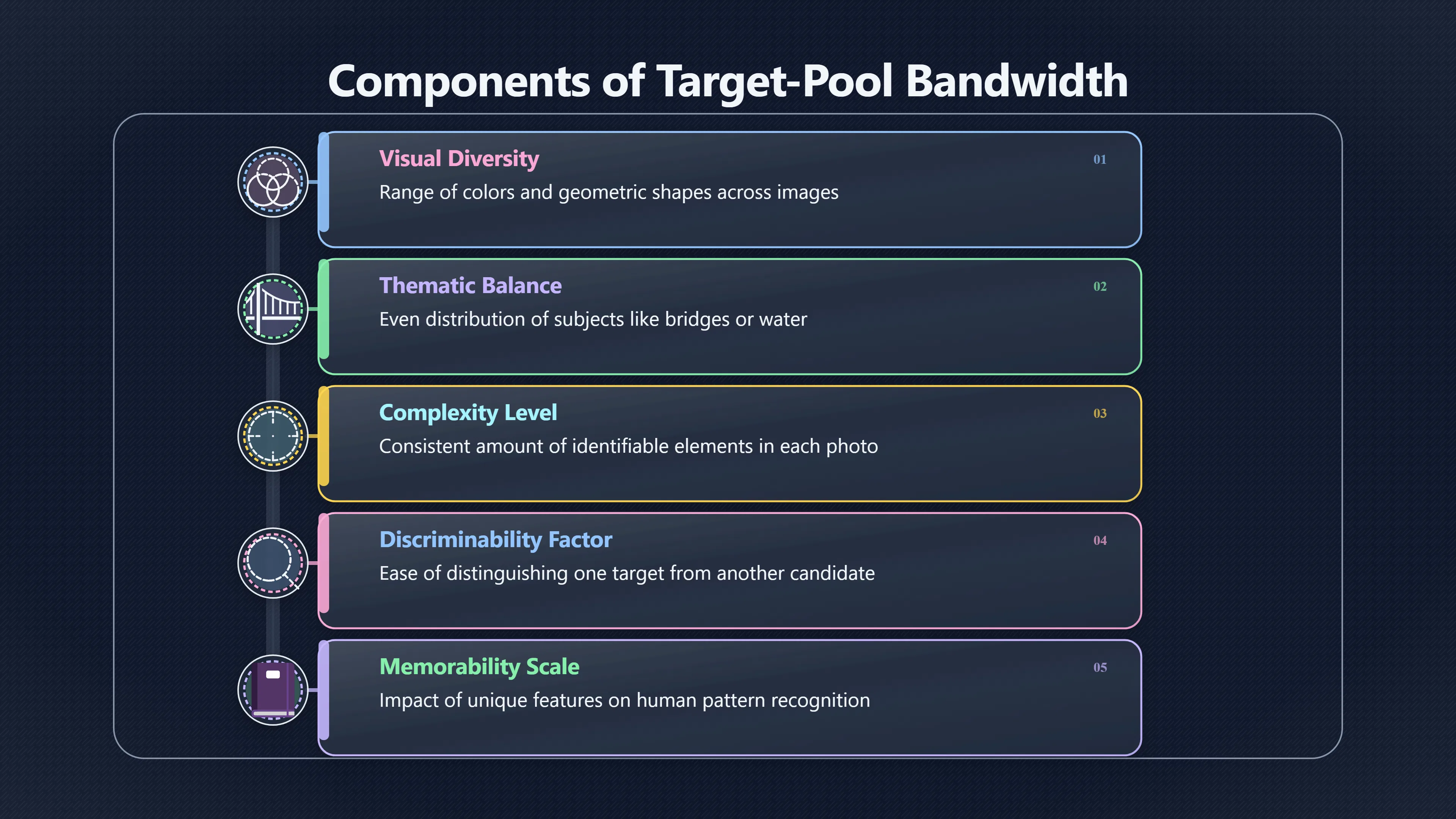
Researchers sometimes describe this issue in terms of target-pool bandwidth: the overall range and distinctiveness of the possible targets presented for judging. A well-balanced pool makes it harder for ordinary guessing or subjective interpretation to produce apparent successes. An uneven pool can inflate or obscure performance, making it difficult to determine whether an apparent match reflects genuine information or simply the structure of the target set itself. This seemingly technical issue has become one of the key methodological concerns in evaluating remote-viewing experiments.[National Security Archive]nsarchive2.gwu.eduNational Security ArchiveAn Evaluation of Remote Viewing: Research and…March 13, 2015 — by MD Mumford · 1995 · Cited by 76 — We would…
What Target-Pool Bandwidth Means
Target-pool bandwidth refers to the diversity and discriminability of the available targets before judging begins. Rather than describing the number of targets alone, it reflects how easily the targets can be distinguished from one another.
A narrow-bandwidth pool might contain several photographs of beaches, forests or office buildings. Even if the viewer produces an accurate impression such as “water”, “trees” or “large structure”, those descriptions may fit several candidates equally well.
A very wide-bandwidth pool, however, may contain images such as:
- a suspension bridge,
- a rocket launch,
- a coral reef,
- an elephant,
- a cathedral interior.
These images differ dramatically in colour, geometry, scale and subject matter. Generic descriptions are more likely to appear meaningful because one target often stands out from the rest.
The challenge is that neither extreme is ideal. If every target is highly distinctive, judges may find it easy to match transcripts using broad, non-specific language. If every target is extremely similar, even genuinely informative descriptions become difficult to separate from competing alternatives. Good experimental design therefore aims for a pool that is varied enough to avoid repetition while remaining balanced in overall distinctiveness.[National Security Archive]nsarchive2.gwu.eduNational Security ArchiveAn Evaluation of Remote Viewing: Research and…March 13, 2015 — by MD Mumford · 1995 · Cited by 76 — We would…
Why Distinctive Images Can Distort Judging
Free-response remote-viewing transcripts usually contain mixtures of sketches, sensory impressions and descriptive words. Because these reports are rarely precise enough to identify a single photograph uniquely, judges inevitably interpret the degree of correspondence.
This creates several mechanisms through which uneven images can influence outcomes.
Salient visual features attract matches. Images containing waterfalls, aircraft, pyramids, explosions or brightly coloured objects naturally draw attention. A transcript mentioning “movement”, “height”, “metal” or “bright” may appear especially convincing when paired with such photographs.
Generic statements fit memorable targets. Many common descriptions—water, circles, crowds, mountains, buildings, open space—occur across numerous transcripts. If one target possesses a particularly memorable combination of those features, judges may overestimate the quality of the correspondence.
Negative evidence receives less weight. Human judges often focus on impressive similarities while overlooking mismatches. A transcript may correctly mention “water” yet incorrectly describe the target as enclosed, dark and artificial. The vivid match can dominate overall judgement.
Visual richness varies. Some photographs naturally contain far more identifiable elements than others. A busy cityscape offers dozens of possible matching features, whereas a close-up photograph of a single object provides relatively few. The richer image therefore offers more opportunities for subjective matching.
These effects arise from ordinary cognitive processes and do not depend on whether remote viewing itself is assumed to exist. Consequently, they are recognised as methodological concerns regardless of one’s broader position on paranormal claims.[National Security Archive]nsarchive2.gwu.eduNational Security ArchiveAn Evaluation of Remote Viewing: Research and…March 13, 2015 — by MD Mumford · 1995 · Cited by 76 — We would…
How Balanced Pools Improve Interpretation
Researchers have developed several practices intended to reduce target-pool bias.
A common approach is to construct target sets whose photographs are roughly comparable in visual complexity. Instead of mixing a dramatic erupting volcano with several ordinary office interiors, experimenters try to ensure that each candidate contains a similar level of distinctive information.
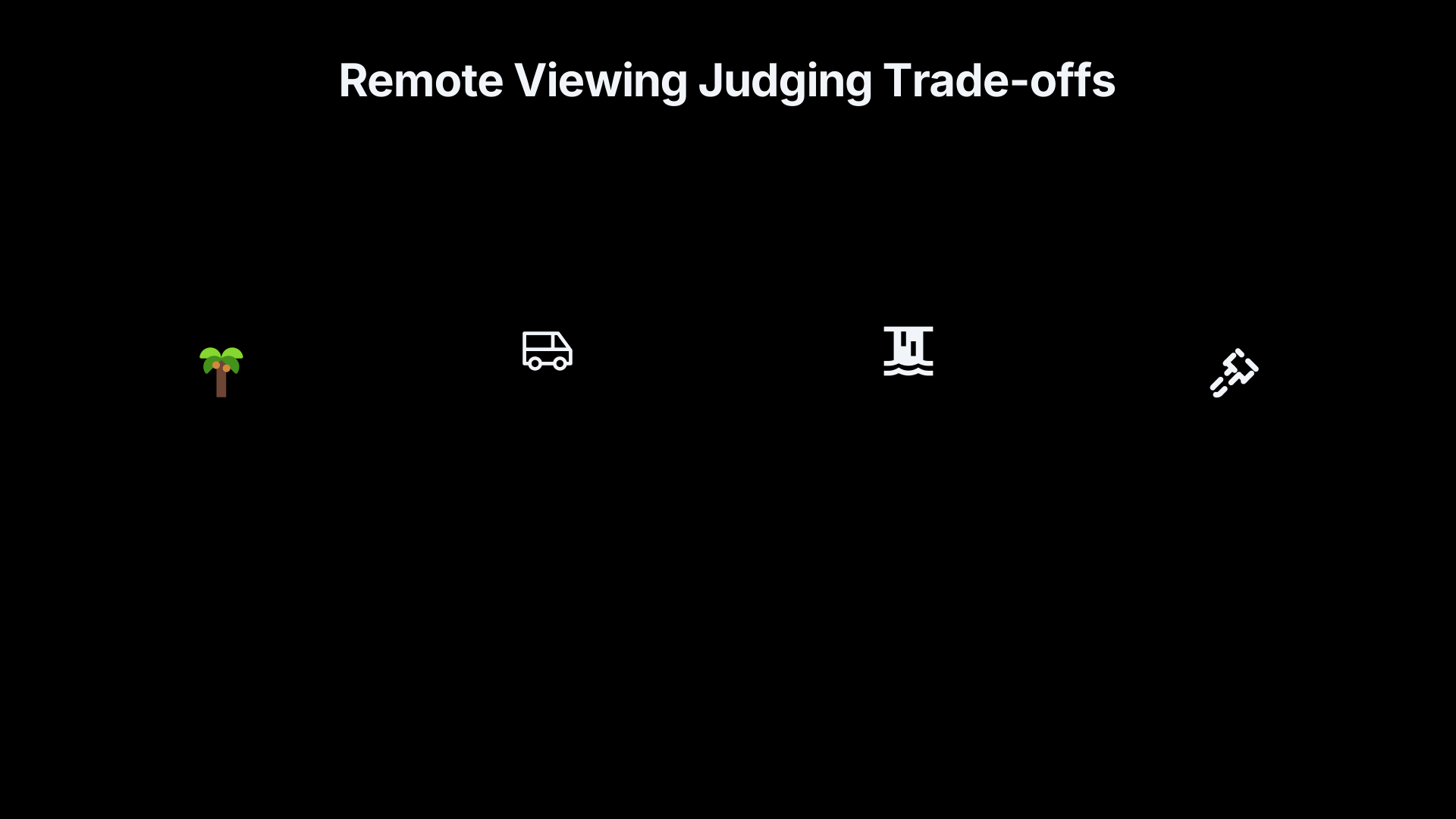
Another strategy is to avoid repeated themes. If several targets depict bridges while only one depicts an underwater scene, broad references to arches or water become difficult to interpret consistently. Greater thematic balance reduces this problem.
Judging can also be strengthened by:
- using larger comparison pools rather than very small sets;
- employing independent judges who work separately;
- randomising target presentation order;
- defining scoring rules before judging begins rather than afterwards.
The 1995 American Institutes for Research evaluation of the U.S. government’s remote-viewing programme emphasised that convincing evidence would require successful replication using new target pools as well as new viewers and independent judges. This recommendation reflects the recognition that an apparent effect should not depend upon one particularly favourable collection of targets.[National Security Archive]nsarchive2.gwu.eduNational Security ArchiveAn Evaluation of Remote Viewing: Research and…March 13, 2015 — by MD Mumford · 1995 · Cited by 76 — We would…
Practical Examples of Pool Imbalance
Consider two hypothetical judging pools.
In the first, every target is an outdoor landscape with trees, hills and water. A transcript describing “natural environment”, “green”, “flowing” and “large open space” could plausibly fit several targets, making ranking difficult and increasing disagreement among judges.
In the second, one target depicts a brightly lit carnival, another an astronaut on the Moon, another a medieval castle, and another a modern office corridor. Here, even a modest description mentioning “celebration”, “lights” or “weightlessness” may seem unusually diagnostic simply because the targets differ so dramatically.
Neither situation provides an ideal test of descriptive accuracy. One obscures possible information through excessive similarity, while the other risks exaggerating weak correspondences because each image possesses unique identifying characteristics.
The same concern extends beyond photographs to real-world target locations. If one site contains a giant suspension bridge while the remaining sites are ordinary suburban streets, judges may again be drawn disproportionately towards the visually distinctive option.[CIA]cia.govSTANDARD REMOTE VIEWING (RV) PROCEDURESThe target pool consists of more than 50 target locations chosen from a target-rich environment…
Why This Issue Remains Important
Target-pool bandwidth illustrates that remote-viewing experiments measure more than a viewer’s reported impressions. They also measure the interaction between those impressions, the available comparison targets and the judging procedure.
Supporters of remote viewing often argue that carefully blinded experiments can still produce above-chance results when target selection and judging are rigorously controlled. Critics counter that subjective matching, target distinctiveness and human pattern recognition remain difficult to eliminate completely, particularly in free-response designs. Government reviews of the research likewise identified replication across different target pools and judging conditions as an essential test of whether reported effects generalise beyond specific experimental materials.[National Security Archive]nsarchive2.gwu.eduNational Security ArchiveAn Evaluation of Remote Viewing: Research and…March 13, 2015 — by MD Mumford · 1995 · Cited by 76 — We would…
For this reason, balanced target pools are not merely an administrative detail. They form part of the measurement instrument itself. The more evenly matched the possible targets are in complexity, memorability and distinctiveness, the more confidently researchers can interpret either successful or unsuccessful judging results.
Amazon book picks
Further Reading
Books and field guides related to When Target Pools Tilt the Test. Use these as the next step if you want deeper reading beyond the article.

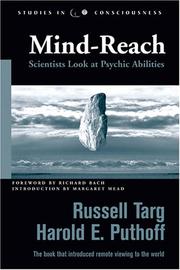
The Reality of ESP: A Physicist's Proof of Psychic Abilities
Covers research design issues relevant to target pools.

eBay marketplace picks
Marketplace Samples
Live-tested eBay searches with available results related to this page.
Endnotes
1.
Source: nsarchive2.gwu.edu
Link:https://nsarchive2.gwu.edu/NSAEBB/NSAEBB438/docs/doc_57.pdf
Source snippet
National Security ArchiveAn Evaluation of Remote Viewing: Research and...March 13, 2015 — by MD Mumford · 1995 · Cited by 76 — We would...
Published: March 13, 2015
2.
Source: Wikipedia
Title: Remote viewing
Link:https://en.wikipedia.org/wiki/Remote_viewing
3.
Source: cia.gov
Link:https://www.cia.gov/readingroom/docs/CIA-RDP96-00788R002000240029-4.pdf
Source snippet
STANDARD REMOTE VIEWING (RV) PROCEDURESThe target pool consists of more than 50 target locations chosen from a target-rich environment...
Additional References
4.
Source: rv-practice.rf.gd
Link:https://rv-practice.rf.gd/
Source snippet
Viewing PracticeWelcome to yet another remote viewing practice site. Here you can find information to get started in remote viewing and a...
5.
Source: researchgate.net
Link:https://www.researchgate.net/publication/327166514_Remote_Viewing_of_Concealed_Target_Pictures_Under_Light_and_Dark_Conditions
Source snippet
g and related phenomena which was carried out at Stanford Re-search Institute...Read more...
6.
Source: reddit.com
Link:https://www.reddit.com/r/remoteviewing/comments/1phppu9/i_built_a_free_web_app_to_practice_remote_viewing/
Source snippet
digit [Target IDs]({{ 'target-ids/' | relative_url }}) (linked to a curated pool of high-quality images)...
7.
Source: pubmed.ncbi.nlm.nih.gov
Link:https://pubmed.ncbi.nlm.nih.gov/30291000/
Source snippet
Viewing of Concealed Target Pictures Under Light...by S Krippner · 2019 · Cited by 15 — This study explored the differential effect of d...
8.
Source: koestler-parapsychology.psy.ed.ac.uk
Title: KPU 1034 Published Results
Link:https://www.koestler-parapsychology.psy.ed.ac.uk/Documents/KPU_1034_Published_Results.pdf
Source snippet
remote viewing projects: Assessing rater...by DL KATZ · 2021 · Cited by 10 — Remote Viewing (ARV) is a psi-based methodology used by ind...
9.
Source: youtube.com
Title: The Sport of Remote Viewing
Link:https://www.youtube.com/watch?v=OZvu3I992xM
Source snippet
This Remote Viewing Psychology video featuring Charles T. Tart is relevant because it discusses the critical importance of judging protoc...
10.
Source: journalofscientificexploration.org
Link:https://journalofscientificexploration.org/index.php/jse/article/view/3687/2559
Source snippet
Experts' Remote Viewing Guidelines26 Mar 2026 — A survey of renowned experts in remote viewing was conducted to gather their opinions on...
11.
Source: acadintuition.com
Link:https://acadintuition.com/wp-content/uploads/2018/07/Applications.pdf
Source snippet
Care is taken so as to prevent [leakage]({{ 'leakage/' | relative_url }}) of information regarding these targets to the remote viewer, the judges...Read mor...
12.
Source: youtube.com
Title: Guide: How to Build Targets for Remote Viewing Training
Link:https://www.youtube.com/watch?v=VRJpWBIDUOs
Source snippet
Beginners Remote Viewing Template + Guide...
13.
Source: youtube.com
Title: Remote Viewing Psychology with Charles T. Tart
Link:https://www.youtube.com/watch?v=jPZwaicuiek
Source snippet
TSP - The Next Generation of Remote Viewing...
Topic Tree