Within Hits
How Target Photos Create After the Fact Hits
A target image can teach viewers how to reinterpret earlier words, turning ordinary pattern-seeking into apparent recognition.
On this page
- What changes before and after feedback
- How photographs supply the interpretive frame
- Why long transcripts increase apparent matches
Page outline Jump by section
Introduction
One of the strongest-looking remote viewing “hits” can arise not from an unusually accurate description, but from a change in how the description is interpreted after the target has been revealed. Once a target photograph is shown, it provides a visual framework that encourages readers to reinterpret earlier words and sketches in its light. Impressions that previously seemed vague or unrelated can suddenly appear specific because the image suggests what each phrase might mean. This timing effect is central to sceptical critiques of free-response remote viewing: the transcript has not changed, but the interpretation has.
This does not prove that every apparent correspondence is illusory. Rather, it highlights why researchers have long emphasised blind judging, predefined scoring methods and independent assessment. If a transcript only appears convincing after the target photograph has been seen, the possibility of hindsight-driven pattern matching becomes difficult to separate from genuine predictive information.[CIA+2CIA]cia.govAN EVALUATION OF THE REMOTE VIEWING PROGRAMTypically, the remote viewers described the results of their experiences in written reports…
What changes before and after feedback
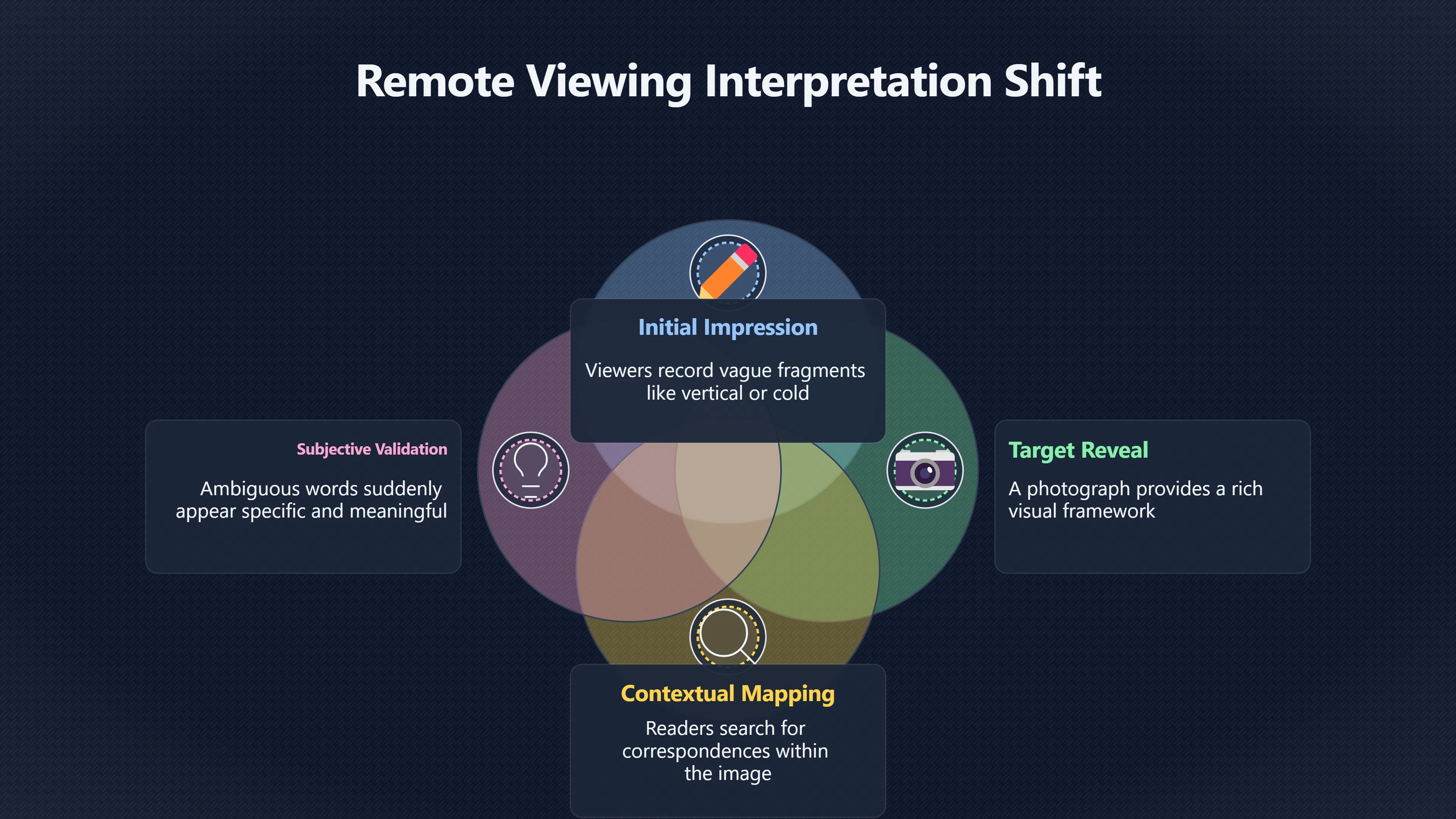
Before feedback, a remote viewing transcript is usually a collection of fragments rather than a single clear prediction. A viewer may note impressions such as “vertical”, “bright”, “metal”, “movement”, “cold”, “crowded” or “layered”. Standing alone, these descriptors often fit many different scenes.
After the target photograph is revealed, however, those same words are no longer interpreted in isolation. Instead, readers naturally begin searching for correspondences:
- “Vertical” becomes a tower, lighthouse or skyscraper.
- “Movement” becomes traffic, waves or crowds.
- “Cold” becomes snow, ice or blue water.
- “Metal” becomes railings, bridges, machinery or aircraft.
- “Circular” becomes a dome, wheel, fountain or arena.
The transcript itself has not acquired new information. What has changed is the interpretive context supplied by the photograph. This distinction is important because judging accuracy after the answer is known introduces hindsight that was unavailable when the original impressions were recorded. Researchers evaluating remote viewing have repeatedly recognised this issue and have therefore relied on blind matching procedures rather than simple visual comparison between transcript and target.[CIA]cia.govAN EVALUATION OF REMOTE VIEWINGUse of the same remote viewers, the same judge, and the same target photographs makes it impossible to…
How photographs supply the interpretive frame
Photographs are especially powerful because they contain far more information than a written label.
A target identified only as “Eiffel Tower” provides one obvious referent. A photograph of the Eiffel Tower also provides steel latticework, shadows, tourists, open sky, symmetry, height, railings, perspective, surrounding gardens and nearby streets. Each visual feature creates another opportunity to connect previously ambiguous words with something visible.
This abundance of detail encourages what psychologists describe as subjective validation: the tendency to perceive ambiguous information as meaningful once an appropriate context is available. Rather than evaluating whether the transcript uniquely predicted the photograph, observers often ask whether they can find any convincing overlap.
The result is asymmetric interpretation. Successful-looking correspondences become memorable, while unmatched statements receive much less attention. A transcript containing twenty impressions may be remembered primarily for the three or four that resemble elements of the target image.
Why long transcripts increase apparent matches
Length works in favour of after-the-fact fitting.
A brief prediction containing only a handful of precise claims leaves relatively little room for reinterpretation. A long transcript containing dozens or hundreds of descriptive fragments creates many more opportunities for partial correspondence.
For example, an extended session might include references to:
- water
- stone
- bright light
- enclosed areas
- curves
- machinery
- vegetation
- people
- movement
- height
- circles
- darkness
Many photographs contain several of these features simultaneously. As the number of statements grows, the probability of finding at least some apparently impressive matches also increases.
This is one reason why formal remote viewing experiments often avoid relying solely on intuitive visual comparison. Instead, they may require judges to rank multiple potential targets against a transcript or use predefined scoring systems intended to reduce flexible interpretation. The very existence of these procedures reflects an awareness that free-response material can otherwise be judged too subjectively.[CIA]cia.govAN EVALUATION OF REMOTE VIEWINGUse of the same remote viewers, the same judge, and the same target photographs makes it impossible to…
Why the photograph often feels more convincing than the transcript alone
Human perception is naturally skilled at recognising patterns, particularly in rich visual scenes. Once viewers know the correct answer, they often experience a strong feeling that the correspondence was obvious all along.
This impression can be surprisingly persuasive because:
- visual images encourage rapid association between words and objects;
- memory tends to favour successful matches over unsuccessful ones;
- ambiguous sketches can often be mentally rotated or reinterpreted;
- observers rarely compare the transcript equally carefully against alternative target photographs.
A useful thought experiment is to hide the true target and ask independent judges to match the transcript against several candidate photographs without knowing which is correct. If the transcript genuinely contains distinctive information, independent judges should consistently select the correct image before being told the answer. If convincing matches emerge only after the target is revealed, the apparent success may owe more to retrospective interpretation than to uniquely identifying the photograph.
How researchers try to reduce after-the-fact fitting
Because target photographs naturally encourage reinterpretation, remote viewing experiments have developed methods intended to separate genuine predictive content from hindsight.
Common safeguards include:
- Blind judging: judges do not know which photograph is the correct target.
- Decoy targets: transcripts are compared against several plausible images rather than one.
- Rank-order scoring: judges rank all candidate photographs instead of deciding only whether one “fits”.
- Predefined scoring criteria: matches are evaluated using rules established before feedback rather than after discussion.
- Independent replication: different judges analyse the same material separately.
These methods cannot by themselves establish whether remote viewing is genuine, but they are designed to address the specific problem that target photographs provide a powerful interpretive frame once revealed. Reviews of the U.S. government’s remote viewing programme noted that subjective judgement, the reuse of viewers and judges, and reliance on target photographs complicated interpretation of apparent successes, reinforcing the need for rigorous experimental controls.[CIA+2National Security Archive]cia.govAN EVALUATION OF REMOTE VIEWINGUse of the same remote viewers, the same judge, and the same target photographs makes it impossible to…
The key mechanism
The central issue is not simply that photographs contain recognisable objects. It is that revealing the photograph changes the way earlier information is read.
Before feedback, the transcript consists of uncertain impressions with many possible meanings. After feedback, the target image narrows those meanings and encourages readers to interpret each phrase in whichever way best aligns with what they now know. This shift from open-ended ambiguity to guided interpretation is the essence of after-the-fact fit in target photographs and explains why blind evaluation remains a central methodological concern in assessing free-response remote viewing claims.
Amazon book picks
Further Reading
Books and field guides related to How Target Photos Create After-the-Fact Hits. Use these as the next step if you want deeper reading beyond the article.
Why People Believe Weird Things
Directly supports discussion of retrospective interpretation.
The Demon-Haunted World
Explains hindsight and evidence evaluation relevant to after-the-fact matches.

Remote Viewers: The Secret History of America's Psychic Spies
Provides context for the experiments discussed.
eBay marketplace picks
Marketplace Samples
Live-tested eBay searches with available results related to this page.

Endnotes
1.
Source: cia.gov
Link:https://www.cia.gov/readingroom/docs/CIA-RDP96-00791R000200180005-5.pdf
Source snippet
AN EVALUATION OF THE REMOTE VIEWING PROGRAMTypically, the remote viewers described the results of their experiences in written reports...
2.
Source: cia.gov
Link:https://www.cia.gov/readingroom/docs/CIA-RDP96-00791R000200180006-4.pdf
Source snippet
AN EVALUATION OF REMOTE VIEWINGUse of the same remote viewers, the same judge, and the same target photographs makes it impossible to...
3.
Source: nsarchive2.gwu.edu
Link:https://nsarchive2.gwu.edu/NSAEBB/NSAEBB438/docs/doc_57.pdf
Source snippet
National Security ArchiveAn Evaluation of Remote Viewing: Research and...by MD Mumford · 1995 · Cited by 76 — In the early 1970s, the CI...
Additional References
4.
Source: researchgate.net
Title: 374881423 Remote Viewing A 1974 2022 Systematic Review and [Meta Analysis]({{ ‘meta-analysis/’ | relative_url }})
Link:https://www.researchgate.net/publication/374881423_Remote_Viewing_A_1974-2022_Systematic_Review_and_Meta-Analysis
Source snippet
(PDF) Remote Viewing: A 1974-2022 Systematic Review...26 Oct 2023 — This is the first meta-analysis of all studies related to remote-vie...
5.
Source: academia.edu
Link:https://www.academia.edu/38286031/Remote_Viewing_of_Concealed_Target_Pictures_Under_Light_and_Dark_Conditions
Source snippet
ote viewing ability alongside the effect of time and their potential interaction.Read more...
6.
Source: thenonphysicalfuture.medium.com
Title: remote viewing the subjective experience c5fa6afb6486
Link:https://thenonphysicalfuture.medium.com/remote-viewing-the-subjective-experience-c5fa6afb6486
Source snippet
Viewing: the subjective experienceExcerpt from the declassified [CIA files]({{ 'cia-files/' | relative_url }}) on Project Stargate. This is the piece I've been wanting to wri...
7.
Source: facebook.com
Link:https://www.facebook.com/groups/Ethpolsocpsy/posts/1956619287829100/
Source snippet
ng what they are, different types, and the scientific and skeptical...Read more...
8.
Source: reddit.com
Link:https://www.reddit.com/r/remoteviewing/comments/1501do7/the_complete_skeptics_guide_to_remote_viewing_how/
Source snippet
nd what the field needs to address in order to be legitimized.Read more...
9.
Source: pmc.ncbi.nlm.nih.gov
Link:https://pmc.ncbi.nlm.nih.gov/articles/PMC10275521/
Source snippet
Central Intelligence Agency's (CIA...by Á Escolà‐Gascón · 2023 · Cited by 10 — Programs addressed remote viewing (RV), that is, determin...
10.
Source: youtube.com
Title: Remote Viewing and Statistical Validation
Link:https://www.youtube.com/watch?v=YrwAiU2g5RU
Source snippet
The Mistake That Makes You See Proof Everywhere...
11.
Source: youtube.com
Title: Texas sharpshooter fallacy
Link:https://www.youtube.com/watch?v=PniicEqWhYQ
Source snippet
Remote Viewing: The Evidence (Psychic Spies! Stargate Project!)...
12.
Source: youtube.com
Title: Remote Viewing: The Evidence (Psychic Spies! Stargate Project!)
Link:https://www.youtube.com/watch?v=Ph-kd1Igwzs
Source snippet
The Confirmation Bias...
13.
Source: youtube.com
Title: The Mistake That Makes You See Proof Everywhere
Link:https://www.youtube.com/watch?v=UFBWGPuCA7A
Source snippet
Texas sharpshooter fallacy...
Topic Tree