Within Protocol
Would Your Notes Fit Other Targets Too?
Comparing notes with decoys shows whether a response really fits the target better than several plausible alternatives.
On this page
- Why one target matching invites over reading
- How a five image comparison set works
- Specific matches versus vague reusable impressions
Page outline Jump by section
Introduction
A beginner remote viewing session is only meaningful if there is a fair way to judge the results. Free-response notes are naturally flexible: a few words such as “water”, “tower”, “movement” or “bright” can often be made to fit many different photographs after the correct answer is revealed. For that reason, stronger remote viewing protocols compare the session against several plausible alternative targets rather than asking whether it resembles only the intended target. This simple change makes it much harder to over-read vague impressions and provides a clearer test of whether the session genuinely matches one image better than the others. It has become one of the most important methodological safeguards discussed by both supporters and critics of remote viewing research.[CIA+2Koestler Unit]cia.govAN EVALUATION OF THE REMOTE VIEWING PROGRAMIn the typical remote viewing experiment in the laboratory, a remote viewer is asked to vis…
Why One-Target Matching Invites Over-Reading
If a viewer is shown only the correct target after completing a session, almost any description can appear surprisingly accurate. Human pattern recognition is excellent at finding similarities, especially once the answer is known. A sketch containing curves, vertical lines and shaded areas may be interpreted as a waterfall, a cathedral, a canyon or a bridge depending on which photograph is eventually revealed.
This tendency is not unique to remote viewing. Psychologists recognise hindsight bias and confirmation bias as common ways people unintentionally exaggerate how well earlier impressions matched later information. In remote viewing, these biases become particularly important because the responses are usually open-ended rather than consisting of simple right-or-wrong answers. Critics have long argued that generous post-hoc interpretation can create an illusion of success even when descriptions are nonspecific, while proponents generally agree that judging procedures must minimise this problem if experiments are to be persuasive.[Wikipedia+2CIA]WikipediaRemote viewingRemote viewing
For beginners, this means that the question should never be, “Can I find something that matches the target?” A better question is, “Does this session fit the target substantially better than several realistic alternatives?”
How a Five-Image Comparison Set Works
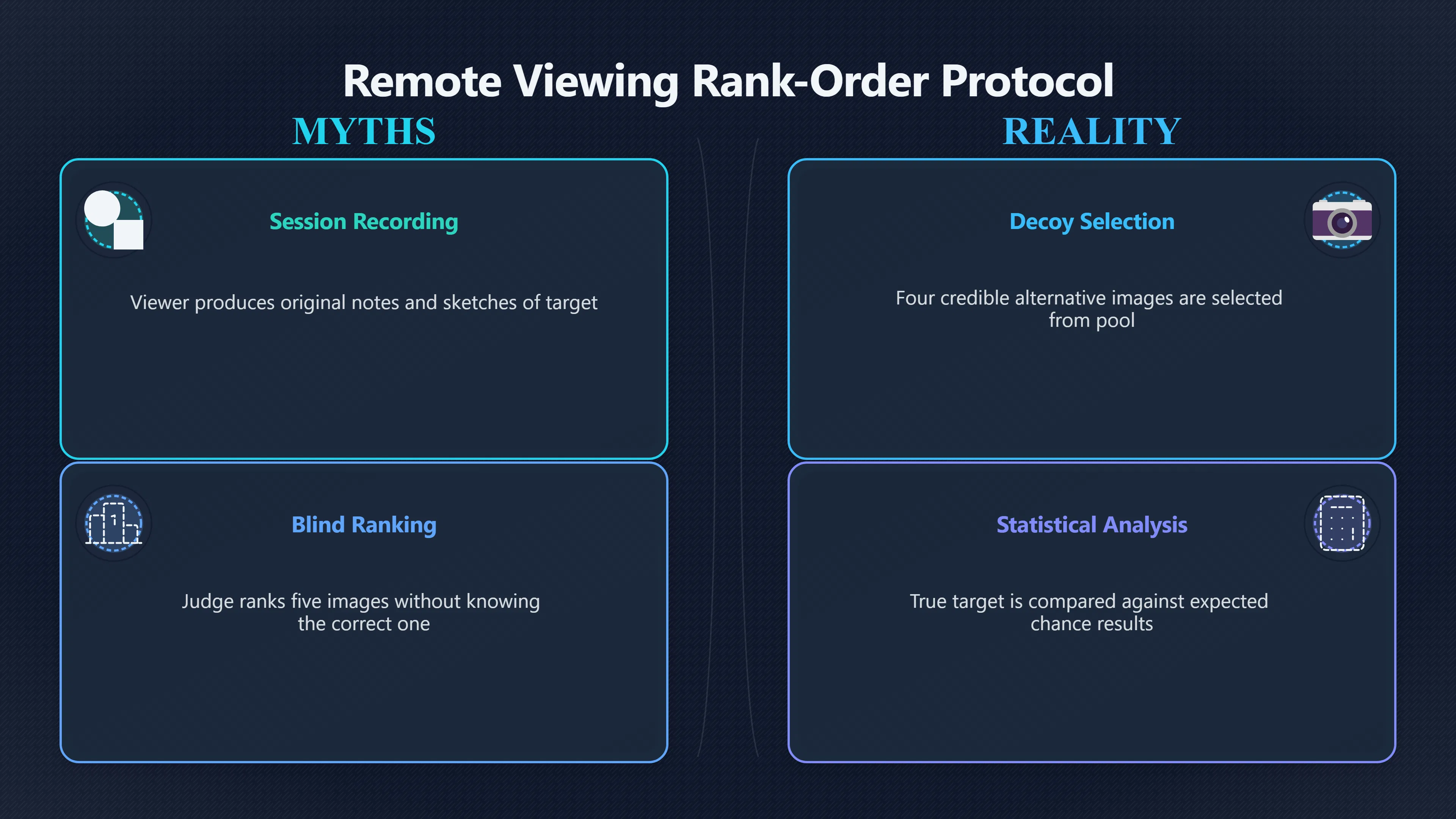
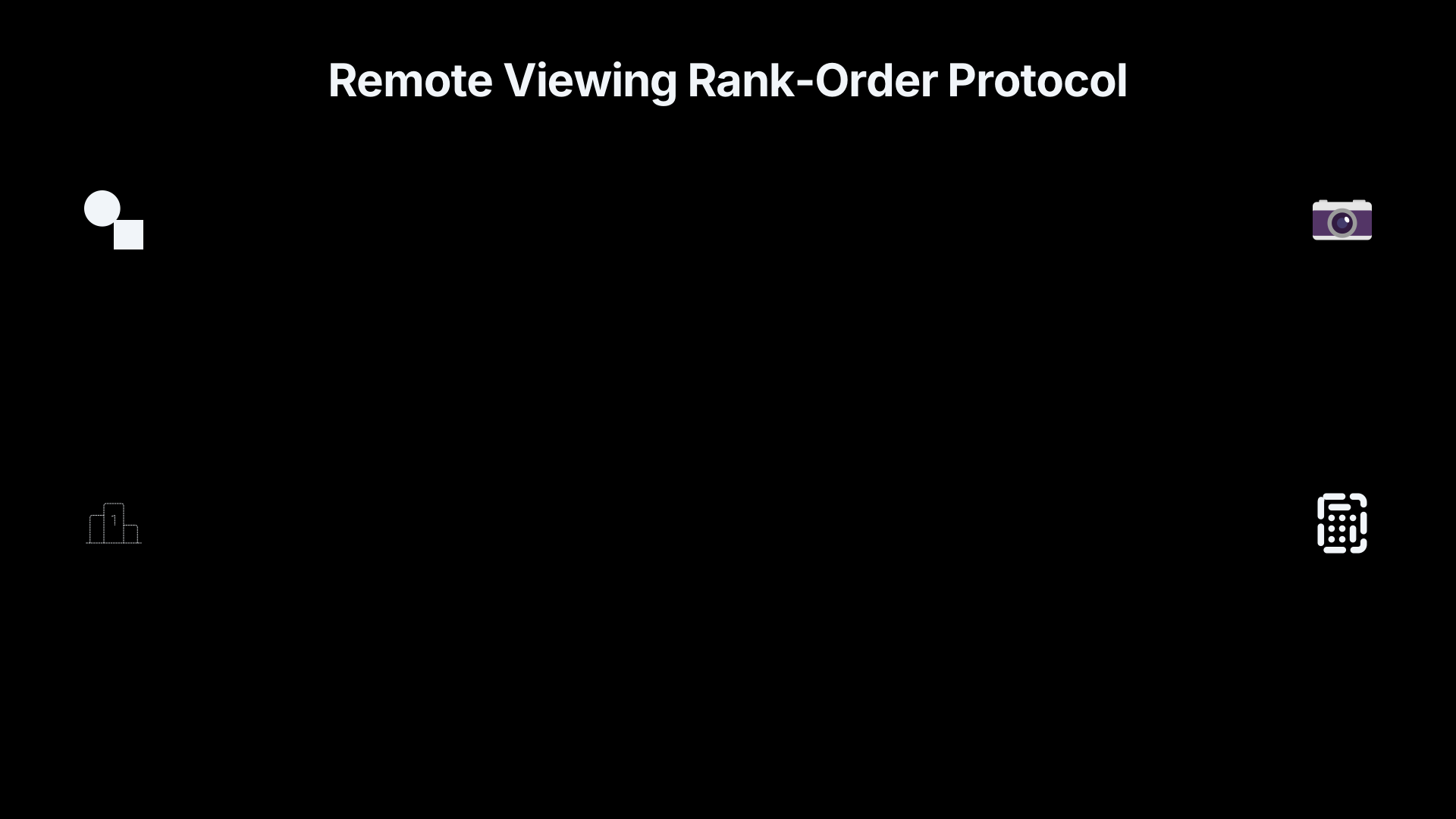
One practical solution, used in several remote viewing research programmes, is rank-order judging with decoy targets.
Instead of presenting only the true target, the judge receives:
- the viewer’s original notes and sketches;
- the actual target image;[reddit.com]reddit.comI've built ClairV: Free Remote Viewing Practice ToolEach session gives you a random target ID. You do your RV session however you like, t…
- four additional images drawn from the same target pool.
The judge does not know which image is correct. Their task is simply to rank the five images from best match to worst match based solely on the recorded session.
If the true target consistently receives the highest ranking more often than expected by chance across many independent trials, that provides stronger evidence than isolated anecdotes. Conversely, if the notes appear equally compatible with several images, the protocol reveals that the apparent “hit” is less impressive than it first seemed. This approach was used in a number of SRI and SAIC-style free-response experiments employing sets of five potential targets, including collections of National Geographic photographs and other image pools.[National Security Archive+2Koestler Unit]nsarchive2.gwu.eduNational Security ArchiveAn Evaluation of Remote Viewing: Research and…March 13, 2015 — by MD Mumford · 1995 · Cited by 76 — For each…
The important feature is not that there are exactly five images. Rather, the alternatives must be credible enough that the judge has to make a genuine discrimination instead of recognising the answer immediately.
What Makes a Good Decoy?
Decoy targets should resemble the kinds of images that genuinely appear in the target pool without being obvious mismatches.
For example, if the actual target is a lighthouse on a rocky coast, poor decoys would include:
- a close-up portrait,
- a page of printed text,
- a bowl of fruit,
- a football match.
These can be rejected almost instantly.
Better decoys might include:
- another coastal landscape,
- a harbour,
- a cliffside monument,
- a tall tower beside water.
These alternatives force the judge to rely on the specific content of the session rather than broad categories such as “outdoors”, “vertical object” or “water”.
A well-designed target pool therefore contains images with enough variety to distinguish them, but enough overlap that judging remains challenging. This balance reduces the chance that an apparently successful match is simply the result of very broad descriptions.

Specific Matches Matter More Than Reusable Impressions
Not all session elements carry equal evidential weight.
Descriptions that could fit dozens of photographs contribute relatively little, including:
- “bright”;
- “cold”;
- “large structure”;
- “open space”;
- “movement”;
- “people nearby”.
These are common features across many targets.
More informative elements combine several independent characteristics, for example:
- a circular building beside water;
- repeating arches with strong vertical shadows;
- a steep waterfall bordered by dense forest;
- a suspension bridge crossing a deep valley.
No single feature proves anything by itself, but multiple uncommon details pointing toward the same image become increasingly difficult to explain as coincidence if they consistently distinguish the correct target from realistic alternatives.
Judges therefore assess the overall pattern rather than counting isolated “hits”. A session with one spectacularly accurate feature and many contradictions may be less convincing than one showing numerous mutually consistent correspondences.
Fair Judging Requires Blindness
A comparison set only works if the judge does not know which image is correct.
If the judge already knows the answer, unconscious expectations can influence how similarities are interpreted. Research methodology in remote viewing has therefore emphasised blind judging, where the evaluator receives anonymous response sheets and an unordered set of possible targets.
Maintaining blindness also reduces subtle pressures to reward particularly impressive-looking sketches or favour viewers with good reputations. The evaluation becomes a comparison exercise rather than an attempt to confirm a hoped-for result.[Psi Encyclopedia]psi-encyclopedia.spr.ac.ukPsi Encyclopedia Remote ViewingPsi EncyclopediaRemote Viewing - Psi EncyclopediaJan 13, 2017 — A target pool and database for anomalous cognition experiments. Paper pre…
Lessons from Methodological Critiques
Discussion of remote viewing methodology has repeatedly highlighted that judging procedures can accidentally introduce information not present in the original session.
One widely cited critique of an SAIC experiment argued that judging order could allow information from later responses to influence interpretation of earlier ones. Richard Wiseman and Julie Milton illustrated a scenario in which drawings from previous trials could unintentionally help a judge recognise targets during subsequent rankings if sessions were reviewed out of sequence. Their argument was not that every experiment suffered this problem, but that judging procedures must be designed carefully enough to eliminate such leakage pathways.[Koestler Unit]koestlerunit.wordpress.comKoestler UnitExperiment One of the SAIC Remote Viewing Programby R Wiseman · Cited by 24 — When judging the first trial the judge would e…
This debate illustrates an important principle for beginners: even apparently small procedural details can affect the credibility of a result. A protocol is strongest when it prevents both intentional and unintentional clues from influencing the judge.
What Beginners Should Look For
When reviewing a practice session, ask several simple questions:
- Would these notes rank the correct image first without knowing the answer?
- Could the same notes fit two or three other plausible targets equally well?
- Are the strongest correspondences specific rather than generic?
- Was the original record preserved before any feedback was given?
- Was the judging performed blind to the correct target?
These questions shift attention away from dramatic anecdotes and towards reproducible comparisons. Regardless of one’s view on remote viewing itself, comparing session records against realistic decoy targets is one of the most effective ways to distinguish genuinely distinctive descriptions from impressions that could have matched almost anything.
Amazon book picks
Further Reading
Books and field guides related to Would Your Notes Fit Other Targets Too?. Use these as the next step if you want deeper reading beyond the article.
Thinking, Fast and Slow
Explains confirmation bias and hindsight effects relevant to judging sessions.
The seventh sense
Discusses structured procedures that reduce subjective interpretation.
eBay marketplace picks
Marketplace Samples
Live-tested eBay searches with available results related to this page.

Endnotes
1.
Source: cia.gov
Link:https://www.cia.gov/readingroom/docs/CIA-RDP96-00791R000200180005-5.pdf
Source snippet
AN EVALUATION OF THE REMOTE VIEWING PROGRAMIn the typical remote viewing experiment in the laboratory, a remote viewer is asked to vis...
2.
Source: Wikipedia
Title: Remote viewing
Link:https://en.wikipedia.org/wiki/Remote_viewing
3.
Source: cia.gov
Link:https://www.cia.gov/readingroom/document/cia-rdp96-00791r000200180006-4
Source snippet
l than "forced choice" experiments, in which subjects were asked...Read more...
4.
Source: cia.gov
Link:https://www.cia.gov/readingroom/docs/CIA-RDP96-00789R002200390001-5.pdf
Source snippet
RDP96-00789R002200390001-5For a given remote viewing session, the remote viewer (or an analyst who is blind to the target site) attem...
5.
Source: koestlerunit.wordpress.com
Link:https://koestlerunit.wordpress.com/wp-content/uploads/2015/06/wiseman-milton-1998.pdf
Source snippet
Koestler UnitExperiment One of the SAIC Remote Viewing Programby R Wiseman · Cited by 24 — When judging the first trial the judge would e...
6.
Source: psi-encyclopedia.spr.ac.uk
Title: Psi Encyclopedia Remote Viewing
Link:https://psi-encyclopedia.spr.ac.uk/articles/remote-viewing/
Source snippet
Psi EncyclopediaRemote Viewing - Psi EncyclopediaJan 13, 2017 — A target pool and database for [anomalous cognition]({{ 'not-clairvoyance/' | relative_url }}) experiments. Paper pre...
7.
Source: nsarchive2.gwu.edu
Link:https://nsarchive2.gwu.edu/NSAEBB/NSAEBB438/docs/doc_57.pdf
Source snippet
National Security ArchiveAn Evaluation of Remote Viewing: Research and...March 13, 2015 — by MD Mumford · 1995 · Cited by 76 — For each...
Published: March 13, 2015
8.
Source: psi-encyclopedia.spr.ac.uk
Title: spr.ac.uk Experimental Parapsychology
Link:https://psi-encyclopedia.spr.ac.uk/articles/experimental-parapsychology/
Source snippet
Parapsychology - Psi Encyclopedia - SPRSep 7, 2015 — Although testing was typically structured in runs of 25 cards, the target cards were...
9.
Source: psi-encyclopedia.spr.ac.uk
Title: spr.ac.uk Psi for Financial Gain
Link:https://psi-encyclopedia.spr.ac.uk/articles/psi-financial-gain/
Source snippet
for Financial Gain - Psi EncyclopediaJun 5, 2015 — This protocol was initially developed as a means to guarantee that a remote viewing ta...
10.
Source: public.ukp.informatik.tu-darmstadt.de
Title: wikipedia doc frequencies.txt
Link:https://public.ukp.informatik.tu-darmstadt.de/reimers/embeddings/wikipedia_doc_frequencies.txt
Source snippet
tu-darmstadt.dewikipedia_doc_frequencies.txt... national 674847 would 673343 second 668550 united 666735 these 661990 until 649481 follow...
Additional References
11.
Source: reddit.com
Link:https://www.reddit.com/r/remoteviewing/comments/1ohbtfb/ive_built_clairv_free_remote_viewing_practice_tool/
Source snippet
I've built ClairV: Free Remote Viewing Practice ToolEach session gives you a random target ID. You do your RV session however you like, t...
12.
Source: law.resource.org
Link:https://law.resource.org/pub/us/works/Phase1Searches/Data/WebOfScience/DOISearch01.WOS.0048.4.16.ris
Source snippet
resource.org[https://law.resource.org/pub/us/works/Phase1Search](https://law.resource.org/pub/us/works/Phase1Search)...... National Park, Montana, USA SO CANADIAN JOURNAL OF ZOOLOGY-REVUE CAN...
13.
Source: richardwiseman.com
Link:https://www.richardwiseman.com/resources/SAICreply.pdf
Source snippet
In our original paper (Wiseman & Milton, 1999), we described a number of potential information leakage pathways in Experiment One of the...
14.
Source: researchgate.net
Title: 369604750 Remote Viewing a 1974 2022 systematic review and [meta analysis]({{ ‘meta-analysis/’ | relative_url }})
Link:https://www.researchgate.net/publication/369604750_Remote_Viewing_a_1974-2022_systematic_review_and_meta-analysis
Source snippet
(PDF) Remote Viewing: a 1974-2022 systematic review...This is the first meta-analysis of all studies related to remote viewing tasks con...
15.
Source: psi-unit.com
Title: Remote Viewing Replication Evaluated By Concept Analysis Jp Volume58 pg259to272
Link:https://psi-unit.com/wp-content/uploads/RemoteViewingReplicationEvaluatedByConceptAnalysisJpVolume58_pg259to272.pdf
Source snippet
Remote viewing replication: Evaluated with concept analysisby R TARG · 1994 · Cited by 35 — The target is determined by random-number acc...
16.
Source: scribd.com
Link:https://www.scribd.com/document/150673461/Remote-Viewing
Source snippet
the course of a year. The study uses 12 experienced remote...Read more...
17.
Source: scispace.com
Link:https://scispace.com/pdf/remote-viewing-of-concealed-target-pictures-under-light-and-229j8c3s0e.pdf
Source snippet
ng ability alongside the effect of time and their potential interaction...
18.
Source: reddit.com
Link:https://www.reddit.com/r/remoteviewing/comments/qrmn2c/can_someone_explain_remote_viewing_to_me_i_dont/
Source snippet
with the target selection list. According to Shermer with...Read more...
19.
Source: academia.edu
Link:https://www.academia.edu/38286031/Remote_Viewing_of_Concealed_Target_Pictures_Under_Light_and_Dark_Conditions
Source snippet
g ability alongside the effect of time and their potential interaction...
20.
Source: scribd.com
Link:https://www.scribd.com/doc/116854628/Experiments-in-Psychology
Source snippet
tween 1952 and 1954 by RAND Corporation's Systems Research Laboratory...
Topic Tree