Within Middle View
Why Psychic Spying Failed End Users
Remote viewing failed most sharply when vague laboratory-style impressions had to become timely, actionable intelligence.
On this page
- What intelligence users needed from sessions
- Why broad impressions were not enough
- How application failure differs from lab failure
Page outline Jump by section
Introduction
The strongest practical challenge to remote viewing was not whether some laboratory experiments produced statistically unusual results, but whether those results could be turned into intelligence that decision-makers could actually use. Intelligence organisations do not need intriguing impressions; they need information that is timely, specific, independently verifiable and actionable. That requirement exposed a gap between claims of above-chance performance in controlled experiments and the realities of operational work. Even reviewers who disagreed about the interpretation of laboratory findings largely converged on the conclusion that remote viewing had not demonstrated reliable value for real intelligence operations.[CIA]cia.govAN EVALUATION OF THE REMOTE VIEWING PROGRAMIn no case had the information provided ever been used to guide intelligence operations. Th…
This distinction is central to the middle position in the remote-viewing debate. It allows for the possibility that some laboratory studies deserve further scientific discussion while also recognising that operational intelligence imposes much higher standards than statistical significance alone.
What Intelligence Users Needed from Sessions
An intelligence report has value only if it helps someone make a better decision under uncertainty. Analysts and commanders typically require information that answers concrete questions such as:
- Where is a target located?
- What equipment is present?
- When will an event occur?
- How confident should the assessment be?
- Can the information be independently confirmed?
These demands leave little room for vague descriptions or symbolic imagery. Intelligence is rarely judged by whether isolated details seem interesting after the fact. Instead, it is evaluated prospectively: could the information have altered planning before the outcome was known?
This is where remote viewing faced its greatest implementation challenge. Even supporters acknowledged that sessions often generated fragmented impressions, metaphors or partial descriptions requiring interpretation. Those characteristics made it difficult to integrate remote-viewing output with conventional intelligence sources such as satellite imagery, intercepted communications or human reporting.[CIA]cia.govAN EVALUATION OF THE REMOTE VIEWING PROGRAMIn no case had the information provided ever been used to guide intelligence operations. Th…
Why Broad Impressions Were Not Enough
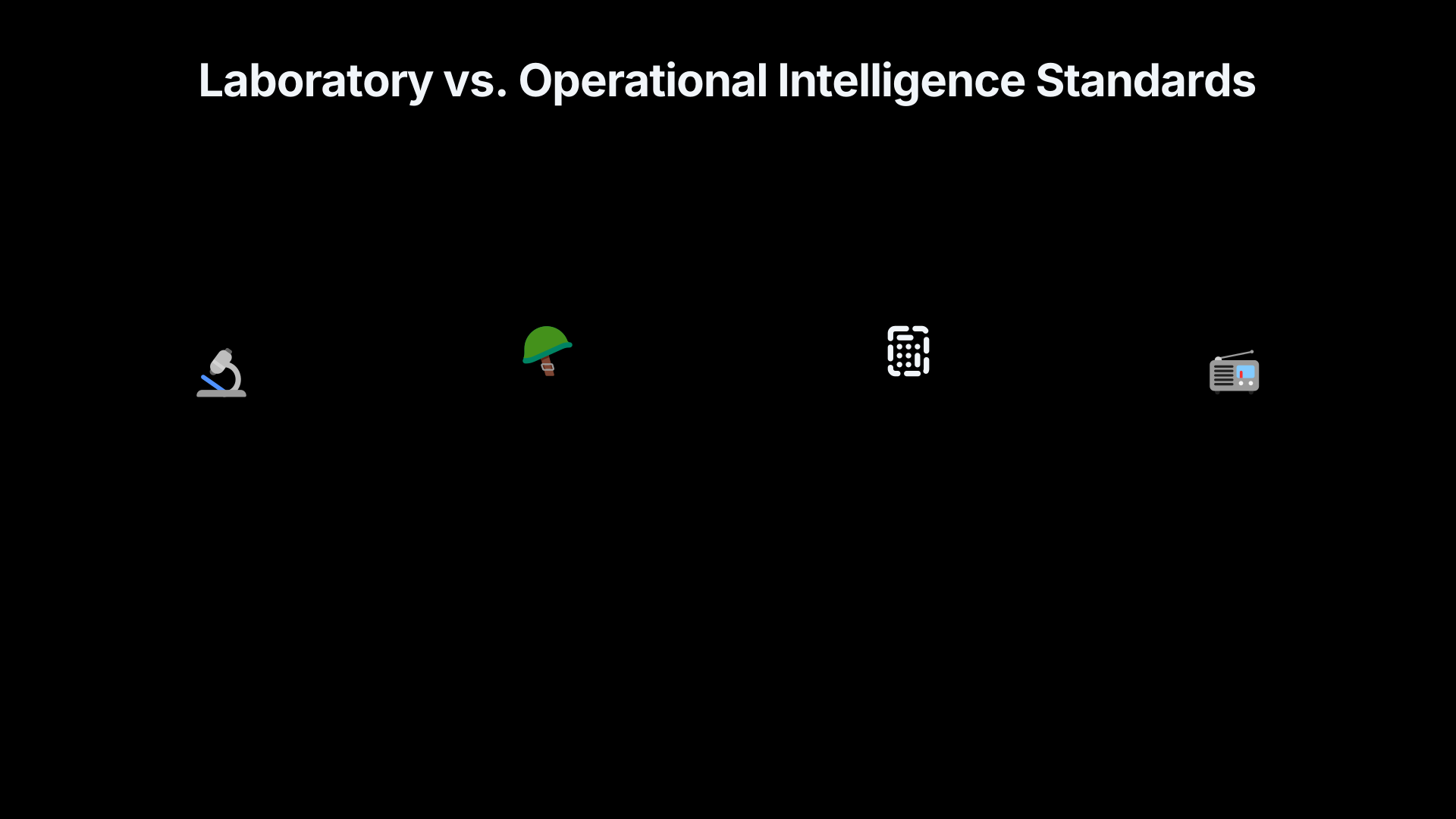
Laboratory experiments often score success by measuring whether a participant produces descriptions that resemble a hidden target more often than chance would predict. Operational intelligence, however, works according to different criteria.
A remote-viewing session might include impressions such as “water”, “metal”, “tall structure” or “industrial activity”. Such descriptions may later appear meaningful when compared with a known target, but they seldom identify one unique location or support an operational decision before verification.
Several practical problems follow:
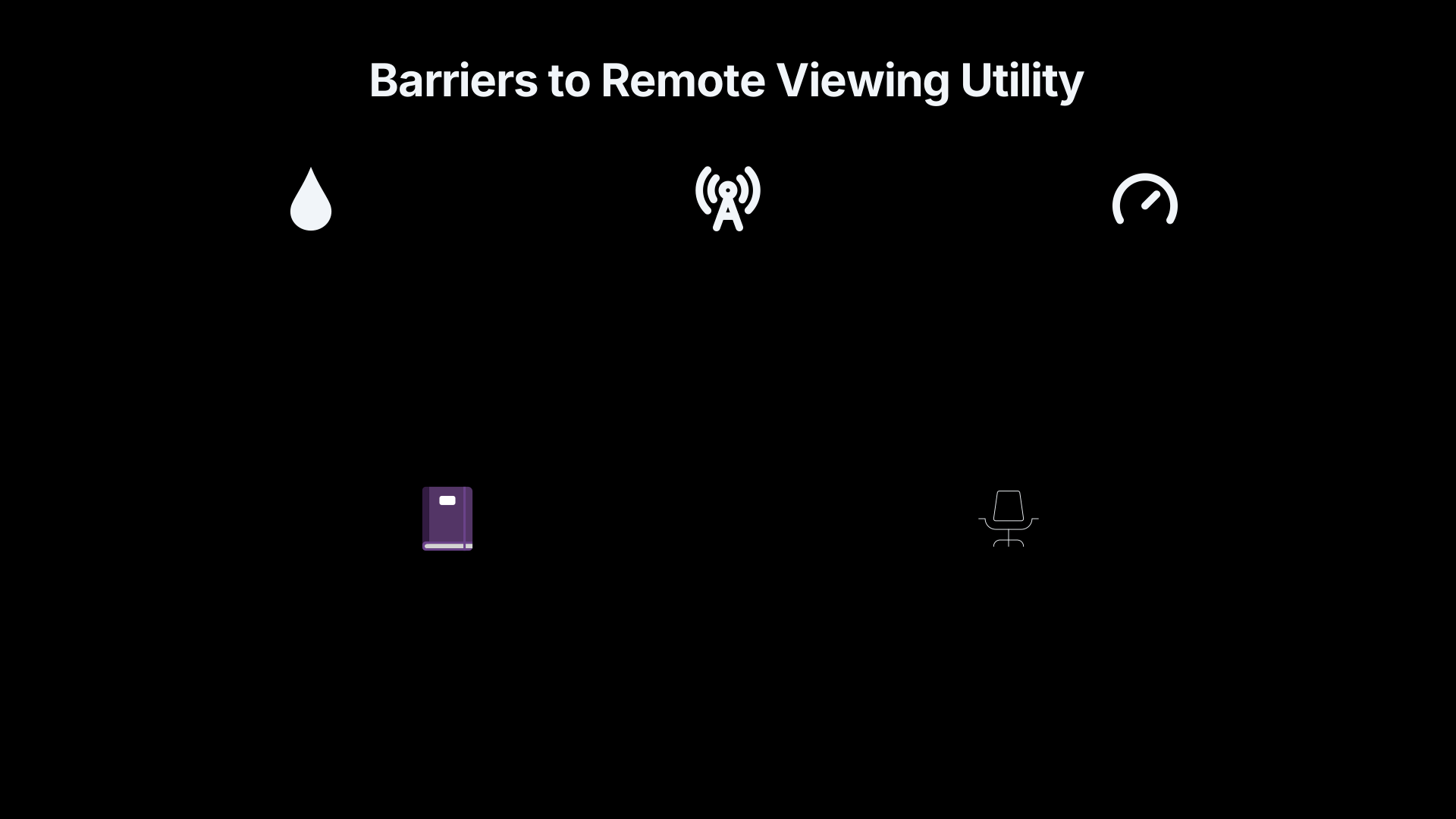
- Ambiguity. General descriptions can match many different locations or objects.
- Mixed accuracy. Correct observations may be accompanied by incorrect or irrelevant details, forcing analysts to separate signal from noise.
- Lack of confidence estimates. Intelligence users need to know how much trust to place in a report; remote-viewing sessions typically offered no objective way to quantify reliability.
- Limited reproducibility. Different viewers frequently produced different accounts of the same target, making independent confirmation difficult.
For intelligence agencies, these limitations are not minor imperfections. They directly affect whether resources are deployed, missions are authorised or strategic assessments are revised.
Why Operational Failure Differs from Laboratory Failure
A common misunderstanding is that failure in intelligence operations automatically disproves every laboratory finding. The two questions are related but not identical.
Laboratory studies generally ask whether participants perform above chance under carefully controlled conditions. Operational programmes ask a much stricter question: can the technique consistently produce information useful enough to influence real decisions?
This difference explains why the 1995 review commissioned by the CIA produced two contrasting interpretations. Jessica Utts argued that portions of the experimental evidence appeared statistically persuasive and merited further scientific investigation. Ray Hyman remained unconvinced that the findings established paranormal functioning and emphasised methodological concerns. Despite those disagreements, both reviewers accepted that operational usefulness had not been demonstrated.[ResearchGate]researchgate.netEvaluation of Program on 'Anomalous Mental Phenomena'PDF | Jessica Utts and I were commissioned to evaluate the research on r…
The distinction is important because a modest statistical effect, even if genuine, does not automatically translate into an effective intelligence capability. Many measurable psychological effects are real but too small, inconsistent or context-dependent to become useful operational tools.
The Decisive Finding of the Star Gate Review
The American Institutes for Research evaluated both the research programme and its practical intelligence applications after more than two decades of government investment.
Its conclusion on operational performance was notably direct. The review found no documented case in which remote-viewing information had been used to guide intelligence operations. Reports were often described as vague, incomplete or mixed with incorrect information, making them unsuitable as a basis for decision-making. The reviewers also noted that conditions under which positive laboratory effects had reportedly been observed did not resemble the conditions faced during intelligence collection.[CIA]cia.govAN EVALUATION OF THE REMOTE VIEWING PROGRAMIn no case had the information provided ever been used to guide intelligence operations. Th…
This assessment became one of the principal reasons the programme was terminated. The issue was not merely whether occasional “hits” existed, but whether the method could reliably outperform existing intelligence practices in ways that justified continued investment.
Why Intelligence Agencies Could Not Depend on It
Operational intelligence functions within severe constraints that laboratory studies rarely face.
Information often has to arrive quickly enough to influence events. Analysts must justify their conclusions to other specialists. Reports must withstand independent scrutiny because incorrect intelligence can have significant military or political consequences.
Remote viewing struggled under these conditions because:
- results varied substantially between sessions;
- interpretation often depended on subjective judgement;
- successful details were difficult to distinguish from incorrect ones before verification;
- there was no established procedure for knowing when a session should be trusted or disregarded.
These are implementation problems rather than purely scientific ones. Even if an anomalous effect existed, intelligence organisations would still require a dependable process for converting it into accurate operational reporting. Evidence that such a process existed has not emerged from the historical record.[CIA]cia.govAN EVALUATION OF THE REMOTE VIEWING PROGRAMIn no case had the information provided ever been used to guide intelligence operations. Th…
What This Means for the Middle Position
The operational record helps explain why debate over remote viewing has persisted despite decades of discussion. Believers can point to laboratory findings that some researchers interpret as statistically unusual, while sceptics emphasise methodological weaknesses and failed replication.
The operational evidence occupies a different category altogether. Intelligence agencies ultimately judge collection methods by whether they improve decisions in the real world. On that measure, remote viewing performed poorly. The historical record shows that intriguing laboratory anomalies—assuming they exist—did not mature into a dependable intelligence capability capable of meeting the standards required by end users.[CIA]cia.govAN EVALUATION OF THE REMOTE VIEWING PROGRAMIn no case had the information provided ever been used to guide intelligence operations. Th…
Amazon book picks
Further Reading
Books and field guides related to Why Psychic Spying Failed End Users. Use these as the next step if you want deeper reading beyond the article.
The Men Who Stare At Goats
Rating: 3.5/5 from 11 Google Books ratings
Explores attempts to apply paranormal ideas inside military and intelligence settings.
Phenomena
Covers the government programme and the question of whether psychic research produced useful intelligence.

Remote Viewers: The Secret History of America's Psychic Spies
Details remote-viewing intelligence work and the disputes over its actual usefulness.
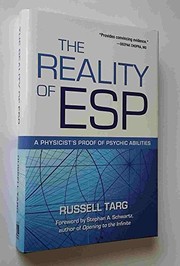
The Reality of ESP: A Physicist's Proof of Psychic Abilities
Argues that remote viewing had real effects, giving readers the believer-side case to compare with operational criticisms.
eBay marketplace picks
Marketplace Samples
Example marketplace items related to this page. Use the search link to explore similar finds on eBay.




Endnotes
1.
Source: cia.gov
Link:https://www.cia.gov/readingroom/docs/CIA-RDP96-00791R000200180005-5.pdf
Source snippet
AN EVALUATION OF THE REMOTE VIEWING PROGRAMIn no case had the information provided ever been used to guide intelligence operations. Th...
2.
Source: researchgate.net
Link:https://www.researchgate.net/publication/267978941Evaluation_of_Program_on%27Anomalous_Mental_Phenomena%27
Source snippet
Evaluation of Program on 'Anomalous Mental Phenomena'PDF | Jessica Utts and I were commissioned to evaluate the research on r...
3.
Source: researchgate.net
Title: Volume 4: Operational Remote Viewing
Link:https://www.researchgate.net/publication/403178755_The_Star_Gate_Archives_Reports_of_the_United_States_Government_Sponsored_Psi_Program_1972-1995_Volume_4_Operational_Remote_Viewing_Memorandums_and_Reports
Source snippet
(PDF) The [Star Gate]({{ 'star-gate/' | relative_url }}) Archives: Reports of the United States...18 Jun 2026 — The Star Gate Archives: Reports of the United States Governme...
4.
Source: researchgate.net
Link:https://www.researchgate.net/publication/342294965Essay_Review_The_Star_Gate_Archives_The_Star_Gate_Archives_Vol_1-4_Reports_of_the_US_Government_Sponsored_Psi_Program_1972-1995_1_Remote_Viewing_1972-1984_2_Remote_Viewing_1985-1995_3_Psychokinesis_4
Source snippet
fic research into psi (purported mental abilities...
5.
Source: Wikipedia
Title: Remote viewing
Link:https://en.wikipedia.org/wiki/Remote_viewing
Source snippet
Remote viewingRemote viewing (RV) is the practice of seeking impressions about a distant or unseen subject, purportedly sensing with t...
6.
Source: ics.uci.edu
Link:https://www.ics.uci.edu/~jutts/may.pdf
Source snippet
Gate program. It is not surprising that the NRC study is liberally...Read more...
Additional References
7.
Source: gateworld.net
Link:https://www.gateworld.net/
Source snippet
GateWorld » Your Complete Guide to StargateThe Web's most complete, most updated [Stargate]({{ 'stargate/' | relative_url }}) news and reference guide! Stargate news, episod...
8.
Source: permutedpress.com
Link:https://permutedpress.com/remote-viewing-men-who-stare-at-goats
Source snippet
Remote Viewing & Men Who Stare at GoatsThe CIA found no cases where psychic phenomenon was responsible for providing any verifiable, usef...
9.
Source: slideshare.net
Link:https://www.slideshare.net/slideshow/an-evaluation-of-remote-viewing-research-and-applications-air1995pdf/257460594
Source snippet
An Evaluation of Remote Viewing, Research and...Remote viewing reports provided vague and ambiguous information that was not useful for...
10.
Source: academia.edu
Link:https://www.academia.edu/95285973/The_Star_Gate_Operational_Remote_Viewing_Program_A_Human_Intelligence_HUMINT_Collection_Platform
Source snippet
remote viewing produced no accurate or actionable intelligence, the evaluation was not redacted.Read more...
11.
Source: medium.com
Title: Psychic Phenomena in Military and Intelligence Operations
Link:https://medium.com/%40thegaijin.wolfenstein/psychic-phenomena-in-military-and-intelligence-operations-article-built-for-the-general-public-4a3248a47a11
Source snippet
failed to produce actionable intelligence... Following the AIR evaluation, the CIA formally terminated all remote viewing programs in 19...
12.
Source: reddit.com
Link:https://www.reddit.com/r/consciousness/comments/181s71r/the_cias_experiments_with_remote_viewing_and/
Source snippet
perimentation with Ingo Swann can provide some evidence toward “non-local...Read more...
13.
Source: youtube.com
Title: [Psychic Spying]({{ ‘psychic-spying/’ | relative_url }}): The Truth About Remote Viewing with Dr. Paul H. Smith
Link:https://www.youtube.com/watch?v=8mnLwfQm7zc
Source snippet
features a veteran remote viewer explaining the friction between laboratory findings and the specific requirements needed for actionable...
14.
Source: facebook.com
Link:https://www.facebook.com/IFLScience/posts/famously-the-cia-investigated-using-out-of-body-experiences-as-a-weapon-in-proje/4132142420140071/
Source snippet
n 1977, and we turned the program over to the Defense...Read more...
15.
Source: ftp.nuneslaw.com
Title: project stargate and remote viewing technology th
Link:https://ftp.nuneslaw.com/default.aspx/fulldisplay/243/219/u2D907/project-stargate-and-remote-viewing-technology-th.pdf
Source snippet
Stargate And Remote Viewing Technology Th25 Mar 2026 — Conclusion: The Enduring Enigma of Remote Viewing and Project Stargate...
16.
Source: medium.com
Link:https://medium.com/lumen-obscura/secret-history-of-the-cia-remote-viewing-project-stargate-and-locating-the-ark-of-the-covenant-f3481a14e1a8
Source snippet
ble intelligence,” leading to the program's closure. However...
Topic Tree