Within Leakage
Can the Monitor Accidentally Lead the Viewer?
Even a well-meaning interviewer can shape a viewer's impressions if prompts, tone or expectations leak target hints.
On this page
- How neutral prompts can become clues
- Why monitor knowledge changes session risk
- Practical safeguards for cleaner sessions
Page outline Jump by section
Introduction
In remote-viewing experiments, the monitor is the person who records the viewer’s spoken impressions, keeps the session moving and, in some protocols, asks brief questions when the viewer appears to stall. That role sounds administrative, but it creates one of the most important opportunities for accidental sensory leakage. Even when a monitor has no intention of influencing the outcome, wording, tone of voice, timing, facial expressions and expectations can all act as ordinary cues that shape what the viewer says next.

Because remote viewing depends on free-form descriptions rather than fixed answers, subtle guidance can have disproportionate effects. A single prompt such as “Look higher” or “Describe the structure” may encourage a line of thought that would never have emerged spontaneously. For this reason, both critics and many proponents agree that monitor behaviour is an important part of experimental design, particularly when the monitor knows the target or has expectations about what the viewer “should” perceive.[CIA+2CIA]cia.govAN EVALUATION OF THE REMOTE VIEWING PROGRAMFor example, viewers cannot be provided with feedback and targets may not display the chara…
How neutral prompts can become clues
A monitor rarely needs to reveal the target directly to influence a session. Human conversation naturally contains feedback signals, many of which operate below conscious awareness.
Common examples include:
- Asking one type of follow-up question but not another.
- Spending longer on descriptions that seem promising.
- Showing enthusiasm when certain details appear.
- Interrupting some lines of description while encouraging others.
- Repeating a particular word or phrase.
- Changing speaking pace after an apparently accurate statement.
None of these behaviours necessarily reflects deliberate coaching. They are familiar forms of interpersonal communication studied across psychology, where experimenter expectations can influence participants even when researchers believe they are behaving neutrally. In remote viewing, where participants often report uncertain impressions, such cues may encourage viewers to elaborate particular themes while abandoning others.[CIA]cia.govAN EVALUATION OF THE REMOTE VIEWING PROGRAMFor example, viewers cannot be provided with feedback and targets may not display the chara…
The problem is especially acute because many reported impressions are ambiguous. A viewer who initially says “something large” could eventually describe a bridge, cathedral or mountain. If the monitor unknowingly reinforces one interpretation through questioning, the resulting transcript may look more target-specific than the original spontaneous perception.
Why monitor knowledge changes session risk
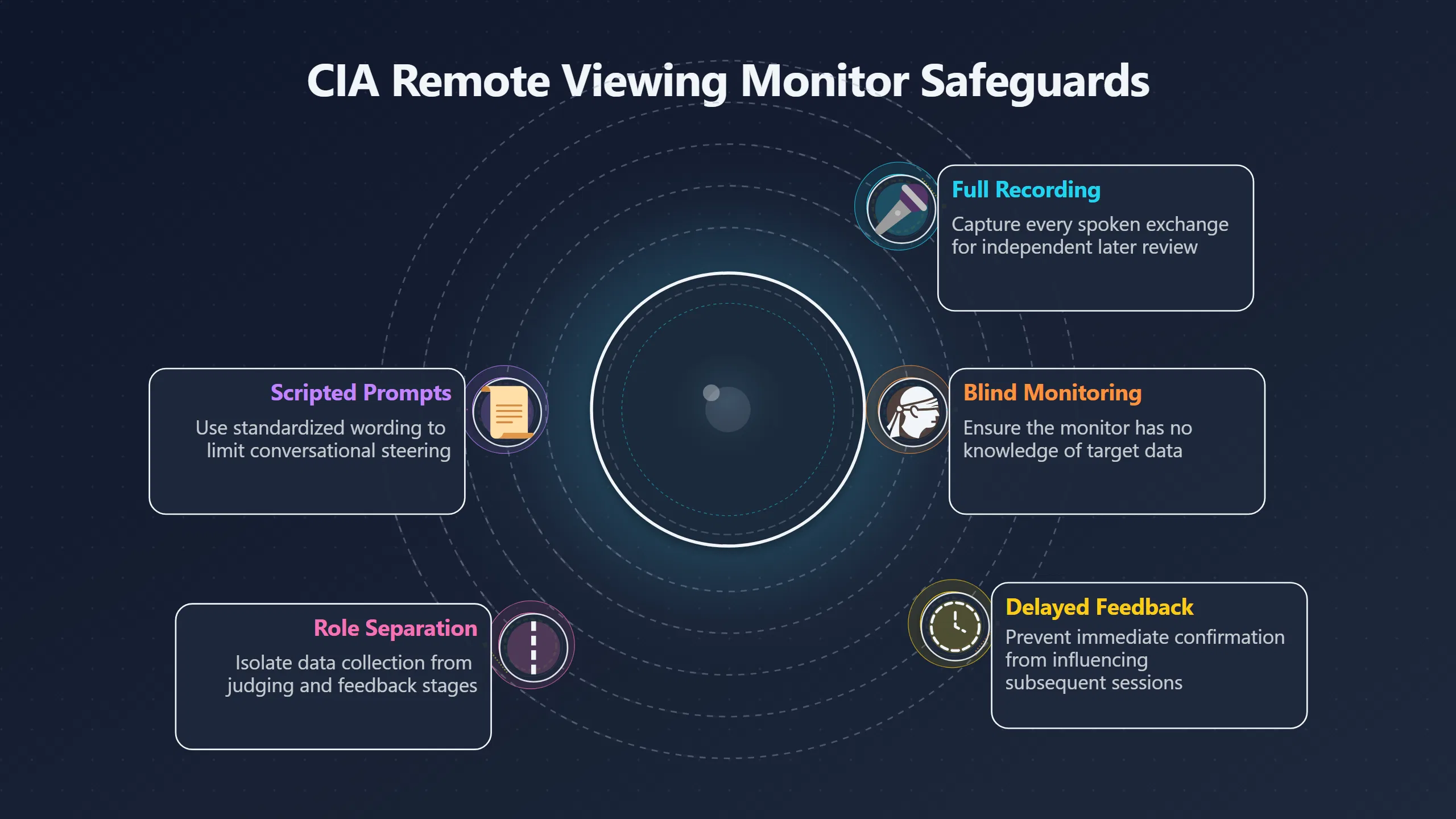
The strongest safeguard against accidental steering is simple: the monitor should not know the target.
If a monitor knows the correct answer, every interaction carries the possibility of unconscious cueing. Psychological research has long shown that expectations can influence interviews, observations and participant behaviour without intentional deception. Remote-viewing protocols therefore face a familiar experimental problem rather than a uniquely paranormal one.
Historically, some remote-viewing procedures allowed monitors to possess at least partial knowledge about the target or the wider experiment, while later protocols increasingly attempted to remove that possibility through blinding. CIA-associated training and operational documents distinguish between protocols in which monitors are blind and those in which additional precautions are taken specifically to prevent target knowledge from influencing sessions.[CIA]cia.govCIA-RDP96-00788R001300140002-2Once some degree of apparent competence has been reached, the monitor is given targets to which he is bl…
A knowledgeable monitor can unintentionally provide clues through:
- Choosing which impressions deserve expansion.
- Reacting differently to apparently accurate and inaccurate statements.
- Altering pauses or conversational rhythm.
- Signalling satisfaction or disappointment through facial expression.
- Ending the session only after hearing something that sounds target-related.
Each behaviour is ordinary human communication. The concern is not paranormal; it is whether conventional social interaction provides information that should have been unavailable.

Why structured interviewing matters
Many remote-viewing methods attempt to standardise monitor behaviour rather than relying on individual discipline.
Examples include:
- Using fixed opening instructions.
- Restricting prompts to generic requests such as “Describe your current impression.”
- Avoiding interpretive questions like “Is it a building?” or “Is someone there?”
- Recording every spoken exchange for later review.
- Separating data collection from interpretation.
The distinction between descriptive and leading prompts is important.
A neutral prompt:
“Describe whatever comes next.”
A potentially leading prompt:
“Can you describe the object more clearly?”
The second question assumes there is an object rather than, for example, a landscape, event or abstract impression. Even subtle assumptions can narrow the viewer’s responses.
Similarly, asking “What colour is the water?” differs from asking “Do you perceive any colours?” The former quietly introduces the existence of water before the viewer has independently reported it.
Lessons from the wider remote-viewing debate
The importance of monitor neutrality became clearer as methodological criticisms accumulated during the history of remote-viewing research.
David Marks and Richard Kammann argued that early positive findings could often be explained by ordinary information available through transcripts and experimental procedures rather than anomalous perception. Although much of their criticism focused on judging and transcript cues, the broader lesson extended to every stage where conventional information might enter the process, including interviewer behaviour. Subsequent exchanges between critics and original investigators led many later studies to strengthen blinding and procedural controls rather than relying solely on participant sincerity.[centerforinquiry.s3.amazonaws.com+2PubMed]centerforinquiry.s3.amazonaws.comRemote Viewing Revisitedby DF Marks · Cited by 13 — The 1970s saw the emergence of an astonishing psychic phenomenon that the principal i…
Even researchers sympathetic to remote viewing increasingly acknowledged that stronger controls were necessary if experimental results were to persuade sceptical scientists. The issue was not merely preventing fraud but preventing ordinary psychological influences from becoming alternative explanations.
Practical safeguards for cleaner sessions
Researchers seeking to minimise monitor-related leakage generally adopt several complementary protections rather than depending on any single rule.
Keep the monitor blind. The most effective safeguard is ensuring the monitor has no information about the target, target pool or expected outcome during data collection.[CIA]cia.govCIA-RDP96-00788R001300140002-2Once some degree of apparent competence has been reached, the monitor is given targets to which he is bl…
Use scripted prompts. Standardised wording reduces variation between sessions and limits opportunities for conversational steering.
Record the complete interaction. Audio or video recordings allow independent reviewers to examine whether prompts became progressively more specific or whether feedback patterns emerged.
Separate roles. The person conducting the session should ideally not select targets, perform judging or provide feedback afterwards, reducing opportunities for information to flow between stages.
Delay feedback. Immediate confirmation of successful impressions can influence later sessions if the same monitor and viewer continue working together. Delayed or carefully controlled feedback reduces cumulative learning effects.[CIA]cia.govAN EVALUATION OF THE REMOTE VIEWING PROGRAMFor example, viewers cannot be provided with feedback and targets may not display the chara…
Review prompt quality. Independent assessment of transcripts can identify recurring leading phrases, unequal questioning or conversational habits that participants themselves may never notice.

Why this issue remains important
Monitor prompts illustrate a broader challenge in remote-viewing research: extraordinary claims depend heavily on ordinary experimental discipline. A monitor does not have to reveal a target directly for bias to occur. Everyday conversational habits—encouraging certain answers, reacting to promising descriptions or asking subtly framed questions—may provide enough guidance to influence free-response reports.
For that reason, modern discussions of sensory leakage increasingly treat monitor neutrality as a practical implementation issue rather than an accusation of misconduct. The cleaner the interaction between viewer and monitor, the more confidently any apparent successes can be evaluated without wondering whether normal social communication helped produce them.
Amazon book picks
Further Reading
Books and field guides related to Can the Monitor Accidentally Lead the Viewer?. Use these as the next step if you want deeper reading beyond the article.
An introduction to parapsychology
Explains experimenter effects and protocol controls.

eBay marketplace picks
Marketplace Samples
Live-tested eBay searches with available results related to this page.




Endnotes
1.
Source: cia.gov
Link:https://www.cia.gov/readingroom/docs/CIA-RDP96-00791R000200180005-5.pdf
Source snippet
AN EVALUATION OF THE REMOTE VIEWING PROGRAMFor example, viewers cannot be provided with feedback and targets may not display the chara...
2.
Source: cia.gov
Link:https://www.cia.gov/readingroom/docs/CIA-RDP96-00788R002000240029-4.pdf
Source snippet
er have a period to relax and discuss the protocols. The goal...Read more...
3.
Source: centerforinquiry.s3.amazonaws.com
Link:https://centerforinquiry.s3.amazonaws.com/wp-content/uploads/sites/29/1982/07/22165420/p20.pdf
Source snippet
Remote Viewing Revisitedby DF Marks · Cited by 13 — The 1970s saw the emergence of an astonishing psychic phenomenon that the principal i...
4.
Source: cia.gov
Link:https://www.cia.gov/readingroom/docs/CIA-RDP96-00788R001300140002-2.pdf
Source snippet
CIA-RDP96-00788R001300140002-2Once some degree of apparent competence has been reached, the monitor is given targets to which he is bl...
5.
Source: cia.gov
Link:https://www.cia.gov/readingroom/docs/CIA-RDP96-00789R002200070001-0.pdf
Source snippet
tracks the progress of the RV session, provides the necessary...Read more...
6.
Source: cia.gov
Link:https://www.cia.gov/readingroom/docs/CIA-RDP96-00787R000500250015-6.pdf
Source snippet
SUMMARY OF KNOWN REMOTE-VIEWING EXPERIMENTS.The following very brief summaries describe those remote viewing experiments, or series of ex...
7.
Source: pubmed.ncbi.nlm.nih.gov
Link:https://pubmed.ncbi.nlm.nih.gov/7254336/
Source snippet
Nature. 1981 Jul 23;292(5821):388. doi: 10.1038/292388a0. Authors. H Puthoff, R Targ.Read more...
Additional References
8.
Source: researchgate.net
Link:https://www.researchgate.net/publication/340914519Performance_at_a_Precognitive_Remote_Viewing_Task_with_and_without[Ganzfeld
Source snippet
(PDF) Performance at a Precognitive Remote Viewing Task...Performance at a Precognitive Remote Viewing Task, with and without Ganzfeld S...
9.
Source: reddit.com
Link:https://www.reddit.com/r/aliens/comments/nqvskt/cia_document_showing_a_transcript_of_a_remote/
Source snippet
CIA document showing a transcript of a "remote viewing...In this episode we're going to talk about the time the Intelligence Agency says...
10.
Source: nectar.northampton.ac.uk
Link:https://nectar.northampton.ac.uk/id/eprint/13569/1/Roe_etal_JoP_2020_Performance_at_a_Precognitive_Remote_Viewing_Task_with_and_without_Ganzfeld_Stimulation_Three_Experiments.pdf
Source snippet
Recent research by the lead author has sought to incorporate ganzfeld stimulation as part of a remote viewing [protocol]({{ 'protocol/' | relative_url }}). Read more...
11.
Source: researchgate.net
Link:https://www.researchgate.net/profile/Harold-Puthoff/publication/15945437_Rebuttal_of_criticisms_of_remote_viewing_experiments/links/57800d8b08ae01f736e49f90/Rebuttal-of-criticisms-of-remote-viewing-experiments.pdf
Source snippet
Kammann offer criticism of the [SRI experiments]({{ 'sri-tests/' | relative_url }}) in 'remote viewing', the abil- ity of certain individuals to access...Read more...
12.
Source: researchgate.net
Title: 369604750 Remote Viewing a 1974 2022 systematic review and meta analysis
Link:https://www.researchgate.net/publication/369604750_Remote_Viewing_a_1974-2022_systematic_review_and_meta-analysis
Source snippet
(PDF) Remote Viewing: a 1974-2022 systematic review...This is the first meta-analysis of all studies related to remote viewing tasks con...
13.
Source: youtube.com
Link:https://www.youtube.com/watch?v=RJrTddUkplY
Source snippet
The CIA Protocol: How to Train Your Brain for Remote ViewingHow to boost your intuition using neuroscience and self-compassion · S...
14.
Source: scispace.com
Title: rebuttal of criticisms of remote viewing experiments 1j3arh0xxi
Link:https://scispace.com/pdf/rebuttal-of-criticisms-of-remote-viewing-experiments-1j3arh0xxi.pdf
Source snippet
Rebuttal of criticisms of remote viewing experiments23 Jul 1981 — Rebuttal of criticisms of remote viewing experiments. MARKS1 has argued...
15.
Source: parapsychologypress.org
Link:https://www.parapsychologypress.org/jparticle/jp
Source snippet
d performance at a remote viewing task in a waking condition with a ganzfeld...Read more...
16.
Source: archive.org
Title: cia readingroom document cia rdp96 00788r001800080001 5
Link:https://archive.org/details/cia-readingroom-document-cia-rdp96-00788r001800080001-5
Source snippet
CIA Reading Room cia-rdp96-00788r001800080001-5: A...Jun 24, 2023 — CIA Reading Room cia-rdp96-00788r001800080001-5: A REMOTE VIEWING EV...
17.
Source: youtube.com
Title: The Strength and Reliability of Remote Viewing with Russell Targ
Link:https://www.youtube.com/watch?v=qp3Ndkg6eJg
Source snippet
This session breakdown with Lori Williams provides crucial insight into managing remote-viewing environments and protocols to prevent ses...
Topic Tree