Within Shutdown
When Multiple Viewers Did Not Agree
The programme struggled because different viewers did not consistently converge on the same target details.
On this page
- Why convergence mattered for intelligence confidence
- What disagreement did to report credibility
- Why reliability mattered more than isolated hits
Page outline Jump by section
Introduction
One of the most practical reasons the U.S. government’s remote-viewing programme lost support was that different viewers often failed to produce mutually reinforcing descriptions of the same target. For intelligence agencies, isolated successes were never enough. Analysts needed confidence that independently collected information would converge on the same conclusions, allowing uncertain reports to be corroborated before influencing operational decisions. According to the 1995 American Institutes for Research (AIR) evaluation commissioned by the Central Intelligence Agency (CIA), remote-viewing reports generally did not meet that standard. Even where laboratory research raised interesting statistical questions, the operational record showed reports that were too inconsistent, too vague, and too difficult to interpret reliably for intelligence use.[CIA]cia.govAN EVALUATION OF THE REMOTE VIEWING PROGRAMUtts and Hyman were asked to prepare independent reports based on their review. In this rev…
Why Convergence Mattered for Intelligence Confidence
Intelligence organisations routinely compare information from multiple independent sources. Human informants, intercepted communications, satellite imagery, and other collection methods rarely agree perfectly, but confidence increases when different sources point towards the same conclusion without influencing one another.
Remote viewing faced the same practical test. If several viewers, working independently and without access to one another’s reports, repeatedly described the same distinctive target features, analysts could treat that agreement as one reason to investigate further. If the reports diverged dramatically, however, there was little objective basis for deciding which, if any, reflected reality.
The AIR review concluded that this type of dependable convergence was largely absent in operational practice. Instead of producing complementary accounts that reduced uncertainty, remote-viewing sessions often generated collections of impressions that varied widely in content and interpretation.[National Security Archive]nsarchive2.gwu.eduIn this review, they were to cover four general topics: •.Read moreNational Security ArchiveAn Evaluation of Remote Viewing: Research and…by MD Mumford · 1995 · Cited by 76 — Utts and Hyman were asked…
When Multiple Viewers Produced Different Answers
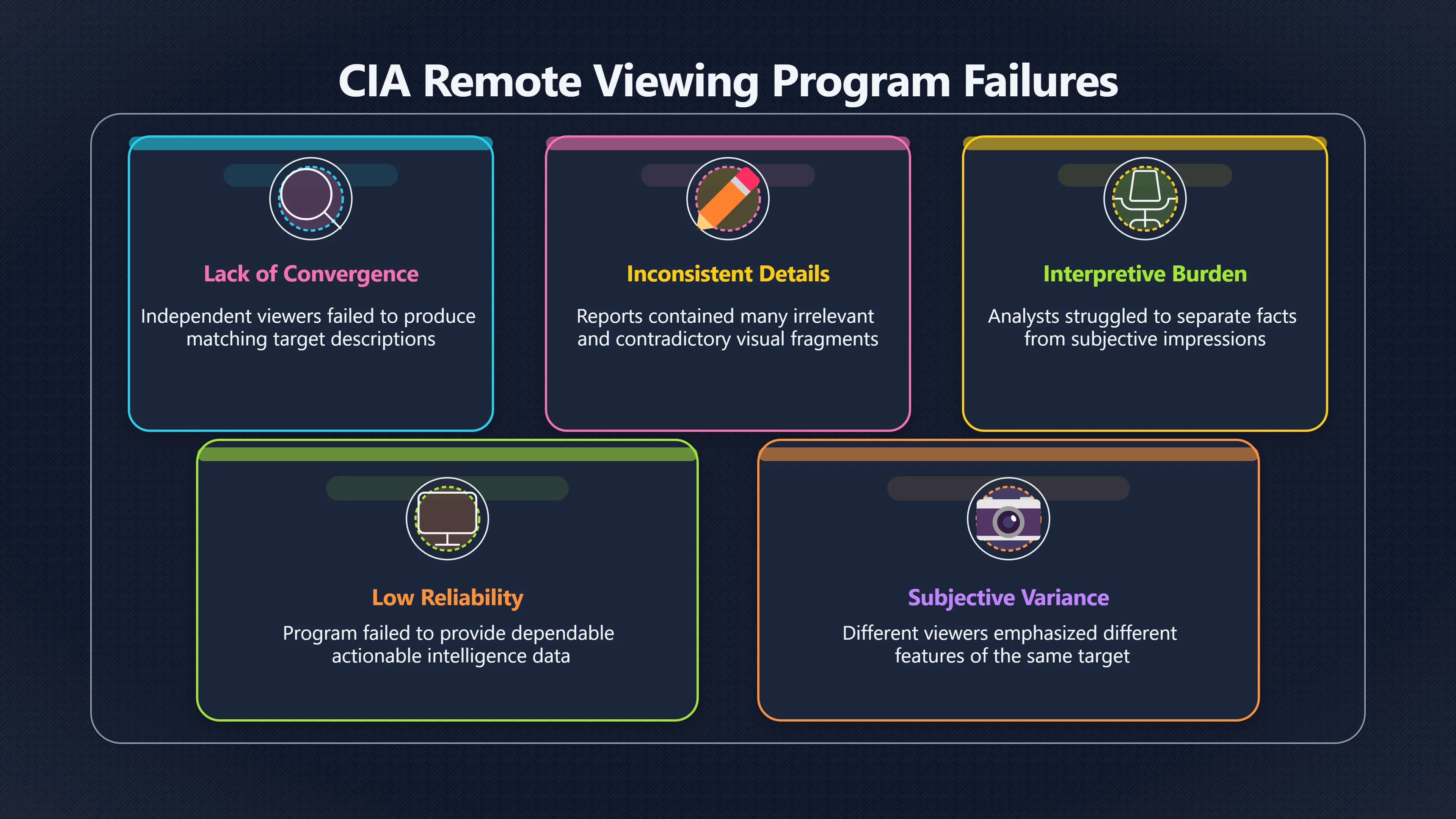
The reliability problem was not simply that viewers sometimes made mistakes. Every intelligence source makes mistakes. The deeper concern was that different viewers frequently described incompatible locations, structures, objects or events while supposedly observing the same target.
Several factors compounded this problem:
- Reports often contained numerous loosely connected images or impressions rather than precise factual statements.
- Different viewers tended to emphasise different features, making direct comparison difficult.
- Analysts frequently had to decide which fragments appeared significant only after the target became known.
- Apparent agreements could be broad enough that they might occur by coincidence, while disagreements were often substantial.
This made it difficult to distinguish genuine convergence from selective interpretation. Analysts could sometimes identify similarities after reviewing completed sessions, but those similarities were often mixed with numerous contradictory or irrelevant details.[National Security Archive]nsarchive2.gwu.eduIn this review, they were to cover four general topics: •.Read moreNational Security ArchiveAn Evaluation of Remote Viewing: Research and…by MD Mumford · 1995 · Cited by 76 — Utts and Hyman were asked…

What Disagreement Did to Report Credibility
Operational intelligence depends on credibility that can survive independent scrutiny. A report becomes more persuasive when separate collection methods reinforce one another before the outcome is known.
Remote-viewing reports often struggled to achieve this standard because they required extensive interpretation. The AIR evaluators noted that reports frequently contained substantial amounts of irrelevant and inaccurate material alongside occasional apparently correct observations. This meant analysts faced an additional problem: deciding which portions deserved attention without already knowing the answer.
Where independent viewers disagreed, that interpretive burden increased further. Rather than reducing uncertainty, multiple sessions could simply provide multiple competing narratives. Instead of functioning as independent confirmation, additional reports sometimes introduced more ambiguity.
For intelligence managers responsible for allocating resources or making operational decisions, this represented a significant weakness. Time spent comparing inconsistent psychic reports offered little advantage over conventional analytical speculation.[National Security Archive]nsarchive2.gwu.eduIn this review, they were to cover four general topics: •.Read moreNational Security ArchiveAn Evaluation of Remote Viewing: Research and…by MD Mumford · 1995 · Cited by 76 — Utts and Hyman were asked…
The Difference Between Interesting and Reliable
Supporters of remote viewing have often highlighted individual sessions that appeared impressively accurate in retrospect. The operational question, however, was different.
Intelligence programmes are judged by their average performance under realistic conditions rather than their best examples. Even an occasional striking success provides limited operational value if decision-makers cannot predict beforehand which reports deserve confidence.
The AIR review drew exactly this distinction. It acknowledged that some experimental findings and individual cases appeared noteworthy, but concluded that these observations did not translate into a dependable intelligence capability. Reliability—not isolated successes—was the deciding criterion.[National Security Archive]nsarchive2.gwu.eduIn this review, they were to cover four general topics: •.Read moreNational Security ArchiveAn Evaluation of Remote Viewing: Research and…by MD Mumford · 1995 · Cited by 76 — Utts and Hyman were asked…
Why Reliability Mattered More Than Isolated Hits
Every intelligence discipline produces some inaccurate reporting. The critical question is whether errors occur at a manageable rate and whether confidence can be improved through corroboration.
Remote viewing struggled on both counts.[cia.gov]cia.govAN EVALUATION OF REMOTE VIEWINGThe first component was a review of the research program. The second component was a review of the oper…
Because viewers frequently failed to agree independently, analysts had no objective method for determining whether agreement reflected genuine information or chance overlap, nor whether disagreement meant that one viewer was correct, all were partially correct, or none had identified the target accurately.
This uncertainty prevented remote viewing from developing into a dependable analytical tool. Without consistent inter-viewer agreement, there was no clear way to estimate confidence levels comparable to those used for conventional intelligence sources.
The Debate Over Laboratory Results Versus Operational Reliability
An important feature of the 1995 review was its separation of two different questions.
Statistician Jessica Utts argued that some laboratory experiments showed evidence of statistically significant effects deserving further scientific investigation. Psychologist Ray Hyman disagreed that the evidence established paranormal functioning and argued that independent replication and stronger methodological controls remained necessary. Despite this disagreement about laboratory evidence, both reviewers recognised that operational intelligence posed a different standard from laboratory experimentation.[CIA]cia.govAN EVALUATION OF THE REMOTE VIEWING PROGRAMUtts and Hyman were asked to prepare independent reports based on their review. In this rev…
The broader AIR evaluation ultimately focused on whether remote viewing had demonstrated practical intelligence value. The answer was negative because operational reports lacked the consistency, specificity and reliability needed to support intelligence decisions. Even if laboratory anomalies warranted further research, they did not overcome the practical problem that independent viewers did not reliably produce convergent, actionable information.
Amazon book picks
Further Reading
Books and field guides related to When Multiple Viewers Did Not Agree. Use these as the next step if you want deeper reading beyond the article.


Paranormality: Why We See What Isn't There
Explains reliability, replication and apparent agreement.
Endnotes
1.
Source: cia.gov
Link:https://www.cia.gov/readingroom/docs/CIA-RDP96-00791R000200180005-5.pdf
Source snippet
AN EVALUATION OF THE REMOTE VIEWING PROGRAMUtts and Hyman were asked to prepare independent reports based on their review. In this rev...
2.
Source: nsarchive2.gwu.edu
Title: In this review, they were to cover four general topics: •.Read more
Link:https://nsarchive2.gwu.edu/NSAEBB/NSAEBB438/docs/doc_57.pdf
Source snippet
National Security ArchiveAn Evaluation of Remote Viewing: Research and...by MD Mumford · 1995 · Cited by 76 — Utts and Hyman were asked...
3.
Source: cia.gov
Link:https://www.cia.gov/readingroom/docs/CIA-RDP96-00791R000200180006-4.pdf
Source snippet
AN EVALUATION OF REMOTE VIEWINGThe first component was a review of the research program. The second component was a review of the oper...
Additional References
4.
Source: youtube.com
Link:https://www.youtube.com/watch?v=5NHQBoEmYBo
Source snippet
Angela Ford - Meet the Army Psychic Who Tracked Spies, Hostages and Fugitives | SRS #145...
5.
Source: youtube.com
Title: Did the CIA Train Psychic Spies? | [Stargate]({{ ‘stargate/’ | relative_url }}) Project
Link:https://www.youtube.com/watch?v=4F5lH0SOqs0
Source snippet
CIA Stargate figure says psychic was 'murdered' | Reality Check with Ross Coulthart...
6.
Source: youtube.com
Title: UFO Roundtable: Former CIA Scientist Proves Aliens Exist!
Link:https://www.youtube.com/watch?v=V-z0k5xu1hM
Source snippet
Did the CIA Train Psychic Spies? | Stargate Project...
7.
Source: youtube.com
Title: Inside The Military’s Secret Psychic Unit
Link:https://www.youtube.com/watch?v=9nY3hu76SyU
Source snippet
UFO Roundtable: Former CIA Scientist Proves Aliens Exist...
8.
Source: youtube.com
Title: Angela Ford
Link:https://www.youtube.com/watch?v=nsxNOIQjCtM
Topic Tree