Within Sketches
Can Sketches Say More Than Words?
Sketches can keep layout and geometry visible before a viewer turns a vague form into a misleading noun.
On this page
- Why drawings matter in free response records
- When a sketch corrects a bad verbal label
- Limits of preserving shape without over reading it
Page outline Jump by section
Introduction
Within remote-viewing practice, sketches are valued not because they are assumed to prove paranormal perception, but because they can preserve raw spatial information before the viewer gives it a potentially misleading name. A freehand drawing of a tall vertical form, a curved shoreline or a cluster of connected shapes may capture relationships that remain useful even if the accompanying words are incorrect. This distinction became especially important because remote-viewing targets were commonly complex scenes rather than isolated symbols, making layout and geometry as important as object identification. Protocols developed during U.S. government-sponsored research therefore encouraged viewers to record impressions quickly, often through sketches, before analytical interpretation took over.[CIA+2CIA]cia.govSTAR GATE PROJECT: AN OVERVIEWSome experiments showed that a remote viewer could also describe the interior contents of target facilit…
The practical question is not whether a sketch is inherently more accurate than words. Rather, it is whether drawing delays premature interpretation long enough to preserve information that later judging can compare against the target without being distorted by an incorrect verbal label.
Why drawings matter in free-response records
Remote-viewing sessions typically produced free-response material instead of multiple-choice answers. Viewers wrote brief descriptors, made rapid sketches and sometimes added a more developed drawing at the end of the session. This approach reflected the belief that distant targets were usually environments containing multiple spatial relationships rather than single identifiable objects.[CIA]cia.govSTAR GATE PROJECT: AN OVERVIEWSome experiments showed that a remote viewer could also describe the interior contents of target facilit…
A sketch can record several kinds of information simultaneously:
- Relative position of features.
- Overall proportions.
- Direction of lines or movement.
- Boundaries between open and enclosed areas.
- Repeated structural patterns.
Unlike a single noun, a drawing does not require the viewer to decide immediately what the object “is”. Instead, it records what the viewer believes was perceived before interpretation becomes dominant.
This implementation choice also assists later judging. A judge comparing a transcript with several possible target photographs can examine whether the overall geometry resembles one image better than the alternatives, rather than relying solely on isolated descriptive words.
How sketching delays interpretation
One of the recurring ideas in controlled remote-viewing training is that perception and interpretation should be separated as much as possible. Early impressions are treated as tentative sensory or spatial fragments, while later conclusions are recognised as hypotheses rather than observations.
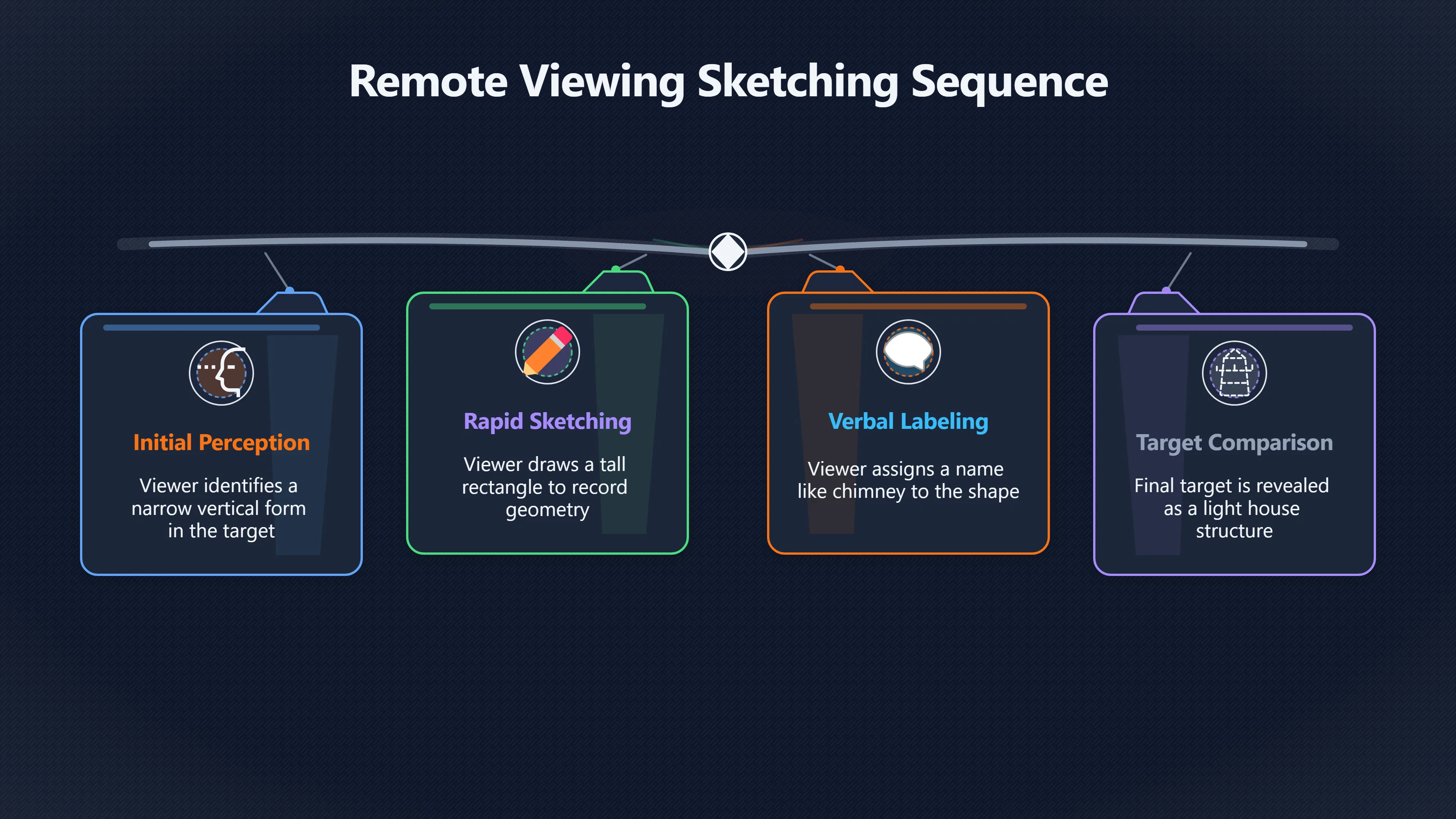
A simple sequence illustrates the mechanism:
- The viewer perceives a narrow vertical form.
- The viewer draws a tall rectangle.
- Only afterwards does the viewer think, “chimney.”
- The actual target later proves to be a lighthouse.
In this example, the verbal label fails while the sketch still captures useful structural information.
Training materials associated with Coordinate Remote Viewing (CRV) describe rapid recording procedures designed to minimise imaginative elaboration. Early ideograms and quick-response sketches are intended to capture immediate impressions before conscious reasoning builds a narrative around them. The broader purpose is not artistic quality but preservation of first-order spatial information.[CIA]cia.govSTAR GATE PROJECT: AN OVERVIEWSome experiments showed that a remote viewer could also describe the interior contents of target facilit…
When a sketch corrects a bad verbal label
The difference between shape and identification appears repeatedly in descriptions of remote-viewing methodology.
A viewer may write:
- “Bridge”
while drawing:
- a long horizontal span crossing water.
If the target is actually a dam, elevated walkway or pipeline crossing, the written noun may be wrong while the geometry remains broadly relevant.
Likewise, a viewer might describe:
- “Factory”
yet sketch:
- several rectangular buildings with one dominant tower.
If the target is an industrial power station, water-treatment facility or launch complex, the drawing may preserve relationships that the chosen label oversimplified.
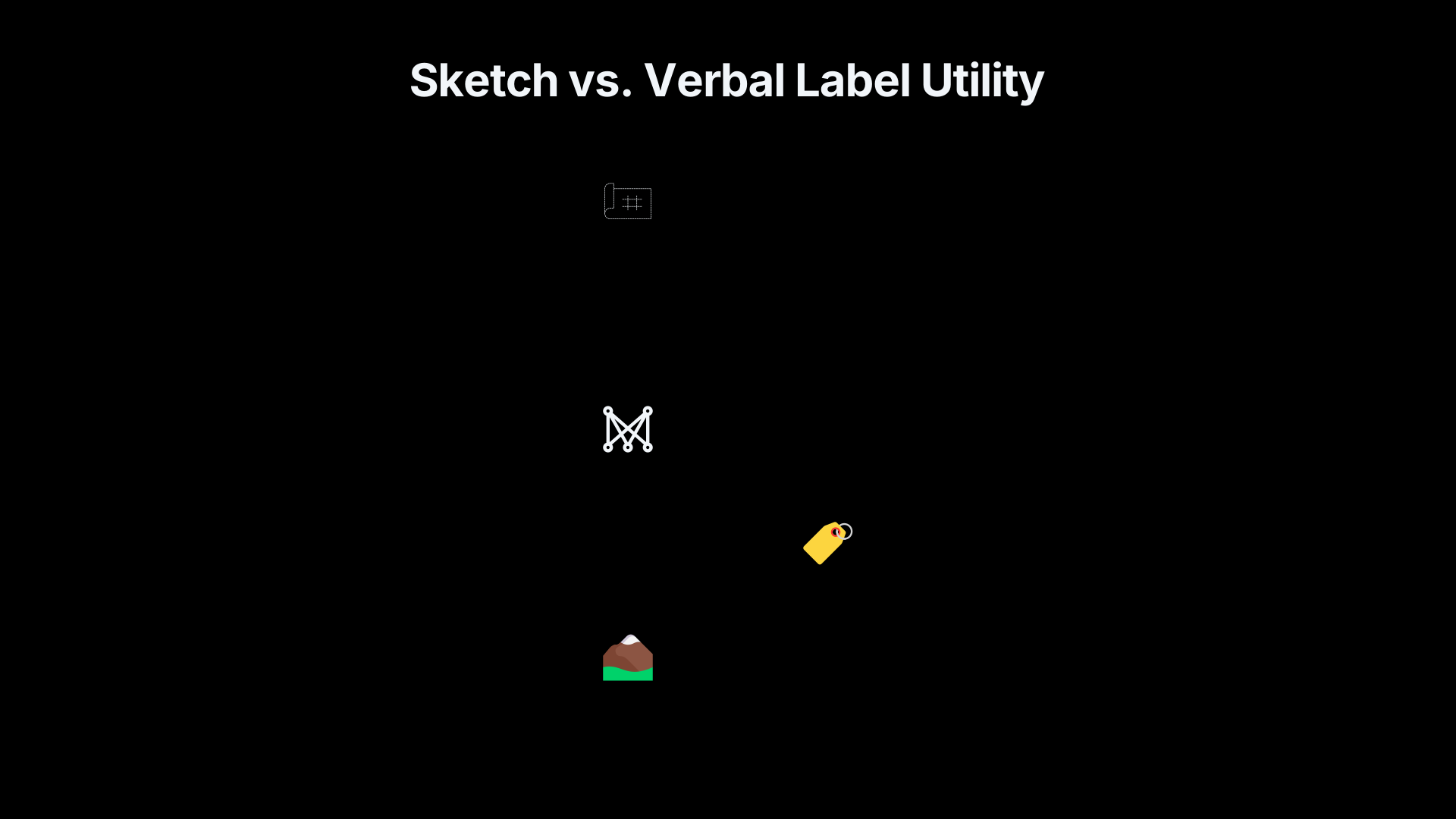
This distinction explains why many practitioners treat sketches and written descriptions as complementary rather than interchangeable records. The sketch preserves configuration, while the words attempt identification.

Why scenes benefit more than symbols
The emphasis on sketching reflects the nature of many historical remote-viewing targets. Photographs selected for experiments frequently contained landscapes, buildings, monuments, industrial sites or geographical features rather than isolated icons.
Scenes contain information that is difficult to compress into language alone:
- Distance between structures.
- Orientation.
- Elevation changes.
- Relative size.
- Overall composition.
A rough drawing can represent these relationships within seconds, even if individual objects remain unidentified.
This is one reason sketches became central to free-response protocols. They offered a compact way to record spatial organisation without requiring the viewer to solve the recognition problem first.
The role of sketches in judging
The usefulness of a sketch depends heavily on how it is evaluated.
In stronger experimental designs, judges compare complete transcripts—including sketches—against several possible targets while remaining blind to the correct answer. They assess the overall correspondence before learning which image was actually selected. Such procedures attempt to reduce hindsight matching, where vague drawings acquire apparent meaning only after the target becomes known.[PMC]pmc.ncbi.nlm.nih.govPMCFollow‐up on the U.SCentral Intelligence Agency's (CIA…by Á Escolà‐Gascón · 2023 · Cited by 10 — Since 1972, the U.S. Central Intelligence Agency (CIA) co…
This means the evidential value of a sketch does not come from isolated similarities but from whether the complete pattern distinguishes the correct target from realistic alternatives.
For example, a drawing showing:
- a dominant central tower,
- surrounding open ground,
- adjacent water,
- and a curved access route,
is more informative if only one candidate target shares that overall arrangement than if similar layouts appear across several decoy photographs.
Limits of preserving shape without over-reading it
Although sketches can preserve geometric information, they also introduce important limitations.
First, freehand drawings are inherently ambiguous. A few intersecting lines may resemble many different structures depending on what comparison image is available.
Second, people naturally search for recognisable patterns. Once the true target is revealed, observers often reinterpret simple marks as surprisingly accurate representations. This tendency can inflate perceived correspondence unless judging occurred under blind conditions.
Third, viewers frequently modify or annotate sketches as sessions progress. If later interpretations become mixed with earlier drawings, distinguishing raw perception from subsequent reasoning becomes difficult.
These concerns formed part of the wider criticism of remote-viewing research. Reviews commissioned after the U.S. intelligence programme ended concluded that while some experimental results appeared statistically interesting, operational reports often contained vague, irrelevant or contradictory material that limited practical usefulness. The flexibility of interpreting sketches was one factor contributing to that assessment.[PMC]pmc.ncbi.nlm.nih.govPMCFollow‐up on the U.SCentral Intelligence Agency's (CIA…by Á Escolà‐Gascón · 2023 · Cited by 10 — Since 1972, the U.S. Central Intelligence Agency (CIA) co…
What sketches contribute—and what they cannot prove
Within remote-viewing methodology, sketches are best understood as a recording tool rather than independent evidence. Their principal value lies in preserving spatial relationships before verbal interpretation narrows the possibilities into a single object or explanation.
When used carefully, sketches can retain information that later proves more accurate than an accompanying noun. They may show proportions, orientation and layout that survive even when identification fails. However, that same openness also creates room for subjective interpretation after the fact.
For this reason, the significance of a remote-viewing sketch depends less on the drawing itself than on the protocol surrounding it: whether it was produced before feedback, preserved without alteration, and evaluated through genuinely blind comparison with appropriate alternative targets. Only within that framework can a sketch’s preservation of shape be meaningfully distinguished from retrospective pattern matching.
Amazon book picks
Further Reading
Books and field guides related to Can Sketches Say More Than Words?. Use these as the next step if you want deeper reading beyond the article.
Drawing on the right side of the brain
Supports the idea of preserving visual information before labeling.
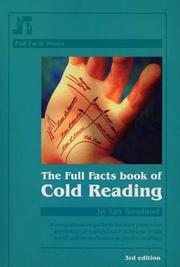
The Full Facts book of Cold Reading
Highlights why raw observations matter more than interpretations.
eBay marketplace picks
Marketplace Samples
Live-tested eBay searches with available results related to this page.

Endnotes
1.
Source: cia.gov
Link:https://www.cia.gov/readingroom/docs/CIA-RDP96-00789R002800180001-2.pdf
Source snippet
STAR GATE PROJECT: AN OVERVIEWSome experiments showed that a remote viewer could also describe the interior contents of target facilit...
2.
Source: cia.gov
Link:https://www.cia.gov/readingroom/document/cia-rdp96-00787r000300290001-9
Source snippet
analysis to interpret the data.Read more...
3.
Source: pmc.ncbi.nlm.nih.gov
Title: PMCFollow‐up on the U.S
Link:https://pmc.ncbi.nlm.nih.gov/articles/PMC10275521/
Source snippet
Central Intelligence Agency's (CIA...by Á Escolà‐Gascón · 2023 · Cited by 10 — Since 1972, the U.S. Central Intelligence Agency (CIA) co...
Additional References
4.
Source: Wikipedia
Link:https://en.wikipedia.org/wiki/[Stargate
Source snippet
Stargate Project (U.S. Army unit)The Stargate Project's work primarily involved remote viewing, the purported ability to psychically "...
5.
Source: reddit.com
Link:https://www.reddit.com/r/consciousness/comments/181s71r/the_cias_experiments_with_remote_viewing_and/
Source snippet
perimentation with Ingo Swann can provide some evidence toward “non-local...Read more...
6.
Source: frieze.com
Title: remote viewing resurrecting cias art psychic travel
Link:https://www.frieze.com/article/remote-viewing-resurrecting-cias-art-psychic-travel
Source snippet
Remote Viewing: Resurrecting the CIA's Art of Psychic Travel26 Nov 2018 — Remote viewing is the technique whereby an individual in one lo...
7.
Source: academia.edu
Link:https://www.academia.edu/95285973/The_Star_Gate_Operational_Remote_Viewing_Program_A_Human_Intelligence_HUMINT_Collection_Platform
Source snippet
ponse to the overall task requirement emerges...
8.
Source: ciaotest.cc.columbia.edu
Title: sa jan02srm01
Link:https://ciaotest.cc.columbia.edu/olj/sa/sa_jan02srm01.html
Source snippet
Remote Viewing: The US Sponsored Psychic...'Remote Viewing,' popularly known as Extra Sensory Perception (ESP) is the ability of human b...
9.
Source: youtube.com
Title: The Ideogram Controversy in Remote Viewing with Paul H. Smith
Link:https://www.youtube.com/watch?v=CGOKfM7AORI
Source snippet
Learn How To Remote View In Less Than 20 Minutes...
10.
Source: youtube.com
Title: Controlled Remote Viewing Ideogram Exercise (Phase 1)
Link:https://www.youtube.com/watch?v=BjcePZtv3WA
Source snippet
The Ideogram Controversy in Remote Viewing with Paul H. Smith...
11.
Source: youtube.com
Title: Learn How To Remote View In Less Than 20 Minutes!
Link:https://www.youtube.com/watch?v=Thq8sVv0lps
Source snippet
Controlled Remote Viewing Ideogram Practice 1...
12.
Source: youtube.com
Title: Controlled Remote Viewing Ideogram Practice 1
Link:https://www.youtube.com/watch?v=7kbh1WFA1lU
Source snippet
Remote Viewing Session Stage 3 - More Results...
13.
Source: youtube.com
Link:https://www.youtube.com/shorts/dONTEBszMm8
Topic Tree