Within Hits
When Ordinary Clues Create Psychic Looking Hits
Ordinary clues in transcripts, order or handling can make a match look paranormal when the judging process has leaked information.
On this page
- How cue leakage can enter judging
- Why early SRI disputes focused on controls
- How better blinding changes the evidence question
Page outline Jump by section
Introduction
One of the central questions in remote viewing research is whether an apparent “hit” reflects paranormal perception or ordinary information leakage. In free-response experiments, participants typically produce sketches and descriptive notes rather than precise predictions. If judges receive even small unintended clues about the target, those ordinary cues can make the correct match seem remarkably accurate without requiring any paranormal explanation. This possibility is known as sensory cueing or sensory leakage, and it became one of the most important methodological disputes in the history of remote viewing research.[PubMed]pubmed.ncbi.nlm.nih.govNature. 1981 Jul 9;292(5819):177. doi: 10.1038/292177a0. Author. D Marks. PMID: 7242682; DOI: 10.1038/…Read more…
The issue is not limited to obvious cheating. A transcript may contain dates, references to previous sessions, handling marks, or subtle contextual information that allows a judge to infer the correct target. Because remote viewing often relies on subjective interpretation, even weak cues can combine with flexible matching to produce convincing-looking successes. For this reason, debates over remote viewing have increasingly focused not only on statistical results but on whether experiments successfully eliminated every plausible source of ordinary information.
How cue leakage can enter judging
Sensory cueing refers to any route by which information about the target reaches a judge or participant through normal means rather than paranormal perception. In remote viewing studies, the viewer may remain genuinely blind to the target while the judging process is unintentionally compromised.
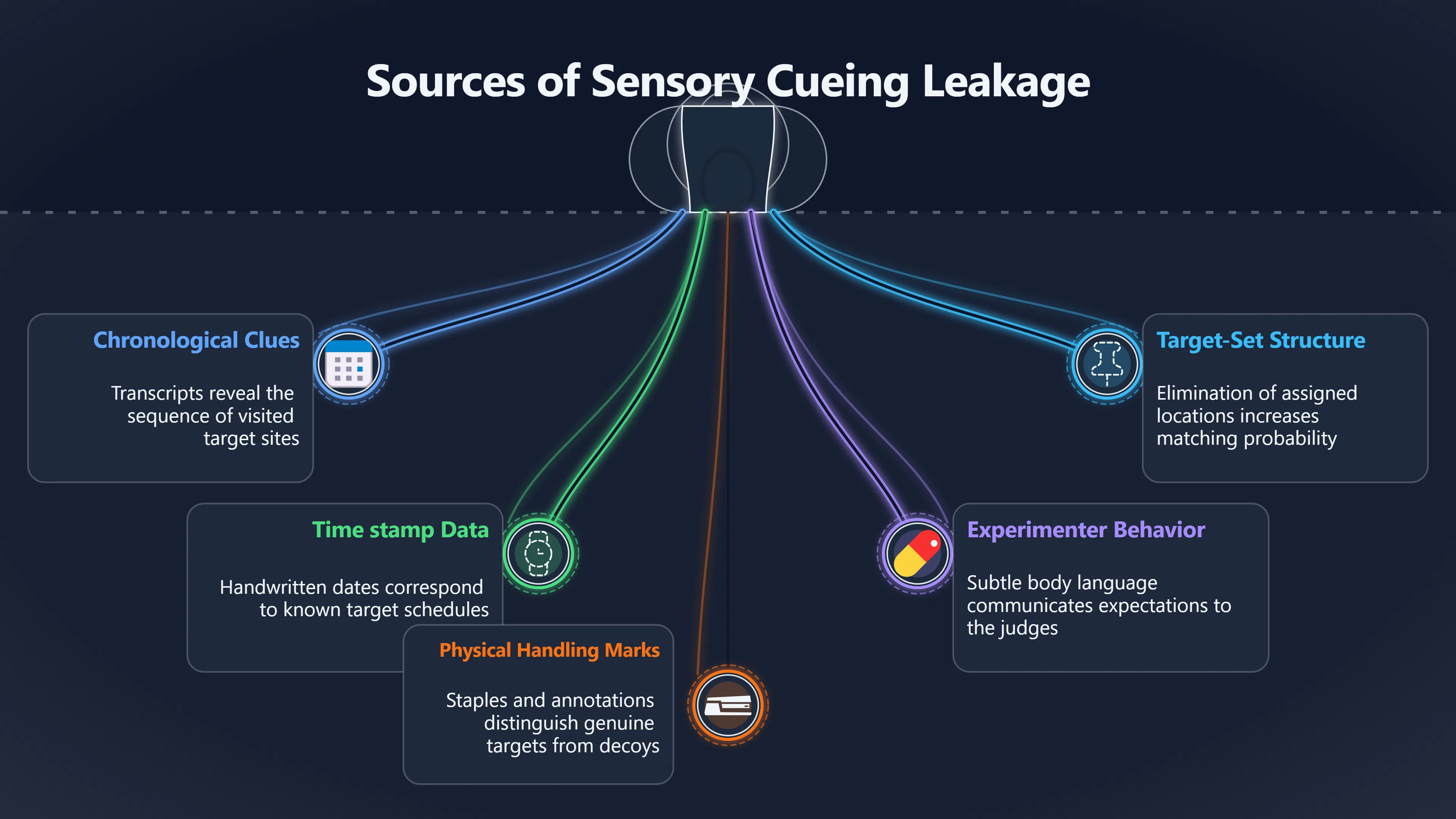
Several kinds of leakage have been identified in published critiques:
- Chronological clues: transcripts mentioning “yesterday’s target” or other sequencing information can reveal the order in which sites were visited.
- Dates and timestamps: handwritten dates or session identifiers may correspond to known target schedules.
- Physical handling cues: differences in paper, annotations, staples or formatting may distinguish genuine targets from decoys.
- Experimenter behaviour: subtle verbal emphasis, body language or expectations can unintentionally influence judging if the experimenter knows the correct answer.
- Target-set structure: if judges know some locations have already been assigned, simple elimination can increase the probability of selecting the remaining correct target. The CIA-commissioned review identified such elimination effects as a genuine statistical weakness in some earlier work.[CIA]cia.govAN EVALUATION OF THE REMOTE VIEWING PROGRAMOne statistical flaw found in early studies of remote viewing, for example, was due to fail…
Individually, these cues may appear trivial. Collectively, they create additional information that can substantially improve matching accuracy without invoking extrasensory perception.
Why early SRI disputes focused on controls
The best-known controversy concerned the early remote viewing experiments conducted at the Stanford Research Institute (SRI) during the 1970s. These studies reported above-chance matching between viewer transcripts and distant target locations.
Psychologists David Marks and Richard Kammann attempted independent replications but were unable to reproduce the findings. They then examined the judging materials used in the original experiments and argued that the transcripts themselves contained chronological and contextual clues that allowed the target locations to be reconstructed through ordinary reasoning. According to their analysis, judges did not need paranormal information if they could exploit these accidental cues.[PubMed]pubmed.ncbi.nlm.nih.govNature. 1981 Jul 9;292(5819):177. doi: 10.1038/292177a0. Author. D Marks. PMID: 7242682; DOI: 10.1038/…Read more…
Marks later reported that he could correctly match transcripts to targets using only these ordinary clues, without visiting any target locations himself. His criticism was therefore directed less at the viewers than at the experimental design. The claim was that apparently impressive hit rates could emerge because the judging materials leaked information.[PubMed]pubmed.ncbi.nlm.nih.govNature. 1981 Jul 9;292(5819):177. doi: 10.1038/292177a0. Author. D Marks. PMID: 7242682; DOI: 10.1038/…Read more…
Supporters of the SRI research disputed these conclusions and argued that later analyses still showed above-chance performance. However, the controversy shifted attention away from individual striking cases and towards methodological questions about whether the judging process had been genuinely blind.[Wikipedia]WikipediaRemote viewingRemote viewing
Why better blinding changes the evidence question
The cueing debate had an important consequence for later remote viewing research: stronger blinding procedures became a methodological necessity rather than an optional refinement.
Modern protocols typically aim to separate every stage of the experiment:
- the viewer does not know the target;
- the monitor does not know the target;
- the person preparing the target pool is separated from judging;
- judges receive standardised materials stripped of identifying information;
- target order is randomised before judging begins.
These procedures are designed to ensure that successful matches cannot reasonably be attributed to ordinary channels of information. CIA protocol documents describing later remote viewing procedures explicitly emphasise formal blind judging for this reason.[CIA]cia.govSTANDARD REMOTE VIEWING (RV) PROCEDURESa formal blind judging procedure (described below) is used to evaluate the data and quantify th…
Importantly, stronger blinding does not itself demonstrate remote viewing. Instead, it changes the interpretation of any positive result. If cueing has genuinely been eliminated, researchers must then ask whether the remaining evidence exceeds chance for some other reason. If cueing has not been eliminated, the experiment cannot distinguish paranormal perception from conventional information leakage.
Why cueing matters even when no one cheats
A common misunderstanding is that sensory cueing implies fraud. In practice, most methodological discussions concern unintentional leakage.
Psychological research shows that people are highly sensitive to contextual information without consciously recognising it. Judges may sincerely believe they are matching transcripts solely because of descriptive similarities while also being influenced by subtle chronological or procedural clues. Likewise, experimenters can unintentionally communicate expectations through routine interactions.
This distinction matters because remote viewing experiments depend heavily on human judgement. The more subjective the matching process, the greater the importance of removing every source of non-paranormal information before evaluating whether a genuine anomaly remains.
What later evaluations concluded
The 1995 American Institutes for Research evaluation commissioned for the CIA accepted that some remote viewing experiments produced statistically interesting results, but concluded that methodological weaknesses prevented the findings from supporting operational intelligence use. Among the concerns discussed were weaknesses in experimental design, dependence on particular judges or viewers, and insufficient separation of potential non-paranormal influences.[National Security Archive+2Alice]nsarchive2.gwu.edurelatively specific informationNational Security ArchiveAn Evaluation of Remote Viewing: Research and…March 13, 2015 — by MD Mumford · 1995 · Cited by 76 — the doubl…
Subsequent debates have therefore tended to separate two questions that are sometimes conflated:
- Were some experiments statistically unusual?
- Can those results be confidently attributed to paranormal perception rather than ordinary information leakage or methodological artefacts?
Sensory cueing sits at the centre of the second question. Even a small amount of leaked information can create convincing-looking matches in free-response judging, making rigorous blinding essential before any apparent remote viewing hit can be interpreted as evidence for anomalous perception rather than normal human pattern recognition.
Amazon book picks
Further Reading
Books and field guides related to When Ordinary Clues Create Psychic-Looking Hits. Use these as the next step if you want deeper reading beyond the article.

Remote Viewers: The Secret History of America's Psychic Spies
Provides historical context for protocol disputes.
eBay marketplace picks
Marketplace Samples
Live-tested eBay searches with available results related to this page.


Endnotes
1.
Source: cia.gov
Link:https://www.cia.gov/readingroom/docs/CIA-RDP96-00791R000200180005-5.pdf
Source snippet
AN EVALUATION OF THE REMOTE VIEWING PROGRAMOne statistical flaw found in early studies of remote viewing, for example, was due to fail...
2.
Source: cia.gov
Link:https://www.cia.gov/readingroom/docs/CIA-RDP96-00791R000200180006-4.pdf
Source snippet
AN EVALUATION OF REMOTE VIEWINGUse of the same remote viewers, the same judge, and the same target photographs makes it impossible to...
3.
Source: Wikipedia
Title: Remote viewing
Link:https://en.wikipedia.org/wiki/Remote_viewing
4.
Source: cia.gov
Link:https://www.cia.gov/readingroom/docs/CIA-RDP96-00788R002000240029-4.pdf
Source snippet
STANDARD REMOTE VIEWING (RV) PROCEDURESa formal blind judging procedure (described below) is used to evaluate the data and quantify th...
5.
Source: pubmed.ncbi.nlm.nih.gov
Link:https://pubmed.ncbi.nlm.nih.gov/7242682/
Source snippet
Nature. 1981 Jul 9;292(5819):177. doi: 10.1038/292177a0. Author. D Marks. PMID: 7242682; DOI: 10.1038/...Read more...
6.
Source: nsarchive2.gwu.edu
Title: relatively specific information
Link:https://nsarchive2.gwu.edu/NSAEBB/NSAEBB438/docs/doc_57.pdf
Source snippet
National Security ArchiveAn Evaluation of Remote Viewing: Research and...March 13, 2015 — by MD Mumford · 1995 · Cited by 76 — the doubl...
Published: March 13, 2015
7.
Source: alice.id.tue.nl
Link:https://www.alice.id.tue.nl/references/mumford-rose-goslin-1995.pdf
Source snippet
An Evaluation of Remote Viewing: Research and...by MD Mumford · 1995 · Cited by 75 — In fact, even the most favorable of the user g...
Additional References
8.
Source: youtube.com
Title: Investigating the Accuracy of Perceptions During Out-of-Body Experiences
Link:https://www.youtube.com/watch?v=G9N3cmcm5e0
Source snippet
This video on Remote Viewing Psychology with Charles T. Tart is highly relevant because it features Dr. Tart explaining how the judging p...
9.
Source: psi-encyclopedia.spr.ac.uk
Title: Psi Encyclopedia Remote Viewing
Link:https://psi-encyclopedia.spr.ac.uk/articles/remote-viewing/
Source snippet
Psi EncyclopediaRemote Viewing - Psi Encyclopedia13 Jan 2017 — Remote viewing replaced repetitive forced-choice tasks with free-response...
10.
Source: youtube.com
Title: Experts’ Remote Viewing Guidelines Presented by Jimmy Akin
Link:https://www.youtube.com/watch?v=TsVhhzBSmIs
Source snippet
Remote Viewing Psychology with Charles T. Tart...
11.
Source: youtube.com
Title: Remote Viewing 3.0 with Jana Rogge
Link:https://www.youtube.com/watch?v=GtyyaV5n6aA
Source snippet
Investigating the Accuracy of Perceptions During Out-of-Body Experiences...
12.
Source: youtube.com
Title: Remote Viewing and Statistical Validation
Link:https://www.youtube.com/watch?v=YrwAiU2g5RU
Source snippet
Experts' Remote Viewing Guidelines Presented by Jimmy Akin...
13.
Source: youtube.com
Title: Remote Viewing Psychology with Charles T. Tart
Link:https://www.youtube.com/watch?v=jPZwaicuiek
Source snippet
Remote Viewing 3.0 with Jana Rogge...
Topic Tree