Within Lab vs Real
What the Official Review Warned About
The official evaluation found that statistical effects did not translate into reliable intelligence value for end users.
On this page
- The laboratory versus operation distinction
- Why intelligence users found limited value
- What the review means for practical claims
Page outline Jump by section
Introduction
The most consequential finding of the 1995 American Institutes for Research (AIR) evaluation was not simply a judgement about whether remote viewing showed statistical effects in laboratory experiments. Its central operational warning was that even if laboratory anomalies existed, they did not translate into intelligence that decision-makers could reliably use. The review drew a deliberate distinction between evidence that a phenomenon might occur under controlled conditions and evidence that it could produce timely, specific and dependable information for real-world operations.[National Security Archive]nsarchive2.gwu.eduNational Security ArchiveAn Evaluation of Remote Viewing: Research and…March 13, 2015 — by MD Mumford · 1995 · Cited by 76 — Thus, we…
This distinction became the defining conclusion of the official evaluation. Rather than asking whether remote viewers occasionally produced descriptions that appeared better than chance, the AIR reviewers examined whether the programme had demonstrated consistent operational value. Their answer was that it had not. The information reaching intelligence users was generally too vague, inconsistent and dependent on subjective interpretation to support action, leading the reviewers to conclude that continued operational use was not justified.[National Security Archive]nsarchive2.gwu.eduNational Security ArchiveAn Evaluation of Remote Viewing: Research and…March 13, 2015 — by MD Mumford · 1995 · Cited by 76 — Thus, we…
The Laboratory-Versus-Operation Distinction
The AIR review separated two questions that had often been treated as if they were the same.
The first question concerned laboratory evidence. Some experimental studies reported statistical departures from chance under tightly controlled conditions, a point emphasised in the parallel assessment by statistician Jessica Utts. The second question was entirely different: whether those findings resulted in intelligence products that could guide military or intelligence decisions. AIR concluded that success on the first question, even if accepted, did not answer the second.[National Security Archive]nsarchive2.gwu.eduNational Security ArchiveAn Evaluation of Remote Viewing: Research and…March 13, 2015 — by MD Mumford · 1995 · Cited by 76 — Thus, we…
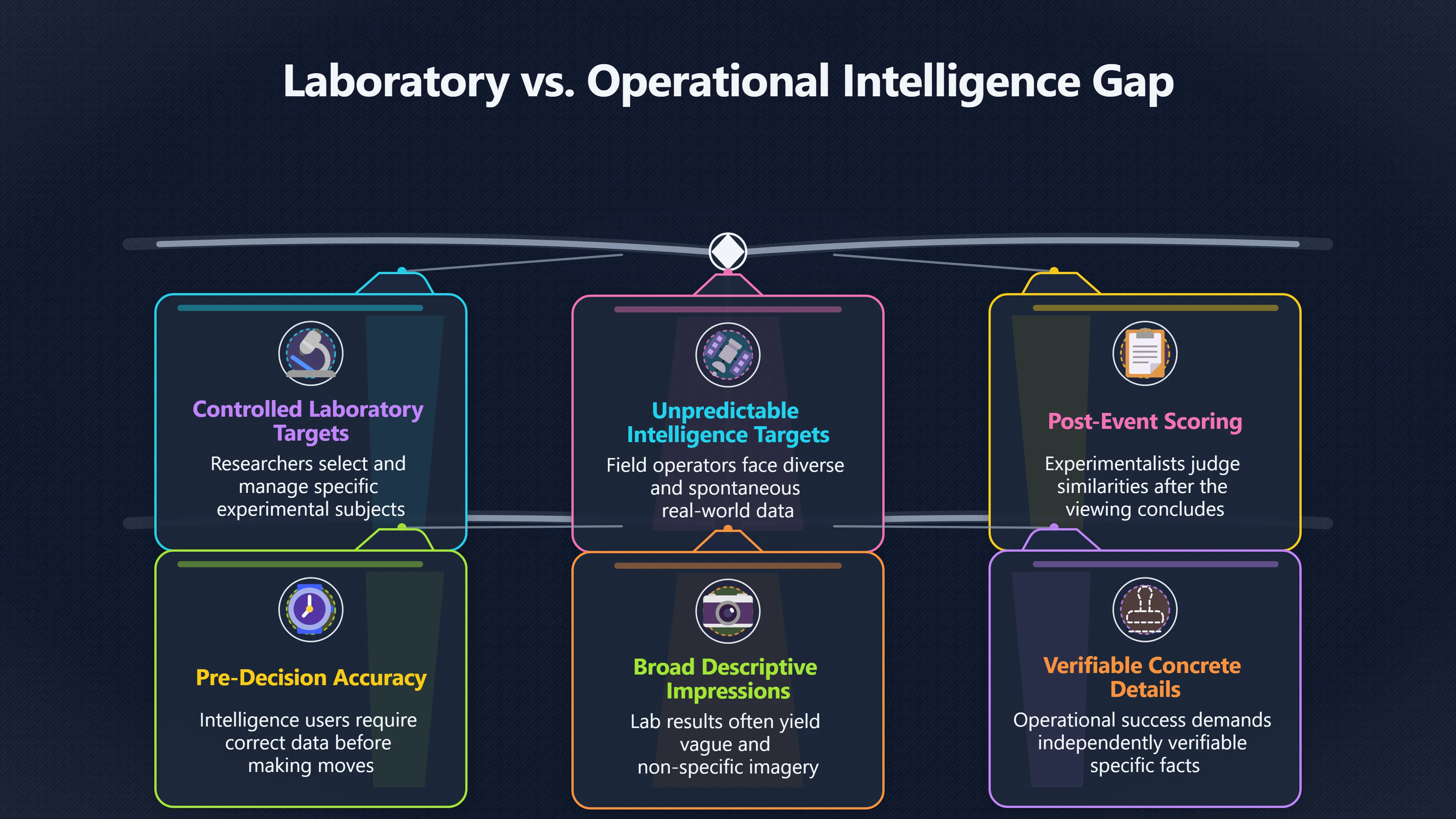
The report identified several reasons why laboratory conditions differed fundamentally from operational intelligence work:
- Laboratory targets were carefully selected and controlled, whereas intelligence targets were diverse and unpredictable.
- Experimental protocols could provide conditions, including forms of feedback, that were unavailable during genuine intelligence collection.
- Laboratory scoring often involved judging similarities after the event, while operational users needed information that was correct before decisions were made.
- Intelligence work required concrete, independently verifiable details rather than broad descriptive impressions.[National Security Archive]nsarchive2.gwu.eduNational Security ArchiveAn Evaluation of Remote Viewing: Research and…March 13, 2015 — by MD Mumford · 1995 · Cited by 76 — Thus, we…
The reviewers therefore argued that a statistical anomaly, even if genuine, would not automatically become a practical intelligence capability.
Why Intelligence Users Found Limited Value
A distinctive feature of the AIR evaluation was that it did not rely solely on statistical reviews. It also examined how intelligence customers had actually used remote-viewing reports.
According to the report, end users acknowledged that reports sometimes appeared to capture broad background characteristics. However, they consistently judged the material to be deficient in the specific information required for operational decisions. The reviewers summarised several recurring problems:
- reports contained mixtures of correct and incorrect information;
- accurate elements were often broad rather than operationally useful;
- specific details were frequently inaccurate;
- analysts had to perform substantial subjective interpretation before reports could be considered meaningful.[National Security Archive]nsarchive2.gwu.eduNational Security ArchiveAn Evaluation of Remote Viewing: Research and…March 13, 2015 — by MD Mumford · 1995 · Cited by 76 — Thus, we…
The practical consequence was significant. Intelligence organisations rarely benefit from information that is merely suggestive. They require enough confidence in locations, identities, timing or capabilities to justify allocating resources or changing plans. AIR concluded that remote-viewing reports did not consistently meet that threshold.[National Security Archive]nsarchive2.gwu.eduNational Security ArchiveAn Evaluation of Remote Viewing: Research and…March 13, 2015 — by MD Mumford · 1995 · Cited by 76 — Thus, we…
The Meaning of “Actionable Intelligence”
Perhaps the report’s most widely cited operational finding was its assessment of actionable intelligence.
The evaluation stated that, despite years of operational effort, there was no documented case in which remote-viewing information had provided a sufficient basis for directing intelligence operations. In other words, reports had not demonstrated practical decision value beyond generating material that analysts might consider alongside other information.[National Security Archive]nsarchive2.gwu.eduNational Security ArchiveAn Evaluation of Remote Viewing: Research and…March 13, 2015 — by MD Mumford · 1995 · Cited by 76 — Thus, we…
This conclusion reflected more than occasional errors. Intelligence systems routinely tolerate uncertainty, but they depend on methods whose reliability can be estimated and whose performance improves operational outcomes. AIR found no convincing evidence that remote viewing achieved this standard.
The report also noted that large quantities of irrelevant or erroneous material reduced confidence in the technique. When genuine-looking correspondences appeared, users still lacked a dependable way to determine in advance which statements were accurate and which were not.[National Security Archive]nsarchive2.gwu.eduNational Security ArchiveAn Evaluation of Remote Viewing: Research and…March 13, 2015 — by MD Mumford · 1995 · Cited by 76 — Thus, we…
Why the Operational Warning Was Separate from the Scientific Debate
The AIR review is often remembered because it contained contrasting expert perspectives. Jessica Utts argued that the laboratory evidence justified serious scientific attention, whereas Ray Hyman maintained that methodological issues and replication concerns prevented firm conclusions about paranormal functioning.[Wikipedia]WikipediaJessica UttsJessica Utts
Importantly, the operational warning issued by AIR did not depend entirely on resolving that scientific disagreement. The review explicitly argued that even if future research established a genuine laboratory phenomenon, the evidence available in 1995 still failed to demonstrate usefulness for intelligence operations because operational conditions differed fundamentally from laboratory settings and the resulting information lacked the specificity required by intelligence users.[National Security Archive]nsarchive2.gwu.eduNational Security ArchiveAn Evaluation of Remote Viewing: Research and…March 13, 2015 — by MD Mumford · 1995 · Cited by 76 — Thus, we…
This separation remains one of the report’s most influential contributions. It recognised that evidence for an unusual effect and evidence for a useful operational capability are different evidential claims requiring different standards of proof.
What the Warning Means for Practical Claims
The AIR report established an evaluation framework that continues to shape discussion of remote viewing.
Its operational warning implies that practical claims should not be judged solely by laboratory statistics or occasional impressive anecdotes. Instead, a technique intended for intelligence or other high-stakes applications must demonstrate that it can repeatedly produce information that is:
- sufficiently specific before outcomes are known;
- consistently accurate across diverse operational tasks;
- reliable enough to justify decisions;
- independently useful without extensive subjective interpretation.[National Security Archive]nsarchive2.gwu.eduNational Security ArchiveAn Evaluation of Remote Viewing: Research and…March 13, 2015 — by MD Mumford · 1995 · Cited by 76 — Thus, we…
Because the official review found these requirements unmet, it concluded that continued operational use within the intelligence community was unwarranted. The lasting significance of the AIR evaluation therefore lies not only in its assessment of remote viewing itself, but also in its clear distinction between statistical laboratory observations and demonstrated real-world performance.[National Security Archive]nsarchive2.gwu.eduNational Security ArchiveAn Evaluation of Remote Viewing: Research and…March 13, 2015 — by MD Mumford · 1995 · Cited by 76 — Thus, we…
Amazon book picks
Further Reading
Books and field guides related to What the Official Review Warned About. Use these as the next step if you want deeper reading beyond the article.
Thinking, Fast and Slow
Explains judgment errors affecting intelligence interpretation.

Remote viewing secrets
Provides first-hand discussion of remote-viewing practice and claims.

The seventh sense
Gives operational perspective relevant to official program evaluations.
eBay marketplace picks
Marketplace Samples
Live-tested eBay searches with available results related to this page.



Endnotes
1.
Source: Wikipedia
Title: Jessica Utts
Link:https://en.wikipedia.org/wiki/Jessica_Utts
2.
Source: Wikipedia
Title: Remote viewing
Link:https://en.wikipedia.org/wiki/Remote_viewing
Source snippet
Remote viewingThe project was transferred from DIA to the CIA in 1995. In 1995, the CIA hired the American Institutes for Research (AI...
3.
Source: nsarchive2.gwu.edu
Link:https://nsarchive2.gwu.edu/NSAEBB/NSAEBB438/docs/doc_57.pdf
Source snippet
National Security ArchiveAn Evaluation of Remote Viewing: Research and...March 13, 2015 — by MD Mumford · 1995 · Cited by 76 — Thus, we...
Published: March 13, 2015
Additional References
4.
Source: cia.gov
Link:https://www.cia.gov/readingroom/docs/CIA-RDP96-00791R000200180006-4.pdf
Source snippet
AN EVALUATION OF REMOTE VIEWINGThe first component was a review of the research program. The second component was a review of the operati...
5.
Source: cia.gov
Link:https://www.cia.gov/readingroom/docs/CIA-RDP96-00791R000200180005-5.pdf
Source snippet
AN EVALUATION OF THE REMOTE VIEWING PROGRAMThe first component was a review of the research program. The second component was a review...
6.
Source: goremoteviewing.com
Title: air [1995 evaluation]({{ ‘1995-review/’ | relative_url }}) remote viewing research applications
Link:https://www.goremoteviewing.com/research/air-1995-evaluation-remote-viewing-research-applications
Source snippet
CIA AIR 1995 Remote Viewing Evaluation SummaryA structured summary of the 1995 CIA/AIR remote viewing evaluation, including Utts, Hyman...
7.
Source: academia.edu
Title: Volume 4: Operational Remote Viewing: Memorandums and Reports.Read more
Link:https://www.academia.edu/95285973/The_Star_Gate_Operational_Remote_Viewing_Program_A_Human_Intelligence_HUMINT_Collection_Platform
Source snippet
(PDF) The Star Gate Operational Remote Viewing Program...The Star Gate Archives: Reports of the United States Government Sponsored Psi P...
8.
Source: youtube.com
Title: [Stargate]({{ ‘stargate/’ | relative_url }}) Project: How Did the CIA Turn the Human Mind into a Weapon?
Link:https://www.youtube.com/watch?v=IDPlEXpzRoQ
Source snippet
The CIA's Secret Psychic Spies | Project Stargate: America's 23-Year Mind War [suspicious link removed]...
9.
Source: researchgate.net
Link:https://www.researchgate.net/publication/403178755_The_Star_Gate_Archives_Reports_of_the_United_States_Government_Sponsored_Psi_Program_1972-1995_Volume_4_Operational_Remote_Viewing_Memorandums_and_Reports
Source snippet
(PDF) The Star Gate Archives: Reports of the United States...18 Jun 2026 — The Star Gate Archives: Reports of the United States Governme...
10.
Source: pmc.ncbi.nlm.nih.gov
Link:https://pmc.ncbi.nlm.nih.gov/articles/PMC10275521/
Source snippet
Central Intelligence Agency's (CIA...by Á Escolà‐Gascón · 2023 · Cited by 10 — Since 1972, the U.S. Central Intelligence Agency (CIA) co...
11.
Source: youtube.com
Title: Remote Viewing and Statistical Validation
Link:https://www.youtube.com/watch?v=YrwAiU2g5RU
Source snippet
Stargate Project: How Did the CIA Turn the Human Mind into a Weapon?...
12.
Source: cdn.centerforinquiry.org
Link:https://cdn.centerforinquiry.org/wp-content/uploads/sites/29/1996/03/22165045/p27.pdf
Source snippet
Has Not Been Shown to Have Value in...The American Institutes... Remote viewing, as exemplified by the efforts in the current pro- gram...
13.
Source: youtube.com
Title: Statistics in Parapsychology with Jessica Utts
Link:https://www.youtube.com/watch?v=WmYGtKB9EEA
Source snippet
Remote Viewing and Statistical Validation...
Topic Tree