Within Lab vs Real
Why Open Targets Are So Hard
Real targets create a huge answer space where vague impressions rarely narrow the field enough to reduce uncertainty.
On this page
- Why target pools make experiments easier
- The missing person and hidden facility problem
- What specificity must add before action
Page outline Jump by section
Introduction
One of the largest gaps between laboratory demonstrations of remote viewing and practical use is the problem of open-ended targets. In many experiments, viewers are asked to describe one target chosen from a limited, predefined pool of photographs or locations. Operational tasks are fundamentally different. A search team may need to identify the location of a missing person, an intelligence analyst may need to determine activity inside an unknown facility, or investigators may seek information about an event with no predefined answer set. In these situations, the possible correct answers are effectively unlimited.
This distinction matters because broad or partially correct impressions can appear meaningful when compared against a known set of candidate targets, yet contribute little when there is no constrained list for comparison. The central question therefore shifts from whether some descriptions resemble a target after the fact to whether the information is sufficiently specific, unique and reliable to guide decisions before the answer is known. The 1995 American Institutes for Research (AIR) evaluation highlighted this practical distinction, noting that operational users required concrete, verifiable information while remote-viewing reports often consisted of broad descriptions requiring substantial interpretation.[National Security Archive]nsarchive2.gwu.eduAppendix C, the interview reports, end users and remote viewers describe the operational targets presented to remote viewers. These…Re…
Why target pools make experiments easier
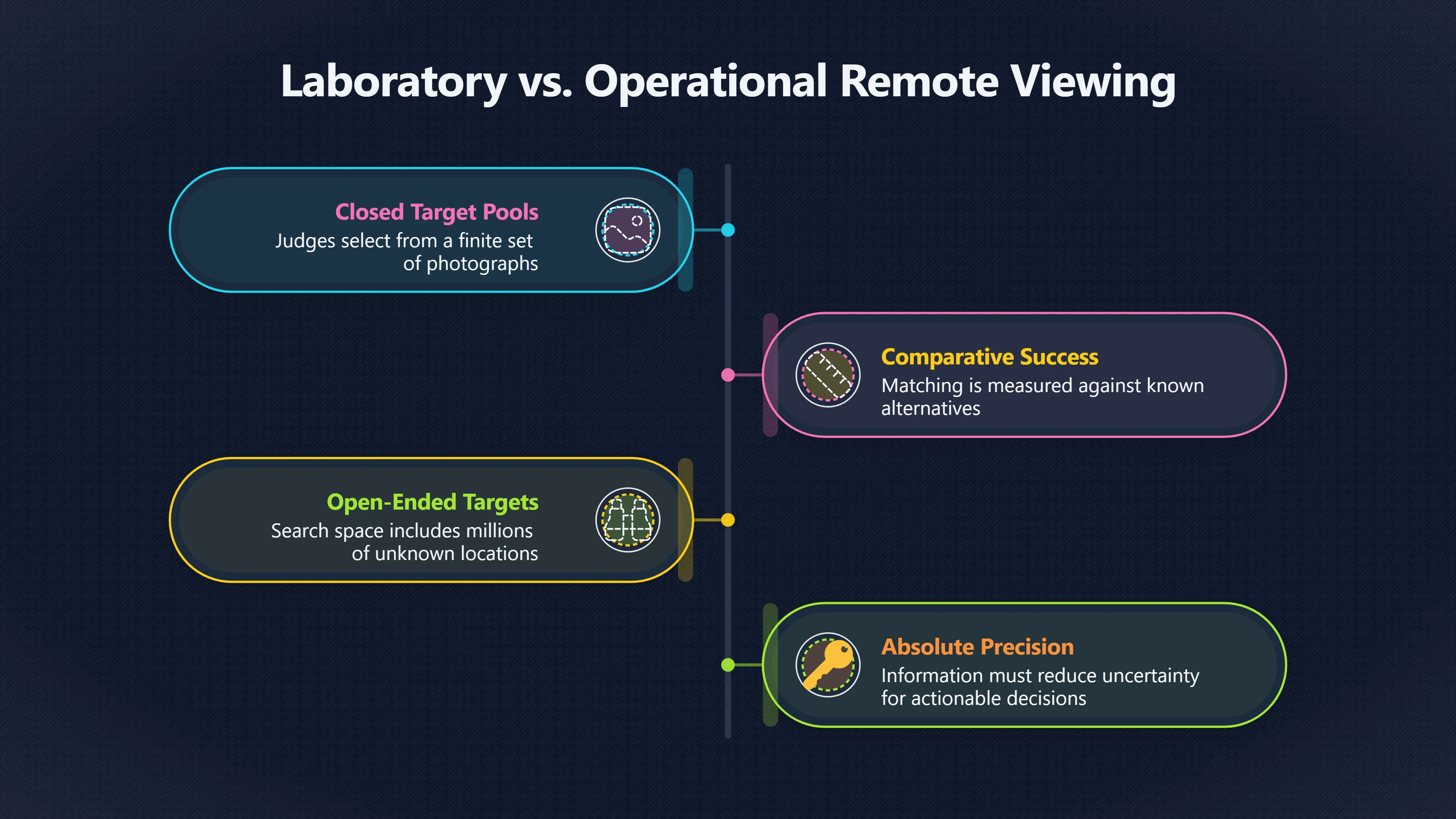
Laboratory remote-viewing studies deliberately simplify the statistical problem. Researchers typically create a finite collection of targets, randomise the selection process and ask independent judges to determine which target best matches the viewer’s transcript. This design helps estimate whether matching exceeds chance expectations.
However, these same design features reduce the complexity of the task compared with real-world applications.
A limited target pool offers several advantages:
- Every possible answer already exists before the session begins.
- Judges know exactly which alternatives are available.
- Even an incomplete description can rank above weaker alternatives.
- Success is measured comparatively rather than absolutely.
For example, if four photographs are available—a bridge, a waterfall, a cathedral and a desert—a transcript mentioning “large stone structure beside water” may be sufficient for a judge to identify the bridge as the best match, even though the description omits many distinguishing details.
Outside the laboratory there is no comparable shortlist. If the task is to locate an unknown warehouse, identify a concealed submarine, or determine where a missing aircraft crashed, there may be millions of possible locations. A description such as “metal”, “water”, “industrial area” or “mountains” does not meaningfully reduce the search space.
The AIR evaluation explicitly recognised this distinction. It noted that intelligence consumers valued specific, concrete and independently verifiable information, whereas remote-viewing reports frequently consisted of general impressions requiring interpretation by analysts.[National Security Archive]nsarchive2.gwu.eduAppendix C, the interview reports, end users and remote viewers describe the operational targets presented to remote viewers. These…Re…
The missing person and hidden facility problem
Open-ended operational targets expose a difficulty that is largely hidden in closed laboratory designs.
Consider a missing-person investigation. The useful questions are highly specific:
- Where is the person?
- Are they alive?
- Which direction should search teams travel?
- What identifiable landmarks surround the location?
- How confident should investigators be?
A report stating that the viewer senses “trees”, “water”, “cold”, “metal fencing” and “an isolated feeling” may later appear compatible with many discovered locations. Before the outcome is known, however, these descriptors rarely identify one location strongly enough to justify allocating personnel or resources.
The same issue appears in intelligence applications. A hidden research facility could potentially exist anywhere within an entire country. Broad descriptions such as “large building”, “security”, “vehicles” or “underground activity” apply to numerous military and industrial sites. Unless the information narrows possibilities dramatically, the operational value remains limited.
This concern appeared repeatedly during reviews of the U.S. government’s remote-viewing programme. Interviews with intelligence users reported that operational reports often lacked the precision needed for actionable decisions. The AIR review also discussed evidence suggesting that performance declined when targets became more novel and less constrained than the familiar photographic targets used in many laboratory studies. Dynamic operational targets presented a much more demanding challenge than static experimental photographs.[National Security Archive]nsarchive2.gwu.eduAppendix C, the interview reports, end users and remote viewers describe the operational targets presented to remote viewers. These…Re…
Why vague impressions rarely reduce uncertainty
Open-ended tasks are difficult because every additional piece of information must meaningfully reduce uncertainty.
Imagine being told only that an unknown location contains:
- concrete,
- vehicles,
- people,
- fences,
- lights.
These characteristics describe countless airports, factories, military bases, warehouses and transport depots. Each individual statement may be accurate somewhere, but together they still fail to identify a unique target.
Operational usefulness depends less on accumulating broadly correct features than on providing combinations that sharply distinguish one possibility from thousands of alternatives.
Information becomes progressively more valuable when it includes characteristics such as:
- unique geographic relationships,
- unusual architectural features,
- identifiable names or markings,
- precise spatial arrangements,
- accurate timing,
- independently verifiable details that would be unlikely to arise through general guessing.
This illustrates why specificity, not simply descriptive richness, becomes the limiting factor. Large numbers of broadly applicable statements may produce an impression of accuracy while leaving decision-makers unable to determine what action should actually be taken.
Why interpretation becomes a major source of error
Open-ended targets also increase the role of interpretation.
Laboratory judging often occurs after both the transcript and target are available. Judges can compare similarities directly and decide which target fits best. Operational users do not have this luxury. They must interpret ambiguous information prospectively.
This creates several difficulties:
- Analysts may unconsciously emphasise statements that fit existing expectations.
- Multiple interpretations of the same description may appear equally plausible.
- Failed predictions can later be reinterpreted in more favourable ways.
- Genuine errors become difficult to separate from flexible interpretation.
The AIR review identified this reliance on analyst interpretation as an important operational weakness. Rather than receiving directly usable intelligence, decision-makers frequently had to infer meaning from broad descriptions, increasing subjectivity and reducing confidence in the resulting assessments.[National Security Archive]nsarchive2.gwu.eduAppendix C, the interview reports, end users and remote viewers describe the operational targets presented to remote viewers. These…Re…
What specificity must add before action
For remote viewing to become operationally valuable, specificity must accomplish more than producing interesting descriptions. It must generate information that changes decisions before outcomes are known.
In practice, that means adding elements such as:
- Location precision: narrowing thousands of possible locations to a realistically searchable area.
- Unique identifiers: providing details unlikely to apply to numerous unrelated targets.
- Independent verification: allowing separate investigators to confirm claims without interpretive flexibility.
- Actionable confidence: indicating which details are dependable enough to justify allocating resources.
- Prospective success: demonstrating these qualities consistently before verification rather than through retrospective matching.
These requirements explain why many researchers distinguish statistical evidence from operational capability. A measurable laboratory effect, even if accepted, does not automatically demonstrate that remote viewing can solve open-ended intelligence, law-enforcement or search-and-rescue problems. The practical challenge is not simply detecting information above chance but producing sufficiently precise information to reduce uncertainty enough for informed action.
The debate over remote viewing therefore centres not only on whether unusual correspondences occur under controlled conditions, but whether those correspondences can survive the transition from closed experimental target pools to the essentially unlimited answer space presented by real-world operational targets. The available government evaluations concluded that this transition had not been demonstrated, even while acknowledging that some laboratory findings merited scientific discussion.[National Security Archive+2CIA]nsarchive2.gwu.eduAppendix C, the interview reports, end users and remote viewers describe the operational targets presented to remote viewers. These…Re…
Amazon book picks
Further Reading
Books and field guides related to Why Open Targets Are So Hard. Use these as the next step if you want deeper reading beyond the article.


Endnotes
1.
Source: nsarchive2.gwu.edu
Link:https://nsarchive2.gwu.edu/NSAEBB/NSAEBB438/docs/doc_57.pdf
Source snippet
Appendix C, the interview reports, [end users]({{ 'end-users/' | relative_url }}) and remote viewers describe the operational targets presented to remote viewers. These...Re...
2.
Source: cia.gov
Link:https://www.cia.gov/readingroom/docs/CIA-RDP96-00791R000200180005-5.pdf
Source snippet
AN EVALUATION OF THE REMOTE VIEWING PROGRAMThe first component was a review of the research program. The second component was a review...
3.
Source: psi-encyclopedia.spr.ac.uk
Title: spr.ac.uk Remote Viewing
Link:https://psi-encyclopedia.spr.ac.uk/articles/remote-viewing/
Source snippet
Viewing - Psi Encyclopedia13 Jan 2017 — Remote viewing is an experimental form of ESP that emerged in the late 1960s, in which a suitably...
Additional References
4.
Source: researchgate.net
Title: 345430975 Remote Viewing Applications An Historical Overview and a New Survey
Link:https://www.researchgate.net/publication/345430975_Remote_Viewing_Applications_An_Historical_Overview_and_a_New_Survey
Source snippet
Remote Viewing Applications: An Historical Overview and...8 Nov 2020 — The primary purpose of this review and exploratory survey of expe...
5.
Source: facebook.com
Link:https://www.facebook.com/100090372200308/posts/during-the-[cold-war
Source snippet
ss of physical barriers, using nothing but mental focus and a...Read more...
6.
Source: academia.edu
Title: Volume 4: Operational Remote Viewing: Memorandums and Reports.Read more
Link:https://www.academia.edu/95285973/The_Star_Gate_Operational_Remote_Viewing_Program_A_Human_Intelligence_HUMINT_Collection_Platform
Source snippet
(PDF) The Star Gate Operational Remote Viewing Program...The Star Gate Archives: Reports of the United States Government Sponsored Psi P...
7.
Source: pmc.ncbi.nlm.nih.gov
Title: Follow‐up on the U.S
Link:https://pmc.ncbi.nlm.nih.gov/articles/PMC10275521/
Source snippet
Central Intelligence Agency's (CIA...by Á Escolà‐Gascón · 2023 · Cited by 10 — Since 1972, the U.S. Central Intelligence Agency (CIA) co...
8.
Source: scispace.com
Title: What Do We Know About Psi?
Link:https://scispace.com/pdf/what-do-we-know-about-psi-the-first-decade-of-remote-viewing-42m4cti21j.pdf
Source snippet
The First Decade of Remote...Remote viewing is a nonanalytic ability; describing a distant shape, form, or location on the planet is eas...
9.
Source: youtube.com
Title: Scientific and Spiritual Implications of Psychic Abilities
Link:https://www.youtube.com/watch?v=zgyYms376Mg
Source snippet
Inside Operation [Stargate]({{ 'stargate/' | relative_url }}): The CIA's Psychic Spy Experiment...
10.
Source: youtube.com
Title: How the CIA Fooled Us to Believe in Remote Viewing: SCAM Exposed! | Jeremy Rys
Link:https://www.youtube.com/watch?v=QbY6rT4sFk0
Source snippet
Remote Viewing and Statistical Validation...
11.
Source: youtube.com
Title: Inside Operation Stargate: The CIA’s Psychic Spy Experiment
Link:https://www.youtube.com/watch?v=oasTnsLw_n8
Source snippet
Remote Viewing Explained: How the Mind Sees Without Eyes...
12.
Source: ciaotest.cc.columbia.edu
Title: sa jan02srm01
Link:https://ciaotest.cc.columbia.edu/olj/sa/sa_jan02srm01.html
Source snippet
Remote Viewing: The US Sponsored Psychic...This paper deals with experiments conducted in USA in which certain individuals were trained...
13.
Source: youtube.com
Title: Remote Viewing and Statistical Validation
Link:https://www.youtube.com/watch?v=YrwAiU2g5RU
Source snippet
Scientific and Spiritual Implications of Psychic Abilities - Russell Targ...
Topic Tree