Within Remote Viewing
The Critique That Shook the Early Claims
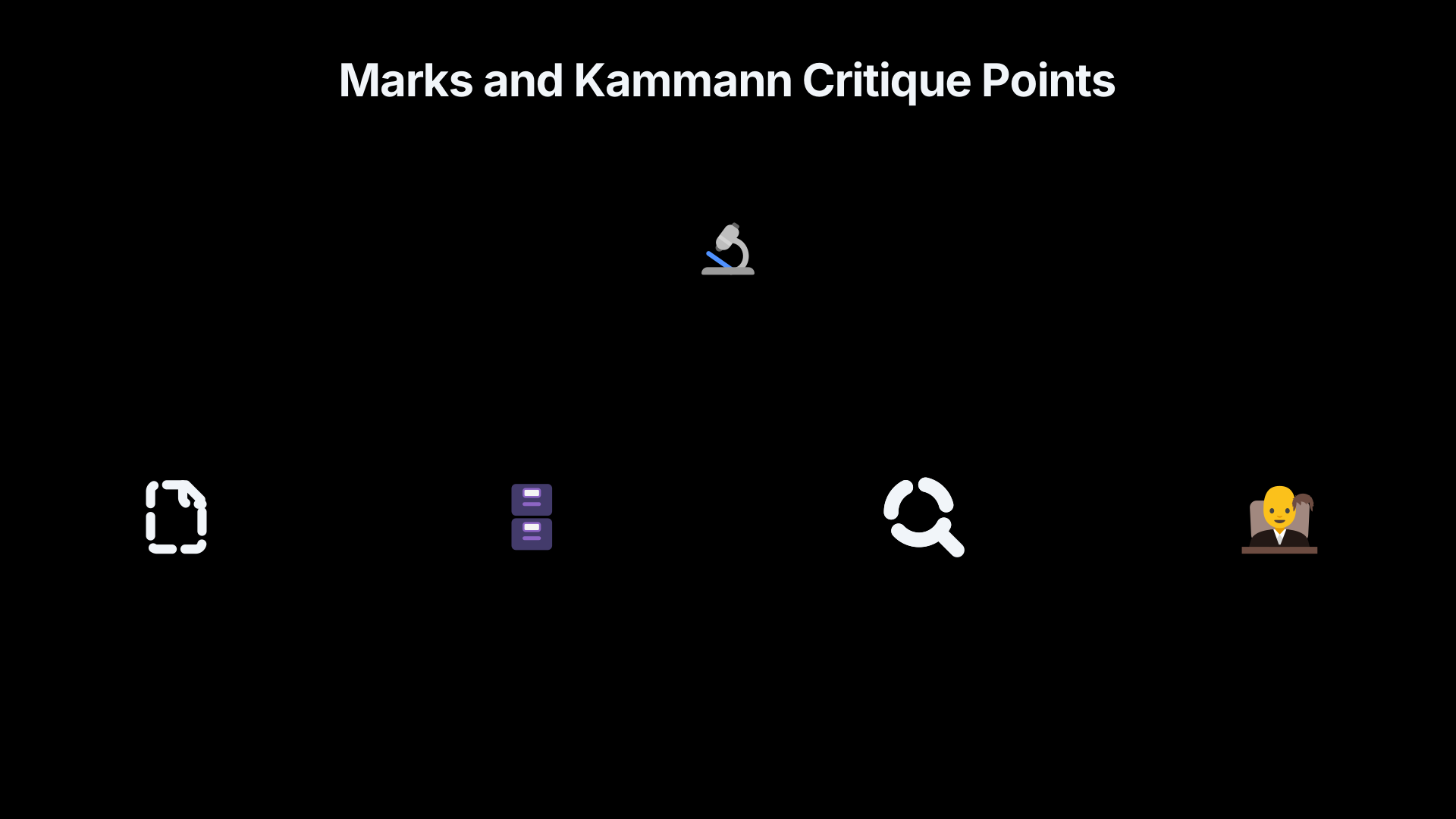
Marks and Kammann challenged the early SRI findings by pointing to possible cues in the judging materials.
On this page
- What They Challenged
- Cueing in Transcripts
- Why the Debate Continued
Page outline Jump by section
Introduction
Marks and Kammann’s critique of Stanford Research Institute’s early remote-viewing work was powerful because it attacked the method, not merely the idea. In their 1978 Nature letter, psychologists David Marks and Richard Kammann said they had tried duplicate remote-viewing experiments but did not verify the claims made by Russell Targ and Harold Puthoff at SRI. Their sharper point was that judging materials in the original SRI work could contain ordinary clues: dates, sequence references, comments about previous targets, or other cues that might help a judge match transcripts to sites without any paranormal information.[Nature]nature.comInformation transmission in remote viewing experiments | NatureInformation transmission in remote viewing experiments | Nature
That criticism became a defining case in the remote-viewing debate. It shifted attention from the dramatic question “Can people perceive distant places?” to the more testable question “Were the judges truly blind to all normal information?” The controversy continued through later Nature exchanges, including a 1980 reply by Charles Tart, Harold Puthoff and Russell Targ, a 1981 response by Marks, and a 1986 follow-up by Marks and Christopher Scott.[Nature+2Nature]nature.comInformation transmission in remote viewing experiments | NatureInformation transmission in remote viewing experiments | Nature
What They Challenged
The early SRI remote-viewing experiments asked participants to describe hidden or distant targets while separated from the people who selected or visited those targets. Targ and Puthoff’s 1974 Nature paper, “Information transmission under conditions of sensory shielding”, reported results suggesting information transfer under conditions intended to block ordinary sensory access.[Semantic Scholar]semanticscholar.orgSemantic Scholar Information transmission under conditions of sensory …Information transmission under conditions of sensory shielding ·Semantic Scholar Information transmission under conditions of sensory …Information transmission under conditions of sensory shielding ·
Marks and Kammann did not need to prove fraud or conscious manipulation to raise a serious objection. Their critique rested on a simpler possibility: in free-response experiments, the viewer’s transcript is often rich, messy and open to interpretation. If the judge receives transcripts that include accidental information about order, timing, place, procedure or previous sessions, the final matching score may partly reflect those clues rather than the viewer’s claimed access to a remote target.
Their 1978 Nature letter is short, but its abstract gives the core result: Targ and Puthoff had claimed evidence for an extrasensory remote-viewing ability, while Marks and Kammann reported that duplicate experiments did not verify those conclusions.[Nature]nature.comInformation transmission in remote viewing experiments | NatureInformation transmission in remote viewing experiments | Nature The importance of the letter was not just that it was negative. It suggested a reason why earlier positive results might have looked stronger than they were.
The challenge can be broken into three connected claims:
- Replication mattered: if the effect was real and widely distributed, similar procedures should produce comparable results under fresh conditions.
- Judging was vulnerable: remote-viewing success depended heavily on later matching between transcripts and targets, so any information leakage into the judging materials could distort the outcome.
- Controls had to be demonstrated, not assumed: a protocol described as “sensory shielding” for the viewer could still fail if clues reached the judge through the records.
That is why the critique became method-based rather than belief-based. Marks and Kammann were not simply saying that remote viewing was implausible. They were saying that the published evidence had not ruled out a more ordinary explanation.

Cueing in Transcripts
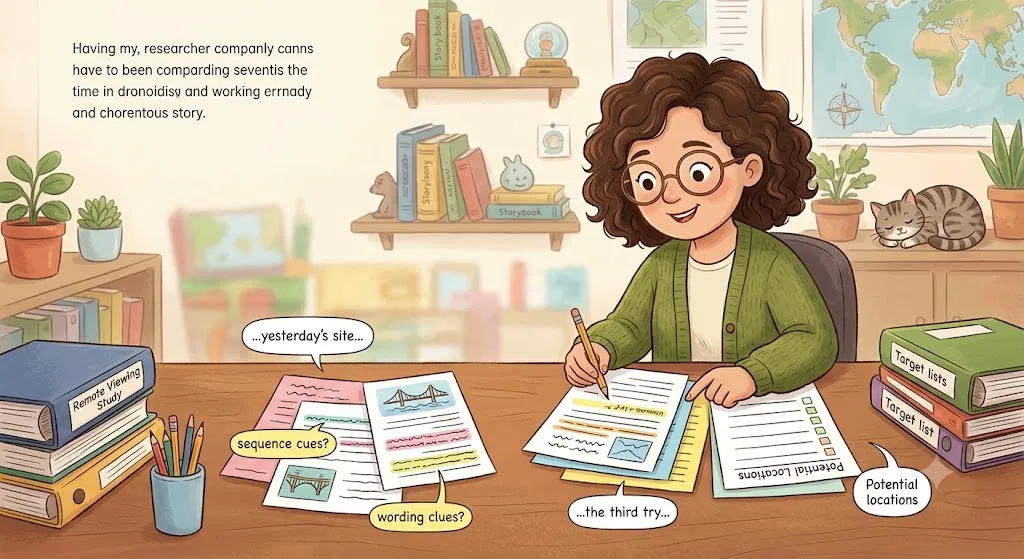
The central issue was cueing in the materials used for judging. In remote-viewing experiments, a judge may be asked to compare a set of viewer descriptions with a set of possible target sites. Ideally, the judge should know nothing that helps identify the correct target except the descriptive match itself. If a transcript says or implies that a session came after “yesterday’s” target, that it was connected with a particular date, or that it belonged to a known sequence, the judge may be able to reconstruct the experimental order.
This matters because remote-viewing transcripts are not like multiple-choice answers. They often contain impressions, sketches, analogies and fragments. A phrase such as “water”, “a structure”, “open space” or “something circular” can match many places if the judge is free to interpret broadly. In that setting, even small procedural hints can help the judge decide which transcript belongs with which target.
Marks later sharpened this criticism in a 1981 Nature piece titled “Sensory cues invalidate remote viewing experiments”. The article explicitly framed the problem as sensory cueing and cited both the 1980 Tart-Puthoff-Targ response and the original 1978 Marks-Kammann critique.[Nature]nature.comSensory cues invalidate remote viewing experiments | NatureSensory cues invalidate remote viewing experiments | Nature The title itself shows how the argument had developed: the issue was no longer only failed duplication, but whether the earlier judging data had been contaminated by normal information.
The most damaging form of cueing was not a dramatic hidden signal. It was mundane paperwork. Dates, ordering references, comments on earlier targets, editing marks, or remarks made during transcription could all become unintended information. A judge who knows the target list and sees such clues may be solving a filing problem rather than detecting a paranormal correspondence.
That distinction explains why the critique had force even against experiments in which the viewer was physically separated from the target. Separation of the viewer is only one part of the control system. The full chain also includes target selection, transcript production, transcript editing, judging, scoring and reporting. A flaw at the judging stage can make the whole result look more impressive than the underlying viewer performance deserves.
Why the Debate Continued
The debate continued because the same data could be read through two very different standards. Supporters of the SRI work tended to emphasise the apparent quality of some transcript-target matches and the fact that remote-viewing procedures were designed to shield the viewer from ordinary sensory contact. Critics focused on whether the materials and judging process were clean enough to justify a paranormal conclusion.
The 1980 Nature reply by Charles Tart, Harold Puthoff and Russell Targ, also titled “Information transmission in remote viewing experiments”, directly cited Marks and Kammann’s 1978 criticism and the earlier SRI publications.[Nature]nature.comInformation transmission in remote viewing experiments | NatureInformation transmission in remote viewing experiments | Nature Puthoff and Targ then published a 1981 Nature rebuttal to Marks’s criticism, citing both Marks’s 1981 article and the Tart-Puthoff-Targ response.[Nature]nature.comRebuttal of criticisms of remote viewing experiments | NatureRebuttal of criticisms of remote viewing experiments | Nature This sequence matters because it shows that the cueing dispute was not a minor footnote; it was argued in the same high-profile journal venue that had helped give the original SRI claims visibility.
Later commentary kept returning to the same methodological fault line. Marks and Scott’s 1986 Nature article, “Remote viewing exposed”, continued the criticism of cue removal in the remote-viewing transcripts.[Nature]nature.comOpen source on nature.com. Even pro-remote-viewing discussions that dispute Marks’s interpretation often acknowledge that his argument centred on whether transcript cues could explain successful matching, which shows how central the issue became to the field’s self-defence.[Singularity Quest]singularityquest.comOpen source on singularityquest.com.
The controversy also persisted because remote viewing depends on subjective matching more than on a single hard measurement. If a viewer says “a bridge, water, concrete, a feeling of height”, the transcript can feel striking when compared with one site and irrelevant when compared with another. That flexibility is exactly why blinding and cue control are so important. Without them, a high match score may measure the judge’s ability to use hints, not the viewer’s ability to perceive a hidden target.
Other failed or negative replication work reinforced the sceptical concern. A 1979 Psychological Reports study using procedures based on earlier demonstrations found no support for the remote-viewing hypothesis, reporting that correct and incorrect protocols were not judged significantly differently and that apparent successes could be explained by rating differences among targets or judges.[Sage Journals]journals.sagepub.comSage Journals Remote Viewing: Failures to Replicate with Control ComparisonsSage Journals Remote Viewing: Failures to Replicate with Control Comparisons This did not prove that every SRI result was invalid, but it made the burden of proof heavier for claims that the original findings had revealed a reliable effect.
What the Critique Changed
Marks and Kammann’s critique changed the remote-viewing debate by making the transcript and judging process the centre of attention. Before their intervention, the most compelling image was the remote viewer describing a distant location. After it, the crucial image was the judge sitting with transcripts and target sites, possibly holding enough ordinary clues to make the correct match.
That shift had lasting consequences for how remote-viewing experiments were evaluated. A convincing protocol now had to show not only that the viewer was shielded, but also that:
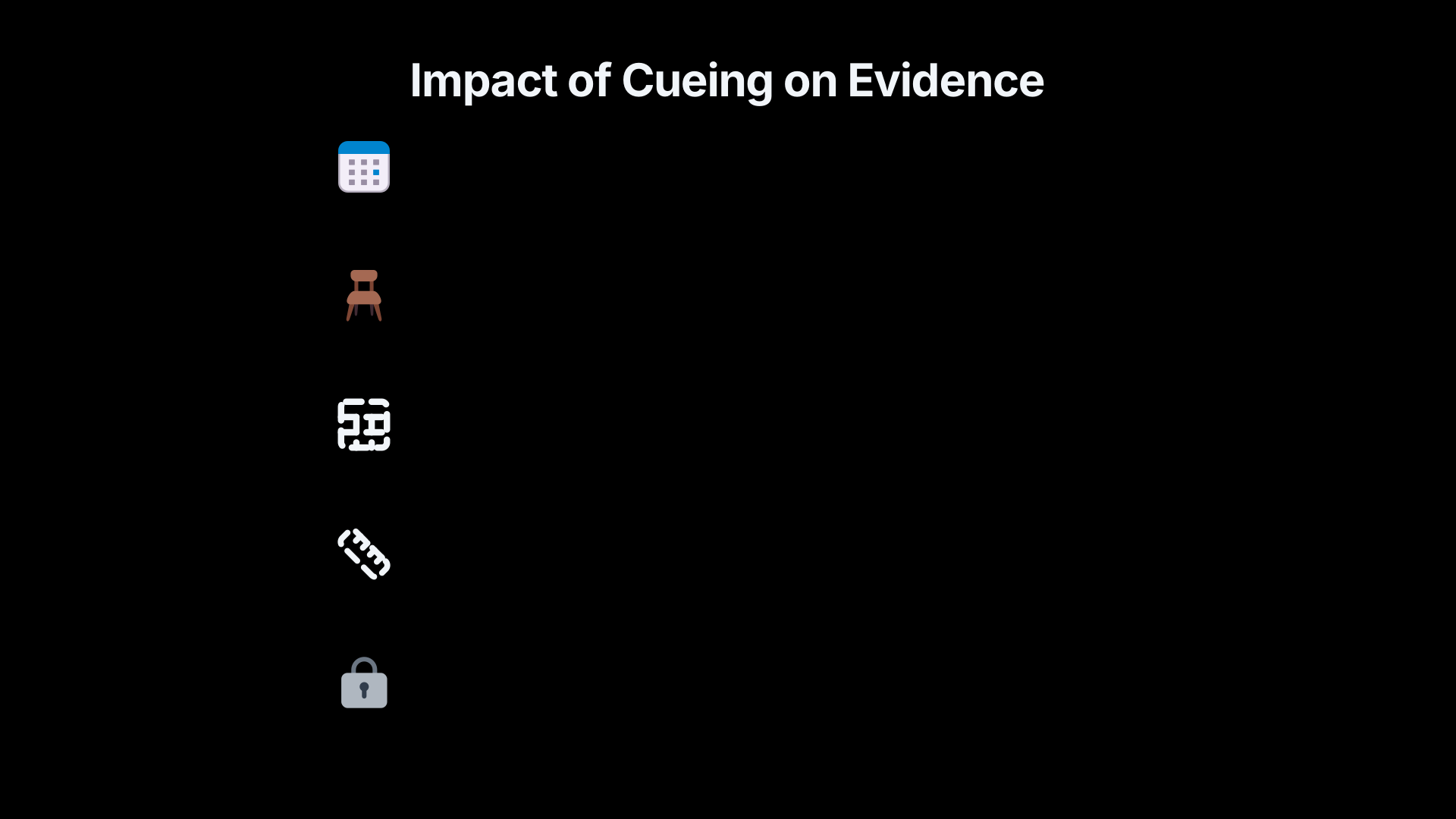
- target selection was randomised and documented;
- transcripts were stripped of dates, sequence clues and procedural remarks;
- judges were blind to target order and session history;
- scoring rules were defined before judging;
- all trials, not just impressive examples, were reported.
The critique also helped expose a common weakness in extraordinary-claim research: a result can look paranormal when the visible performance is separated from the invisible paperwork. In a remote-viewing session, the transcript may appear to describe a target surprisingly well. But if the transcript carries cues about when it was made, what came before it, or how it fits into the experiment’s sequence, the evidential value changes.
This is why the Marks and Kammann critique remains important even for readers who are not committed sceptics. It offers a practical lesson in experimental design. The question is not only whether researchers intended to prevent cueing, but whether the final materials given to judges were actually free of cueing. In controversial free-response research, that difference can decide whether an apparent anomaly survives scrutiny.
The Lasting Lesson for Remote Viewing
The lasting lesson is that remote-viewing evidence lives or dies by control of information leakage. Marks and Kammann did not close every philosophical argument about psychic perception, but they showed that the early SRI claims could not be assessed by headline results alone. The judging records, transcript handling and cue-removal procedures were part of the evidence.
That is why their critique became one of the standard examples of method-based scepticism in remote viewing. It did not depend on dismissing participants as dishonest or researchers as foolish. It showed that ordinary cues, if left in the materials, could create or inflate apparent success. For a field built on the claim that information has arrived without the known senses, even small channels of normal information are not minor technicalities. They are the central risk.
Amazon book picks
Further Reading
Books and field guides related to The Critique That Shook the Early Claims. Use these as the next step if you want deeper reading beyond the article.
Phenomena
Covers the military and intelligence context behind remote viewing and the lab-to-operations gap.
Phenomena: The Secret History of the U.S. Government's Invest...
Places the SRI controversy in historical context.
The Demon-Haunted World: Science as a Candle in the Dark
Explains the importance of controls, replication and avoiding bias.
The Conscious Universe: The Scientific Truth of Psychic Pheno...
Provides the supportive case against which methodological critiques are compared.
eBay marketplace picks
Marketplace Samples
Live-tested eBay searches with available results related to this page.


Endnotes
1.
Source: nature.com
Title: Information transmission in remote viewing experiments | Nature
Link:https://www.nature.com/articles/274680a0
2.
Source: nature.com
Title: Information transmission in remote viewing experiments | Nature
Link:https://www.nature.com/articles/284191a0
3.
Source: nature.com
Title: Sensory cues invalidate remote viewing experiments | Nature
Link:https://www.nature.com/articles/292177a0
4.
Source: nature.com
Link:https://www.nature.com/articles/319444a0
5.
Source: nature.com
Title: Rebuttal of criticisms of remote viewing experiments | Nature
Link:https://www.nature.com/articles/292388a0
6.
Source: semanticscholar.org
Link:https://www.semanticscholar.org/paper/Information-transmission-under-conditions-of-[Targ-Puthoff
7.
Source: singularityquest.com
Link:https://singularityquest.com/why-david-marks-cues-dont-debunk-remote-viewing/
8.
Source: journals.sagepub.com
Title: Sage Journals Remote Viewing: Failures to Replicate with Control Comparisons
Link:https://journals.sagepub.com/doi/10.2466/pr0.1979.45.3.963
Additional References
9.
Source: youtube.com
Title: The History of Remote Viewing with Paul H. Smith
Link:https://www.youtube.com/watch?v=_bMDdBwjfY8
Source snippet
Scientific and Spiritual Implications of Psychic Abilities - Russell Targ...
10.
Source: youtube.com
Title: Skepticism About Remote Viewing with Paul H. Smith
Link:https://www.youtube.com/watch?v=gadka2zweUo
Source snippet
Remote Viewing Psychology with Charles T. Tart...
11.
Source: youtube.com
Title: Remote Viewing Psychology with Charles T. Tart
Link:https://www.youtube.com/watch?v=jPZwaicuiek
Source snippet
The History of Remote Viewing with Paul H. Smith...
12.
Source: youtube.com
Title: [Third Eye Spies]({{ ‘third-eye-spies/’ | relative_url }}) with Russell Targ
Link:https://www.youtube.com/watch?v=k9AsG1iNAyc
Source snippet
Skepticism About Remote Viewing with Paul H. Smith...
13.
Source: youtube.com
Title: Scientific and Spiritual Implications of Psychic Abilities
Link:https://www.youtube.com/watch?v=zgyYms376Mg
14.
Source: pubmed.ncbi.nlm.nih.gov
Link:https://pubmed.ncbi.nlm.nih.gov/4423858/
Topic Tree