Within Remote Viewing
Why Scoring Remote Viewing Is So Hard
Judging is where remote viewing claims often rise or fall because loose matching can make vague descriptions seem accurate.
On this page
- How Blind Judging Works
- The Problem of Rich Descriptions
- Better Scoring Rules
Page outline Jump by section
Introduction
Remote viewing depends on a deceptively difficult step: someone must decide whether a viewer’s free-form impressions match a hidden target better than they match plausible alternatives. That judging stage is where many remote-viewing claims become most fragile. A transcript full of “water”, “vertical structure”, “open space”, “movement” and “metal” can sound impressive after the correct photograph or site is revealed, but the real test is whether a blind judge would have selected that same target from a pre-set pool before knowing the answer. In well-designed trials, judging is therefore not an afterthought; it is the measurement instrument. The core problem is that remote-viewing data are usually rich, vague and mixed: a few possible hits may sit beside many misses, while a judge’s expectations, the target pool, decoys and scoring rules can strongly shape the outcome.[National Security Archive]nsarchive2.gwu.eduNational Security Archiveremote~1.PD FNational Security Archiveremote~1.PD F
How Blind Judging Works
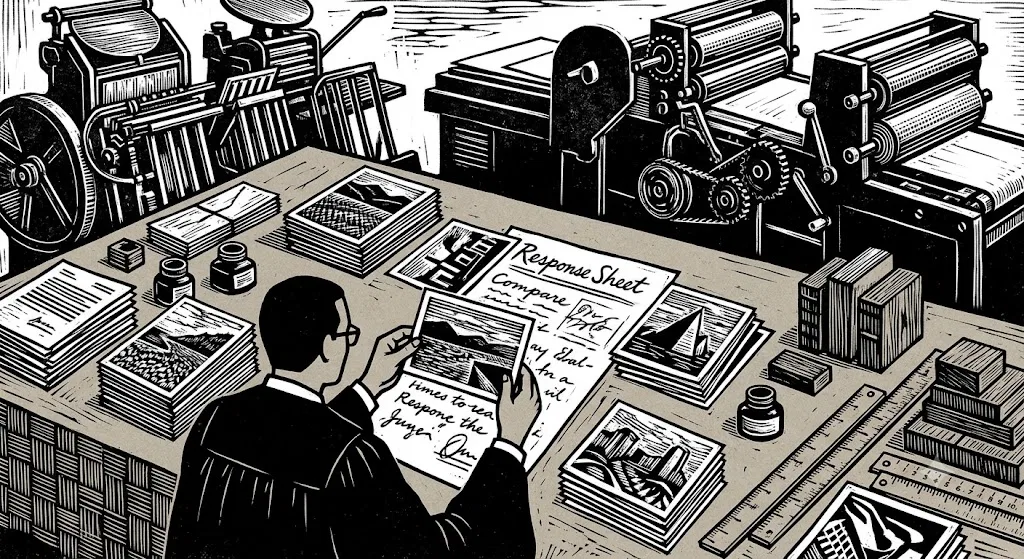
In a typical laboratory remote-viewing trial, the viewer produces notes, sketches or spoken descriptions without knowing the target. After the session, a judge who is blind to the correct answer compares that response with several possible targets. In the rank-order method used in many SRI and SAIC remote-viewing studies, the judge might receive one viewer response and five candidate targets: the real target plus four decoys. The judge ranks the five from best match to worst match; the rank assigned to the real target becomes the trial’s score. If the real target receives rank one, it is treated as the strongest match. If it receives rank five, it is the weakest. Across many trials, above-chance performance would mean that correct targets receive better ranks than would be expected from random selection.[National Security Archive]nsarchive2.gwu.eduNational Security Archiveremote~1.PD FNational Security Archiveremote~1.PD F
This design turns an open-ended claim into something closer to a forced-choice test. The viewer’s transcript is not scored by asking whether it contains anything that resembles the target. Instead, the judge asks a comparative question: “Does this response fit the actual target better than it fits the decoys?” That matters because remote-viewing transcripts often contain enough imagery to be made to fit many different scenes after the fact. A description of “brightness, water, hard edges and people moving” could be made to fit a marina, a swimming pool, a city fountain, a harbour bridge or a market near a river. Blind comparison with decoys is meant to stop the evaluator from only seeing the appealing match.[National Security Archive]nsarchive2.gwu.eduNational Security Archiveremote~1.PD FNational Security Archiveremote~1.PD F
The statistical logic depends on random target selection. The American Institutes for Research review, prepared for the CIA in 1995, explained that there is no meaningful way to say what a free-form psychic-style response should look like “by chance”; the randomness has to enter through the choice of target. A proper experiment therefore defines a target pool in advance and selects the actual target randomly, with known probabilities. Only then can researchers ask whether the correct target matched the response unusually well compared with the alternatives.[National Security Archive]nsarchive2.gwu.eduNational Security Archiveremote~1.PD FNational Security Archiveremote~1.PD F
The same review also explains why early judging procedures were vulnerable. In some early studies, targets were selected without proper control for what had already been judged, meaning not every target had an equal chance of receiving every rank. If judges knew or inferred that a target had already been used, or if the order of trials affected later choices, the scoring model no longer matched the statistics. What looks like a low-probability result can then be partly produced by the judging set-up rather than by anomalous information transfer.[National Security Archive]nsarchive2.gwu.eduNational Security Archiveremote~1.PD FNational Security Archiveremote~1.PD F
Why Rich Descriptions Are So Easy to Match
Remote viewing favours free response: the viewer can draw, describe textures, report emotions, mention shapes and record fleeting impressions. This is one reason proponents prefer it to simple card-guessing tests; it feels more natural and can capture partial or symbolic impressions. But the same richness creates a scoring problem. The more material a viewer produces, the more opportunities there are for selective matching. A long transcript may contain a few details that fit the target, several that fit decoys, and many that fit nothing. Judging then becomes a question of weighting: which details count, which are ignored, and how much should a sketch outweigh a wrong verbal statement?[National Security Archive]nsarchive2.gwu.eduNational Security Archiveremote~1.PD FNational Security Archiveremote~1.PD F
The problem is not simply that descriptions are vague. It is that they are often vague and over-complete. A remote-viewing report can include landscape features, colours, emotions, movements, materials and speculative labels. If the target is a dam, “water” and “concrete” look meaningful; if the same transcript also mentions “people indoors”, “round object”, “desert” and “music”, those misses may be quietly discounted unless the scoring rule forces them to matter. This is why judging rules must decide in advance whether a transcript is scored holistically, feature by feature, by rank comparison, or by a numerical confidence scale.[National Security Archive]nsarchive2.gwu.eduNational Security Archiveremote~1.PD FNational Security Archiveremote~1.PD F
Operational remote-viewing records show the practical version of this problem. In the CIA-commissioned AIR evaluation, end users reported that remote-viewing information was often broad, vague, inaccurate on concrete specifics, full of irrelevant or erroneous material, and inconsistent across independent viewers. The review concluded that such material placed the burden on analysts to decide what was relevant, which could reinforce preconceptions or send investigators down blind alleys. That is target matching outside the laboratory: instead of choosing among five photographs, analysts are trying to decide which parts of a broad narrative should be mapped onto a real person, site or event.[National Security Archive]nsarchive2.gwu.eduNational Security Archiveremote~1.PD FNational Security Archiveremote~1.PD F
A striking feature of this problem is that a transcript can seem better after feedback than it did before. Once the correct target is revealed, human attention naturally moves towards apparent correspondences. The judge may notice that a rough sketch resembles a bridge support, that “cold metallic echo” could fit a railway station, or that “open water” might refer to a canal barely visible in the photograph. Blind judging tries to prevent that hindsight effect by forcing the comparison before the answer is known. But if the judging criteria are loose, hindsight can still return later through informal commentary, promotional write-ups or selective examples.[National Security Archive]nsarchive2.gwu.eduNational Security Archiveremote~1.PD FNational Security Archiveremote~1.PD F
The Decoy Problem
Blind judging is only as good as the target set. Decoys are not neutral background items; they define the difficulty of the match. If the real target is a waterfall and the decoys are a desert, a library, a plate of food and a close-up of a shoe, a transcript mentioning “water”, “mist” and “falling motion” is easy to score. If the decoys include a fountain, a stormy coast and a hydroelectric dam, the same transcript becomes far less decisive. A strong remote-viewing design therefore needs decoys that are plausible enough to test the transcript, but not so similar that no judge could reasonably discriminate among them.[National Security Archive]nsarchive2.gwu.eduNational Security Archiveremote~1.PD FNational Security Archiveremote~1.PD F
Researchers have long recognised this as a target-pool problem. Some remote-viewing protocols used photographs from sources such as National Geographic because they provided varied and visually rich targets, but a varied target pool creates its own issue: some targets are far more visually “attractive” or description-friendly than others. If a target pool contains a volcano, a cathedral, a waterfall and a plain office corridor, viewers and judges may gravitate towards the dramatic images. In associative remote viewing, where photos are paired with future outcomes such as market moves or sporting results, researchers have noted that if one feedback photo is more striking while another is dull or confusing, viewers or judges may be pulled towards the more “numinous” image regardless of the intended target.[ResearchGate]researchgate.netOpen source on researchgate.net.
The decoy issue also affects what counts as a fair miss. Suppose the correct target is a city bridge and a decoy is a railway trestle. If the viewer draws repeated vertical supports and says “transport, elevated, metal structure”, a judge may reasonably prefer either image depending on small interpretive choices. That does not necessarily show that remote viewing succeeded or failed; it shows that the target set has made the measurement unstable. A clean scoring system needs target alternatives that allow judges to make discriminations based on pre-specified features, not on intuitive overall resemblance alone.[National Security Archive]nsarchive2.gwu.eduNational Security Archiveremote~1.PD FNational Security Archiveremote~1.PD F
When “Blind” Is Not Blind Enough
Blind judging can fail if the transcript carries ordinary clues. The best-known critique of early SRI remote-viewing work came from psychologist David Marks, who argued that some transcripts contained cues such as dates, times, references to previous targets, leading remarks, travel details and comments from experimenters. If a judge also had the target list in sequence, those clues could help match transcript to target without any paranormal information. Marks reported that cues in the Price and Hammid series were sufficient to place transcripts in near-correct order, and he gave examples such as references to earlier sessions and explicit date or time information.[centerforinquiry.s3.amazonaws.com]centerforinquiry.s3.amazonaws.comOpen source on amazonaws.com.
This matters because “blind” has several layers. A judge may not be told which target is correct, yet still receive accidental information that narrows the answer. A transcript that says “yesterday’s target was much more active” may reveal where the session sits in a sequence. A note about the outbound person’s travel time may distinguish a nearby site from a distant one. A sketch page dated on the same day as a known site visit can undermine the blind. The judging procedure must therefore blind not only the judge’s formal knowledge but also the paperwork, metadata, order of presentation and casual comments.[National Security Archive]nsarchive2.gwu.eduNational Security Archiveremote~1.PD FNational Security Archiveremote~1.PD F
Later methodological advice in remote-viewing circles reflects this sensitivity. Recent expert-guideline discussions emphasise that viewers, researchers in contact with viewers, target-pool creators, judges and analysts may each need separate blinding rules. One contributor in a 2026 Journal of Scientific Exploration guidelines article argued that viewers and researchers who interact with them should be blind to the entire target pool, that whoever creates the pool should be blind to target order, and that judges and analysts should remain blind to targets until viewers have completed each trial.[Journal of Scientific Exploration]journalofscientificexploration.orgJournal of Scientific Exploration
Blinding also applies to communication style. The same guidelines article notes concern that seemingly harmless communication can pollute a viewer’s report or trigger analytical guessing. It recommends neutral project communication and warns against twisting or filtering viewers’ work to fit an analyst’s biases. That warning is relevant to judging because a judge is not just detecting matches; the judge is often translating raw impressions into a decision. The more human contact, feedback and expectation enter the process, the harder it becomes to know whether the final match came from the transcript or from the surrounding cues.[Journal of Scientific Exploration]journalofscientificexploration.orgJournal of Scientific Exploration
Why Judges Disagree
Even when judging is blind, different judges may not reach the same conclusion. The AIR evaluation identified this as a major boundary condition for applying remote viewing: if analysts or trained judges cannot arrive at similar decisions from the same material, it is difficult to know what action should follow. The review noted that evidence on inter-rater, or cross-judge, agreement was not available for the programme it assessed, leaving open the question of whether different judges would make similar target matches from identical data.[National Security Archive]nsarchive2.gwu.eduNational Security Archiveremote~1.PD FNational Security Archiveremote~1.PD F
A later associative remote-viewing study made that problem concrete. Katz, Grgic, Tressoldi and Fendley rejudged 86 completed ARV trials containing 220 transcripts, with three teams of judges working under blind conditions. The new judges repeated the judging, scoring and prediction process while other variables were held stable. Agreement was low: judges were in complete agreement in only 6 of 86 trials, or 6.9%, and eight of nine judges agreed in 17 trials, or 19.7%. The authors concluded that rating variance was clearly demonstrated and that ARV outcomes may depend heavily on rater decision-making and performance.[ResearchGate]researchgate.netOpen source on researchgate.net.
That finding is important even for readers who are sceptical of associative remote viewing. It shows that the scoring bottleneck is not just a philosophical objection raised by critics; it appears inside practitioner-oriented research too. If nine blind judges looking at the same transcripts and photo pairs often choose differently, then “the result” is partly a product of the judging system. A remote-viewing claim may therefore need to report not only viewer accuracy but also judge reliability, pass rules, target-pair construction, judge experience and whether the same outcome survives independent rejudging.[ResearchGate]researchgate.netOpen source on researchgate.net.
Experience may help, but it also complicates interpretation. In the ARV rater-reliability study, original judges did better than new judges, and more experienced judges obtained statistically significant higher hit rates than less experienced judges. That could mean judging remote-viewing transcripts is a learned skill. It could also mean that original judges benefited from feedback loops, familiarity with viewers, knowledge of target-pair construction or decision habits developed during the project. Those possibilities make judge expertise a variable to control, not merely a credential to cite.[ResearchGate]researchgate.netOpen source on researchgate.net.
Better Scoring Rules
The strongest judging rules make success difficult to manufacture after the fact. They define the target pool in advance, randomise target selection, present decoys fairly, blind judges to the answer and to trial order, preserve the original transcript, and specify before judging how matches will be scored. Rank-order judging does this better than informal “looks like a hit” commentary because it asks whether the real target beats the decoys, not whether any part of the transcript can be made to fit the real target.[National Security Archive]nsarchive2.gwu.eduNational Security Archiveremote~1.PD FNational Security Archiveremote~1.PD F
Good scoring also needs to handle misses visibly. A fair system should not only reward “water” when the target is a harbour; it should penalise or at least record incompatible statements if the transcript also describes mountains, animals and indoor machinery. Feature-based scoring can help when features are defined before feedback, but it can become subjective if judges invent categories after seeing the target. Holistic ranking avoids some feature-counting disputes, but it may hide why a judge preferred one target over another. No scoring system is perfect, so strong studies often benefit from multiple independent judges and clear reporting of judge agreement.[National Security Archive]nsarchive2.gwu.eduNational Security Archiveremote~1.PD FNational Security Archiveremote~1.PD F
A practical scoring checklist for remote-viewing target matching should include:[scribd.com]scribd.comSource details in endnotes.
- Predefined target pool: The possible targets exist before the session, and the actual target is randomly chosen with known probability.
- Clean transcript handling: Dates, sequence clues, file names, metadata and experimenter comments are removed or controlled before judging.
- Balanced decoys: Decoys are neither absurdly different nor confusingly similar, and they are chosen by a rule rather than by convenience.
- Independent blind judges: More than one judge scores the same material without knowing the answer, viewer identity or previous results.
- Reported disagreement: The study reports not only hits but also judge variance, passes, ambiguous cases and failed matches.
- Pre-set scoring thresholds: The rules for a hit, pass, rank or confidence score are fixed before outcomes are known.
These safeguards do not prove remote viewing; they make the claim more testable. They also protect against the common rhetorical move where one striking match is displayed while the decoys, misses and judging uncertainty disappear from view.[ResearchGate]researchgate.netOpen source on researchgate.net.

What Judging Problems Mean for Remote-Viewing Claims
Blind judging and target matching do not settle the entire remote-viewing debate, but they explain why the debate is so persistent. Proponents can point to experiments where blind rank-order judging produced above-chance results, and critics can point to cueing, vague transcripts, unstable target pools and subjective interpretation. The disagreement often turns on whether the judging procedure successfully converts messy human impressions into a reliable measurement.[National Security Archive]nsarchive2.gwu.eduNational Security Archiveremote~1.PD FNational Security Archiveremote~1.PD F
The CIA-commissioned AIR review captured the practical stakes. Laboratory conditions may create a structured target set, fixed feedback and measurable ranks, but intelligence work often involves unconstrained targets, incomplete feedback and analysts trying to interpret ambiguous reports. In that environment, vague and mixed material can become less an information source than an interpretive burden. Even if a viewer produces occasional correct generalities, the analyst must decide which parts to trust before independent verification exists.[National Security Archive]nsarchive2.gwu.eduNational Security Archiveremote~1.PD FNational Security Archiveremote~1.PD F
For a reader assessing a remote-viewing example, the key question is not “Does anything in the transcript resemble the target?” It is “Would a blind judge, using pre-set rules, choose this target over plausible alternatives without cues?” That question strips away much of the glamour from impressive anecdotes, but it is the question on which evidential value depends. In remote viewing, the session produces raw material; judging turns that material into a claim. If the judging is loose, the claim is loose too.
Amazon book picks
Further Reading
Books and field guides related to Why Scoring Remote Viewing Is So Hard. Use these as the next step if you want deeper reading beyond the article.

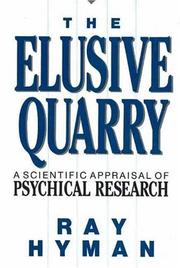
The Elusive Quarry: A Scientific Appraisal of Psychical Research
Covers judging and methodological weaknesses.
Parapsychology: A Handbook for the 21st Century
Includes discussion of experimental methods.
eBay marketplace picks
Marketplace Samples
Live-tested eBay searches with available results related to this page.



Endnotes
1.
Source: researchgate.net
Link:https://www.researchgate.net/publication/356109550_ASSOCIATIVE_REMOTE_VIEWING_PROJECTS_ASSESSING_RATER_RELIABILITY_AND_FACTORS_AFFECTING_SUCCESSFUL_PREDICTIONS
2.
Source: centerforinquiry.s3.amazonaws.com
Link:https://centerforinquiry.s3.amazonaws.com/wp-content/uploads/sites/29/1982/07/22165420/p20.pdf
3.
Source: journalofscientificexploration.org
Title: Journal of Scientific Exploration
Link:https://journalofscientificexploration.org/index.php/jse/article/view/3687/2559
4.
Source: cia.gov
Link:https://www.cia.gov/readingroom/docs/CIA-RDP96-00788R002000240029-4.pdf
5.
Source: cia.gov
Link:https://www.cia.gov/readingroom/document/cia-rdp96-00791r000200180006-4
6.
Source: cia.gov
Link:https://www.cia.gov/readingroom/docs/CIA-RDP96-00789R002200660001-5.pdf
7.
Source: cia.gov
Link:https://www.cia.gov/readingroom/docs/CIA-RDP96-00791R000200180005-5.pdf
8.
Source: cia.gov
Link:https://www.cia.gov/readingroom/document/cia-rdp96-00789r002200590001-3
9.
Source: cia.gov
Link:https://www.cia.gov/readingroom/docs/CIA-RDP96-00791R000200180006-4.pdf
10.
Source: cia.gov
Link:https://www.cia.gov/readingroom/document/cia-rdp96-00791r000200180005-5
11.
Source: cia.gov
Link:https://www.cia.gov/readingroom/document/cia-rdp96-00789r002200660001-5
12.
Source: cia.gov
Link:https://www.cia.gov/readingroom/docs/CIA-RDP96-00789R002200340001-0.pdf
13.
Source: cia.gov
Link:https://www.cia.gov/readingroom/docs/CIA-RDP96-00789R002200200001-5.pdf
14.
Source: cia.gov
Link:https://www.cia.gov/readingroom/docs/CIA-RDP96-00789R002200300001-4.pdf
15.
Source: cia.gov
Link:https://www.cia.gov/readingroom/docs/CIA-RDP96-00789R002200210001-4.pdf
16.
Source: cia.gov
Link:https://www.cia.gov/readingroom/document/cia-rdp96-00789r002200430001-0
17.
Source: cia.gov
Link:https://www.cia.gov/readingroom/docs/CIA-RDP96-00787R000200090017-5.pdf
18.
Source: researchgate.net
Link:https://www.researchgate.net/publication/340914519Performance_at_a_Precognitive_Remote_Viewing_Task_with_and_without[Ganzfeld
19.
Source: researchgate.net
Title: 369604750 Remote Viewing a 1974 2022 systematic review and meta analysis
Link:https://www.researchgate.net/publication/369604750_Remote_Viewing_a_1974-2022_systematic_review_and_meta-analysis
20.
Source: researchgate.net
Title: 267978941 Evaluation of Program on ‘Anomalous Mental Phenomena’
Link:https://www.researchgate.net/publication/267978941Evaluation_of_Program_on%27Anomalous_Mental_Phenomena%27
21.
Source: researchgate.net
Title: 15839349 Information transmission in remote viewing experiments
Link:https://www.researchgate.net/publication/15839349_Information_transmission_in_remote_viewing_experiments
22.
Source: cdn.centerforinquiry.org
Link:https://cdn.centerforinquiry.org/wp-content/uploads/sites/29/1982/07/22165420/p20.pdf
23.
Source: cdn.centerforinquiry.org
Link:https://cdn.centerforinquiry.org/wp-content/uploads/sites/29/1979/01/22165458/p05.pdf
24.
Source: nsarchive2.gwu.edu
Title: National Security Archiveremote~1.PD F
Link:https://nsarchive2.gwu.edu/NSAEBB/NSAEBB438/docs/doc_57.pdf
25.
Source: Wikipedia
Title: Remote viewing
Link:https://en.wikipedia.org/wiki/Remote_viewing
Additional References
26.
Source: youtube.com
Title: SSE Talks
Link:https://www.youtube.com/watch?v=K3x5QHD7Ewo
Source snippet
New Directions in Remote Viewing with Chase from Social-RV...
27.
Source: youtube.com
Title: [Stargate]({{ ‘stargate/’ | relative_url }}) Project: How Did the CIA Turn the Human Mind into a Weapon?
Link:https://www.youtube.com/watch?v=IDPlEXpzRoQ
Source snippet
Remote Viewing and Statistical Validation...
28.
Source: youtube.com
Title: Statistics in Parapsychology with Jessica Utts
Link:https://www.youtube.com/watch?v=WmYGtKB9EEA
Source snippet
SSE Talks - Remote viewing the Stock Market - Christopher Carson Smith...
29.
Source: skepticalinquirer.org
Link:https://skepticalinquirer.org/wp-content/uploads/sites/29/2019/03/Issue-02-18.pdf
30.
Source: reddit.com
Link:https://www.reddit.com/r/remoteviewing/comments/qrmn2c/can_someone_explain_remote_viewing_to_me_i_dont/
31.
Source: facebook.com
Link:https://www.facebook.com/shawnryan762/posts/do-you-believe-in-remote-viewing-or-any-other-forms-of-parapsychology-shawnryans/1511586156155460/
32.
Source: reddit.com
Link:https://www.reddit.com/r/remoteviewing/comments/1nh3ib3/my_success_so_far_with_remote_viewing_posted_some/
33.
Source: scribd.com
Link:https://www.scribd.com/document/78062126/Jack-Houck-Instructions-for-Conducting-a-Remote-Viewing-Experiment
34.
Source: academia.edu
Link:https://www.academia.edu/38286031/Remote_Viewing_of_Concealed_Target_Pictures_Under_Light_and_Dark_Conditions
35.
Source: reddit.com
Link:https://www.reddit.com/r/remoteviewing/comments/1501do7/the_complete_skeptics_guide_to_remote_viewing_how/
Topic Tree