Within CIA Myths
Why STAR GATE Failed the Intelligence Test
The key question is not whether remote viewing was studied, but whether it produced intelligence people could use.
On this page
- What actionable intelligence means in practice
- Why later review mattered more than striking transcripts
- How supporters and skeptics misquote the conclusion
Page outline Jump by section
Introduction
The decisive question in the STAR GATE debate was never simply whether unusual remote-viewing sessions occurred. By the mid-1990s, the United States intelligence community was asking a more practical question: did the programme produce intelligence that analysts could reliably use to make operational decisions? That standard—not the existence of intriguing transcripts—ultimately determined the programme’s fate.

The CIA-commissioned final review concluded that STAR GATE had not demonstrated operational value. Although some reviewers believed laboratory experiments showed statistically unusual results worthy of further scientific investigation, the intelligence assessment focused on a different issue: whether remote-viewing reports consistently generated timely, specific and verifiable information that improved intelligence operations. The review concluded they did not.[CIA]cia.govAN EVALUATION OF THE REMOTE VIEWING PROGRAMRemote viewing failed to produce actionable intelligence. Conclusions research The foregoin…
What “actionable intelligence” means in practice
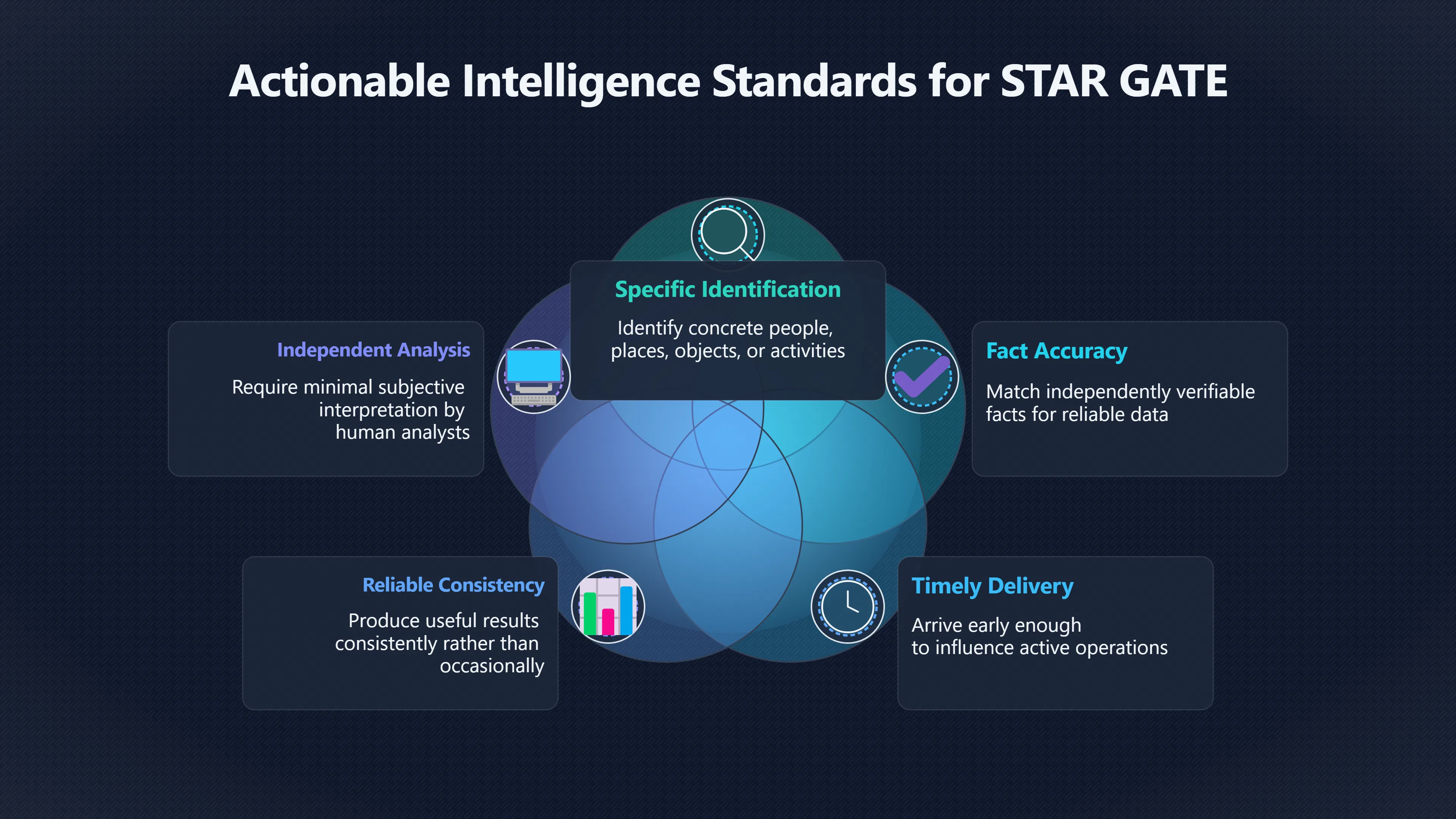
In intelligence work, information is valuable only if it can support decisions. “Actionable intelligence” is generally expected to be:
- Specific, identifying concrete people, places, objects or activities.
- Accurate, matching independently verifiable facts.
- Timely, arriving early enough to influence operations.
- Reliable, producing useful results consistently rather than occasionally.
- Independent, requiring minimal subjective interpretation by analysts.
The AIR (American Institutes for Research) evaluation found that remote-viewing reports generally failed these operational requirements. End users reported that while some descriptions occasionally resembled broad characteristics of targets, the reports typically lacked the precision necessary for intelligence work. The information was often vague, ambiguous and difficult to distinguish from incorrect or irrelevant material.[CIA]cia.govAN EVALUATION OF THE REMOTE VIEWING PROGRAMRemote viewing failed to produce actionable intelligence. Conclusions research The foregoin…
This distinction explains why striking anecdotes did not outweigh the programme’s overall assessment. Intelligence agencies judge collection methods by their average operational performance, not by isolated successes.
Why the later review mattered more than dramatic transcripts
One of the most persistent misunderstandings surrounding STAR GATE is treating individual session transcripts as evidence that the programme “worked.”
The final review deliberately evaluated the programme differently. Rather than asking whether any impressive descriptions existed, reviewers examined whether remote viewing had demonstrated sustained intelligence value over approximately two decades of government-sponsored research and operational use.
The operational evidence proved more influential than memorable stories. Intelligence customers who had received remote-viewing products reported that useful information tended to be limited to broad impressions rather than concrete intelligence suitable for operational decisions. Reports frequently contained a mixture of apparently correct observations alongside inaccuracies, irrelevant details and subjective interpretation, making it difficult to determine which elements, if any, deserved confidence.[CIA]cia.govAN EVALUATION OF THE REMOTE VIEWING PROGRAMRemote viewing failed to produce actionable intelligence. Conclusions research The foregoin…
This evaluation reflects a standard feature of intelligence analysis. A method that occasionally produces impressive coincidences may still be unusable if analysts cannot reliably identify which outputs are correct before acting upon them.

The two parallel questions the review separated
An important feature of the 1995 review is that it separated two different questions that are often merged in public discussion.
First, reviewers examined whether laboratory experiments showed statistically unusual effects. Statistician Jessica Utts argued that the accumulated experimental evidence justified taking the phenomenon seriously as a subject for scientific research. Psychologist Ray Hyman remained unconvinced that the evidence established paranormal functioning and argued that methodological concerns and independent replication remained unresolved.[PMC]pmc.ncbi.nlm.nih.govPMCFollow‐up on the U.SCentral Intelligence Agency's (CIA…by Á Escolà‐Gascón · 2023 · Cited by 10 — Scientific reviews and conclusions after the CIA declassi…
Second, and separately, the review considered whether the programme had demonstrated practical intelligence utility.
On this operational question, the overall AIR report reached a clear conclusion. Even if one assumed laboratory anomalies deserved further study, the available evidence did not show that remote viewing produced information of sufficient quality, consistency or precision for intelligence operations. The report concluded that continued operational use was not warranted.[CIA]cia.govAN EVALUATION OF THE REMOTE VIEWING PROGRAMRemote viewing failed to produce actionable intelligence. Conclusions research The foregoin…
This distinction is often overlooked in public debate. The scientific disagreement about experimental findings was not equivalent to a finding that the programme succeeded operationally.
How supporters and sceptics misquote the conclusion
Public discussion frequently compresses the STAR GATE review into simplistic claims that misrepresent what it actually concluded.
Supporters sometimes emphasise that one reviewer considered some laboratory evidence statistically significant while omitting that the operational assessment found no demonstrated intelligence value. This creates the misleading impression that the CIA rejected a proven intelligence capability. In reality, the review distinguished between laboratory observations and operational usefulness.[CIA]cia.govAN EVALUATION OF THE REMOTE VIEWING PROGRAMRemote viewing failed to produce actionable intelligence. Conclusions research The foregoin…
Sceptics can also oversimplify by claiming the review proved every reported remote-viewing result was fabricated or fraudulent. The report did not make that claim. Instead, it concluded that whatever unusual results might have appeared in research settings, they had not translated into a dependable intelligence collection method capable of supporting operational decisions.[CIA]cia.govAN EVALUATION OF THE REMOTE VIEWING PROGRAMRemote viewing failed to produce actionable intelligence. Conclusions research The foregoin…
The review therefore addressed programme effectiveness rather than resolving every scientific or philosophical question about anomalous cognition.
Why intelligence agencies judged the programme by operational standards
The STAR GATE evaluation illustrates how intelligence organisations assess unconventional collection methods.
A successful intelligence capability must outperform chance in ways that are operationally meaningful. Analysts need confidence that information is sufficiently precise to justify allocating surveillance assets, launching investigations, warning policymakers or directing military resources.
The AIR reviewers concluded that remote-viewing reports required extensive subjective interpretation, making it impossible to determine in advance which statements deserved confidence. Because intelligence decisions often carry substantial political, financial and human consequences, methods that cannot reliably distinguish accurate information from inaccurate information provide little operational advantage.[CIA]cia.govAN EVALUATION OF THE REMOTE VIEWING PROGRAMRemote viewing failed to produce actionable intelligence. Conclusions research The foregoin…
This explains why the programme’s final assessment centred on utility rather than novelty. Even accepting that some laboratory findings appeared statistically interesting, the intelligence community required demonstrated decision-making value.
What the final review means for interpreting CIA archive documents
The AIR evaluation provides essential context for reading declassified STAR GATE files.
Individual session records remain historically significant because they document what participants reported during government-sponsored remote-viewing activities. However, those records should not be interpreted as validated intelligence products simply because they appear in official archives.
The programme’s final evaluation serves as the interpretive framework for those documents. It indicates that reviewers examined years of operational experience and concluded that the reports had not produced actionable intelligence for intelligence operations. Consequently, dramatic transcripts should be understood as records of experimental or operational attempts rather than evidence that the intelligence community confirmed remote viewing as a dependable collection capability.[CIA]cia.govAN EVALUATION OF THE REMOTE VIEWING PROGRAMRemote viewing failed to produce actionable intelligence. Conclusions research The foregoin…
Amazon book picks
Further Reading
Books and field guides related to Why STAR GATE Failed the Intelligence Test. Use these as the next step if you want deeper reading beyond the article.
Phenomena: The Secret History of the U.S. Government's Invest...
Explains the history and eventual evaluation of government programs.
Phenomena
Covers the military and intelligence context behind remote viewing and the lab-to-operations gap.
The Men Who Stare At Goats
Rating: 3.5/5 from 11 Google Books ratings
Provides accessible background on military psychic research.
eBay marketplace picks
Marketplace Samples
Live-tested eBay searches with available results related to this page.


Endnotes
1.
Source: cia.gov
Link:https://www.cia.gov/readingroom/docs/CIA-RDP96-00791R000200180005-5.pdf
Source snippet
AN EVALUATION OF THE REMOTE VIEWING PROGRAMRemote viewing failed to produce actionable intelligence. Conclusions research The foregoin...
2.
Source: pmc.ncbi.nlm.nih.gov
Title: PMCFollow‐up on the U.S
Link:https://pmc.ncbi.nlm.nih.gov/articles/PMC10275521/
Source snippet
Central Intelligence Agency's (CIA...by Á Escolà‐Gascón · 2023 · Cited by 10 — Scientific reviews and conclusions after the CIA declassi...
3.
Source: Wikipedia
Title: Jessica Utts
Link:https://en.wikipedia.org/wiki/Jessica_Utts
4.
Source: Wikipedia
Title: Remote viewing
Link:https://en.wikipedia.org/wiki/Remote_viewing
Source snippet
Remote viewingThe program ran from 1975 to 1995 and ended after evaluators concluded that remote viewers consistently failed to produc...
Additional References
5.
Source: greydynamics.com
Link:https://greydynamics.com/intelligence-past-the-tangible-world-cias-[stargate
Source snippet
Intelligence Past the Tangible World: CIA's Stargate ProjectThe Stargate Project is one of the most interesting and enigmatic intelligenc...
6.
Source: academia.edu
Link:https://www.academia.edu/95285973/The_Star_Gate_Operational_Remote_Viewing_Program_A_Human_Intelligence_HUMINT_Collection_Platform
Source snippet
In early 1995, a Congressionally Directed Action required the DIA to transfer the Star Gate program to the CIA. Evaluation: High...
7.
Source: journalofscientificexploration.org
Link:https://journalofscientificexploration.org/index.php/jse/article/view/3865/2573
Source snippet
D., Rose, A. M., & Goslin, D. A. (1995). An evaluation of remote viewing: Research and applications. American Institutes for Research. Mö...
8.
Source: ciaotest.cc.columbia.edu
Link:https://ciaotest.cc.columbia.edu/olj/sa/sa_jan02srm01.html
Source snippet
ere trained to acquire such 'Remote Viewing' capabilities for collecting...Read more...
9.
Source: facebook.com
Title: During the [Cold War]({{ ‘cold-war/’ | relative_url }}), the CIA funded research into what
Link:https://www.facebook.com/100090372200308/posts/during-the-cold-war-the-cia-funded-research-into-what-they-called-remote-viewing/937678002587931/
Source snippet
AIR, which performed a review of the project, no remote viewing report ever provided actionable information for any intelligence operatio...
10.
Source: Wikipedia
Title: Stargate Project (U.S. Army unit)
Link:https://en.wikipedia.org/wiki/Stargate_Project_%28U.S._Army_unit%29
Source snippet
Stargate Project (U.S. Army unit)According to the AIR review, no remote viewing report ever provided actionable information for any in...
11.
Source: slideshare.net
Link:https://www.slideshare.net/slideshow/an-evaluation-of-remote-viewing-research-and-applications-air1995pdf/257460594
Source snippet
An Evaluation of Remote Viewing, Research and...Remote viewing reports provided vague and ambiguous information that was not useful for...
12.
Source: youtube.com
Title: How the CIA Fooled Us to Believe in Remote Viewing: SCAM Exposed! | Jeremy Rys
Link:https://www.youtube.com/watch?v=QbY6rT4sFk0
Source snippet
Stargate Project: How Did the CIA Turn the Human Mind into a Weapon?...
13.
Source: youtube.com
Title: The CIA Filed a 9-Page Report Describing Pyramids on Mars. Then Classified It
Link:https://www.youtube.com/watch?v=lGenw1l8rjk
Source snippet
[Statistics]({{ 'statistics/' | relative_url }}) in Parapsychology with Jessica Utts...
14.
Source: theclassifiedrecord.com
Title: primary documents
Link:https://theclassifiedrecord.com/documents/stargate/primary-documents
Source snippet
STARGATE 1995 AIR Evaluation: Full Transcription29 Sept 1995 — AIR concluded that continued use of remote viewing in intelligence operati...
Topic Tree