Within Fair Test
When Random Targets Are Not Random Enough
A target pool only protects the test when every option is fixed in advance, randomly selectable, and hidden from the session team.
On this page
- Why target pools must be fixed before the session
- How random selection makes chance measurable
- Common ways target lists leak the answer
Page outline Jump by section
Introduction
A random target pool is one of the foundations of a fair remote viewing test because it defines what counts as chance before any session begins. Without a fixed, pre-prepared collection of possible targets and a genuinely random method of selecting one, there is no reliable way to distinguish a meaningful result from coincidence, selective matching, or accidental information leakage. The target pool therefore serves two purposes at once: it limits the experimenter’s freedom to make choices after seeing the data, and it provides a known probability model against which the viewing results can be evaluated. Studies and methodological reviews of remote viewing have repeatedly stressed that apparent successes are difficult to interpret unless target selection, judging and scoring are all constrained by procedures fixed in advance.[National Security Archive]nsarchive2.gwu.eduThe second component was a review of the operational application of the remote viewing…Read more…
Why target pools must be fixed before the session
A target pool is a collection of possible targets prepared before any viewing session takes place. Each item should be eligible for selection, and the complete list should remain unchanged throughout the experiment.
This requirement prevents a subtle but important source of false positives. If experimenters can add, remove or substitute targets after reading the viewer’s description, they can unintentionally improve the apparent match. Even without deliberate fraud, knowledge of the session may influence which photographs, locations or objects are judged to be “close enough” to the transcript.
A fixed pool reduces these opportunities because:
- every possible target exists before the session begins;
- the number of alternatives is known;
- the selection process can be audited afterwards;
- the statistical chance of obtaining a correct match is defined in advance.
Later laboratory protocols reviewed by the American Institutes for Research commonly used pre-existing collections of photographs rather than allowing experimenters to invent targets during the study. This made formal rank-order judging possible and helped separate the randomisation process from the interpretation of the transcript.[National Security Archive]nsarchive2.gwu.eduThe second component was a review of the operational application of the remote viewing…Read more…
How random selection makes chance measurable
Randomisation is valuable not because randomness is mysterious, but because it produces known probabilities.
Suppose a judging procedure presents one genuine target together with four decoys. If every target has an equal probability of being selected and the judge has no hidden information, a random guess should identify the correct target approximately one time in five. That expected success rate becomes the benchmark against which the experiment is assessed.
If the target is instead chosen because it “fits” the transcript, because someone prefers visually distinctive images, or because some targets are reused far more often than others, the theoretical chance level no longer reflects what actually happened. Statistical tests lose their meaning because the assumptions behind them have been violated.
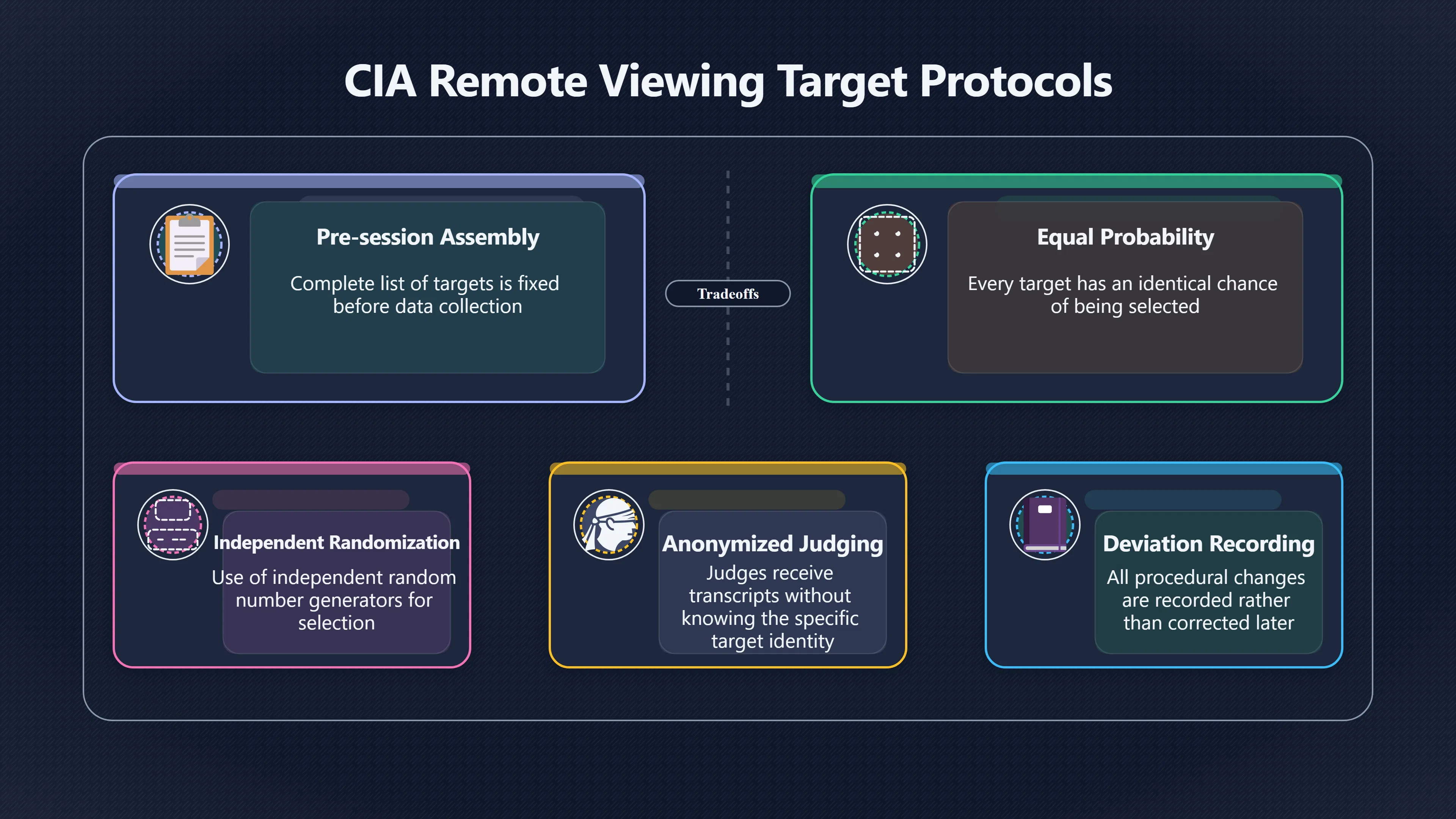
For this reason, robust protocols typically:
- assign equal selection probability to every target;
- use independent random number generators or equivalent randomisation procedures;
- document the selection method before the trial;
- prevent the session team from influencing target assignment.
Government-sponsored remote viewing protocols and later evaluations repeatedly treated random target assignment as a basic methodological requirement rather than an optional refinement.[CIA+2National Security Archive]cia.govSTANDARD REMOTE VIEWING (RV) PROCEDURESThe target pool consists of more than 50 target locations chosen from a target-rich environment…
When random targets are not random enough
Simply claiming that targets were chosen “at random” does not guarantee a sound design. Several practical problems can make an apparently random pool predictable.
One problem is unequal sampling. If certain targets appear far more frequently than others, experienced viewers or judges may unconsciously favour common categories. Another is an unbalanced pool. For example, if most targets contain water while only a few depict urban scenes, even vague references to oceans or rivers will appear unusually successful.
Target pools can also become predictable through familiarity. Repeated use of the same photographs or famous locations allows participants to learn the characteristics of the collection itself rather than demonstrating information about a newly selected target.
A stronger design therefore aims for:
- balanced representation of target types;
- approximately equal visual complexity;
- similar emotional salience;
- minimal reuse of individual targets;
- documented retirement or replacement of overused targets.
These precautions reduce the possibility that success reflects properties of the pool rather than accurate identification of the selected target.
Common ways target lists leak the answer
A target pool only protects the experiment if it remains hidden from everyone involved in collecting or judging the session.
Historical debates over early remote viewing experiments illustrate why this matters. David Marks argued that judges could identify correct targets using unintended clues embedded in transcripts and target materials rather than the descriptive content itself. These cues reportedly included dates, references to previous sessions and the sequence in which targets had been used. Marks demonstrated that when these contextual clues were available, matching accuracy could be artificially inflated; when they were removed, the apparent effect disappeared in his analyses. Supporters of the original studies disputed aspects of these conclusions, but the controversy reinforced the need to eliminate every possible non-paranormal source of information.[Wikipedia]WikipediaRemote viewingRemote viewing
Common leakage routes include:
- filenames revealing the target identity;
- sequential numbering that exposes trial order;
- handwritten notes or dates on transcripts;
- experimenters reacting differently when they know the target;
- incomplete shuffling of target sets;
- travel schedules or logistics revealing destination targets;
- digital metadata such as timestamps or folder structures.
None of these cues relates to remote viewing itself, yet any of them can increase apparent hit rates if not controlled.
False positives without fraud
False positives do not require anyone to cheat deliberately. They can emerge naturally from flexible procedures.
For example, if researchers repeatedly redraw targets until an interesting one appears, remove poor sessions from analysis, alter the judging criteria after seeing the responses, or allow judges to compare transcripts with multiple alternative target sets, the probability of finding apparently impressive matches increases substantially.
This problem is not unique to remote viewing. Across experimental science, researchers seek to avoid false discoveries by fixing hypotheses, sampling procedures and statistical analyses before examining results. In remote viewing, the equivalent safeguards include fixing the target pool, documenting the randomisation procedure, defining the judging protocol in advance and reporting unsuccessful sessions alongside successful ones. These measures reduce opportunities for unconscious selection effects and hindsight bias.[National Security Archive]nsarchive2.gwu.eduThe second component was a review of the operational application of the remote viewing…Read more…
Practical characteristics of a robust target pool
Within a fair remote viewing protocol, a well-designed target pool typically has the following characteristics:
- It is assembled before data collection begins.
- Every target has an equal opportunity to be selected.
- Selection uses a documented random process.
- The session monitor cannot influence target assignment.
- The viewer has no access to the pool.
- Judges receive anonymised transcripts together with predetermined comparison targets.
- The composition of the pool remains stable until the study is complete.
- All deviations from the planned procedure are recorded rather than corrected retrospectively.
These safeguards do not establish whether remote viewing exists. Their purpose is narrower but essential: to ensure that any observed success cannot be explained simply by predictable target selection, information leakage or post hoc choices that inflate the number of apparent hits.
Amazon book picks
Further Reading
Books and field guides related to When Random Targets Are Not Random Enough. Use these as the next step if you want deeper reading beyond the article.


The conscious universe
Contrasts laboratory evidence with practical application questions.

eBay marketplace picks
Marketplace Samples
Live-tested eBay searches with available results related to this page.



Endnotes
1.
Source: cia.gov
Link:https://www.cia.gov/readingroom/document/cia-rdp96-00787r000500400001-4
Source snippet
ection; (2) subject orientation; (3) outbound experimenter...Read more...
2.
Source: cia.gov
Link:https://www.cia.gov/readingroom/docs/CIA-RDP96-00788R002000240029-4.pdf
Source snippet
STANDARD REMOTE VIEWING (RV) PROCEDURESThe target pool consists of more than 50 target locations chosen from a target-rich environment...
3.
Source: Wikipedia
Title: Remote viewing
Link:https://en.wikipedia.org/wiki/Remote_viewing
4.
Source: nsarchive2.gwu.edu
Link:https://nsarchive2.gwu.edu/NSAEBB/NSAEBB438/docs/doc_57.pdf
Source snippet
The second component was a review of the operational application of the remote viewing...Read more...
Additional References
5.
Source: rv-practice.rf.gd
Link:https://rv-practice.rf.gd/
Source snippet
Viewing PracticeWelcome to yet another remote viewing practice site. Here you can find information to get started in remote viewing and a...
6.
Source: mitre.org
Link:https://www.mitre.org/sites/default/files/2022-04/11-strategies-of-a-world-class-cybersecurity-operations-center.pdf
Source snippet
tional security, critical infrastructure, economic stability, and personal privacy.Read more...
7.
Source: reddit.com
Link:https://www.reddit.com/r/remoteviewing/comments/1qte59o/my_most_recent_bullseye_sessions_got_some_really/
Source snippet
my house. I like having an offline pool just in case.Read more...
8.
Source: youtube.com
Title: The Farsight Institute’s Approach to Remote Viewing with Courtney Brown
Link:https://www.youtube.com/watch?v=4neYKcE3MYc
Source snippet
How to Conduct Parapsychology Research with Stephan A. Schwartz...
9.
Source: pmc.ncbi.nlm.nih.gov
Link:https://pmc.ncbi.nlm.nih.gov/articles/PMC4240437/
Source snippet
Spatial Learning and Memory in Rodents - PMC - NIHby CV Vorhees · 2014 · Cited by 781 — In this article, several allocentric assessment m...
10.
Source: reddit.com
Link:https://www.reddit.com/r/remoteviewing/
Source snippet
mal means, in particular…...
11.
Source: youtube.com
Title: [Statistics]({{ ‘statistics/’ | relative_url }}) in Parapsychology with Jessica Utts
Link:https://www.youtube.com/watch?v=WmYGtKB9EEA
Source snippet
The Farsight Institute's Approach to Remote Viewing with Courtney Brown...
12.
Source: 178wing.ang.af.mil
Title: afh33 337
Link:https://www.178wing.ang.af.mil/Portals/69/documents/afh33-337.pdf
Source snippet
Tongue and Quill19 Nov 2015 — The Tongue and Quill has been a valued Air Force resource for decades and many Airmen from our Total Force...
13.
Source: youtube.com
Title: Training Anomalous Cognition with Edwin C. May
Link:https://www.youtube.com/watch?v=6vbb7E7UD30
Source snippet
Statistics in Parapsychology with Jessica Utts...
14.
Source: youtube.com
Title: Target Workbook 100 Remote Viewing Targets
Link:https://www.youtube.com/watch?v=HjVKnQ6ZiWw
Source snippet
Training Anomalous Cognition with Edwin C. May...
Topic Tree