Within SAIC Tests
Why Significant Results Still Fell Short
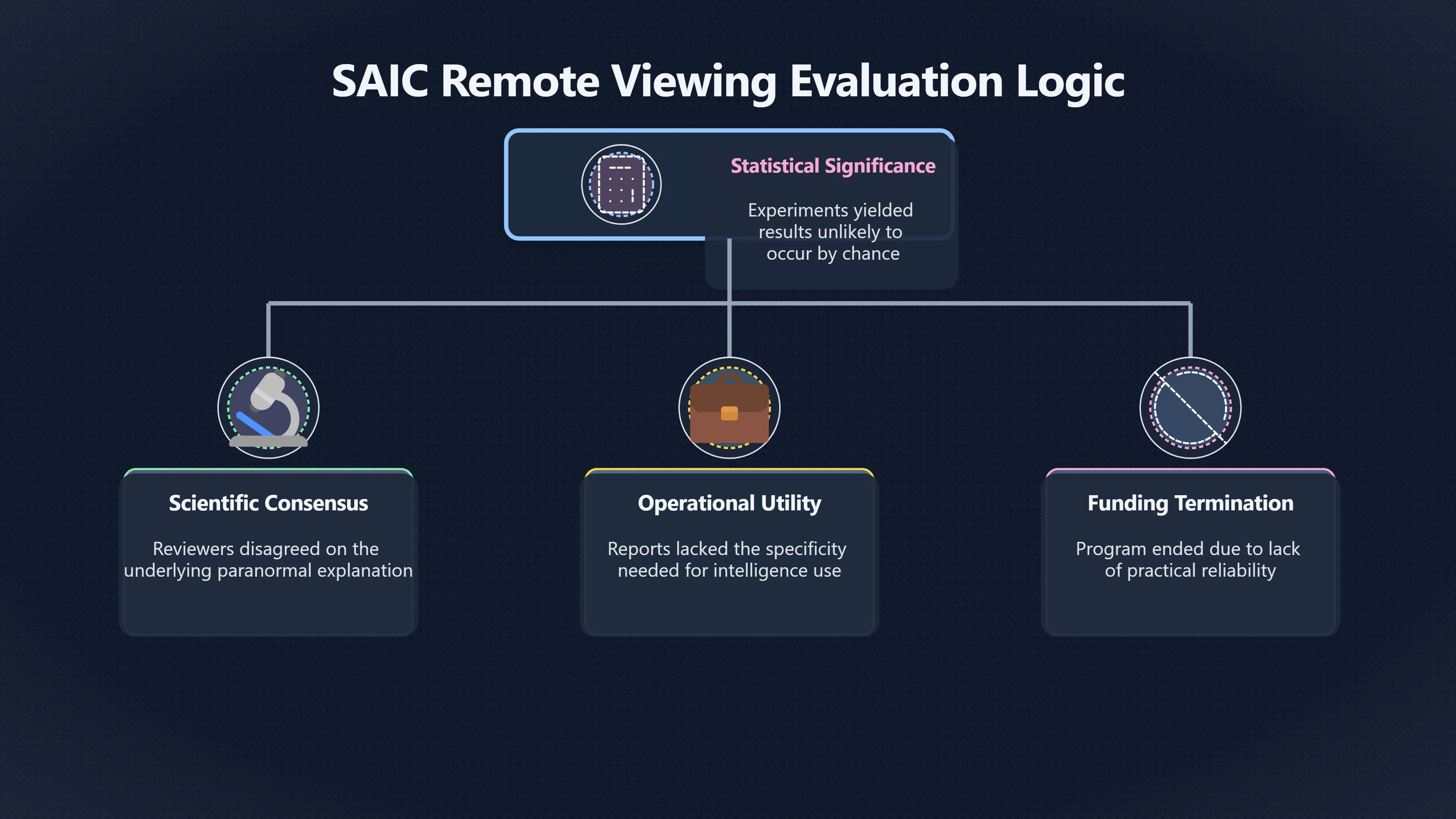
Utts and Hyman agreed the SAIC data were statistically significant, but that agreement did not translate into accepted science or useful intelligence.
On this page
- What statistical significance did and did not prove
- Why paranormal interpretation remained disputed
- Why intelligence usefulness was a separate hurdle
Page outline Jump by section
Introduction
The late experiments conducted by Science Applications International Corporation (SAIC) occupy an unusual place in the history of remote viewing. They were strong enough that both statistician Jessica Utts and psychologist Ray Hyman agreed the results were statistically significant, yet they still failed to persuade either the wider scientific community or the U.S. intelligence establishment to continue the programme. This apparent contradiction is central to understanding why the Stargate programme ended in 1995. Statistical significance showed that the experimental outcomes were unlikely to be explained by simple chance under the study assumptions. It did not, by itself, establish that paranormal perception had been demonstrated, identify the underlying cause, or prove that the phenomenon could produce reliable intelligence in real-world operations. Those unresolved questions ultimately proved more important than the statistical findings themselves.[CIA+2UC Irvine Bren School]cia.govAN EVALUATION OF THE REMOTE VIEWING PROGRAMOne might demonstrate the existence of a statistically significant paranormal phenomenon in…
What Statistical Significance Did and Did Not Prove
The SAIC experiments represented some of the most carefully designed studies in the government’s remote-viewing programme. Both Utts and Hyman accepted that the later studies showed effect sizes exceeding what would normally be expected by chance and that the most obvious methodological weaknesses seen in much earlier work had been reduced. This agreement is often overlooked because the two reviewers reached very different conclusions from the same evidence.[CIA+2UC Irvine Bren School]cia.govAN EVALUATION OF THE REMOTE VIEWING PROGRAMOne might demonstrate the existence of a statistically significant paranormal phenomenon in…
The disagreement centred on interpretation rather than arithmetic.
Utts argued that repeated statistically significant results across multiple experiments justified accepting that an anomalous information-transfer effect existed. In her view, the burden had shifted away from proving whether the phenomenon occurred and towards explaining how it operated. She also pointed to similar findings reported in other parapsychology laboratories as evidence that the results were not isolated.[UC Davis]ucdavis.edupsychic spying research produces credible evidenceUC Davis'Psychic Spying' Research Produces Credible Evidence28 Nov 1995 — Hyman asserts that one of the biggest drawbacks to the scientif…
Hyman accepted the statistical findings but rejected the conclusion that they established extrasensory perception. His position reflected a standard principle in science: a statistically significant result demonstrates that an observed pattern deserves explanation, not that any particular explanation has been proven. Alternative possibilities—including unnoticed methodological artefacts, subtle biases, or unknown features of the judging procedures—had not been eliminated convincingly enough to justify accepting a paranormal interpretation.[UC Irvine Bren School]ics.uci.eduShe does not…
In other words, the reviewers agreed on the existence of an unusual statistical pattern while disagreeing about its meaning.
Why the Paranormal Interpretation Remained Disputed
The principal obstacle was that remote viewing lacked an accepted explanatory framework. Even if the SAIC data reflected a genuine anomaly, no established physical or psychological theory explained how accurate perception of distant targets could occur without conventional sensory channels. In mainstream science, extraordinary empirical claims normally require not only statistical evidence but also independent confirmation and a coherent theoretical account.[UC Irvine Bren School]ics.uci.eduShe does not…
Independent replication was another concern. Much of the strongest evidence came from a relatively small research community using similar investigators, experienced viewers and comparable judging methods. Hyman argued that genuinely persuasive evidence would require successful replication by independent laboratories with no prior commitment to the phenomenon. The secrecy surrounding much of the government programme also limited the normal process of scientific scrutiny through open publication, criticism and replication.[UC Irvine Bren School]ics.uci.eduShe does not…
Subsequent critics also revisited individual SAIC experiments after the AIR review. Richard Wiseman and Julie Milton argued that at least one influential experiment contained methodological ambiguities and possible sources of information leakage that deserved greater attention. Their criticism did not prove that the observed effects were entirely artefactual, but it reinforced the broader argument that statistically significant findings alone were insufficient to settle the debate.[Hertfordshire Research Profiles]researchprofiles.herts.ac.ukexperiment one of the saic remote viewing program a critical re ethere are severe problems associted with reconstructing important aspects of the study…
The result was an enduring “significance gap”: evidence strong enough to prevent easy dismissal, but not strong enough to establish scientific consensus.

Why Intelligence Usefulness Was a Separate Hurdle
Even if one assumed that the laboratory effect reflected a genuine anomaly, intelligence agencies faced a different question altogether: could remote viewing reliably produce operationally useful information?
The American Institutes for Research (AIR) concluded that the available evidence did not support that conclusion. Interviews with programme users and examination of operational records suggested that remote-viewing reports generally lacked the specificity, consistency and reliability needed for intelligence decision-making. Descriptions were often broad, ambiguous or difficult to distinguish from informed guesswork after the fact. Accurate elements could coexist with substantial amounts of incorrect or irrelevant material, making it difficult for analysts to know which details to trust.[National Security Archive]nsarchive2.gwu.edu• The process isNational Security ArchiveAn Evaluation of Remote Viewing: Research and…by MD Mumford · 1995 · Cited by 76 — The viewing process has no…
The AIR review therefore separated two distinct questions that are often conflated:
- Did laboratory experiments produce statistically unusual results? The reviewers broadly agreed they did.
- Did those results justify operational intelligence use? The evaluation concluded they did not.
This distinction was decisive because intelligence organisations evaluate methods primarily by their practical performance rather than by laboratory anomalies alone. A technique that occasionally generates intriguing results but cannot consistently identify which outputs are accurate offers limited operational value.[National Security Archive]nsarchive2.gwu.edu• The process isNational Security ArchiveAn Evaluation of Remote Viewing: Research and…by MD Mumford · 1995 · Cited by 76 — The viewing process has no…
Why the Programme Was Not Saved
The SAIC studies demonstrated that improving experimental controls did not automatically resolve the broader controversy. Instead, they exposed three separate standards that all needed to be met.
First, the research had to demonstrate a reproducible statistical effect. The SAIC experiments came closest to achieving this and were widely regarded as the programme’s strongest laboratory evidence.[CIA]cia.govAN EVALUATION OF THE REMOTE VIEWING PROGRAMOne might demonstrate the existence of a statistically significant paranormal phenomenon in…
Second, the evidence had to convince the wider scientific community that the effect reflected a genuine paranormal phenomenon rather than an unresolved methodological issue. On this point, the reviewers diverged sharply, and no scientific consensus emerged.[UC Irvine Bren School]ics.uci.eduShe does not…
Third, and most important for government funding, the phenomenon had to provide dependable operational intelligence. The AIR assessment concluded that existing evidence failed this practical test, stating that the available research did not demonstrate information of sufficient specificity and reliability for intelligence purposes.[National Security Archive]nsarchive2.gwu.edu• The process isNational Security ArchiveAn Evaluation of Remote Viewing: Research and…by MD Mumford · 1995 · Cited by 76 — The viewing process has no…
Because the programme failed to satisfy the final requirement, statistically significant laboratory findings were not enough to justify continued investment. The SAIC results therefore became the strongest evidence ever produced within the programme while simultaneously illustrating why statistically significant experimental outcomes, by themselves, could not preserve government support for remote-viewing research.[National Security Archive+2CIA]nsarchive2.gwu.edu• The process isNational Security ArchiveAn Evaluation of Remote Viewing: Research and…by MD Mumford · 1995 · Cited by 76 — The viewing process has no…
Amazon book picks
Further Reading
Books and field guides related to Why Significant Results Still Fell Short. Use these as the next step if you want deeper reading beyond the article.
The Demon-Haunted World
Provides context for evaluating extraordinary scientific claims.
The conscious universe
Explains statistical arguments for psi claims and their interpretation.
ESP Wars: East & West
Covers the SAIC era, statistical evidence, and competing interpretations.
Extrasensory Perception: Support, Skepticism, and Science
Balances evidence, criticism, and scientific standards.
Endnotes
1.
Source: cia.gov
Link:https://www.cia.gov/readingroom/docs/CIA-RDP96-00791R000200180005-5.pdf
Source snippet
AN EVALUATION OF THE REMOTE VIEWING PROGRAMOne might demonstrate the existence of a statistically significant paranormal phenomenon in...
2.
Source: ics.uci.edu
Link:https://www.ics.uci.edu/~jutts/hyman.html
Source snippet
She does not...
3.
Source: nsarchive2.gwu.edu
Title: • The process is
Link:https://nsarchive2.gwu.edu/NSAEBB/NSAEBB438/docs/doc_57.pdf
Source snippet
National Security ArchiveAn Evaluation of Remote Viewing: Research and...by MD Mumford · 1995 · Cited by 76 — The viewing process has no...
4.
Source: ucdavis.edu
Title: [psychic spying]({{ ‘psychic-spying/’ | relative_url }}) research produces credible evidence
Link:https://www.ucdavis.edu/news/psychic-spying-research-produces-credible-evidence
Source snippet
UC Davis'Psychic Spying' Research Produces Credible Evidence28 Nov 1995 — Hyman asserts that one of the biggest drawbacks to the scientif...
5.
Source: Wikipedia
Title: Remote viewing
Link:https://en.wikipedia.org/wiki/Remote_viewing
6.
Source: researchprofiles.herts.ac.uk
Title: experiment one of the saic remote viewing program a critical re e
Link:https://researchprofiles.herts.ac.uk/en/publications/experiment-one-of-the-saic-remote-viewing-program-a-critical-re-e/
Source snippet
there are severe problems associted with reconstructing important aspects of the study...
Additional References
7.
Source: reddit.com
Link:https://www.reddit.com/r/remoteviewing/comments/1dazs09/creation_of_study_on_statistical_evidence_of/
8.
Source: koestlerunit.wordpress.com
Title: Both Hyman and Utts agreed that this experiment didn’t contain any
Link:https://koestlerunit.wordpress.com/wp-content/uploads/2015/06/wiseman-milton-1998.pdf
Source snippet
Koestler UnitExperiment One of the SAIC Remote Viewing Programby R Wiseman · Cited by 24 — The study chosen was Experiment One, which had...
9.
Source: researchgate.net
Link:https://www.researchgate.net/publication/267978941Evaluation_of_Program_on%27Anomalous_Mental_Phenomena%27
Source snippet
g and related phenomena which was carried out at Stanford Re-search...
10.
Source: pmc.ncbi.nlm.nih.gov
Title: PMCFollow‐up on the U.S
Link:https://pmc.ncbi.nlm.nih.gov/articles/PMC10275521/
Source snippet
Central Intelligence Agency's (CIA...by Á Escolà‐Gascón · 2023 · Cited by 10 — Hyman and Utts concurred that the significant [effect size]({{ 'effect-size/' | relative_url }})...
11.
Source: youtube.com
Title: Remote Viewing Training, Part One: The Initial Phases, with Paul H. Smith
Link:http://www.youtube.com/watch?v=Y2Ryc196s0I
Source snippet
Principles of Remote Viewing with Paul H. Smith...
12.
Source: ciaotest.cc.columbia.edu
Title: sa jan02srm01
Link:https://ciaotest.cc.columbia.edu/olj/sa/sa_jan02srm01.html
Source snippet
Remote Viewing: The US Sponsored Psychic...Unfortunately, to obtain statistically significant results the experiment had to be repeated...
13.
Source: youtube.com
Title: Remote Viewing From the Inside Out with Russell Targ
Link:http://www.youtube.com/watch?v=V6Pn6WGahYI
Source snippet
Skepticism About Remote Viewing with Paul H. Smith...
14.
Source: youtube.com
Title: Principles of Remote Viewing with Paul H. Smith
Link:http://www.youtube.com/watch?v=Smo1aP0v4xg
Source snippet
Remote Viewing From the Inside Out with Russell Targ...
15.
Source: youtube.com
Title: Skepticism About Remote Viewing with Paul H. Smith
Link:http://www.youtube.com/watch?v=gadka2zweUo
Source snippet
Russell Targ on the Science of Remote Viewing...
16.
Source: youtube.com
Title: Russell Targ on the Science of Remote Viewing
Link:http://www.youtube.com/watch?v=IDaFwLS6goU
Topic Tree