Within Anecdotes
When Lab Results Meet Real Targets
Statistical anomalies in controlled experiments did not translate into dependable intelligence for open-ended real-world targets.
On this page
- What laboratory scoring can measure
- Why intelligence targets are harder
- Why usefulness requires more than significance
Page outline Jump by section
Introduction
One of the longest-running debates over remote viewing is not simply whether some laboratory experiments produced results that differed from chance, but whether those findings translated into dependable intelligence work. Those are different questions. A laboratory can demonstrate a statistically unusual pattern under tightly controlled scoring rules, while an intelligence service needs timely, specific and actionable information about unique real-world targets. The historical record shows that this gap became the central issue in the evaluation of the U.S. government’s remote-viewing programme. Even reviewers who accepted that some laboratory data deserved further scientific investigation concluded that the operational evidence was much weaker because usefulness depends on accuracy, clarity, consistency and decision value rather than statistical significance alone.[CIA+2National Security Archive]cia.govAN EVALUATION OF THE REMOTE VIEWING PROGRAMAlthough parapsychological research has a long history, studies of "remote viewing" also re…

What laboratory scoring can measure
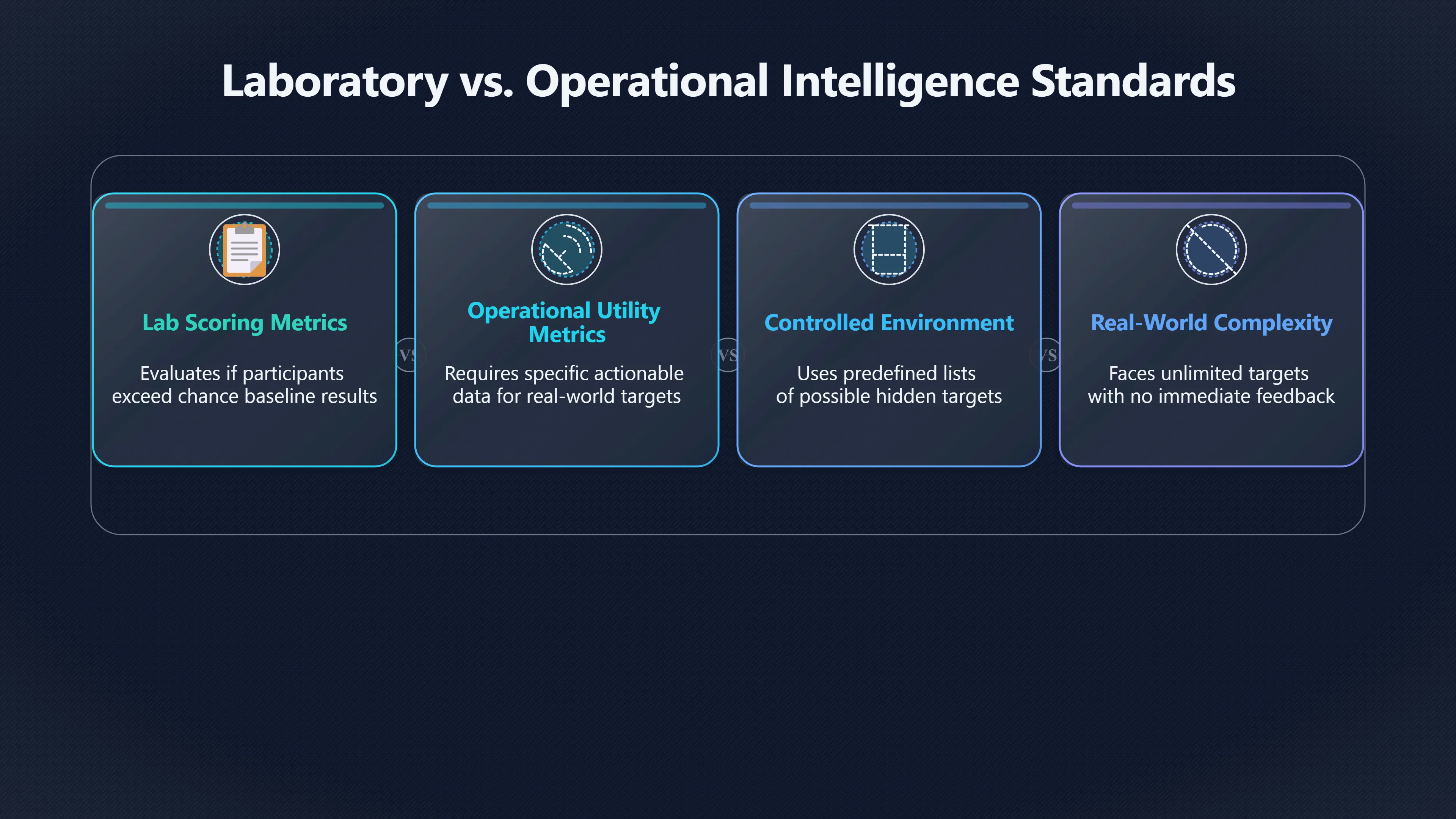
Laboratory remote-viewing studies typically evaluate whether participants describe hidden targets at rates exceeding chance using predefined judging procedures. Instead of asking whether a viewer correctly identified an enemy installation or solved an intelligence problem, researchers score correspondences between session transcripts and a limited set of possible targets.
This approach has important strengths. Researchers can blind judges, randomise targets and apply statistical tests across many trials. If participants consistently perform above the expected baseline, investigators may argue that the results warrant scientific attention, even if the underlying mechanism remains unknown.
That distinction lay at the heart of the 1995 review commissioned after the Stargate programme ended. Statistician Jessica Utts argued that the accumulated experimental evidence contained statistically significant effects that she believed could not easily be dismissed as chance. However, she also acknowledged that statistical evidence alone did not establish how, when or whether such effects could be applied reliably outside laboratory conditions.[National Security Archive]nsarchive2.gwu.eduNational Security ArchiveAn Evaluation of Remote Viewing: Research and…by MD Mumford · 1995 · Cited by 76 — This evidence for anomalou…
Laboratory scoring therefore answers a relatively narrow question:
- Did participants perform better than an expected chance baseline under controlled conditions?
- Were the judging procedures sufficiently blinded?
- Did the effect appear consistently across repeated trials?
Those questions are scientifically meaningful, but they are not identical to asking whether an intelligence agency can make dependable operational decisions from the output.
Why intelligence targets are harder
Operational intelligence presents a much more demanding problem than laboratory testing.
Unlike experimental targets, real intelligence questions rarely have a small, predefined list of possible answers. Analysts may need information about hidden facilities, military intentions, hostage locations or future events where there is no immediate feedback and no obvious way to score partial matches objectively.
This changes the evaluation standard. A laboratory transcript can be judged after the correct answer is known. An intelligence report must help someone make a decision before the answer is available.
The American Institutes for Research (AIR) review repeatedly identified this distinction. Reviewers found that remote-viewing reports often contained mixtures of correct, incorrect, vague and unverifiable statements. Such material could appear impressive after the fact, particularly when evaluators already knew the target, but it was much less effective when assessed prospectively by analysts who had to identify the correct target from the report alone.[National Security Archive]nsarchive2.gwu.eduNational Security ArchiveAn Evaluation of Remote Viewing: Research and…by MD Mumford · 1995 · Cited by 76 — This evidence for anomalou…
In operational settings, several additional difficulties emerge:
- No fixed answer set. Intelligence targets are effectively unlimited rather than chosen from a small experimental pool.
- Time pressure. Decisions often cannot wait for extensive interpretation or repeated viewing sessions.
- High cost of false positives. A convincing but incorrect impression can divert resources or influence policy.
- Mixed information quality. Operational reports commonly combine potentially accurate observations with speculation, errors and ambiguous descriptions.
These challenges mean that even a modest laboratory effect may not survive the demands of practical intelligence work.

Why usefulness requires more than significance
The central disagreement surrounding Stargate illustrates the difference between demonstrating an anomaly and demonstrating utility.
Jessica Utts argued that the experimental database contained evidence suggesting an anomalous information effect deserving further scientific investigation. Psychologist Ray Hyman accepted that some findings merited additional research but argued that methodological issues and lack of independent replication prevented stronger conclusions about paranormal functioning. Despite their disagreement over interpretation, both reviewers distinguished scientific anomalies from operational usefulness.[National Security Archive]nsarchive2.gwu.eduNational Security ArchiveAn Evaluation of Remote Viewing: Research and…by MD Mumford · 1995 · Cited by 76 — This evidence for anomalou…
The AIR team’s broader operational assessment reached a different practical conclusion. After reviewing programme files and interviewing intelligence personnel, the evaluators concluded there was no persuasive evidence that remote viewing had provided intelligence of sufficient quality or consistency to justify operational use. Information was frequently too vague, subjective or inconsistent to support decision-making.[CIA]cia.govAN EVALUATION OF THE REMOTE VIEWING PROGRAMAlthough parapsychological research has a long history, studies of "remote viewing" also re…
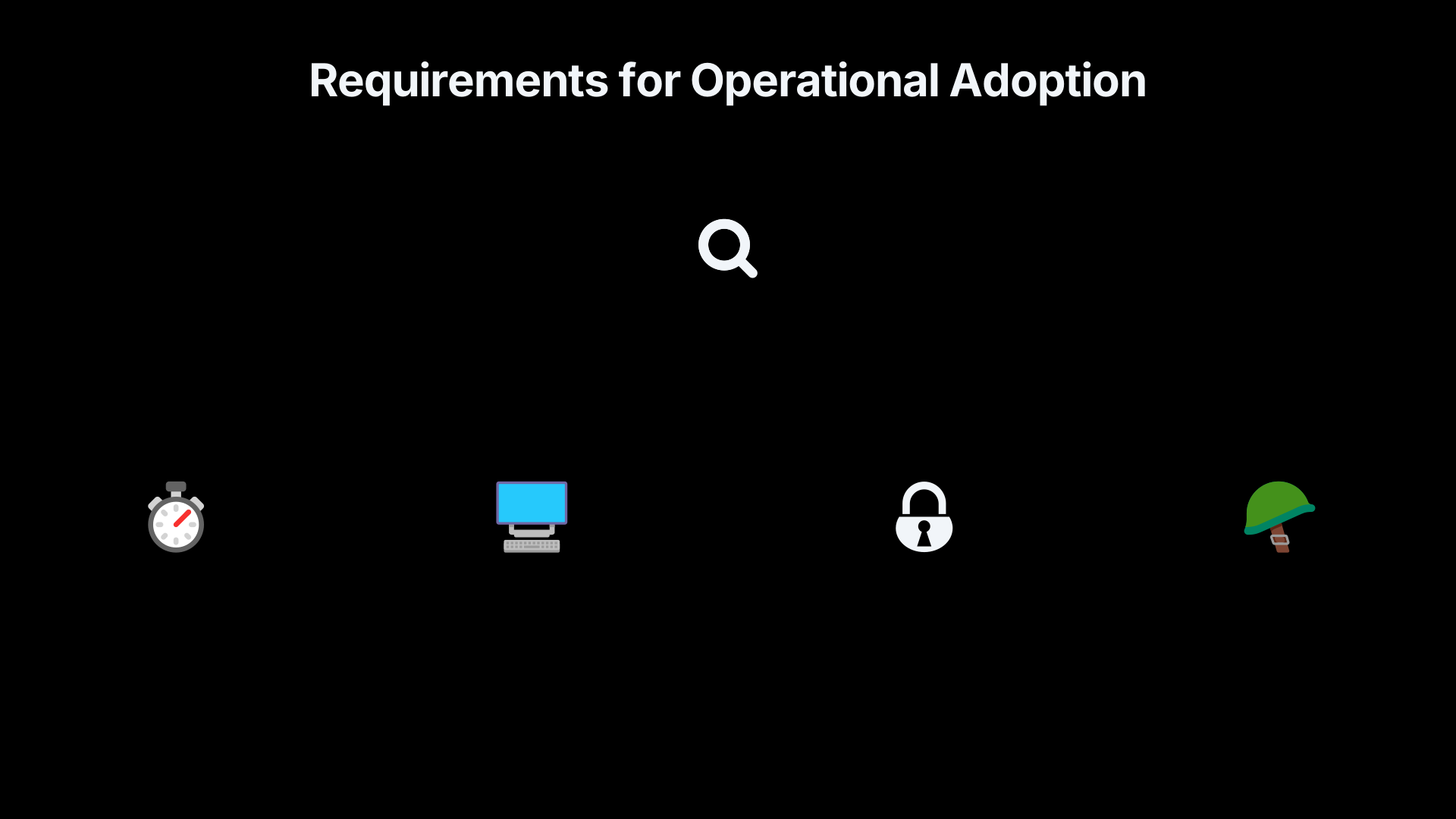
This distinction explains why a statistically interesting research result does not automatically become an effective intelligence tool. Operational systems must satisfy several requirements simultaneously:
- produce information that is specific rather than impressionistic;
- perform consistently across many different targets;
- improve decisions beyond existing intelligence methods;
- minimise costly errors and ambiguous interpretations;
- demonstrate value under realistic working conditions rather than specialised testing environments.
Meeting only the first requirement—showing a statistical departure from chance—is insufficient for operational adoption.
The historical comparison between laboratory and operational performance
The history of the U.S. programme illustrates an increasingly clear separation between experimental promise and operational evaluation.
Early laboratory work at the Stanford Research Institute generated enough interest for government agencies to continue funding research over many years. Later investigators at Science Applications International Corporation attempted to refine experimental methods and scoring procedures, seeking stronger evidence under tighter controls. Some researchers involved with the programme have continued to argue that these laboratory findings deserve greater scientific attention.[ResearchGate]researchgate.net369604750 Remote Viewing a 1974 2022 systematic review and meta analysisUtts, J. (1996). An assessment of the evidence… Keywords: Remote viewing, target material, extrasensory perception, anomalous cognitio…
Operational experience proved less convincing. Reports occasionally contained details that participants and supporters regarded as striking, but these examples were difficult to convert into a reliable collection system. Intelligence consumers needed dependable information across many cases, not isolated successes surrounded by uncertain or unusable material.
The CIA-commissioned review therefore separated two questions that are often conflated in public discussion:
- Did some controlled experiments report statistically unusual results?
- Did those results produce a dependable intelligence capability?
The available evidence led reviewers to answer those questions differently. The first remained disputed among researchers. The second was judged negatively in the programme’s operational assessment, contributing to the decision to end government sponsorship.[CIA+2National Security Archive]cia.govAN EVALUATION OF THE REMOTE VIEWING PROGRAMAlthough parapsychological research has a long history, studies of "remote viewing" also re…
Why this distinction matters when evaluating anecdotes
This laboratory-versus-operational divide helps explain why dramatic remote-viewing anecdotes remain compelling even when broader evaluations are sceptical.
Individual cases naturally emphasise apparent successes: an unexpectedly accurate sketch, a striking descriptive phrase or a memorable coincidence. Operational evaluation instead asks whether analysts could repeatedly rely on such reports to guide real decisions under uncertainty.
Those are different standards of evidence. Laboratory scoring examines whether an effect appears under controlled conditions. Intelligence organisations require a method that consistently improves decisions in complex, open-ended situations where mistakes have practical consequences.
That difference is why historical assessments of Stargate focused less on whether unusual individual sessions existed and more on whether the programme delivered dependable intelligence. According to the official operational reviews, the evidence for the latter never reached the level required for a sustained intelligence capability, even as debate over the interpretation of laboratory findings continued.[CIA+2National Security Archive]cia.govAN EVALUATION OF THE REMOTE VIEWING PROGRAMAlthough parapsychological research has a long history, studies of "remote viewing" also re…
Amazon book picks
Further Reading
Books and field guides related to When Lab Results Meet Real Targets. Use these as the next step if you want deeper reading beyond the article.
The Men Who Stare At Goats
Rating: 3.5/5 from 11 Google Books ratings
Explores strange U.S. military attempts to turn psychic and paranormal ideas into operational capability.
Phenomena
Covers the military and intelligence context behind remote viewing and the lab-to-operations gap.
The Demon-Haunted World
Gives readers tools for distinguishing intriguing claims from reliable scientific evidence.

Remote Viewers: The Secret History of America's Psychic Spies
Directly addresses Stargate-era claims, intelligence use, personalities and operational controversies.
eBay marketplace picks
Marketplace Samples
Live-tested eBay searches with available results related to this page.
Endnotes
1.
Source: cia.gov
Link:https://www.cia.gov/readingroom/docs/CIA-RDP96-00791R000200180005-5.pdf
Source snippet
AN EVALUATION OF THE REMOTE VIEWING PROGRAMAlthough parapsychological research has a long history, studies of "remote viewing" also re...
2.
Source: researchgate.net
Title: 369604750 Remote Viewing a 1974 2022 systematic review and [meta analysis]({{ ‘meta-analysis/’ | relative_url }})
Link:https://www.researchgate.net/publication/369604750_Remote_Viewing_a_1974-2022_systematic_review_and_meta-analysis
Source snippet
Utts, J. (1996). An assessment of the evidence... Keywords: Remote viewing, target material, extrasensory perception, anomalous cognitio...
3.
Source: nsarchive2.gwu.edu
Link:https://nsarchive2.gwu.edu/NSAEBB/NSAEBB438/docs/doc_57.pdf
Source snippet
National Security ArchiveAn Evaluation of Remote Viewing: Research and...by MD Mumford · 1995 · Cited by 76 — This evidence for anomalou...
4.
Source: Wikipedia
Title: Remote viewing
Link:https://en.wikipedia.org/wiki/Remote_viewing
Source snippet
Remote viewing... Anomalies Research Lab (PEAR) carried out extensive research on remote viewing.... "Evaluation of a program on anom...
Additional References
5.
Source: facebook.com
Link:https://www.facebook.com/historyoasis/posts/from-1972-to-1995-the-united-states-military-invested-over-20-million-in-one-of-/790173214116954/
Source snippet
From 1972 to 1995, the United States military invested over...Results varied, and information was sometimes vague. But government summar...
6.
Source: academia.edu
Link:https://www.academia.edu/95285973/The_Star_Gate_Operational_Remote_Viewing_Program_A_Human_Intelligence_HUMINT_Collection_Platform
Source snippet
Journal of Parapsychology, 78(2), 195–208. May, E. C., & Marwaha, S. B. (2018). The [Star Gate]({{ 'star-gate/' | relative_url }})...Read more...
7.
Source: youtube.com
Title: PROJECT STARGATE: The CIA’s Secret Psychic Spy Program That Actually Existed
Link:http://www.youtube.com/watch?v=XDGvKReZZAk
Source snippet
"Stargate programme" "remote viewing" Jessica Utts laboratory vs operational The CIA Experiments With Remote Viewing The Story of Then...
8.
Source: ucdavis.edu
Title: psychic spying research produces credible evidence
Link:https://www.ucdavis.edu/news/psychic-spying-research-produces-credible-evidence
Source snippet
'Psychic Spying' Research Produces Credible Evidence28 Nov 1995 — Inexplicable statistical departures from chance, however, are a far cry...
9.
Source: scribd.com
Title: Brain and Behavior 2023 Escol Gasc n
Link:https://www.scribd.com/document/882189970/Brain-and-Behavior-2023-Escol-Gasc-n
Source snippet
CIA Remote Viewing Study Insights | PDF | Parapsychology1995, 1996, 2018) that allows two types of [anomalous cognitions]({{ 'not-clairvoyance/' | relative_url }}) to Utts determine...
10.
Source: pmc.ncbi.nlm.nih.gov
Link:https://pmc.ncbi.nlm.nih.gov/articles/PMC10275521/
Source snippet
Central Intelligence Agency's (CIA...by Á Escolà‐Gascón · 2023 · Cited by 10 — What is remote viewing? RV is an experiential technique f...
11.
Source: youtube.com
Title: Project Stargate, The Declassified Story of Government Psychic Spies
Link:http://www.youtube.com/watch?v=WADoI0mL_As
Source snippet
Project Stargate's Strangest Findings Before It Was Shut Down...
12.
Source: youtube.com
Title: How the CIA Trained PSYCHICS for the [Cold War]({{ ‘cold-war/’ | relative_url }})
Link:http://www.youtube.com/watch?v=Ijt920ZM9hc
Source snippet
PROJECT STARGATE: The CIA's Secret Psychic Spy Program That Actually Existed...
13.
Source: youtube.com
Title: Project Stargate’s Strangest Findings Before It Was Shut Down
Link:http://www.youtube.com/watch?v=4bMJkOENDew
Source snippet
How the CIA Trained PSYCHICS for the Cold War...
14.
Source: youtube.com
Title: The CIA Experiments With Remote Viewing
Link:http://www.youtube.com/watch?v=4Nb4zCeEKRk
Source snippet
Project Stargate, The Declassified Story of Government Psychic Spies...
Topic Tree