Within Anecdotes
Why the Story Wins First
Remote-viewing stories feel human, vivid, and easy to imagine, while statistical reviews require slower thinking about chance and controls.
On this page
- Why vivid scenes feel persuasive
- How emotional engagement changes judgment
- Why statistics correct but rarely captivate
Page outline Jump by section
Introduction
When people argue about remote viewing, a vivid success story often feels more persuasive than a careful review of decades of mixed evidence. That difference is not unique to remote viewing. Psychological research shows that human judgment naturally gives disproportionate weight to concrete, emotionally engaging stories while treating statistical summaries as abstract and cognitively demanding. A memorable account of someone apparently describing a hidden target creates a mental scene that is easy to imagine and recall. A statistical review, by contrast, asks readers to think about base rates, failed sessions, methodological controls and the role of chance. The result is that a single compelling anecdote can seem more convincing than a much larger body of cautious evidence, even when the broader record provides the more reliable guide.
Why vivid scenes feel persuasive
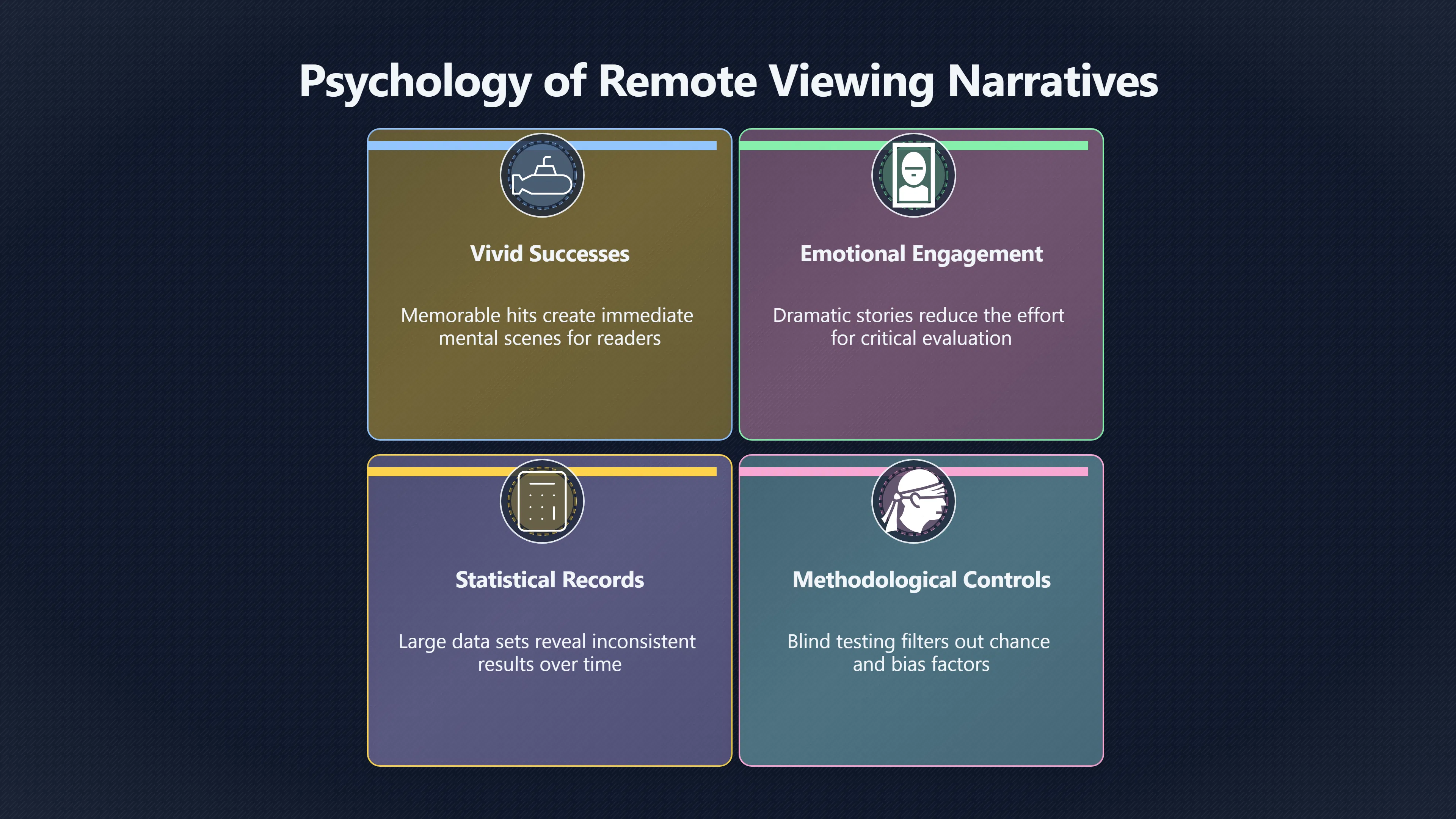
A remote-viewing anecdote usually unfolds like a story. There is a participant, a mysterious target, moments of uncertainty and an apparent revelation. Stories organised around people and events are naturally easier for the brain to encode and remember than tables of probabilities or methodological summaries.
Psychologists describe one reason as the availability heuristic. People estimate how common or credible something is partly by how easily examples come to mind. A striking remote-viewing success that can be vividly recalled therefore feels more representative than hundreds of uneventful or unsuccessful sessions that are never retold. This shortcut is often useful in everyday life but can produce systematic errors when memorable events are statistically unusual.[Wikipedia]WikipediaAvailability heuristicAvailability heuristic
Another related mechanism is narrative transportation. When readers become mentally immersed in a story, they spend less effort critically evaluating each factual claim and more effort imagining the events themselves. The emotional engagement produced by a well-told account can therefore increase its persuasive power independently of its evidential strength.[Wikipedia]WikipediaTransportation theory (psychologyTransportation theory (psychology
In remote-viewing discussions, this means that a detailed description of an apparently accurate sketch or impression is psychologically richer than a report stating that overall performance failed to exceed operational usefulness under controlled evaluation. The first creates an experience; the second demands analysis.
How emotional engagement changes judgment
Emotion influences judgment by changing what receives attention and what is remembered afterwards. A dramatic apparent “hit” encourages readers to focus on the surprising correspondence between prediction and outcome while paying less attention to everything that did not fit.
Several well-established psychological processes contribute:
- Concrete images outweigh abstractions. A sketch resembling a crane or a submarine is easier to visualise than percentages describing overall accuracy.
- Memory favours emotional events. Unexpected successes become memorable reference points, while ordinary failures fade quickly.
- People seek coherent stories. Once a narrative has a beginning, middle and satisfying ending, contradictory details often receive less attention than they would in an isolated statistical table.
These processes do not require deception or irrationality. They are ordinary features of human cognition that influence many areas of judgment, from medical decisions to financial investing as well as controversial subjects such as remote viewing.[Wikipedia]WikipediaHeuristic (psychologyHeuristic (psychology

Why statistics correct but rarely captivate
Statistical reviews ask different questions from anecdotes. Instead of asking, “Did this remarkable event happen?”, they ask, “How often did similar events happen compared with failures, chance expectations and appropriate controls?”
Answering those questions requires slower, more deliberate reasoning. Readers must consider:
- the total number of sessions rather than selected examples;
- how many descriptions were vague or ambiguous;
- whether judging was performed blind;
- whether apparent matches exceeded what chance could plausibly produce; and
- whether independent evaluators reached the same conclusions.
These considerations rarely generate memorable stories because they remove dramatic structure. A statement that “overall results were inconsistent after accounting for all trials” is intellectually informative but emotionally flat. As a result, statistical reviews often have less immediate persuasive force despite being better suited to evaluating reliability.
This contrast explains why discussions about remote viewing frequently revolve around famous successes rather than comprehensive programme evaluations. Individual cases satisfy the mind’s preference for narrative, whereas systematic reviews deliberately resist that preference by including both successes and failures.
The lesson for evaluating remote-viewing claims
Understanding why anecdotes feel convincing does not determine whether any individual remote-viewing claim is true or false. Instead, it explains why personal stories and comprehensive evidence often create different impressions.
A compelling anecdote answers the emotionally satisfying question, “Could this have happened?” Statistical evaluation addresses the more demanding question, “How often does this happen under conditions that rule out ordinary explanations?” The first question naturally produces memorable stories. The second determines whether those stories represent a reliable phenomenon or exceptional events within a much larger record.
That distinction is why psychologists generally regard anecdotes as valuable for generating hypotheses but insufficient for establishing reliability on their own. In debates about remote viewing, the emotional power of individual stories helps explain why striking cases continue to circulate, while broader statistical assessments—although less captivating—remain the stronger tool for judging the overall evidence.
Amazon book picks
Further Reading
Books and field guides related to Why the Story Wins First. Use these as the next step if you want deeper reading beyond the article.
Phenomena
Supplies the real programme context behind many of the anecdotes readers encounter.
Thinking, Fast and Slow
Directly explains availability, intuition and why stories feel more persuasive than statistics.
The Demon-Haunted World
Connects paranormal claims to evidence standards and critical thinking.
How We Know What Isn't So
Rating: 4.0/5 from 6 Google Books ratings
Covers everyday reasoning errors behind compelling anecdotes and selective evidence.
eBay marketplace picks
Marketplace Samples
Live-tested eBay searches with available results related to this page.


Endnotes
1.
Source: Wikipedia
Title: Availability heuristic
Link:https://en.wikipedia.org/wiki/Availability_heuristic
2.
Source: Wikipedia
Title: Heuristic (psychology)
Link:https://en.wikipedia.org/wiki/Heuristic_%28psychology%29
3.
Source: Wikipedia
Title: Transportation theory (psychology)
Link:https://en.wikipedia.org/wiki/Transportation_theory_%28psychology%29
4.
Source: Wikipedia
Title: Identifiable victim effect
Link:https://en.wikipedia.org/wiki/Identifiable_victim_effect
Source snippet
Identifiable victim effectThe identifiable victim effect is the tendency of individuals to offer greater aid when a specific, identifi...
5.
Source: youtube.com
Title: Availability Heuristic: Are You Making Decisions the Wrong Way?
Link:http://www.youtube.com/watch?v=TvcCvnE8ncM
Source snippet
Availability Heuristic | #psychology #psychologyfacts #humanbehaviour #generalpsychology...
6.
Source: youtube.com
Link:http://www.youtube.com/watch?v=ZuTV80P-5jM
Source snippet
"Availability heuristic" examples stories vs [statistics]({{ 'statistics/' | relative_url }}) The Availability Heuristic: Why Your Brain Mistakes Vivid for Likely Critical Thi...
Additional References
7.
Source: researchgate.net
Link:https://www.researchgate.net/publication/403824236_Narrative_over_Numbers_The_Identifiable_Victim_Effect_and_its_Amplification_Under_Alignment_and_Reasoning_in_Large_Language_Models
Source snippet
Narrative over Numbers: The Identifiable Victim Effect and...13 Apr 2026 — The Identifiable Victim Effect (IVE) − - the tendency to allo...
8.
Source: thedecisionlab.com
Link:https://thedecisionlab.com/biases/identifiable-victim-effect
Source snippet
Identifiable Victim EffectThe identifiable victim effect describes our increased empathy for specific, identifiable people that are suffe...
9.
Source: mgto.org
Link:https://mgto.org/wp-content/uploads/2023/10/Maier-etal-2023-Collabra-Small-etal-2007-replication-extension-print.pdf
Source snippet
tendency to help a specific victim than to help a group of unidentified statistical...Read more...
10.
Source: medium.com
Link:https://medium.com/%40jeffreybarlatier/the-identifiable-victim-effect-why-one-face-moves-us-more-than-a-statistic-5d89f0cd2a27
Source snippet
r aid, empathy, or action toward a specific, identifiable...Read more...
11.
Source: swaystorytelling.com
Title: the identifiable victim effect
Link:https://www.swaystorytelling.com/blog/2020/8/12/the-identifiable-victim-effect
Source snippet
12 Aug 2020 — Baby Jessica was an Identifiable Victim, because she was a character that the story could center on and embrace, and that t...
12.
Source: youtube.com
Link:https://www.youtube.com/watch?v=8cRei1NlnIc
Source snippet
e that encourages us to give more of our attention, time, and money...
13.
Source: cmu.edu
Title: identifiable Victim
Link:https://www.cmu.edu/dietrich/sds/docs/loewenstein/identifiableVictim.PDF
Source snippet
Explaining the “Identifiable Victim Effect”by KE JENNI · 1997 · Cited by 1126 — It is widely believed that people are willing to expend g...
14.
Source: youtube.com
Title: The Availability Heuristic: Why Your Brain Mistakes Vivid for Likely
Link:http://www.youtube.com/watch?v=qCcIh5LD89Y
Source snippet
Deceived by Vivid Stories: The Mental Shortcut That Distorts Your Reality...
15.
Source: pmc.ncbi.nlm.nih.gov
Link:https://pmc.ncbi.nlm.nih.gov/articles/PMC10836171/
Source snippet
by H Zhao · 2024 · Cited by 15 — The phenomenon known as the “identifiable victim effect” describes how individuals tend to offer more...
16.
Source: youtube.com
Title: Deceived by Vivid Stories: The Mental Shortcut That Distorts Your Reality
Link:http://www.youtube.com/watch?v=zTLSMXZjYrY
Source snippet
Why Your Brain Lies to You: The Availability Heuristic...
Topic Tree