Within Remote Viewing
Inside the Military Remote Viewing Unit
Fort Meade gave remote viewing a military setting, but its operational reports still faced questions about usefulness.
On this page
- The Fort Meade Setting
- Military Viewer Roles
- Operational Limits
Page outline Jump by section
Introduction
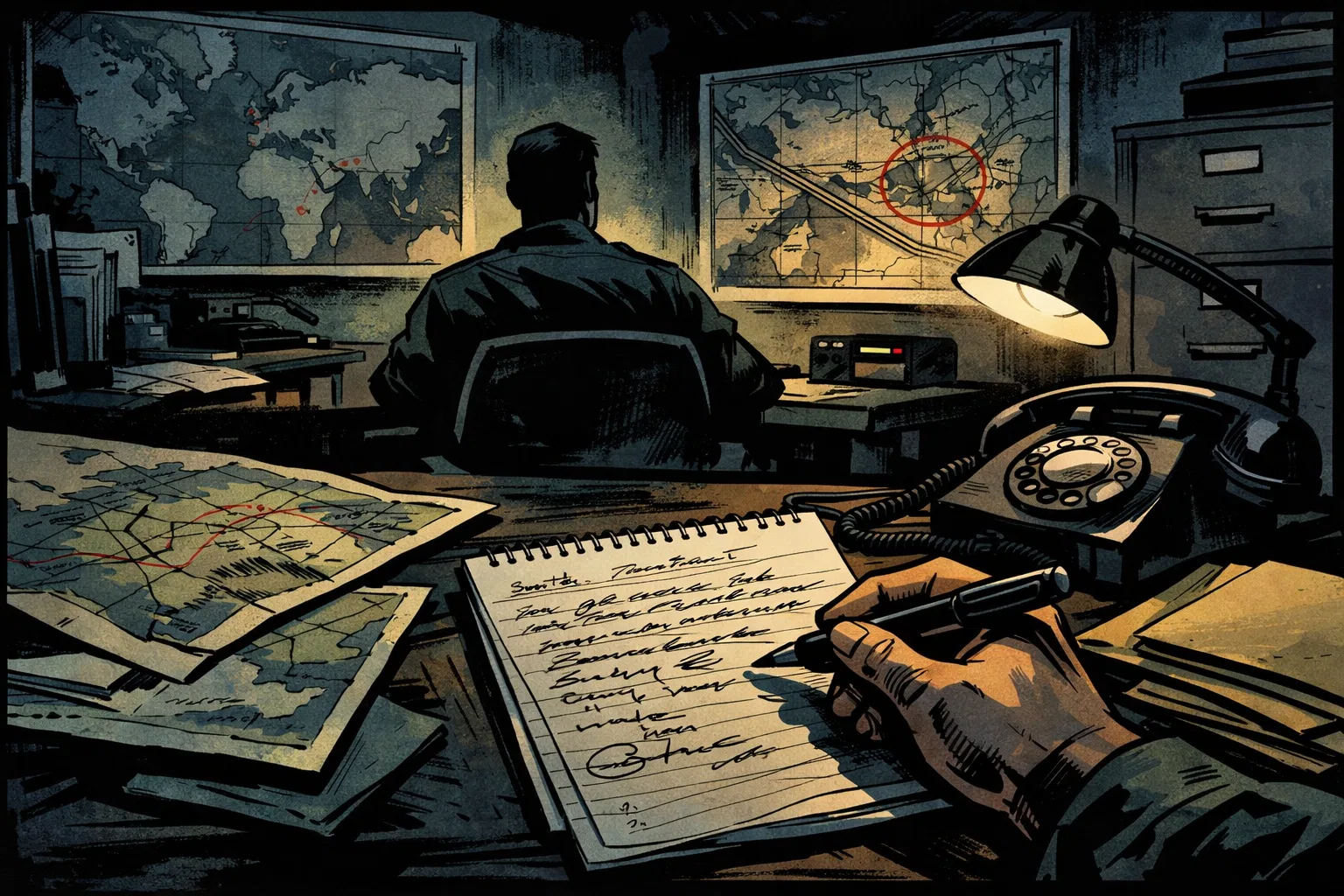
Fort Meade is where remote viewing stopped being only a laboratory claim and became an organised military experiment. From buildings on the U.S. Army installation in Maryland, a small unit of soldiers and civilians was tasked to produce intelligence reports by attempting to describe distant, hidden or otherwise inaccessible targets. That military setting gave remote viewing much of its later public legend: classified code names, intelligence customers, operational tasking, trained “viewers” and claims of striking successes.
The documentary record, however, gives a more restrained picture. The Fort Meade unit was real, and it did perform operational work for military and intelligence customers. But later evaluations found that its reports tended to be broad, ambiguous and hard to use, and that no remote-viewing report had been shown to provide actionable intelligence for an operation. The Fort Meade story is therefore best understood as a serious Cold War intelligence trial whose symbolic afterlife became much larger than its proven operational value.[Intelligence Resource Program]irp.fas.orgIntelligence Resource Program STAR GATE [Controlled Remote ViewingIntelligence Resource Program STAR GATE [Controlled Remote Viewing
The Fort Meade Setting
The Fort Meade remote-viewing unit emerged from a sequence of U.S. government programmes with shifting code names. A useful public summary from the Federation of American Scientists describes STAR GATE as one of several related remote-viewing efforts, including GRILL FLAME, CENTER LANE and SUN STREAK, carried out by DIA and U.S. Army Intelligence and Security Command, with earlier CIA work under SCANATE. Its stated purposes were to assess foreign programmes, support research into the phenomenon and test remote viewing as an intelligence tool.[Intelligence Resource Program]irp.fas.orgIntelligence Resource Program STAR GATE [Controlled Remote ViewingIntelligence Resource Program STAR GATE [Controlled Remote Viewing
The military setting mattered because it turned a speculative research protocol into a collection activity. GRILL FLAME was formalised under Army intelligence in 1978 and located in buildings 2560 and 2561 at Fort Meade, where the unit was identified as INSCOM “Detachment G”. The unit included soldiers and a small number of civilians believed to have remote-viewing potential, while the separate research side remained tied to contractors such as Stanford Research Institute.[Intelligence Resource Program]irp.fas.orgIntelligence Resource Program STAR GATE [Controlled Remote ViewingIntelligence Resource Program STAR GATE [Controlled Remote Viewing
The project’s name and administrative home changed as sponsorship shifted. In 1983 it became the INSCOM CENTER LANE Project; after Army funding ended in late 1985, the unit was redesignated SUN STREAK and moved under DIA’s Scientific and Technical Intelligence Directorate; in 1991, under DIA auspices, the work was reorganised as STAR GATE with Science Applications International Corporation involved on the research side. The changes are important because the public often treats “Project Stargate” as one neat programme, when Fort Meade was really the operational centre of a longer, changing case family.[Intelligence Resource Program]irp.fas.orgIntelligence Resource Program STAR GATE [Controlled Remote ViewingIntelligence Resource Program STAR GATE [Controlled Remote Viewing
That institutional instability also shows the uneasy status of the work inside government. Declassified CENTER LANE material described the project as a Special Access Program using remote viewing as a collection method, while later STAR GATE management papers still framed the work as paranormal or anomalous mental phenomena used primarily for intelligence collection. This was not simply an eccentric hobby inside the barracks; it had paperwork, tasking, security controls and customers. But its repeated relabelling also reflected controversy, funding pressure and uncertainty about whether it belonged in intelligence, research or nowhere at all.[CIA]cia.govOpen source on cia.gov.
What Military Viewers Actually Did
The Fort Meade viewer’s job was not to “predict the future” in a cinematic sense. In operational terms, a customer would identify a target with as little leading information as possible, and viewers would produce written reports, sketches or impressions. Those products were then passed to the tasking organisation, which could compare them with other sources or decide whether they had any practical value. The 1995 American Institutes for Research evaluation describes this process: intelligence “end users” presented targets, viewers described their impressions in written reports, and those reports were forwarded for evaluation and possible action.[National Security Archive]nsarchive2.gwu.eduNational Security Archiveremote~1.PD FNational Security Archiveremote~1.PD F
The unit used several methods over time. Public summaries distinguish coordinate remote viewing, in which viewers were cued by geographical co-ordinates or abstract identifiers; extended remote viewing, which used relaxation or meditative procedures; and written remote viewing, a later and more controversial method associated with automatic-writing-like output. These categories matter because they show the military programme trying to make a claimed psychic ability behave like a repeatable collection discipline, with roles, protocols and training expectations rather than merely relying on spontaneous impressions.[Intelligence Resource Program]irp.fas.orgIntelligence Resource Program STAR GATE [Controlled Remote ViewingIntelligence Resource Program STAR GATE [Controlled Remote Viewing
Named military viewers helped shape the programme’s reputation. Joseph McMoneagle, often described as “Remote Viewer No. 1”, was a retired U.S. Army intelligence figure associated with the Fort Meade unit and later became one of its best-known public interpreters. Public accounts also connect figures such as Mel Riley, Angela Ford, Skip Atwater and Ed Dames with the wider Fort Meade and STAR GATE ecosystem, although their exact roles varied between viewer, trainer, monitor, analyst or manager.[Wikipedia+2CIA]WikipediaJoseph Mc MoneagleJoseph Mc Moneagle
Those role distinctions are easy to blur but important. A viewer produced the raw session material. A monitor or interviewer helped run a session without, in principle, giving away target information. Analysts and managers decided how to package or evaluate outputs for customers. That meant the Fort Meade process was not just a lone psychic writing down visions; it was an intelligence workflow trying to separate cueing, interpretation, confidence and customer use. The weakness was that each extra stage also introduced room for subjective judgement, selective emphasis and after-the-fact matching.
The Intelligence Promise
The appeal of Fort Meade remote viewing was straightforward: if even a small number of people could describe inaccessible targets, the method could supplement expensive, risky or unavailable collection methods. The AIR review noted that, conceptually, people with such an ability could be asked to describe intelligence targets and potentially add information where human intelligence, signals intelligence or records were unavailable. This promise helps explain why a fringe-seeming idea survived in classified settings for years.[National Security Archive]nsarchive2.gwu.eduNational Security Archiveremote~1.PD FNational Security Archiveremote~1.PD F
The unit’s customers were not just testing curiosity. Appendix material in the AIR evaluation says that from 1986 to the first quarter of fiscal year 1995, the Department of Defence paranormal psychology programme received more than 200 operational tasks from military organisations seeking information not available from other sources. In 1994, DIA also created a method for obtaining numerical evaluations from tasking organisations about the accuracy and value of STAR GATE products; by May 1995, three assigned remote viewers had provided products for 40 evaluated tasks from five operational organisations.[National Security Archive]nsarchive2.gwu.eduNational Security Archiveremote~1.PD FNational Security Archiveremote~1.PD F
This makes the Fort Meade unit historically distinct from remote viewing in popular culture. It was not merely people claiming private impressions. It operated in response to tasking, with government customers requesting product, sometimes because conventional sources had not delivered. The strongest reason to take the unit seriously as a historical object is not that it proved paranormal perception, but that serious institutions created a process to test whether such claims could be made useful.
That process also generated the central tension. Intelligence customers rarely need poetic resemblance; they need concrete detail that can be checked, acted on and distinguished from noise. A report saying a target involves water, metal, anxiety, machinery or a guarded structure might later feel suggestive, but it may not tell an analyst what to do next. The Fort Meade viewer therefore sat between two standards: the loose, impressionistic standard by which a session could appear meaningful, and the operational standard by which information had to be reliable enough to guide decisions.

Why Usefulness Remained Contested
The strongest institutional criticism of the Fort Meade operational work came from the 1995 AIR evaluation. The review separated two questions: whether laboratory studies showed any above-chance effect, and whether the intelligence programme produced useful operational information. On the first question, the evaluators noted disagreement between Jessica Utts and Ray Hyman: Utts saw evidence of a statistical effect, while Hyman argued that the evidence did not yet justify concluding that paranormal functioning had been demonstrated.[National Security Archive]nsarchive2.gwu.eduNational Security Archiveremote~1.PD FNational Security Archiveremote~1.PD F
On the operational question, the finding was much harder on the programme. AIR reported that end users sometimes observed accuracy in broad background characteristics, but that reports failed to provide the concrete, specific information valued in intelligence gathering. It also concluded that the information was inconsistent, inaccurate in specifics and required substantial subjective interpretation. Most damagingly, it found that in no case had the information been used to guide intelligence operations.[National Security Archive]nsarchive2.gwu.eduNational Security Archiveremote~1.PD FNational Security Archiveremote~1.PD F
The evaluation’s appendix gives a more granular picture of the problem. In the 40 evaluated tasks, product assessments generated 99 accuracy scores and 100 value scores. Accuracy clustered around middling ratings, while value scores clustered even lower; the report concluded that operational utility could not be substantiated and that the subjective nature of the products created a need for additional analyst effort with questionable return.[National Security Archive]nsarchive2.gwu.eduNational Security Archiveremote~1.PD FNational Security Archiveremote~1.PD F
Several limits flowed from the nature of operational targets themselves:
- Real targets were not laboratory targets. Experiments might use photographs or bounded target pools, but intelligence targets were often dynamic, hidden and poorly defined.
- Feedback was often weak or unavailable. Remote-viewing advocates commonly treated feedback as important for viewer performance, but intelligence targets might never produce clear confirmation.
- Specificity was the bottleneck. Broad impressions could seem interesting, but operational use required names, locations, timings, identities or concrete features.
- Analyst interpretation carried too much weight. If a report contained many impressions, an analyst could sometimes find a match after the fact, but that is not the same as predictive or actionable collection.
These limits explain why Fort Meade could produce memorable stories without satisfying intelligence standards. An ambiguous hit can be striking in hindsight while still failing to provide a decision-maker with dependable guidance in the moment.
How the Unit Became a Public Legend
The Fort Meade unit became famous partly because the setting had all the ingredients of a durable legend: secret programmes, Cold War anxieties, military viewers, strange methods and declassified files. The phrase “psychic spies” compressed a complicated administrative history into an image the public could easily remember. Press coverage and later books helped turn Fort Meade into the symbolic home of remote viewing, even though the programme also depended on contractors, research labs and sponsors outside the installation.[CIA]cia.govOpen source on cia.gov.
The legend also grew because some participants later became authors, trainers, interviewees or public advocates. McMoneagle, Atwater, Riley, Dames and others entered remote-viewing lore in different ways, and their accounts often preserved insider texture that official evaluations did not provide. But public recollections, memoirs and interviews have to be read differently from tasking records and independent evaluations. They can reveal how participants understood their work, but they do not by themselves establish that the work produced reliable intelligence.
The “military viewer” label itself changed the cultural status of remote viewing. A laboratory subject might be dismissed as a paranormal volunteer; a Fort Meade viewer sounded like an intelligence asset. That shift is why the unit matters in the broader history of remote viewing. It gave the claim a uniform, a classified file trail and a chain of command, even though the eventual evaluation judged the operational product too vague and uncertain for continued intelligence use.
What Fort Meade Shows About Remote Viewing
The Fort Meade record does not reduce to a simple joke or a simple vindication. The unit was real, it was tasked, and it existed inside recognisable military-intelligence structures. It had procedures, methods, named participants and customers. It also generated enough output for later evaluators to ask the practical question that mattered most: did this collection method help the intelligence community make better decisions?
The answer from the strongest official review was no. AIR acknowledged that laboratory data had been interpreted by some reviewers as showing a statistical effect, but it found that even if such an effect existed, the operational version did not meet the needs of intelligence work. The products were too ambiguous, too inconsistent and too dependent on subjective interpretation to justify continuation.[National Security Archive]nsarchive2.gwu.eduNational Security Archiveremote~1.PD FNational Security Archiveremote~1.PD F
Fort Meade therefore occupies a distinctive place in remote-viewing history. It is the point where the subject became operational, bureaucratic and military; it is also the point where the gap between intriguing claims and useful intelligence became impossible to avoid. The unit gave remote viewing its most famous real-world setting, but the same record that makes it fascinating also shows why official support ended.
Amazon book picks
Further Reading
Books and field guides related to Inside the Military Remote Viewing Unit. Use these as the next step if you want deeper reading beyond the article.
The Men Who Stare At Goats
Rating: 3.5/5 from 11 Google Books ratings
Introduces the public mythology surrounding military psychic projects.

Remote viewing secrets
First published 2000. Subjects: Remote viewing (Parapsychology), Parapsychology, Prophecies (occultism), Astral projection.

Mind trek
First published 1993. Subjects: Astral projection, Parapsychology, Remote viewing (Parapsychology), Research, Parapsychology, psychic pow...
eBay marketplace picks
Marketplace Samples
Live-tested eBay searches with available results related to this page.


Endnotes
1.
Source: cia.gov
Link:https://www.cia.gov/readingroom/docs/CIA-RDP96-00789R001100020002-6.pdf
2.
Source: cia.gov
Link:https://www.cia.gov/readingroom/document/cia-rdp96-00788r001500090010-7
3.
Source: cia.gov
Link:https://www.cia.gov/readingroom/document/cia-rdp96-00791r000100150002-0
4.
Source: Wikipedia
Title: Joseph Mc Moneagle
Link:https://en.wikipedia.org/wiki/Joseph_McMoneagle
5.
Source: cia.gov
Link:https://www.cia.gov/readingroom/docs/CIA-RDP96-00791R000100030073-5.pdf
6.
Source: Wikipedia
Title: Stargate Project (U.S. Army unit)
Link:https://en.wikipedia.org/wiki/Stargate_Project_%28U.S._Army_unit%29
7.
Source: cia.gov
Link:https://www.cia.gov/readingroom/docs/CIA-RDP96-00791R000200180005-5.pdf
8.
Source: cia.gov
Link:https://www.cia.gov/readingroom/document/cia-rdp96-00791r000100030073-5
9.
Source: cia.gov
Link:https://www.cia.gov/readingroom/docs/CIA-RDP96-00789R002100240001-2.pdf
10.
Source: cia.gov
Link:https://www.cia.gov/readingroom/document/cia-rdp96-00789r001100020002-6
11.
Source: cia.gov
Link:https://www.cia.gov/readingroom/document/cia-rdp81r00560r000100010001-0
12.
Source: cia.gov
Link:https://www.cia.gov/readingroom/docs/CY%202007%20CASE%20LOG%5B15829352%5D.pdf
13.
Source: cia.gov
Link:https://www.cia.gov/readingroom/docs/CIA-RDP96-00789R002800180001-2.pdf
14.
Source: cia.gov
Link:https://www.cia.gov/readingroom/docs/CIA-RDP96-00788R001500090026-0.pdf
15.
Source: cia.gov
Link:https://www.cia.gov/readingroom/document/cia-rdp96-00788r001500040002-0
16.
Source: cia.gov
Link:https://www.cia.gov/readingroom/document/cia-rdp96-00791r000300010003-2
17.
Source: cia.gov
Link:https://www.cia.gov/readingroom/docs/CIA-RDP96-00788R001700270001-5.pdf
18.
Source: cia.gov
Link:https://www.cia.gov/readingroom/document/cia-rdp96-00788r001500180001-7
19.
Source: cia.gov
Link:https://www.cia.gov/readingroom/document/cia-rdp96-00791r000200090001-7
20.
Source: cia.gov
Link:https://www.cia.gov/readingroom/docs/CIA-RDP96-00788R001500090002-6.pdf
21.
Source: cia.gov
Title: MEMORANDU M THRU COL PARTRIDGE
Link:https://www.cia.gov/readingroom/document/cia-rdp96-00788r001700030008-4
22.
Source: cia.gov
Link:https://www.cia.gov/readingroom/document/cia-rdp96-00792r000100140036-3
23.
Source: cia.gov
Link:https://www.cia.gov/readingroom/docs/CIA-RDP96-00788R001500090053-0.pdf
24.
Source: cia.gov
Link:https://www.cia.gov/readingroom/document/cia-rdp96-00791r000300010002-3
25.
Source: cia.gov
Link:https://www.cia.gov/readingroom/document/cia-rdp96-00788r001100200004-5
26.
Source: cia.gov
Link:https://www.cia.gov/readingroom/docs/cia-rdp96-00788r001700210016-5.pdf
27.
Source: cia.gov
Link:https://www.cia.gov/readingroom/docs/CIA-RDP96-00791R000200180006-4.pdf
28.
Source: cia.gov
Link:https://www.cia.gov/readingroom/docs/CIA-RDP96-00789R002200650001-6.pdf
29.
Source: Wikipedia
Title: United States
Link:https://en.wikipedia.org/wiki/United_States
30.
Source: Wikipedia
Title: Project Stargate
Link:https://de.wikipedia.org/wiki/Project_Stargate
31.
Source: Wikipedia
Title: Us (2019 film)
Link:https://en.wikipedia.org/wiki/Us_%282019_film%29
32.
Source: Wikipedia
Title: Stargate Project
Link:https://en.wikipedia.org/wiki/Stargate_Project
33.
Source: Wikipedia
Title: Remote viewing
Link:https://en.wikipedia.org/wiki/Remote_viewing
34.
Source: irp.fas.org
Title: Intelligence Resource Program STAR GATE [Controlled Remote Viewing]
Link:https://irp.fas.org/program/collect/stargate.htm
35.
Source: nsarchive2.gwu.edu
Title: National Security Archiveremote~1.PD F
Link:https://nsarchive2.gwu.edu/NSAEBB/NSAEBB438/docs/doc_57.pdf
36.
Source: facebook.com
Link:https://www.facebook.com/SimpleHistoryCartoons/photos/the-stargate-project-was-a-secret-us-army-unit-at-fort-meade-maryland-active-fro/1276829501138063/
37.
Source: nsarchive2.gwu.edu
Title: DIA 21
Link:https://nsarchive2.gwu.edu/NSAEBB/NSAEBB534-DIA-Declassified-Sourcebook/documents/DIA-21.pdf
38.
Source: ics.uci.edu
Link:https://www.ics.uci.edu/~jutts/may.pdf
39. Source: citeseerx.ist.psu.edu
40.
Source: huggingface.co
Link:https://huggingface.co/datasets/GotThatData/STARGATE
Additional References
41.
Source: youtube.com
Link:https://www.youtube.com/watch?v=iH065Et-Uew
Source snippet
These videos provide relevant context on the Fort Meade remote viewing unit, its operational history under various code names, and interv...
42.
Source: youtube.com
Title: How The CIA Found The Ark Of The Covenant
Link:https://www.youtube.com/watch?v=e9aVr3NkMV0
Source snippet
How the CIA worked with psychics on 'Project Stargate' | Reality Check with Ross Coulthart...
43.
Source: youtube.com
Title: Joe Mc Moneagle: Project Stargate, CIA Remote Viewing & The [Mars Session]({{ ‘mars-session/’ | relative_url }})
Link:https://www.youtube.com/watch?v=Mk9bTm4IPps
Source snippet
Project Stargate: The CIA's Search for Tabut-e-Sakinah...
44.
Source: usa.gov
Link:https://www.usa.gov/about-the-us
45.
Source: youtube.com
Title: Inside The Military’s Secret Psychic Unit
Link:https://www.youtube.com/watch?v=9nY3hu76SyU
Source snippet
Joe McMoneagle: Project Stargate, CIA Remote Viewing & The Mars Session...
46.
Source: academia.edu
Link:https://www.academia.edu/95285973/The_Star_Gate_Operational_Remote_Viewing_Program_A_Human_Intelligence_HUMINT_Collection_Platform
47.
Source: researchgate.net
Link:https://www.researchgate.net/publication/403178755_The_Star_Gate_Archives_Reports_of_the_United_States_Government_Sponsored_Psi_Program_1972-1995_Volume_4_Operational_Remote_Viewing_Memorandums_and_Reports
48.
Source: scribd.com
Link:https://www.scribd.com/document/357635150/Aperture-Issue-28
49.
Source: skepsis.nl
Link:https://skepsis.nl/stargate/
50.
Source: facebook.com
Link:https://www.facebook.com/100090372200308/posts/during-the-cold-war-the-cia-funded-research-into-what-they-called-remote-viewing/937678002587931/
Topic Tree