Within Fort Meade
What Was Detachment G Really Built To Do?
The Fort Meade viewers were organized as a small intelligence detachment, not a loose group of private psychics.
On this page
- How the Fort Meade unit was organized
- Buildings, staff, and intelligence roles
- Why the military setting changed the claim
Page outline Jump by section
Introduction
Detachment G was not an informal circle of psychics operating on the fringes of the U.S. military. It was a small, compartmented intelligence organisation embedded within the U.S. Army Intelligence and Security Command (INSCOM) at Fort Meade, Maryland. During the late 1970s and early 1980s, it served as the operational arm of the Army’s remote-viewing effort, receiving intelligence tasking, producing written collection reports and operating under Special Access security controls. Although later renamed as programmes evolved, Detachment G represents the period when remote viewing was treated as an intelligence capability that could be organised, managed and evaluated like other specialised collection activities. Declassified Army and CIA records show a structured unit with designated facilities, reporting channels and administrative oversight rather than an experimental club operating independently.[CIA+2National Security Archive]cia.govDETACHMENT G REORGANIZATION (U)To explore several cover options available to Detachment G to protect its true mission and operations f…

How the Fort Meade Unit Was Organised
Detachment G emerged as part of the Army’s effort to move remote viewing beyond contractor-led research into an operational military environment. Earlier laboratory work had been conducted primarily through Stanford Research Institute, but the Army wanted to determine whether the claimed phenomenon could produce useful intelligence under military control.
The unit was established within INSCOM and became associated with the GRILL FLAME programme before later transitioning into the INSCOM CENTER LANE Project. Unlike research contractors, Detachment G answered through Army intelligence channels and accepted tasking from intelligence customers rather than designing scientific experiments. Its mission was therefore operational implementation rather than basic research.[Wikipedia]WikipediaStargate Project (U.S. Army unitStargate Project (U.S. Army unit
Several features distinguished the organisation:
- It was deliberately small, allowing strict compartmentalisation.
- It combined military personnel with a limited number of civilian specialists.
- It operated within the existing Army intelligence command structure rather than outside it.
- It maintained formal reporting procedures, security documentation and administrative oversight.
This organisational model reflected an attempt to treat remote viewing as one more specialised intelligence collection method whose outputs could be requested, documented and archived alongside other intelligence products, even though the underlying mechanism remained controversial.[CIA+2National Security Archive]cia.govDETACHMENT G REORGANIZATION (U)To explore several cover options available to Detachment G to protect its true mission and operations f…
Buildings, Staff and Intelligence Roles
One of the strongest pieces of evidence that Detachment G functioned as a genuine military unit is the level of administrative detail preserved in declassified records.
Operational work was conducted primarily from Buildings 2560 and 2561 at Fort Meade. These were ordinary Army facilities rather than isolated laboratories. Intelligence customers submitted requirements, project personnel prepared sessions, viewers generated written descriptions and sketches, and administrative staff handled classification, document control and dissemination. The physical location reinforced that the activity was integrated into an intelligence installation rather than separated as an academic experiment.[Wikipedia]WikipediaStargate Project (U.S. Army unitStargate Project (U.S. Army unit
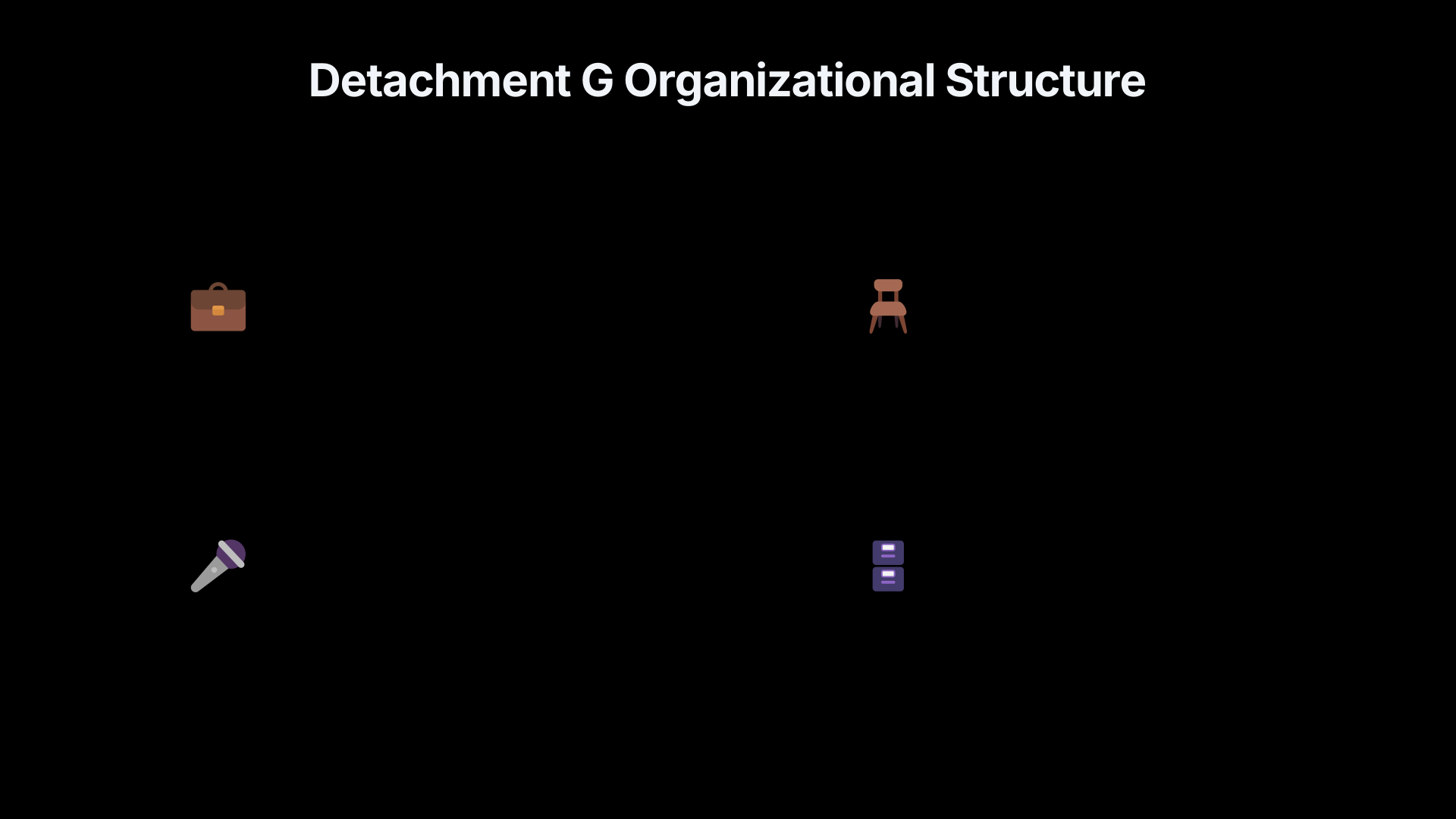
The unit contained several distinct roles rather than relying only on individual viewers.
Operational viewers attempted remote-viewing sessions in response to assigned targets.
Monitors and interviewers guided sessions while attempting to minimise cueing or unnecessary information that might influence the viewer.
Project leadership managed tasking, coordinated with higher headquarters and maintained programme security.
Administrative personnel controlled classified records, scheduling and communications with customer organisations.
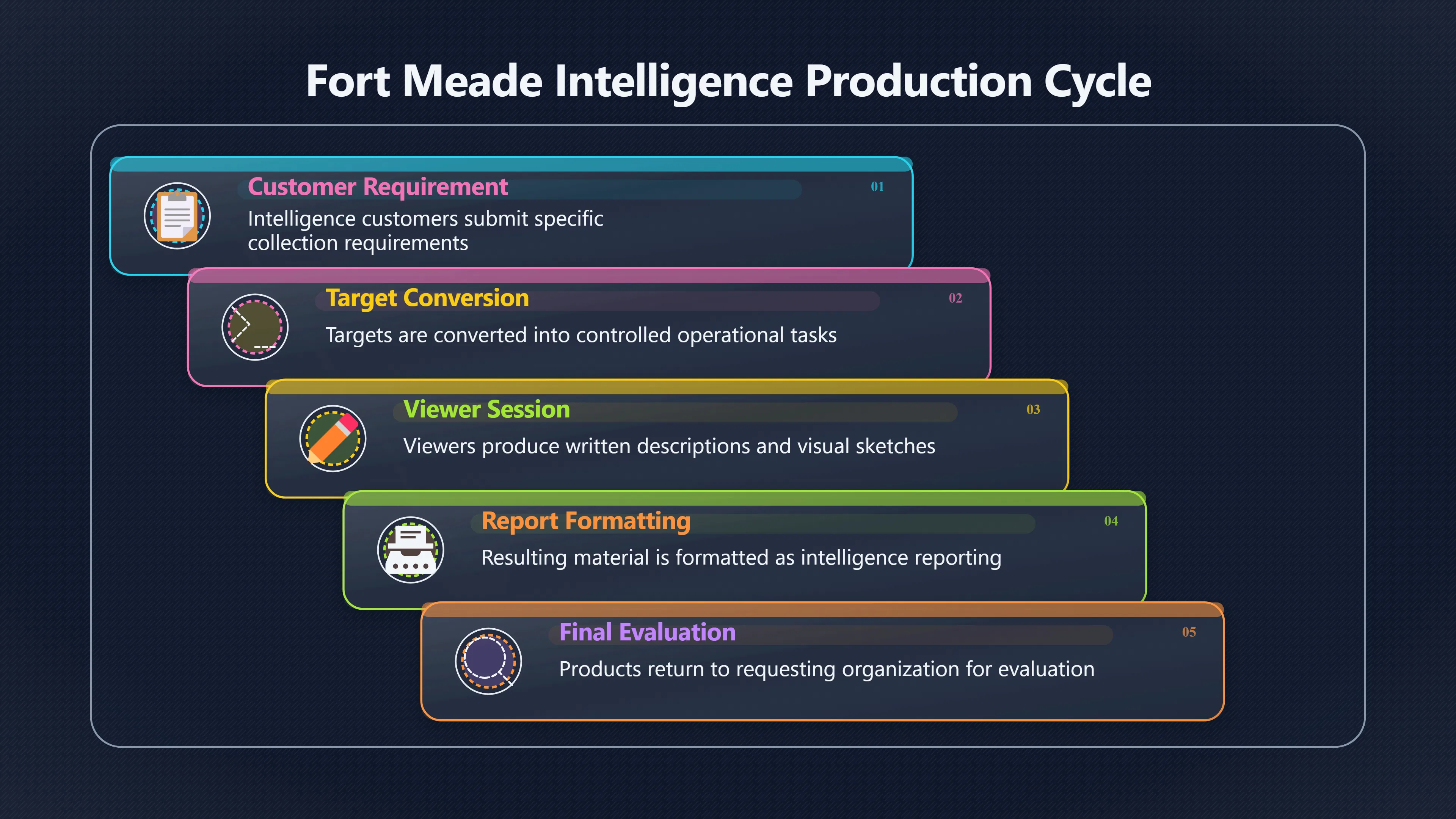
The workflow resembled a conventional intelligence production cycle:
- A customer submitted a collection requirement.
- The target was converted into a controlled task.
- One or more viewers produced reports and sketches.
- The resulting material was formatted as intelligence reporting.
- The product was returned to the requesting organisation for evaluation against other sources.
This process explains why surviving documents resemble intelligence memoranda rather than laboratory notebooks. The emphasis was on producing reports that commanders or analysts could potentially use, not simply recording psychological observations.[National Security Archive]nsarchive2.gwu.eduOpen source on gwu.edu.
Why the Military Setting Changed the Claim
Housing remote viewing inside an intelligence detachment fundamentally changed what the programme claimed to accomplish.
Laboratory research asks whether a phenomenon exists under controlled conditions. Detachment G instead assumed that, if the claimed ability existed, it should be possible to incorporate it into military collection. That shift imposed operational demands absent from academic experiments.
The unit therefore had to demonstrate qualities expected of any intelligence capability:
- responsiveness to real tasking;
- security for classified operations;
- repeatable reporting procedures;
- usefulness to intelligence customers;
- compatibility with other collection methods.
This institutional setting also subjected the programme to pressures uncommon in civilian parapsychology. Military commanders expected timely reporting, measurable performance and practical value. As a result, remote-viewing reports were increasingly judged not by whether they appeared intriguing but by whether they improved intelligence decisions. Later reviews concluded that this standard was rarely met consistently, despite occasional reports that participants regarded as impressive.[National Security Archive+2Wikipedia]nsarchive2.gwu.eduOpen source on gwu.edu.
Security, Cover and Administrative Reality
Detachment G operated under unusually tight security arrangements. Declassified memoranda discuss efforts to protect the unit’s true function through organisational changes and cover arrangements, reflecting concern that its unusual mission could become publicly known or misunderstood. These discussions focused less on hiding paranormal discoveries than on preserving operational secrecy and shielding a sensitive Special Access activity from unnecessary attention.[CIA]cia.govDETACHMENT G REORGANIZATION (U)To explore several cover options available to Detachment G to protect its true mission and operations f…
The repeated administrative redesignations—from GRILL FLAME to CENTER LANE and later SUN STREAK under different sponsoring organisations—also illustrate that the unit’s bureaucratic identity changed as funding, oversight and institutional support shifted. Importantly, the personnel and operational mission evolved more gradually than the programme names. The succession of code names therefore reflected changing administrative control rather than the creation of entirely new organisations.[Wikipedia+2National Security Archive]WikipediaStargate Project (U.S. Army unitStargate Project (U.S. Army unit
What Detachment G Demonstrates About Military Remote Viewing
Detachment G occupies an unusual place in Cold War intelligence history because it represents an attempt to institutionalise an extraordinary claim within a conventional military framework.
Its significance lies less in proving remote viewing than in demonstrating how seriously portions of the U.S. intelligence community explored unconventional collection methods during the Cold War. The unit possessed many characteristics expected of an intelligence organisation: designated facilities, formal leadership, operational tasking, classified reporting, document control and customer relationships. Those features are well documented.
At the same time, later programme evaluations found little persuasive evidence that these organisational strengths translated into a consistently reliable intelligence capability. Detachment G therefore stands as an example of a disciplined military implementation built around a collection method whose operational effectiveness remained unproven despite years of structured testing and real-world tasking.[National Security Archive+2CIA]nsarchive2.gwu.eduOpen source on gwu.edu.
Amazon book picks
Further Reading
Books and field guides related to What Was Detachment G Really Built To Do?. Use these as the next step if you want deeper reading beyond the article.
The Men Who Stare At Goats
Rating: 3.5/5 from 11 Google Books ratings
Provides accessible context for the military culture surrounding psychic programs.

Remote Viewers: The Secret History of America's Psychic Spies
Explains how the Fort Meade unit functioned within Army intelligence.

The seventh sense
Describes operational procedures and daily life in the military unit.

eBay marketplace picks
Marketplace Samples
Live-tested eBay searches with available results related to this page.


Endnotes
1.
Source: cia.gov
Link:https://www.cia.gov/readingroom/document/cia-rdp96-00788r001700350002-5
Source snippet
DETACHMENT G REORGANIZATION (U)To explore several cover options available to Detachment G to protect its true mission and operations f...
2.
Source: Wikipedia
Title: [Stargate]({{ ‘stargate/’ | relative_url }}) Project (U.S. Army unit)
Link:https://en.wikipedia.org/wiki/Stargate_Project_%28U.S._Army_unit%29
3.
Source: usainscom.army.mil
Link:https://www.usainscom.army.mil/MSCs/ACIC/
Source snippet
Counterintelligence CommandThe MICECP is administered by the U.S. Army Field Support Center, a subordinate element of INSCOM, and is loca...
4.
Source: nsarchive2.gwu.edu
Link:https://nsarchive2.gwu.edu/NSAEBB/NSAEBB534-DIA-Declassified-Sourcebook/documents/DIA-21.pdf
Additional References
5.
Source: facebook.com
Link:https://www.facebook.com/historyoasis/posts/from-1972-to-1995-the-united-states-military-invested-over-20-million-in-one-of-/790173214116954/
Source snippet
From 1972 to 1995, the United States military invested over...Operating under various code names including "Grill Flame," "Center Lane,"...
6.
Source: installations.militaryonesource.mil
Link:https://installations.militaryonesource.mil/military-installation/fort-george-g-meade/base-essentials/major-units
Source snippet
Meade Major Units | MilitaryINSTALLATIONSBrowse or search for Major Units at Fort Meade. Here you'll find command name, phone numbers & w...
7.
Source: pclt.defense.gov
Title: a0614 115 dami
Link:https://pclt.defense.gov/DIRECTORATES/Privacy-and-Civil-Liberties-Directorate/Privacy/SORNsIndex/Article/4013113/a0614-115-dami/
Source snippet
defense.govA0614-115 DAMI > Privacy, Civil Liberties...Investigative Records Repository, U.S. Army Intelligence and Security Command, 9...
8.
Source: governmentattic.org
Title: USAINSCOMhistoryFY 1983
Link:https://www.governmentattic.org/36docs/USAINSCOMhistoryFY_1983.pdf
Source snippet
Meade, Maryland). US Army Intelligence and... USA INSCOM Security Support Detachment, Fort Meade. USA INSCOM...
9.
Source: youtube.com
Title: Joe Mc Moneagle: Project Stargate, CIA Remote Viewing & The [Mars Session]({{ ‘mars-session/’ | relative_url }})
Link:https://www.youtube.com/watch?v=Mk9bTm4IPps
Source snippet
Project Stargate: The CIA's Search for Tabut-e-Sakinah...
10.
Source: youtube.com
Title: Inside The Military’s Secret Psychic Unit
Link:https://www.youtube.com/watch?v=9nY3hu76SyU
Source snippet
Joe McMoneagle: Project Stargate, CIA Remote Viewing & The Mars Session...
11.
Source: youtube.com
Title: Project Stargate: The CIA’s Search for Tabut-e-Sakinah
Link:https://www.youtube.com/watch?v=OZwnVNM7PcU
Source snippet
Remote Viewing: The Real Story of the Stargate Project...
Topic Tree