Within Fair Test
Can the Transcript Give the Game Away?
The Marks critique shows why transcripts must be stripped of dates, order clues, file labels, and experimenter notes before judging.
On this page
- What accidental cues can appear in transcripts
- Why blind editing matters before judging
- How cleaned transcripts should be locked and coded
Page outline Jump by section
Introduction
The dispute over transcript handling became one of the most influential methodological lessons in remote viewing research. Rather than focusing on whether remote viewing itself was possible, psychologist David Marks argued that some early judging materials contained ordinary clues that allowed judges to identify targets without relying on the descriptive content of the transcripts. If true, impressive scoring could arise from information leakage rather than anomalous perception. Although the criticism was challenged by proponents of the original experiments, the controversy permanently changed expectations for experimental design. Modern remote viewing protocols therefore treat transcript cleaning as an essential safeguard: before judging begins, every document should be stripped of accidental identifiers, anonymised, locked, and coded so that only the descriptive content remains.[Nature+2Nature]nature.comDAVID MARKS &; RICHARD KAMMANN. Nature volume 274, pages 680–681 (…Read more…

What accidental cues can appear in transcripts?
Marks and Richard Kammann examined published Stanford Research Institute (SRI) remote viewing materials and argued that the judging transcripts contained information unrelated to the claimed psychic descriptions. According to their analysis, judges could sometimes infer the correct target because the paperwork preserved details about the order in which sessions occurred rather than because the descriptions matched the targets. They reported that references such as session dates, remarks about “yesterday’s target”, and chronological sequencing created an unintended path to the correct answer.[Nature]nature.comDAVID MARKS &; RICHARD KAMMANN. Nature volume 274, pages 680–681 (…Read more…
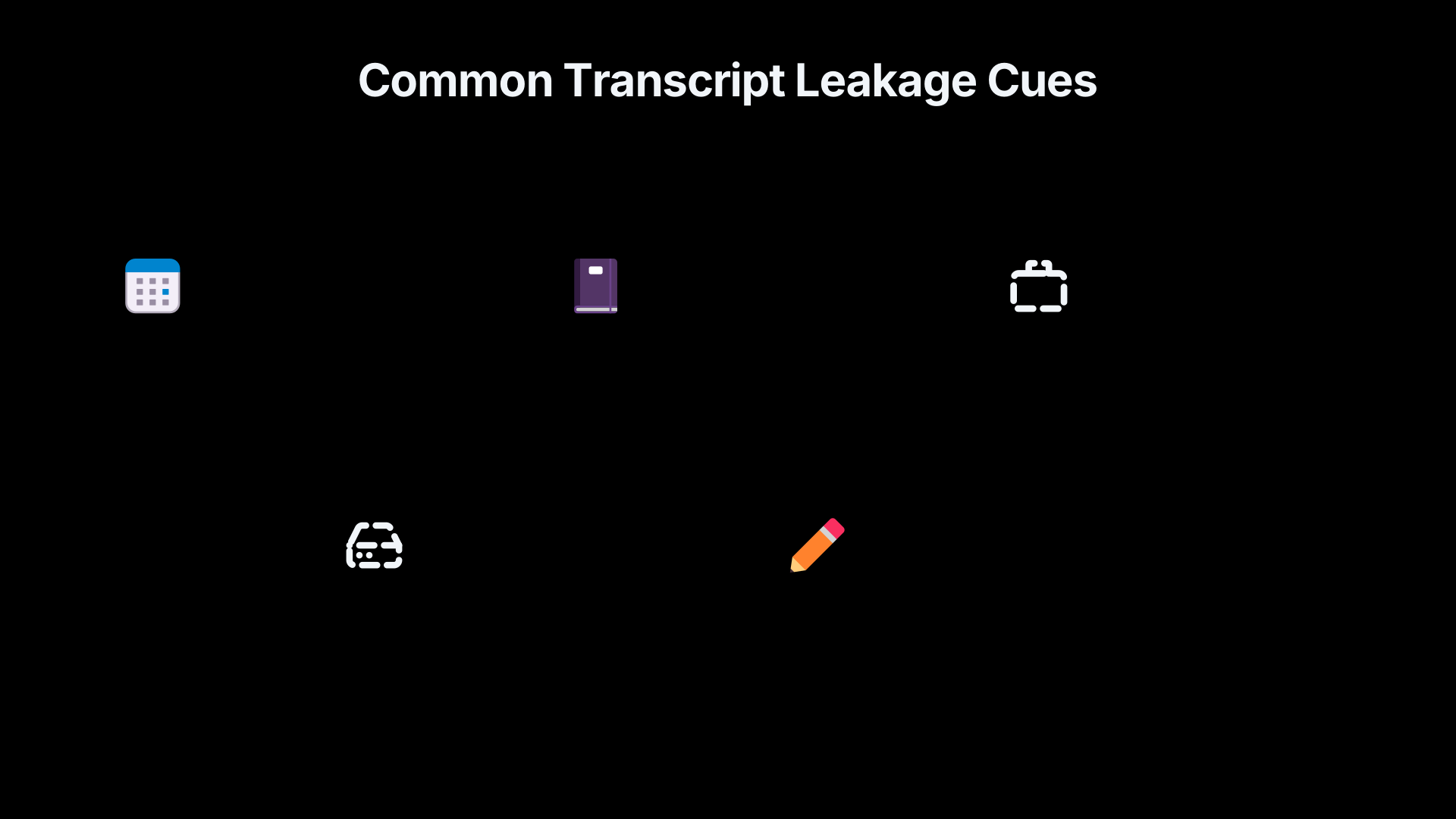
The broader lesson extends well beyond the specific examples identified in that debate. Potential cues include:
- Dates and timestamps showing when sessions occurred.
- Sequential trial numbers revealing target order.
- File names or document identifiers that encode the experiment sequence.
- Handwritten notes from experimenters.
- Comments indicating previous or upcoming sessions.
- References to travel schedules, weather, or logistical arrangements.
- Differences in document formatting that distinguish particular trials.
- Metadata preserved in digital files, such as creation dates or author names.
None of these items is evidence for or against remote viewing. The problem is that each can provide ordinary information that an experienced judge may use consciously or unconsciously. Once such cues exist, the experiment no longer isolates the descriptive content that the protocol is supposed to evaluate.[Nature+2Nature]nature.comDAVID MARKS &; RICHARD KAMMANN. Nature volume 274, pages 680–681 (…Read more…
The issue is not unique to remote viewing. Across psychology and medicine, blinding procedures are designed precisely because humans are adept at extracting patterns from seemingly trivial contextual information. The Marks critique applied that general experimental principle to free-response judging.
Why blind editing matters before judging
The transcript controversy shifted attention from whether judges were honest to whether they were unintentionally influenced. Even well-intentioned judges can be affected by contextual information that appears irrelevant.
Blind editing serves several purposes:
- It isolates the evidence under test. Judges should evaluate only the viewer’s descriptions, sketches, and statements.
- It removes unconscious bias. Even subtle chronological hints can influence subjective matching decisions.
- It improves reproducibility. Independent researchers can repeat judging using the same cleaned materials.
- It separates editing from scoring. The person preparing transcripts should not also evaluate the results.
This distinction became important because the original debate evolved into competing claims. Marks maintained that removing sensory and contextual cues reduced successful matching to chance levels, while Puthoff, Targ and their supporters argued that the criticism either overstated the problem or failed to account for stronger datasets. The disagreement itself reinforced a procedural lesson accepted even by many researchers interested in anomalous cognition: if transcript cleaning is performed before judging, the possibility that ordinary cues explain positive results becomes substantially harder to argue.[Nature+2PubMed]nature.comSensory cues invalidate remote viewing experimentsby D MARKS · 1981 · Cited by 25 — Sensory cues invalidate remote viewing experime…
Later remote-viewing studies frequently incorporated stronger blinding procedures specifically because the Marks critique had highlighted this vulnerability. Some published protocols explicitly mention checking transcripts for temporal references before judges receive them, demonstrating that the criticism influenced subsequent experimental practice regardless of differing views about its conclusions.[CIA]cia.govTRANSCONTINENTAL REMOTE VIEWING (SCHLITZ…The translators then checked the transcripts for phrases from which one might infer tempo…
How cleaned transcripts should be locked and coded
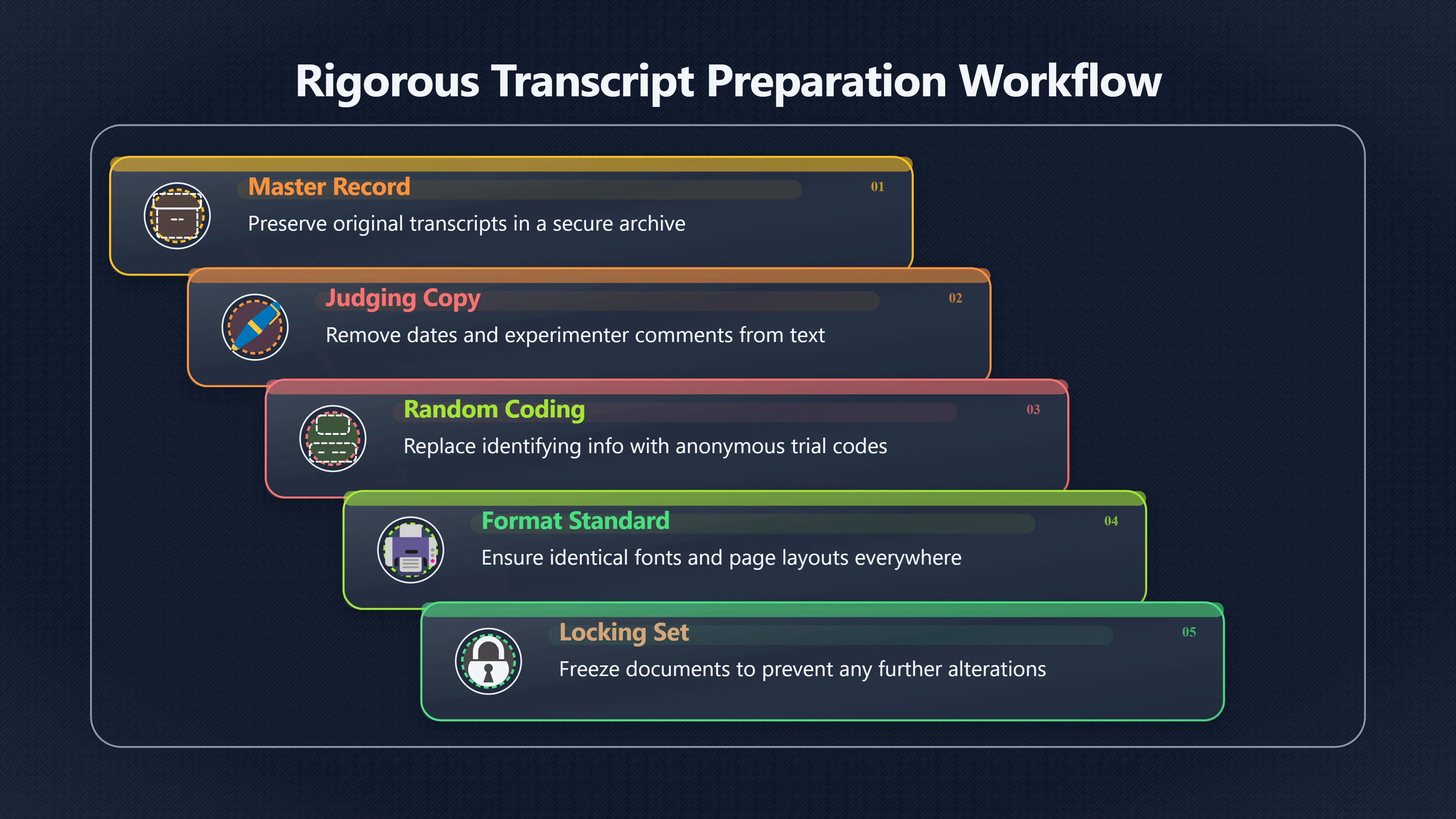
A rigorous transcript preparation process aims to ensure that every judge sees identical, context-free material.
A robust workflow typically includes these steps:
- Create a master record. Preserve the original transcript unchanged in a secure archive.
- Produce a judging copy. Remove dates, session numbers, experimenter comments, filenames, page headers, metadata, and any logistical references.
- Assign a random code. Replace identifying information with randomly generated trial identifiers that reveal nothing about target order.
- Standardise formatting. Ensure every transcript uses identical fonts, page layouts, numbering, and sketch presentation.
- Lock the judging set. Once cleaning is complete, freeze the documents so they cannot be altered during scoring.
- Maintain an audit trail. Keep a confidential correspondence table linking original records to anonymous codes for later verification.
This approach preserves scientific accountability. Researchers can later reconstruct the complete chain of evidence without exposing judges to identifying information during evaluation.
A practical example of cue removal
Consider two versions of the same transcript.
An original document might begin:
- Session 12
- 18 March
- Conducted after yesterday’s harbour target
- Monitor: Initial sketch looks promising
None of those details describes the target itself, yet together they may narrow the possibilities if the judge knows the experimental schedule.
A cleaned judging copy would instead contain only:
- Trial A47
- Viewer narrative
- Sketches
- No dates
- No experimenter annotations
- No chronological references
The descriptive evidence remains intact, while every obvious source of contextual leakage has been removed.
Why transcript cleaning remains a benchmark for fair testing
The Marks critique continues to matter because it redirected discussion from dramatic claims to experimental controls. Whether one accepts Marks’ interpretation in full or prefers the rebuttals offered by Puthoff and Targ, the historical outcome is clear: transcript cleaning became recognised as a fundamental component of credible remote viewing research.
Modern protocol design therefore assumes that transcripts should be anonymous before judging, with target coding performed independently and all original records securely preserved for later inspection. That procedure does not establish whether remote viewing exists, but it substantially reduces one of the best-documented alternative explanations for apparently successful matches—ordinary information inadvertently embedded in the experimental paperwork.[Nature+2PubMed]nature.comDAVID MARKS &; RICHARD KAMMANN. Nature volume 274, pages 680–681 (…Read more…
Amazon book picks
Further Reading
Books and field guides related to Can the Transcript Give the Game Away?. Use these as the next step if you want deeper reading beyond the article.
The conscious universe
Contrasts laboratory evidence with practical application questions.

eBay marketplace picks
Marketplace Samples
Live-tested eBay searches with available results related to this page.



Endnotes
1.
Source: nature.com
Link:https://www.nature.com/articles/274680a0
Source snippet
DAVID MARKS &; RICHARD KAMMANN. Nature volume 274, pages 680–681 (...Read more...
2.
Source: nature.com
Link:https://www.nature.com/articles/292177a0
Source snippet
Sensory cues invalidate remote viewing experimentsby D MARKS · 1981 · Cited by 25 — [Sensory cues]({{ 'sensory-cues/' | relative_url }}) invalidate remote viewing experime...
3.
Source: nature.com
Link:https://www.nature.com/articles/284191a0
Source snippet
Information transmission in remote viewing experimentsby CT TART · 1980 · Cited by 55 — TART, C., PUTHOFF, H. & TARG, R. Information tran...
4.
Source: cia.gov
Link:https://www.cia.gov/readingroom/docs/CIA-RDP96-00792R000400240002-6.pdf
Source snippet
TRANSCONTINENTAL REMOTE VIEWING (SCHLITZ...The translators then checked the transcripts for phrases from which one might infer tempo...
5.
Source: cia.gov
Link:https://www.cia.gov/readingroom/docs/CIA-RDP96-00787R000200090017-5.pdf
Source snippet
INFORMATION TRANSMISSION IN REMOTE VIEWING...the judging package was cue-free (light editing of transcript preambles, randomization proc...
6.
Source: nature.com
Link:https://www.nature.com/articles/292388a0
Source snippet
T., Puthoff, H. E. & Targ, R. Nature 284, 191 (1980). Article ADS CAS Google Scholar. Marks, D. & Kammann, R. The Psychology of the...Re...
7.
Source: pubmed.ncbi.nlm.nih.gov
Link:https://pubmed.ncbi.nlm.nih.gov/7254336/
Source snippet
Nature. 1981 Jul 23;292(5821):388. doi: 10.1038/292388a0. Authors. H Puthoff, R Targ.Read more...
8.
Source: pubmed.ncbi.nlm.nih.gov
Link:https://pubmed.ncbi.nlm.nih.gov/7242682/
Source snippet
Nature. 1981 Jul 9;292(5819):177. doi: 10.1038/292177a0. Author. D Marks. PMID: 7242682; DOI: 10.1038...Read more...
9.
Source: pubmed.ncbi.nlm.nih.gov
Link:https://pubmed.ncbi.nlm.nih.gov/7360248/
10.
Source: researchgate.net
Link:https://www.researchgate.net/profile/David-Marks-2
Source snippet
David MARKS | Independent | PhD | Research profileThis article reviews historically significant phenomenological studies of visual mental...
11.
Source: Wikipedia
Title: Remote viewing
Link:https://en.wikipedia.org/wiki/Remote_viewing
Source snippet
Remote viewingDavid Marks, a critic of remote viewing, after finding sensory cues and editing in the original transcripts generated by...
12.
Source: psi-encyclopedia.spr.ac.uk
Title: spr.ac.uk Remote Viewing
Link:https://psi-encyclopedia.spr.ac.uk/articles/remote-viewing/
Source snippet
Viewing - Psi Encyclopedia13 Jan 2017 — Remote viewing is an experimental form of ESP that emerged in the late 1960s, in which a suitably...
Additional References
13.
Source: miguelangelmartinez.net
Link:https://www.miguelangelmartinez.net/IMG/pdf/2017_silverman_doing__qualitative_research_book.pdf
Source snippet
Doing Qualitative ResearchThis clear, student- centred guide offers first person insights and true-to-life stories that prepare readers f...
14.
Source: academia.edu
Link:https://www.academia.edu/116341239/Information_transmission_in_remote_viewing_experiments
Source snippet
Information transmission in remote viewing experimentsInformation transmission in remote viewing experiments IN a recent Jetter to Nature...
15.
Source: cdn.centerforinquiry.org
Link:https://cdn.centerforinquiry.org/wp-content/uploads/sites/29/2002/01/22164755/p46.pdf
Source snippet
REVIEWS definitive critique of the Targ and. Puthoff remote viewing (RV) studies that had at their outset persuaded many people, both wit...
16.
Source: researchgate.net
Link:https://www.researchgate.net/profile/Harold-Puthoff/publication/15945437_Rebuttal_of_criticisms_of_remote_viewing_experiments/links/57800d8b08ae01f736e49f90/Rebuttal-of-criticisms-of-remote-viewing-experiments.pdf
Source snippet
Kammann offer criticism of the [SRI experiments]({{ 'sri-tests/' | relative_url }}) in 'remote viewing', the abil- ity of certain individuals to access...Read more...
17.
Source: centerforinquiry.s3.amazonaws.com
Link:https://centerforinquiry.s3.amazonaws.com/wp-content/uploads/sites/29/1982/07/22165420/p20.pdf
Source snippet
Targ for copies of their remote viewing (RV) transcripts obtained in their experiments...Read more...
18.
Source: scispace.com
Title: rebuttal of criticisms of remote viewing experiments 1j3arh0xxi
Link:https://scispace.com/pdf/rebuttal-of-criticisms-of-remote-viewing-experiments-1j3arh0xxi.pdf
Source snippet
Rebuttal of criticisms of remote viewing experiments23 Jul 1981 — Rebuttal of criticisms of remote viewing experiments. MARKS1 has argued...
19.
Source: instagram.com
Link:https://www.instagram.com/robgmacfarlane/?hl=en
Source snippet
us see birds for the first time. It's also a love letter...Read more...
20.
Source: pmc.ncbi.nlm.nih.gov
Title: PMCFollow‐up on the U.S
Link:https://pmc.ncbi.nlm.nih.gov/articles/PMC10275521/
Source snippet
Central Intelligence Agency's (CIA...by Á Escolà‐Gascón · 2023 · Cited by 10 — We propose the Production‐Identification‐Comprehension (P...
21.
Source: facebook.com
Link:https://www.facebook.com/AskImtinan/posts/project-[stargate
Source snippet
Why did intelligence agencies invest so heavily in it? And what does this mean for...Read more...
22.
Source: jasonbrownlee.me
Title: Mind-Reach and PSI Debunking
Link:https://jasonbrownlee.me/blog/posts/mind-reach/
Source snippet
Jason Brownlee20 Jan 2025 — David Marks and Richard Kammann attempted to replicate Targ and Puthoff's remote viewing experiments and foun...
Topic Tree