Within Intel Value
Why Lab Hits Did Not Become Field Value
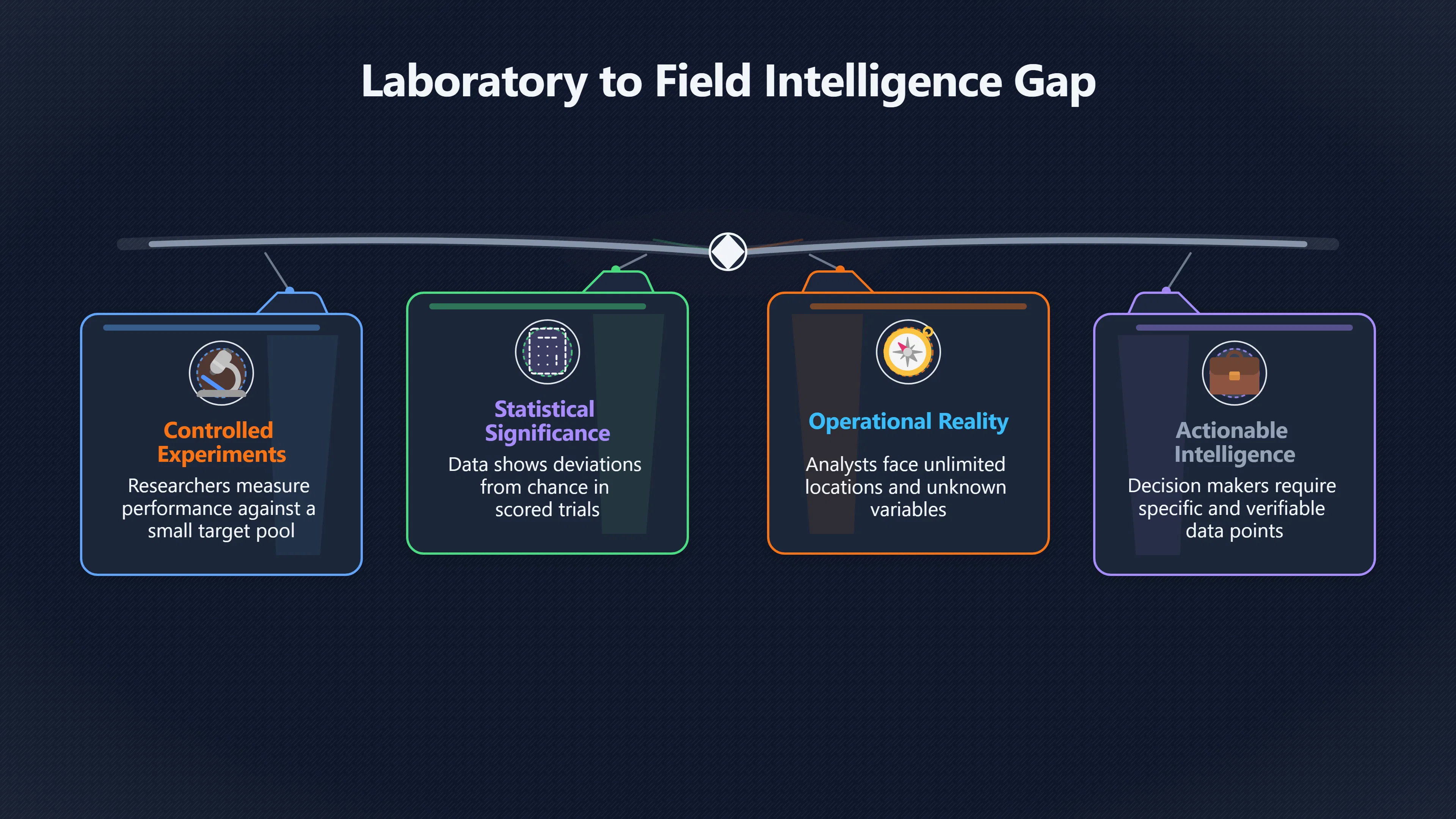
Controlled experiments could score statistical anomalies, but field operations needed specific claims under messy conditions.
On this page
- What laboratory scoring could measure
- What field operations demanded instead
- Why feedback and target limits mattered
Page outline Jump by section
Introduction
One of the central puzzles in the remote-viewing debate is why apparently encouraging laboratory findings did not translate into useful intelligence operations. This distinction became the decisive issue in the U.S. government’s evaluation of the Star Gate programme. Some reviewers accepted that certain controlled experiments produced results that appeared statistically unusual and merited further scientific investigation. Yet the same review concluded that these findings did not produce operational intelligence that decision-makers could rely upon. The gap between laboratory performance and field usefulness ultimately proved more important than the laboratory debate itself, because intelligence organisations require information that is specific, timely, verifiable and capable of guiding real-world decisions under uncertainty.[National Security Archive]nsarchive2.gwu.eduerror of the sample.Read moreNational Security ArchiveAn Evaluation of Remote Viewing: Research and…March 13, 2015 — by MD Mumford · 1995 · Cited by 76 — 1 One sta…
What laboratory scoring could measure
Laboratory remote-viewing experiments were designed to answer a relatively narrow question: could participants describe a hidden target at rates exceeding chance under controlled conditions? Rather than asking whether viewers could locate enemy assets or prevent attacks, researchers often asked judges to compare a participant’s descriptions with a small set of possible targets and determine whether the correct target ranked unusually highly.
This experimental design offered several advantages. Researchers could:
- conceal the target until after the session through double-blind procedures;
- measure performance statistically across many trials rather than relying on dramatic anecdotes;
- standardise judging methods and compare results across experiments.
By the late 1980s and early 1990s, later studies attempted to address criticisms directed at earlier experiments, including problems such as sensory leakage, inadequate blinding and statistical weaknesses. Jessica Utts, serving as one of the independent reviewers for the CIA-sponsored evaluation, argued that the accumulated laboratory evidence showed statistically significant deviations from chance that deserved scientific attention.[National Security Archive]nsarchive2.gwu.eduerror of the sample.Read moreNational Security ArchiveAn Evaluation of Remote Viewing: Research and…March 13, 2015 — by MD Mumford · 1995 · Cited by 76 — 1 One sta…
However, statistical significance in laboratory research answers a different question from operational usefulness. A small average advantage spread across hundreds of carefully scored trials does not necessarily produce reliable information in any individual case.
What field operations demanded instead
Intelligence work reverses many of the assumptions built into laboratory experiments.
Instead of selecting from a limited target pool, analysts confront an effectively unlimited number of possible locations, people and events. They rarely know in advance whether a report contains useful information, and there is no independent judge waiting with the correct answer. Operational decisions must often be made before feedback becomes available.
As a result, intelligence consumers required information with qualities that laboratory scoring did not measure well:
- precise locations rather than general impressions;
- identifiable people, equipment or facilities;
- information available early enough to influence action;
- confidence estimates that could be compared with other intelligence sources;
- consistency across different viewers and repeated sessions.
The American Institutes for Research (AIR) evaluation found that remote-viewing reports generally performed better when describing broad characteristics than when providing the concrete details needed for operational decisions. Reports frequently contained mixtures of potentially accurate statements, ambiguous imagery and demonstrably incorrect material, leaving analysts with no objective method for separating useful content from noise before acting.[National Security Archive]nsarchive2.gwu.eduerror of the sample.Read moreNational Security ArchiveAn Evaluation of Remote Viewing: Research and…March 13, 2015 — by MD Mumford · 1995 · Cited by 76 — 1 One sta…
Why feedback and target limits mattered
Laboratory experiments benefit from immediate and unambiguous feedback. Researchers know the correct target after each trial, allowing scoring systems to classify responses as hits, misses or partial matches.
Operational intelligence rarely offers such clarity.
A reported missile site may never be visited. A suspected meeting may not occur. An alleged covert facility may remain inaccessible for years. Without prompt feedback, neither viewers nor programme managers could reliably determine whether a session represented success, partial success or coincidence.
The size of the search space also changes dramatically.
In a laboratory, matching one photograph from a set of five or ten alternatives can be scored objectively. In intelligence operations, there may be thousands of plausible locations, countless industrial facilities or entire regions fitting a broad description such as “near water”, “large metal structure” or “mountainous terrain”. Descriptions that appear impressive after the correct answer becomes known often provide little practical guidance beforehand.
This difference illustrates why statistical scoring and operational decision-making measure fundamentally different forms of performance.[National Security Archive]nsarchive2.gwu.eduerror of the sample.Read moreNational Security ArchiveAn Evaluation of Remote Viewing: Research and…March 13, 2015 — by MD Mumford · 1995 · Cited by 76 — 1 One sta…
Why apparent laboratory success did not become operational value
Several practical factors repeatedly limited any transition from experimental findings to intelligence use.
Ambiguity accumulated faster than certainty
Remote-viewing sessions often generated lengthy narratives containing symbolic imagery, impressions and multiple possibilities. Analysts attempting to use these reports faced an interpretive problem: deciding which details deserved attention before knowing the outcome.
Unlike conventional intelligence sources, there was no established framework for estimating which portions of a report were likely to be reliable.
False positives carried real costs
An intelligence organisation must consider the consequences of acting on incorrect information.
Searching the wrong location, diverting surveillance assets or launching expensive collection efforts based on vague impressions consumes resources and may delay more reliable investigations. Even if occasional reports contained accurate elements, operational value depended on distinguishing those reports in advance rather than recognising them afterwards.
Replicability mattered more than isolated successes
Supporters of remote viewing frequently highlighted individual cases that appeared striking. Intelligence agencies, however, evaluate collection methods across large numbers of operations rather than memorable anecdotes.
The AIR review concluded that there was no documented evidence showing remote-viewing reports had ever guided intelligence operations or consistently produced actionable intelligence, despite years of operational use and research investment.[National Security Archive]nsarchive2.gwu.eduerror of the sample.Read moreNational Security ArchiveAn Evaluation of Remote Viewing: Research and…March 13, 2015 — by MD Mumford · 1995 · Cited by 76 — 1 One sta…
The disagreement among reviewers
The most enduring debate arising from the 1995 evaluation was not whether remote viewing produced operational intelligence, but how laboratory findings should be interpreted.
Jessica Utts argued that the experimental evidence supported the existence of an anomalous statistical effect that could not easily be dismissed as chance alone. Ray Hyman, while acknowledging that some studies had improved methodologically, argued that the evidence remained insufficient because independent replication, theoretical explanation and elimination of alternative interpretations had not reached the standards expected for extraordinary claims.[National Security Archive]nsarchive2.gwu.eduerror of the sample.Read moreNational Security ArchiveAn Evaluation of Remote Viewing: Research and…March 13, 2015 — by MD Mumford · 1995 · Cited by 76 — 1 One sta…
Importantly, this disagreement concerned the interpretation of laboratory research rather than the programme’s operational record. On the practical intelligence question, the broader AIR evaluation concluded that remote viewing had not demonstrated value sufficient to justify continued operational use.[National Security Archive]nsarchive2.gwu.eduerror of the sample.Read moreNational Security ArchiveAn Evaluation of Remote Viewing: Research and…March 13, 2015 — by MD Mumford · 1995 · Cited by 76 — 1 One sta…
What the laboratory-to-field gap revealed
The Star Gate experience demonstrated that a statistically interesting laboratory effect and a useful intelligence capability are separate achievements requiring different forms of evidence.
Laboratory studies ask whether performance differs from chance under controlled conditions. Intelligence organisations ask whether information can reduce uncertainty enough to improve decisions under real operational constraints. Success on the first question does not automatically answer the second.
This distinction explains why the remote-viewing debate increasingly centred on operational usefulness rather than laboratory anomalies. Even if controlled experiments suggested effects worth further scientific investigation, intelligence agencies ultimately judged the programme by whether it produced timely, specific and dependable information that changed operational decisions. According to the official evaluation, that transition from laboratory performance to field value was never convincingly demonstrated.[National Security Archive]nsarchive2.gwu.eduerror of the sample.Read moreNational Security ArchiveAn Evaluation of Remote Viewing: Research and…March 13, 2015 — by MD Mumford · 1995 · Cited by 76 — 1 One sta…
Amazon book picks
Further Reading
Books and field guides related to Why Lab Hits Did Not Become Field Value. Use these as the next step if you want deeper reading beyond the article.

Parapsychology: A Handbook for the 21st Century
Summarizes laboratory evidence and debate.
eBay marketplace picks
Marketplace Samples
Live-tested eBay searches with available results related to this page.

Endnotes
1.
Source: cia.gov
Link:https://www.cia.gov/readingroom/docs/CIA-RDP96-00791R000200180005-5.pdf
Source snippet
re to control for the elimination of locations already judged...Read more...
2.
Source: cia.gov
Link:https://www.cia.gov/readingroom/docs/CIA-RDP96-00791R000200180006-4.pdf
Source snippet
AN EVALUATION OF REMOTE VIEWING' One statistical flaw found in early studies of remote viewing, for example, was due to failure to contro...
3.
Source: nsarchive2.gwu.edu
Title: error of the sample.Read more
Link:https://nsarchive2.gwu.edu/NSAEBB/NSAEBB438/docs/doc_57.pdf
Source snippet
National Security ArchiveAn Evaluation of Remote Viewing: Research and...March 13, 2015 — by MD Mumford · 1995 · Cited by 76 — 1 One sta...
Published: March 13, 2015
4.
Source: Wikipedia
Title: Jessica Utts
Link:https://en.wikipedia.org/wiki/Jessica_Utts
5.
Source: ics.uci.edu
Link:https://www.ics.uci.edu/~jutts/may.pdf
Source snippet
They didn't. The failure to contact significant program participants does not end with these...Read more...
6.
Source: Wikipedia
Title: Remote viewing
Link:https://en.wikipedia.org/wiki/Remote_viewing
Source snippet
Remote viewingFollowing Utts' emphasis on replication and Hyman's challenge on interlaboratory consistency in the AIR... failure to p...
Additional References
7.
Source: researchgate.net
Title: 374881423 Remote Viewing A 1974 2022 Systematic Review and [Meta Analysis]({{ ‘meta-analysis/’ | relative_url }})
Link:https://www.researchgate.net/publication/374881423_Remote_Viewing_A_1974-2022_Systematic_Review_and_Meta-Analysis
Source snippet
Star. Gate—America's psychic espionage program. Tom. Dougherty... (1995). Viewing the future: A pilot study with an error-de-. tecting...
8.
Source: facebook.com
Link:https://www.facebook.com/historyoasis/posts/from-1972-to-1995-the-united-states-military-invested-over-20-million-in-one-of-/790173214116954/
Source snippet
emote viewing fails to produce actionable intelligence.Read more...
9.
Source: academia.edu
Link:https://www.academia.edu/95285973/The_Star_Gate_Operational_Remote_Viewing_Program_A_Human_Intelligence_HUMINT_Collection_Platform
Source snippet
It is possible that the information...Read more...
10.
Source: youtube.com
Title: Edwin May, [Psychic Spying]({{ ‘psychic-spying/’ | relative_url }}) (Remote Viewing, Star Gate Program)
Link:https://www.youtube.com/watch?v=EPvrOsEXBbE
Source snippet
CONTROLLED REMOTE VIEWING - Lori Williams #32...
11.
Source: pmc.ncbi.nlm.nih.gov
Link:https://pmc.ncbi.nlm.nih.gov/articles/PMC10275521/
Source snippet
Central Intelligence Agency's (CIA...by Á Escolà‐Gascón · 2023 · Cited by 10 — Keywords: anomalous cognitions, central intelligence agen...
12.
Source: youtube.com
Title: Statistics in Parapsychology with Jessica Utts
Link:https://www.youtube.com/watch?v=WmYGtKB9EEA
Source snippet
Edwin May, Psychic Spying (Remote Viewing, Star Gate Program) - Jimmy Akin's Mysterious World...
13.
Source: youtube.com
Title: [Stargate]({{ ‘stargate/’ | relative_url }})’s Gatekeeper: DIA & Remote Viewing with Dale E. Graff
Link:https://www.youtube.com/watch?v=VRAsTmT_nQo
Source snippet
Statistics in Parapsychology with Jessica Utts...
14.
Source: governmentattic.org
Link:https://www.governmentattic.org/57docs/ThesisAnomalousHumanCognition2023.pdf
Source snippet
Thesis: Anomalous Human Cognition: A Possible Role...20 Sept 2023 — Intelligence - found that remote viewing was an effective operationa...
15.
Source: youtube.com
Title: CONTROLLED REMOTE VIEWING
Link:https://www.youtube.com/watch?v=wWqldsr_zIg
Source snippet
Remote Viewing and Statistical Validation...
16.
Source: youtube.com
Title: Remote Viewing and Statistical Validation
Link:https://www.youtube.com/watch?v=YrwAiU2g5RU
Topic Tree