Within Future Targets
What the Chicago Precognition Trial Really Tested
The Chicago-area study is a key early case because viewers described sites before the locations were chosen.
On this page
- The eight trial design in plain language
- How the judging procedure tried to tighten the evidence
- Why the reported result remains disputed
Page outline Jump by section
Introduction
Dunne and Bisaha’s Chicago precognition trial is one of the best-known early attempts to test a specific claim within remote-viewing research: whether people can describe a target location before that location has even been selected. Reported in 1979 as Precognitive Remote Viewing in the Chicago Area, the study deliberately shifted the challenge from hidden-location perception to future-target perception. Rather than asking whether a participant could perceive a distant place in the present, it asked whether descriptions produced in advance would later correspond to a location chosen only after the viewing session had ended.[Pear Lab]pear-lab.com1979 precognitive remote viewing stanfordDunne, designated here as E. J. Bisaha (E,) served as coordinator and observer in the laboratory. Apparatus.Read more

The experiment remains important because it introduced procedural changes intended to strengthen earlier Stanford Research Institute-style remote-viewing protocols. Supporters cite the reported statistical outcome as evidence that the design deserved serious attention. Critics argue that the experiment still relied on subjective judging and a small dataset, making the findings insufficient to establish precognition. The Chicago trial therefore occupies a distinctive place in the history of future-target remote-viewing claims: influential within parapsychology, but never accepted as persuasive evidence by mainstream science.[Pear Lab+2Pear Lab]pear-lab.com1979 precognitive remote viewing stanfordDunne, designated here as E. J. Bisaha (E,) served as coordinator and observer in the laboratory. Apparatus.Read more
What the Chicago precognition trial really tested
The central innovation was timing. In conventional outbound remote-viewing experiments, an agent visits a randomly selected location while a participant attempts to describe it from elsewhere. Dunne and John P. Bisaha instead arranged the sequence so that participants completed their descriptions before the target site had been determined. Only afterwards was a destination selected and visited by the outbound experimenter.[Pear Lab]pear-lab.com1979 precognitive remote viewing stanfordDunne, designated here as E. J. Bisaha (E,) served as coordinator and observer in the laboratory. Apparatus.Read more
This sequence was designed to remove the possibility that the participant was perceiving a location that already existed as the experimental target. If successful, the experiment would imply correspondence with a future event rather than present-time perception. That is why the study is frequently described as an early “future-target” or “precognitive remote-viewing” experiment rather than simply another remote-viewing replication.[Pear Lab]pear-lab.com1979 precognitive remote viewing stanfordDunne, designated here as E. J. Bisaha (E,) served as coordinator and observer in the laboratory. Apparatus.Read more

The eight-trial design in plain language
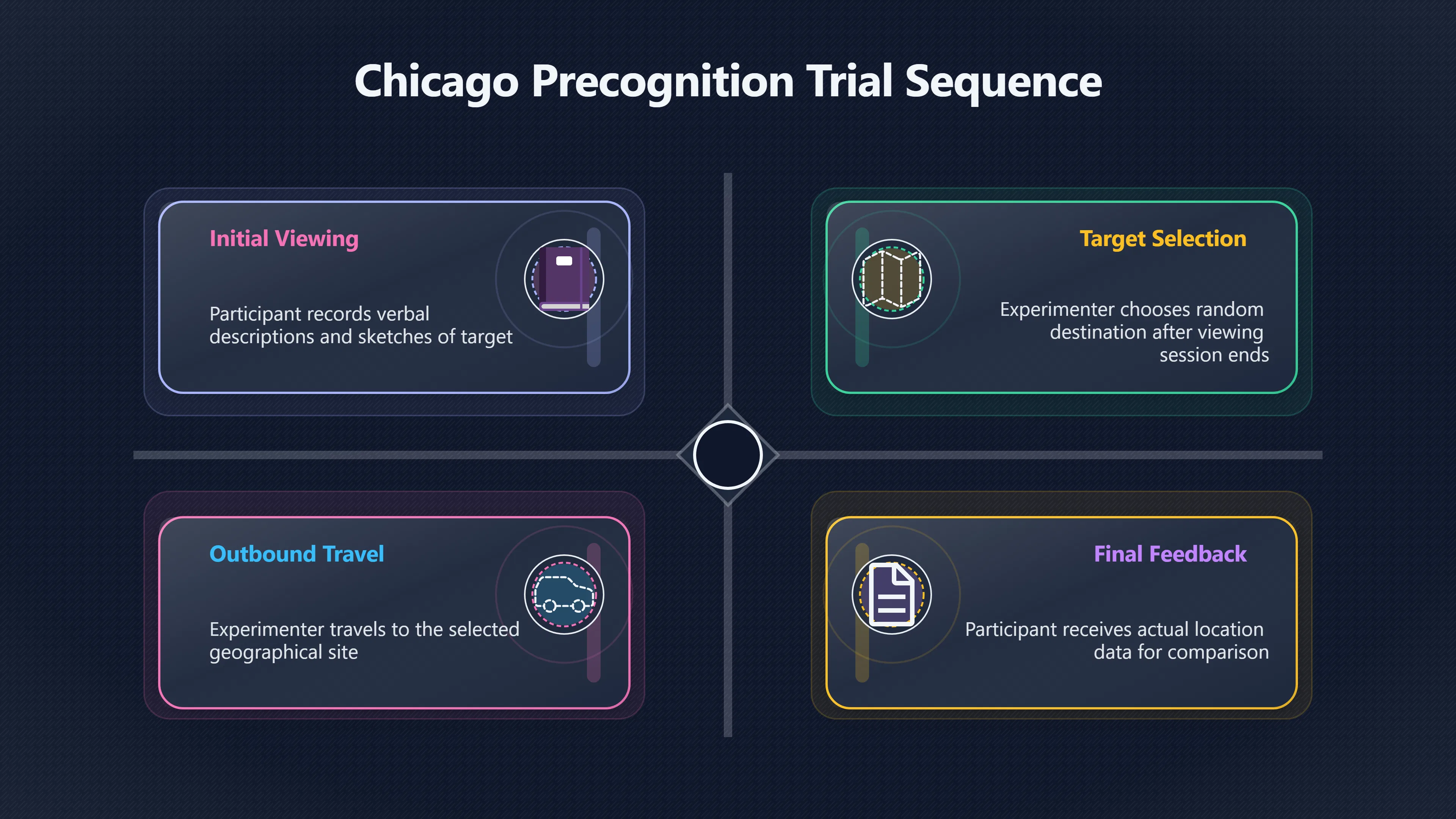
The published experiment consisted of eight separate trials conducted around the Chicago area. In each trial:
- A participant recorded verbal descriptions and sketches during the viewing session.
- At that stage, no target location had yet been chosen.
- After the viewing session ended, an outbound experimenter travelled to the randomly selected destination.
- The participant eventually received feedback about the actual location only after the trial was complete. Pear Lab
The locations were ordinary geographical sites rather than symbolic targets or photographs. The study therefore attempted to preserve the familiar remote-viewing format while changing only the temporal order of events.
Because there were only eight formal trials, every individual result contributed substantially to the final statistics. That small sample size has remained one of the principal limitations discussed by later commentators, regardless of whether they view the reported outcome as encouraging or unconvincing. Pear Lab+2Pear Lab
How the judging procedure tried to tighten the evidence
One of the study’s most distinctive features was its judging method.
Earlier remote-viewing experiments had been criticised because judges could sometimes compare many transcripts against many targets in ways that were statistically difficult to evaluate. Dunne and Bisaha attempted to simplify the analysis by having multiple independent judges rank each transcript against a fixed set of candidate locations rather than relying on a single evaluator or informal matching. Pear Lab
According to the published report:
- eight independent judges participated;
- each judge ranked one viewing transcript against eight possible target sites;
- rankings were combined using a predefined statistical procedure rather than selecting only the most impressive correspondences. Pear Lab
The authors reported that the correct targets received significantly favourable rankings, corresponding to a one-tailed probability of less than 0.008 under their statistical model. Within parapsychology, this result was presented as evidence that the correspondence exceeded chance expectations. Pear Lab
The judging procedure later influenced analytical methods developed at the Princeton Engineering Anomalies Research (PEAR) laboratory, where researchers increasingly sought more formal scoring systems to reduce reliance on intuitive matching. Pear Lab
Why the reported result remains disputed
The reported statistical significance has never ended the debate because statistical significance alone does not resolve questions about experimental design.
Several concerns continue to appear in later discussions.
Small number of trials. Eight experiments provide limited statistical power. A few unusually successful matches can have a large effect on the final probability estimate, making independent replication especially important. Pear Lab
Subjective similarity judgements. Even with independent judges, remote-viewing scoring depends on assessing how well a narrative or sketch resembles a real location. Critics argue that broad descriptions can often be interpreted in multiple ways after the target becomes known. Pear Lab
Replication versus acceptance. The Chicago experiment was presented as a replication and methodological refinement of earlier Stanford work, and later PEAR publications cited it as part of a growing body of positive remote-perception findings. However, mainstream reviewers have generally maintained that the wider literature does not provide sufficiently reliable, independently reproducible evidence to establish precognition as a real phenomenon. ICRL+2Pear Lab
The disagreement therefore concerns more than one p-value. It reflects differing views about whether subjective judging, small samples and repeated experimentation across many studies can collectively demonstrate an effect that would challenge established ideas about causality.
Why the Chicago trial still matters
Although the Chicago experiment has not changed the scientific consensus on precognition, it remains historically significant because it clearly separated future-target remote viewing from conventional hidden-target experiments.
Its lasting contribution lies in three methodological ideas:
- moving target selection until after the viewing session;
- attempting to reduce judging bias through multiple independent rankings;
- treating temporal order itself as the primary experimental variable. Pear Lab
For that reason, the Chicago trial continues to be cited whenever researchers discuss future-target remote-viewing protocols. Supporters regard it as one of the clearest early demonstrations that such designs can produce statistically unusual results. Critics view it as an instructive example of why extraordinary claims require much larger, more objective and independently replicated datasets before they can overturn conventional explanations. ICRL+2Pear Lab
Amazon book picks
Further Reading
Books and field guides related to What the Chicago Precognition Trial Really Tested. Use these as the next step if you want deeper reading beyond the article.

Remote Viewers: The Secret History of America's Psychic Spies
Places future-target research into wider program history.

eBay marketplace picks
Marketplace Samples
Live-tested eBay searches with available results related to this page.
Endnotes
2.
Source: pear-lab.com
Title: 1998 information uncertainty remote perception
Link:https://www.pear-lab.com/pdfs/1998-information-uncertainty-remote-perception.pdf
Source snippet
J., & Bisaha, J. P. (1979). Precognitive remote viewing in the Chicago area: A replication of the Stanford experiment. Journal of Parapsy...
3.
Source: icrl.org
Link:https://icrl.org/wp-content/uploads/2020/02/1996-precognitive-remote-perception-replication.pdf
Source snippet
J. and J. P. Bisaha (1979). Precognitive re- mote viewing in the Chicago area: a replication of the Stanford experiment. J. Parapsycholo...
4.
Source: Wikipedia
Title: Remote viewing
Link:https://en.wikipedia.org/wiki/Remote_viewing
5.
Source: journalofscientificexploration.org
Link:https://journalofscientificexploration.org/index.php/jse/article/view/3437/2247
Source snippet
J., & Bisaha, J. P. (1979). Precognitive remote viewing in the Chicago area: A replication of the Stan- ford experiment. Journal of...Re...
Additional References
6.
Source: semanticscholar.org
Link:https://www.semanticscholar.org/paper/Precognitive-Remote-Perception%3A-Replication-of-Nelson-Dunne/9ba750c832f62ac70943368be8977d7551934d92
Source snippet
[PDF] Precognitive Remote Perception: Replication of...Although the PEAR program has accumulated several hundred experimental trials, it...
7.
Source: academia.edu
Title: Through Time and Space: The Evidence for Remote Viewing60 Bisaha J and Dunne B
Link:https://www.academia.edu/9540484/Through_Time_and_Space_The_Evidence_for_Remote_Viewing
Source snippet
Precognitive remote viewing in the Chicago area: A replication of the Stanford experiment. In Research in Parapsychology, 1976. Eds...Re...
8.
Source: scribd.com
Title: R D Nelson et al Precognitive Remote Perception Replication of Remote Viewing
Link:https://www.scribd.com/document/78205448/R-D-Nelson-et-al-Precognitive-Remote-Perception-Replication-of-Remote-Viewing
Source snippet
Nelson Et Al - Precognitive Remote PerceptionJ. Parapsychology, 56, 2, [Link], B. J. and J. P. Bisaha (1979). Precognitive remote viewing...
9.
Source: researchgate.net
Title: 374881423 Remote Viewing A 1974 2022 Systematic Review and [Meta Analysis]({{ ‘meta-analysis/’ | relative_url }})
Link:https://www.researchgate.net/publication/374881423_Remote_Viewing_A_1974-2022_Systematic_Review_and_Meta-Analysis
Source snippet
(PDF) Remote Viewing: A 1974-2022 Systematic Review...26 Oct 2023 — This is the first meta-analysis of all studies related to remote-vie...
10.
Source: researchgate.net
Link:https://www.researchgate.net/publication/251752421_Precognitive_Remote_Perception_Replication_of_Remote_Viewing
Source snippet
J. and J. P. Bisaha (1979). Precognitive remote viewing in the Chicago area: a replication of the Stanford experiment. J. Parapsychology...
11.
Source: academia.edu
Title: Remote Viewing A 1974 2022 Systematic Review and Meta Analysis
Link:https://www.academia.edu/108445581/Remote_Viewing_A_1974_2022_Systematic_Review_and_Meta_Analysis
Source snippet
J., & Bisaha, J. P. (1979). Precognitive remote viewing in the Chicago area: A replication of the Stanford experiment. Journal of Parapsy...
12.
Source: scispace.com
Link:https://scispace.com/pdf/remote-viewing-the-future-with-a-[tasking
Source snippet
J., & Bisaha, J. P. (1979). Precognitive remote viewing in the Chicago area: A replication of the Stanford experiment. Journal of Parapsy...
13.
Source: iris-ic.com
Title: Bibliographie scientifique du Remote Viewing Bisaha, J
Link:https://www.iris-ic.com/bibliographie-scientifique-du-remote-viewing/
Source snippet
D., B. (1979). Multiple subject and long-distance precognitive remote viewing of geographical locations. Mind at Large: Institute of Elec...
14.
Source: cambridge.org
Link:https://www.cambridge.org/core/journals/behavioral-and-brain-sciences/article/parapsychologys-critics-a-link-with-the-past/9B9DC4002546BA3747A8BF4AB01554CC
Source snippet
J. & Bisaha, J. P. (1979) Precognitive remote viewing in the Chicago area: A replication of the Stanford experiment. Journal of...Read more...
15.
Source: youtube.com
Title: Remote Viewing Magic, Russell Targ: EP 319
Link:https://www.youtube.com/watch?v=WF_PyqbQZRE
Source snippet
These videos provide relevant context by featuring key figures associated with the PEAR laboratory (such as Brenda Dunne) and the pioneer...
Topic Tree