Within Leakage
How One Clue Can Shift the Odds
When targets are not reused, one ordinary clue can help eliminate options and inflate remote-viewing scores.
On this page
- What no replacement target pools mean
- How elimination helps rank order judging
- Why randomisation and replacement matter
Page outline Jump by section
Introduction
In many remote-viewing experiments, success is not measured by a viewer naming a hidden target outright. Instead, a judge compares the viewer’s transcript with a small set of possible targets and ranks them from best to worst match. This seemingly straightforward procedure creates an important statistical issue: if targets are drawn without replacement, information gained in one trial can change the odds in later trials. Even a small ordinary clue can allow a judge to eliminate possibilities, making later choices easier without any paranormal information.
This mechanism differs from obvious sensory leakage such as visible dates or comments on transcripts. Here, the design of the target pool itself can provide an unintended advantage. For that reason, critics have long argued that target randomisation, replacement, and blind judging are as important as shielding the viewer from the target. Experimental designers who support remote-viewing research have likewise recognised that careful target handling is necessary to prevent ordinary inference from inflating apparent success.[Koestler Unit]koestlerunit.wordpress.comjudge could match the day's target and re- sponseKoestler Unitmeta-analysis of free-response esp studies withoutMay 19, 2015 — each trial's target is se- lected randomly from the large p…
What no-replacement target pools mean
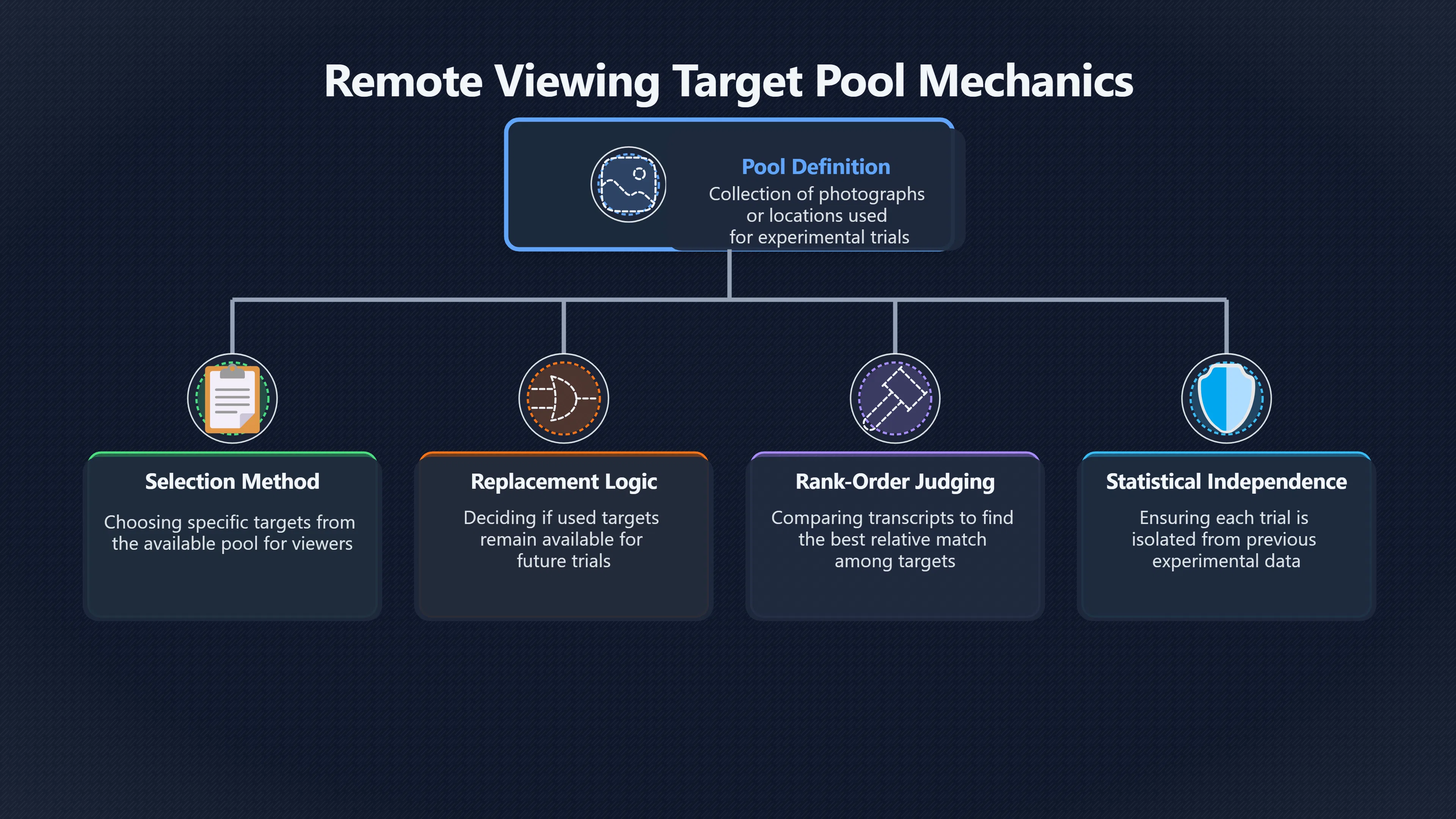
A target pool is the collection of photographs, locations or objects from which experimental targets are chosen. Two common approaches are:
- Selection with replacement: after a target is used, it remains eligible to appear again on later trials.
- Selection without replacement: once a target has been used, it is removed from the pool until the pool is reset.
At first glance, removing used targets appears sensible because it prevents repetition. However, it also creates a changing probability structure. Anyone who knows, or can infer, that certain targets have already appeared gains information about what remains available.
For example, imagine a pool of ten photographs used over ten sessions without replacement. By the ninth session, eight photographs have already been used. Even if the viewer has no paranormal ability, someone with knowledge of previous selections knows that only two possibilities remain. Any additional ordinary clue—perhaps a vague reference in a transcript or an accidental comment from an experimenter—can become far more informative because the list of candidates has already been narrowed.
The issue is not that no-replacement designs are automatically invalid. Rather, they require stronger safeguards to ensure that nobody involved in judging or handling the data can exploit the evolving composition of the target pool.[Koestler Unit]koestlerunit.wordpress.comjudge could match the day's target and re- sponseKoestler Unitmeta-analysis of free-response esp studies withoutMay 19, 2015 — each trial's target is se- lected randomly from the large p…
How elimination helps rank-order judging
Remote-viewing judging often relies on rank-order matching rather than exact identification. A judge reads a transcript containing broad impressions such as “water”, “metal”, “open area” or “tower”, then decides which target photograph fits best.
Because these descriptions are usually ambiguous, judging involves comparing relative rather than absolute similarity. In this setting, eliminating unlikely targets can be nearly as valuable as recognising the correct one.
A simplified example illustrates the mechanism:
- A judging set contains five possible targets.
- One transcript clearly does not match three of them.
- Previous sessions or procedural knowledge suggest another candidate has already been used.
- The judge is effectively choosing between only one or two realistic options.
The transcript has not become more accurate, but the decision problem has become easier. As a result, rank-order scores can improve even when the viewer’s information has not.
This is one reason statisticians distinguish between genuine evidence for target information and performance that benefits from changes in the decision environment. In free-response experiments, reducing the number of plausible alternatives increases the probability of obtaining apparently successful rankings through ordinary reasoning alone.[Koestler Unit]koestlerunit.wordpress.comjudge could match the day's target and re- sponseKoestler Unitmeta-analysis of free-response esp studies withoutMay 19, 2015 — each trial's target is se- lected randomly from the large p…
False hits and cumulative information
A related concern is the creation of false hits—matches that appear meaningful because of accumulated ordinary information rather than anomalous perception.
False hits do not necessarily arise from deliberate cheating. They can emerge through several subtle pathways:
- Judges gradually become familiar with the limited target pool.
- Experimenters unintentionally reveal which targets have already been used.
- Participants remember distinctive photographs from earlier sessions.
- Administrative records or transcript ordering reveal the experimental sequence.
Each clue may be weak in isolation. Combined with a no-replacement target pool, however, they reduce uncertainty. Over many trials, this can produce a pattern of above-chance scoring even though no single decision relied on a dramatic information leak.
This cumulative effect has been discussed more broadly in parapsychology because free-response experiments depend heavily on subjective matching rather than simple right-or-wrong answers. Researchers have therefore emphasised that the statistical independence of successive trials is a critical design feature.[Koestler Unit]koestlerunit.wordpress.comjudge could match the day's target and re- sponseKoestler Unitmeta-analysis of free-response esp studies withoutMay 19, 2015 — each trial's target is se- lected randomly from the large p…
Why randomisation and replacement matter
Modern experimental methodology treats target management as part of blinding rather than as a minor administrative detail.
Common safeguards include:
- Selecting targets using independent random procedures.
- Keeping judges unaware of which targets have already appeared.
- Using sufficiently large target pools that familiarity develops slowly.
- Allowing replacement, or otherwise ensuring that previous selections cannot be inferred.
- Separating personnel responsible for target selection, interviewing and judging.
The aim is to ensure that every judging decision is statistically independent of previous ones. If each trial begins with the same uncertainty, then success cannot be explained by gradually eliminating possibilities.
These precautions mirror standard experimental practice in many other fields, where randomisation is used to prevent hidden patterns from influencing outcomes rather than merely to make the experiment appear fair.[Koestler Unit]koestlerunit.wordpress.comjudge could match the day's target and re- sponseKoestler Unitmeta-analysis of free-response esp studies withoutMay 19, 2015 — each trial's target is se- lected randomly from the large p…

Why this issue remains important
Debates over remote viewing often focus on dramatic questions about whether information can be obtained paranormally. The target-selection issue is much narrower but scientifically important because it concerns a specific mechanism by which ordinary information can influence scores.
Critics have argued that even subtle procedural weaknesses can produce misleadingly positive results when judging depends on comparison and elimination. Supporters of remote-viewing research generally agree that rigorous target handling is essential, although they disagree over whether existing positive findings survive increasingly strict controls. Recent reviews of the literature continue to describe randomisation, blind judging and careful target management as central methodological features rather than optional refinements.[ResearchGate]researchgate.net369604750 Remote Viewing a 1974 2022 systematic review and meta analysisResearchGate(PDF) Remote Viewing: a 1974-2022 systematic review…March 20, 2023 — This is the first meta-analysis of all studies relate…
Amazon book picks
Further Reading
Books and field guides related to How One Clue Can Shift the Odds. Use these as the next step if you want deeper reading beyond the article.
Statistics Done Wrong
Explains how design choices can distort experimental conclusions.


Parapsychology: A Handbook for the 21st Century
Places target-pool debates in broader research context.
eBay marketplace picks
Marketplace Samples
Live-tested eBay searches with available results related to this page.




Endnotes
1.
Source: researchgate.net
Title: 369604750 Remote Viewing a 1974 2022 systematic review and [meta analysis]({{ ‘meta-analysis/’ | relative_url }})
Link:https://www.researchgate.net/publication/369604750_Remote_Viewing_a_1974-2022_systematic_review_and_meta-analysis
Source snippet
ResearchGate(PDF) Remote Viewing: a 1974-2022 systematic review...March 20, 2023 — This is the first meta-analysis of all studies relate...
Published: March 20, 2023
2.
Source: researchgate.net
Link:https://www.researchgate.net/publication/248497861_Remote_viewing_as_applied_to_futures_studies
Source snippet
(PDF) Remote viewing as applied to futures studiesRemote viewing is set of related protocols that allow a viewer to intuitively gather in...
3.
Source: koestlerunit.wordpress.com
Title: judge could match the day’s target and re- sponse
Link:https://koestlerunit.wordpress.com/wp-content/uploads/2015/06/milton-1997a.pdf
Source snippet
Koestler Unitmeta-analysis of free-response esp studies withoutMay 19, 2015 — each trial's target is se- lected randomly from the large p...
Published: May 19, 2015
4.
Source: Wikipedia
Title: Remote viewing
Link:https://en.wikipedia.org/wiki/Remote_viewing
Additional References
5.
Source: ia600501.us.archive.org
Link:https://ia600501.us.archive.org/20/items/FritjofCapraTheTurningPoint/Dean%20Radin%20-%20The%20Conscious%20Universe%20-%20The%20Scientific%20Truth%20of%20Psychic%20Phenomena%20%5BOCR%5D.pdf
Source snippet
Internet ArchiveE CONSCIOUS UNIVERSERobert Morris and Deborah Delanoy target pool were not selected uniformly over the course of the stud...
6.
Source: newdualism.org
Link:https://www.newdualism.org/papers/D.Stokes/Experimental_Psi.html
Source snippet
New Dualism Archive4. The Evidence for Psi: Experimental StudiesThe subject or an outside judge then ranks the pictures in the target poo...
7.
Source: youtube.com
Title: Finding Treasures and Missing Objects with Remote Viewing | Dr. Debra Lynne Katz
Link:https://www.youtube.com/watch?v=CQ_ci75kDRQ
Source snippet
Michael Daw | Vegetarians & Meat Eaters: Performance in a Precognitive [Ganzfeld]({{ 'ganzfeld/' | relative_url }}) Remote Viewing Task...
8.
Source: resolve.cambridge.org
Title: are scientists materialistic monists
Link:https://resolve.cambridge.org/core/services/aop-cambridge-core/content/view/14259900287AECBEE8098108E538CD04/S0140525X00054959a.pdf/are-scientists-materialistic-monists.pdf
Source snippet
anomaly called psi: Recent research and criticismThis computer-based procedure uses scoring al- gorithms that not only match perceptions...
9.
Source: scribd.com
Link:https://www.scribd.com/document/683851011/MARGINS-of-REALITY-the-Role-of-Consciousness-in-the-Physical-World-Jahn-Robert-G-dunne-Brenda-J-Z-lib-org
Source snippet
MARGINS of REALITY The Role of Consciousness in The...Swaroff, “Remote viewing: Failures to replicate with control comparisons,” Psychol...
10.
Source: youtube.com
Title: The CIA [Protocol]({{ ‘protocol/’ | relative_url }}): How to Train Your Brain for Remote Viewing
Link:https://www.youtube.com/watch?v=RJrTddUkplY
Source snippet
Finding Treasures and Missing Objects with Remote Viewing | Dr. Debra Lynne Katz...
11.
Source: youtube.com
Title: Experts’ Remote Viewing Guidelines Presented by Jimmy Akin
Link:https://www.youtube.com/watch?v=TsVhhzBSmIs
Source snippet
The CIA Protocol: How to Train Your Brain for Remote Viewing...
12.
Source: youtube.com
Title: Remote Viewing Explained: How the Mind Sees Without Eyes
Link:https://www.youtube.com/watch?v=whpZzUwrUNU
Source snippet
Experts' Remote Viewing Guidelines Presented by Jimmy Akin...
13.
Source: repositories.lib.utexas.edu
Link:https://repositories.lib.utexas.edu/bitstreams/b28b85e6-7a05-40f4-8370-254217289a75/download
Source snippet
by Paul Hamilton Smith 2009by PH Smith · 2009 · Cited by 5 — Usually, the remote viewer produces nothing correlating to either target (th...
14.
Source: youtube.com
Link:https://www.youtube.com/watch?v=UTV7kJHHWzk
Topic Tree