Within Shutdown
Why Correct Details Still Were Not Enough
Even when some details seemed right, analysts could not reliably separate useful signal from errors, guesses, and irrelevant material.
On this page
- How accurate looking details were buried in noise
- Why analysts could not know what to trust
- Why retrospective matching weakened usefulness
Page outline Jump by section
Introduction
One of the most important reasons the U.S. government’s remote-viewing programme failed as an intelligence tool was not that every report was wrong. Rather, the central problem was that potentially correct observations were embedded within large amounts of incorrect, vague, or irrelevant material. Analysts could not reliably distinguish genuine information from errors before making decisions, which meant that even occasional accurate details had limited operational value. This “signal versus noise” problem became a decisive criticism during the 1995 evaluation of the programme. The American Institutes for Research (AIR) concluded that the reports were too ambiguous and inconsistent to support actionable intelligence, even if some laboratory studies suggested that anomalous effects might exist under controlled conditions.[National Security Archive]nsarchive2.gwu.eduNational Security ArchiveAn Evaluation of Remote Viewing: Research and…March 13, 2015 — by MD Mumford · 1995 · Cited by 76 — In the ea…
Why Correct Details Still Were Not Enough
In intelligence work, information is valuable only if decision-makers can identify trustworthy reporting before acting on it. A report that mixes one correct observation with dozens of misleading or irrelevant statements creates an analytical burden rather than reducing uncertainty.
The AIR review repeatedly returned to this practical issue. Evaluators found that remote-viewing reports often contained broad descriptions that could appear meaningful after the target became known, but they rarely supplied the precise, verifiable details needed for operational decisions. They concluded that the information was “vague and ambiguous,” making it difficult or impossible to produce intelligence of sufficient quality for real-world use.[National Security Archive]nsarchive2.gwu.eduNational Security ArchiveAn Evaluation of Remote Viewing: Research and…March 13, 2015 — by MD Mumford · 1995 · Cited by 76 — In the ea…
This distinction mattered because intelligence agencies are not rewarded for occasionally recognising correct information after an event. They need methods that consistently identify useful information before decisions must be made.
How Accurate-Looking Details Were Buried in Noise
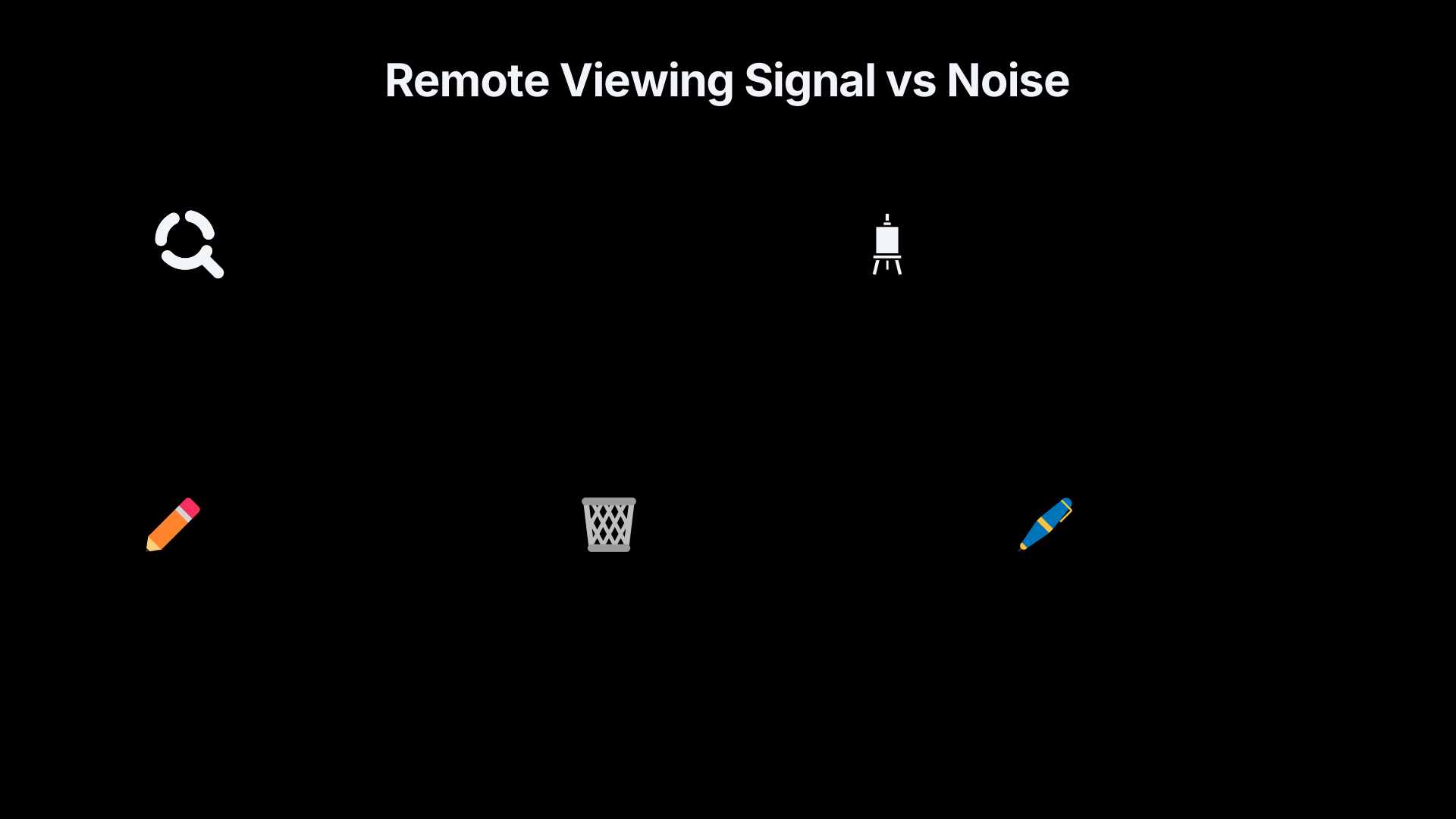
Remote-viewing sessions typically generated several pages of descriptive impressions rather than concise factual answers. These reports frequently mixed:
- specific observations that appeared plausible,
- symbolic or metaphorical imagery,
- incorrect descriptions,
- speculative interpretations by the viewer, and
- details unrelated to the assigned target.
The resulting documents forced analysts to decide which fragments deserved attention. Without an independent way to identify reliable elements in advance, every statement effectively carried the same uncertain status.
The AIR evaluation noted that although users sometimes recognised accurate background characteristics, those successes were accompanied by substantial quantities of irrelevant and erroneous information. Because intelligence analysis depends on separating reliable reporting from false leads, this high level of noise sharply reduced operational usefulness.[National Security Archive]nsarchive2.gwu.eduNational Security ArchiveAn Evaluation of Remote Viewing: Research and…March 13, 2015 — by MD Mumford · 1995 · Cited by 76 — In the ea…
The problem resembles searching for a few meaningful signals hidden within a much larger collection of random observations. Even if genuine signals exist, they lose practical value when no objective method identifies them before action is required.
Why Analysts Could Not Know What to Trust
The signal-noise problem was amplified by the absence of reliable criteria for judging individual statements.
Normally, intelligence officers compare information across multiple independent sources, assess source reliability, examine consistency over time, and estimate confidence levels. Remote-viewing reports did not naturally support those procedures.
Several related difficulties emerged:
- No internal confidence marker. Viewers could not reliably indicate which impressions were accurate and which were guesses or mental imagery.
- Limited agreement between viewers. Independent viewers often produced substantially different descriptions of the same target, making cross-validation difficult.
- Subjective interpretation. Analysts frequently had to decide whether a description should be interpreted literally, symbolically, or dismissed entirely.
- No predictive filter. There was no demonstrated method for identifying accurate statements before independent confirmation became available.[National Security Archive]nsarchive2.gwu.eduNational Security ArchiveAn Evaluation of Remote Viewing: Research and…March 13, 2015 — by MD Mumford · 1995 · Cited by 76 — In the ea…
These weaknesses meant that analysts faced an impossible task: extracting dependable intelligence from reports whose own contents provided little indication of which parts deserved confidence.

Why Retrospective Matching Weakened Usefulness
One of the strongest criticisms concerned retrospective evaluation.
After the actual target became known, readers could often identify passages that appeared remarkably accurate. However, knowing the correct answer changes how people interpret ambiguous descriptions. A phrase that seemed meaningless beforehand may appear highly specific afterwards.
Psychologists refer to this tendency as subjective validation or hindsight-based matching. During the AIR review, evaluators warned against relying on impressive-looking matches identified only after the outcome was known. They argued that such retrospective assessment could exaggerate apparent success because readers naturally emphasise correct-looking details while overlooking numerous misses.[National Security Archive]nsarchive2.gwu.eduNational Security ArchiveAn Evaluation of Remote Viewing: Research and…March 13, 2015 — by MD Mumford · 1995 · Cited by 76 — In the ea…
The review therefore distinguished between:
- retrospective recognition, where correct details become visible after confirmation, and
- prospective intelligence, where useful information must be identified before operational decisions are made.
Only the second standard matters for intelligence operations.
The Compounding Effect of Report Editing and Background Knowledge
The evaluators also raised concerns that complicated interpretation even further.
According to interviews conducted during the review, some viewers stated that reports had occasionally been modified by programme managers. The evaluators additionally suggested that certain well-known operational successes may have involved more background information than was initially apparent. If reports were edited or influenced by prior knowledge, distinguishing genuinely novel observations from conventional inference became even harder.[National Security Archive]nsarchive2.gwu.eduNational Security ArchiveAn Evaluation of Remote Viewing: Research and…March 13, 2015 — by MD Mumford · 1995 · Cited by 76 — In the ea…
This issue did not require proving deliberate misconduct to undermine confidence. Even the possibility that reports reflected existing knowledge weakened the ability to evaluate whether any apparently accurate details represented an independent information source.
Why the Signal-Noise Problem Became Decisive
The signal-noise problem ultimately mattered more than isolated success stories because intelligence organisations evaluate systems by reliability rather than memorable anecdotes.
Even if a report occasionally contained strikingly accurate observations, decision-makers still needed answers to practical questions:
- Which statements should be trusted immediately?
- Which should be ignored?
- How often would apparently accurate details turn out to be false?
- Could another analyst independently reach the same conclusions?
According to the AIR assessment, the programme never demonstrated dependable answers to those questions. The reviewers concluded that remote-viewing reports contained too much irrelevant and erroneous material, showed too little agreement across viewers, and had never produced intelligence compelling enough to justify operational action. Under those conditions, occasional apparent hits could not overcome the larger problem of separating genuine signal from overwhelming analytical noise.[National Security Archive]nsarchive2.gwu.eduNational Security ArchiveAn Evaluation of Remote Viewing: Research and…March 13, 2015 — by MD Mumford · 1995 · Cited by 76 — In the ea…

Amazon book picks
Further Reading
Books and field guides related to Why Correct Details Still Were Not Enough. Use these as the next step if you want deeper reading beyond the article.


Paranormality: Why We See What Isn't There
Covers pattern matching, coincidence and apparent hits.
Endnotes
1.
Source: nsarchive2.gwu.edu
Link:https://nsarchive2.gwu.edu/NSAEBB/NSAEBB438/docs/doc_57.pdf
Source snippet
National Security ArchiveAn Evaluation of Remote Viewing: Research and...March 13, 2015 — by MD Mumford · 1995 · Cited by 76 — In the ea...
Published: March 13, 2015
2.
Source: ics.uci.edu
Link:https://www.ics.uci.edu/~jutts/may.pdf
Source snippet
UCI Bren School of ICSresearch review of the departmentby C EDwIN · 1996 — The CIA-sponsored AIR investigation concluded that a statistic...
Additional References
3.
Source: cia.gov
Link:https://www.cia.gov/readingroom/docs/CIA-RDP96-00791R000200180005-5.pdf
Source snippet
hich were forwarded to the [end users]({{ 'end-users/' | relative_url }}) for evaluation and, if.Read more...
4.
Source: researchgate.net
Link:https://www.researchgate.net/publication/267978941Evaluation_of_Program_on%27Anomalous_Mental_Phenomena%27
Source snippet
related phenomena which was carried out at Stanford Re-search Institute...Read more...
5.
Source: facebook.com
Link:https://www.facebook.com/100090372200308/posts/during-the-cold-war-the-cia-funded-research-into-what-they-called-remote-viewing/937678002587931/
Source snippet
ss of physical barriers, using nothing but mental focus and a...Read more...
6.
Source: scribd.com
Title: CIA RDP96 00791R000200180006 4 1 pdf
Link:https://www.scribd.com/document/395167398/CIA-RDP96-00791R000200180006-4-1-pdf
Source snippet
Cia RDP96 00791R000200180006 4 PDF'The NRC provided a thorough review of the unclassified remote viewing research through 1986, In this r...
7.
Source: facebook.com
Link:https://www.facebook.com/AskImtinan/posts/project-[stargate
Source snippet
Project Stargate: The CIA's Search for Tabut-e-Sakinah In...The final AIR report concluded that no remote viewing report ever provided a...
8.
Source: youtube.com
Title: Scientific and Spiritual Implications of Psychic Abilities
Link:https://www.youtube.com/watch?v=zgyYms376Mg
Source snippet
Remote Viewing and ESP: Train Your Subconscious to See Beyond...
9.
Source: pmc.ncbi.nlm.nih.gov
Link:https://pmc.ncbi.nlm.nih.gov/articles/PMC10275521/
Source snippet
Central Intelligence Agency's (CIA...by Á Escolà‐Gascón · 2023 · Cited by 10 — Since 1972, the U.S. Central Intelligence Agency (CIA) co...
10.
Source: youtube.com
Title: Stargate Project: How Did the CIA Turn the Human Mind into a Weapon?
Link:https://www.youtube.com/watch?v=IDPlEXpzRoQ
Source snippet
Inside Operation Stargate: The CIA's Psychic Spy Experiment...
11.
Source: youtube.com
Title: Remote Viewing and ESP: Train Your Subconscious to See Beyond
Link:https://www.youtube.com/watch?v=QW9HdqdTQD8
Source snippet
Stargate Project: How Did the CIA Turn the Human Mind into a Weapon?...
12.
Source: Wikipedia
Title: Remote viewing
Link:https://en.wikipedia.org/wiki/Remote_viewing
Source snippet
Remote viewingThe program ran from 1975 to 1995 and ended after evaluators concluded that remote viewers consistently failed to produc...
Topic Tree