Within Utts Review
Why Lab Hits Did Not Become Intelligence
The AIR evaluation separated laboratory scoring success from the much harder demand for useful intelligence.
On this page
- Why lab judging gave cleaner feedback
- Why intelligence targets were harder to use
- How AIR separated evidence from usefulness
Page outline Jump by section
Introduction
One of the most important distinctions in the 1995 review of the U.S. government’s remote-viewing programme was between statistical evidence in laboratory experiments and useful intelligence for real-world decision-making. Jessica Utts argued that the best-controlled laboratory studies produced results that consistently exceeded chance expectations. However, the American Institutes for Research (AIR) reached a different conclusion on the programme’s practical value: even if some laboratory findings were statistically interesting, they had not translated into reliable intelligence that commanders or analysts could act upon. This separation between evidence of an experimental effect and operational usefulness became the central policy question behind the programme’s closure.[CIA]cia.govAN EVALUATION OF THE REMOTE VIEWING PROGRAMJessica Utts, Remote viewing failed to produce actionable intelligence. Conclusions researc…
Rather than asking whether remote viewing ever produced an impressive session, the AIR review asked a more demanding question: could it deliver accurate, timely and sufficiently specific information under the conditions faced by intelligence agencies? The answer to that implementation question was far less favourable than the laboratory record.
Why laboratory judging gave cleaner feedback
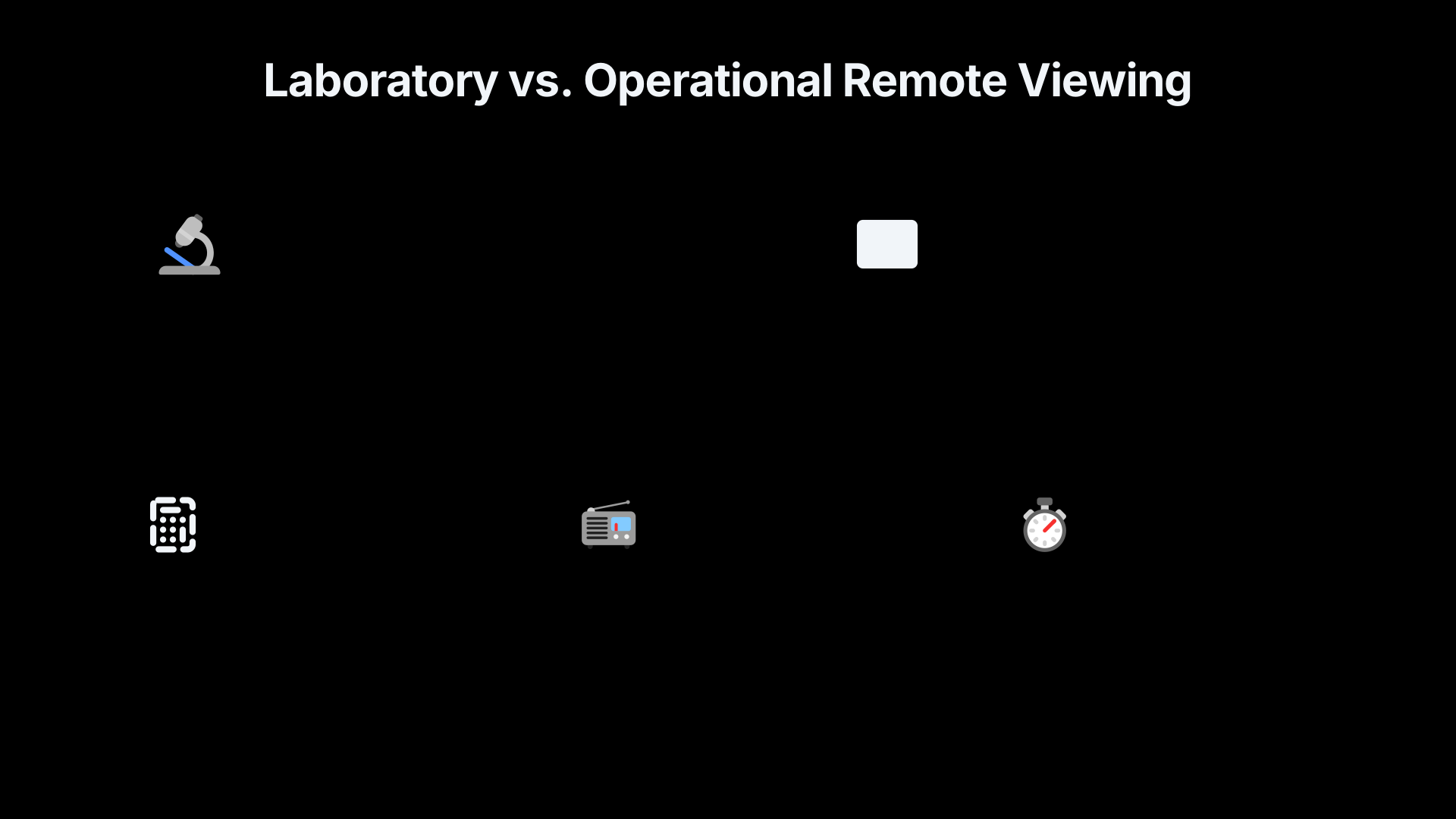
Laboratory remote-viewing experiments were deliberately designed to maximise objective evaluation. Participants attempted to describe a hidden target while ordinary communication was blocked, after which independent judges compared the description against several possible targets using predefined scoring methods such as rank ordering or blind matching.
This environment had several advantages:
- Known correct answers. Every trial had an objectively defined target, allowing statistical comparison against chance.
- Controlled conditions. Randomisation, blinding and standardised judging reduced opportunities for conscious or unconscious cueing.
- Large numbers of trials. Researchers evaluated averages across many sessions rather than relying on dramatic individual successes.
- Statistical aggregation. Weak effects could become measurable across repeated experiments even when individual sessions were inconsistent.[CIA]cia.govAN EVALUATION OF THE REMOTE VIEWING PROGRAMJessica Utts, Remote viewing failed to produce actionable intelligence. Conclusions researc…
These features explain why Utts placed considerable weight on later SAIC experiments. From her perspective, stronger protocols made it increasingly difficult to dismiss above-chance results as mere statistical accidents or obvious methodological flaws. Her argument concerned the existence of a repeatable statistical effect, not the routine production of intelligence reports.[CIA]cia.govAN EVALUATION OF THE REMOTE VIEWING PROGRAMJessica Utts, Remote viewing failed to produce actionable intelligence. Conclusions researc…
Why intelligence targets proved much harder
Operational intelligence imposed demands that laboratory experiments largely avoided.
Unlike laboratory targets, intelligence problems often have no immediate, objective answer. Analysts may not know whether a report is correct until months or years later, if ever. Decisions frequently must be made before independent verification is possible.
In addition, operational requirements differ fundamentally from statistical experiments:
- Intelligence consumers need specific locations, identities or events, not general similarities.
- Reports must arrive quickly enough to influence decisions.
- Information must be reliable enough that decision-makers can distinguish genuine leads from false ones.
- Success cannot depend on averaging hundreds of attempts after the fact.
These practical demands expose a key weakness. A method that performs slightly above chance across many laboratory trials may still fail as an operational tool if any individual report remains too uncertain to support action. AIR concluded that this was precisely the problem facing remote viewing.[CIA]cia.govAN EVALUATION OF THE REMOTE VIEWING PROGRAMJessica Utts, Remote viewing failed to produce actionable intelligence. Conclusions researc…
Why impressive sessions were not enough
Supporters of the programme often highlighted striking individual cases in which viewers appeared to describe unexpected features of targets. Intelligence organisations, however, cannot evaluate a collection of memorable anecdotes in isolation.
Operational systems must also account for:
- the number of inaccurate reports;
- the frequency of vague or ambiguous descriptions;
- whether successes can be predicted in advance rather than recognised afterwards;
- whether analysts can separate genuine information from coincidence.
AIR noted that remote-viewing reports frequently contained mixtures of correct details, incorrect statements and highly general descriptions. Even when some elements appeared accurate, there was no dependable procedure for determining which portions deserved confidence before independent confirmation became available.[CIA]cia.govAN EVALUATION OF THE REMOTE VIEWING PROGRAMJessica Utts, Remote viewing failed to produce actionable intelligence. Conclusions researc…
This distinction is crucial. Intelligence agencies evaluate methods according to their ability to improve decisions, not simply to produce occasional impressive examples.
How AIR separated evidence from usefulness
The AIR review deliberately treated two questions as independent.
The first was a scientific question:
Do controlled laboratory experiments show statistically significant departures from chance?
The second was an operational question:
Has the programme demonstrated practical value for intelligence collection?
Jessica Utts answered the first question affirmatively, arguing that the statistical evidence justified accepting an anomalous effect as scientifically established. Ray Hyman remained unconvinced that the statistics excluded all conventional explanations, although he acknowledged that the later SAIC studies appeared stronger than earlier work and deserved serious attention.[UC Irvine Bren School]ics.uci.eduUC Irvine Bren SchoolEvaluation of Program on Anomalous Mental PhenomenaProfessor Utts uses the ganzfeld data and the SAIC remote viewing…
On the second question, however, the broader AIR evaluation was considerably more unified. The final assessment concluded that the programme had not produced actionable intelligence of sufficient quality to justify continued operational use. It also found no documented evidence that remote-viewing reports had provided intelligence value commensurate with the programme’s intended mission.[CIA]cia.govAN EVALUATION OF THE REMOTE VIEWING PROGRAMJessica Utts, Remote viewing failed to produce actionable intelligence. Conclusions researc…
Why small statistical effects do not automatically become practical tools
The remote-viewing debate illustrates a broader principle that applies well beyond parapsychology.
A statistically detectable effect is not automatically a useful technology. Many phenomena are measurable in carefully controlled experiments but remain too weak, variable or context-dependent for practical deployment.
For an intelligence capability to become operational, it typically must demonstrate:
- consistent performance across users and situations;
- predictable reliability for individual cases rather than average outcomes;
- measurable improvement over existing methods;
- decision-making value that exceeds its costs and uncertainties.
According to AIR, remote viewing did not satisfy these implementation requirements, regardless of the continuing disagreement over laboratory statistics. This distinction explains why government funding ended despite acknowledgement that parts of the experimental database deserved scientific discussion.[CIA]cia.govAN EVALUATION OF THE REMOTE VIEWING PROGRAMJessica Utts, Remote viewing failed to produce actionable intelligence. Conclusions researc…
The lasting significance of the distinction
The separation between laboratory scoring and actionable intelligence remains one of the most enduring lessons of the 1995 evaluation.
Supporters of remote viewing often focus on statistical outcomes from controlled experiments, arguing that these indicate an unexplained phenomenon worthy of further study. Critics generally accept that unusual statistical patterns may warrant investigation while arguing that intelligence agencies require a far higher standard: information that is consistently accurate, operationally relevant and dependable enough to guide real-world decisions.
The AIR review concluded that the available evidence failed to bridge that gap. As a result, the programme’s policy outcome was driven less by the debate over statistical significance than by the absence of demonstrated intelligence utility.[CIA]cia.govAN EVALUATION OF THE REMOTE VIEWING PROGRAMJessica Utts, Remote viewing failed to produce actionable intelligence. Conclusions researc…
Amazon book picks
Further Reading
Books and field guides related to Why Lab Hits Did Not Become Intelligence. Use these as the next step if you want deeper reading beyond the article.


The Reality of ESP: A Physicist's Proof of Psychic Abilities
Explores evidence and limitations of psi research.

eBay marketplace picks
Marketplace Samples
Example marketplace items related to this page. Use the search link to explore similar finds on eBay.



Endnotes
1.
Source: cia.gov
Link:https://www.cia.gov/readingroom/docs/CIA-RDP96-00791R000200180005-5.pdf
Source snippet
AN EVALUATION OF THE REMOTE VIEWING PROGRAMJessica Utts, Remote viewing failed to produce actionable intelligence. Conclusions researc...
2.
Source: cia.gov
Link:https://www.cia.gov/readingroom/docs/CIA-RDP96-00791R000200180006-4.pdf
Source snippet
y significant effect has been observed in the...
3.
Source: ics.uci.edu
Link:https://www.ics.uci.edu/~jutts/hyman.html
Source snippet
UC Irvine Bren SchoolEvaluation of Program on Anomalous Mental PhenomenaProfessor Utts uses the [ganzfeld]({{ 'ganzfeld/' | relative_url }}) data and the SAIC remote viewing...
4.
Source: psi-encyclopedia.spr.ac.uk
Title: spr.ac.uk Remote Viewing
Link:https://psi-encyclopedia.spr.ac.uk/articles/remote-viewing/
Source snippet
Viewing - Psi Encyclopedia13 Jan 2017 — Jessica Utts judged the evidence persuasive, and even Ray Hyman conceded methodological criticism...
Additional References
5.
Source: researchgate.net
Link:https://www.researchgate.net/publication/267978941Evaluation_of_Program_on%27Anomalous_Mental_Phenomena%27
Source snippet
Evaluation of Program on 'Anomalous Mental Phenomena'Jessica Utts and I were commissioned to evaluate the research on remote viewing and...
6.
Source: philpapers.org
Link:https://philpapers.org/rec/HYMEOP
Source snippet
ting the program on "Anomalous Mental Phenomena" carried out at SRI International (formerly the...
7.
Source: ucdavis.edu
Title: [psychic spying]({{ ‘psychic-spying/’ | relative_url }}) research produces credible evidence
Link:https://www.ucdavis.edu/news/psychic-spying-research-produces-credible-evidence
Source snippet
'Psychic Spying' Research Produces Credible Evidence28 Nov 1995 — Secret government experiments on "psychic spying" have produced the mos...
8.
Source: youtube.com
Title: Clairvoyance and Synesthesia: Superpower or Speculative Science?
Link:https://www.youtube.com/watch?v=yCYb_VmK3UA
Source snippet
This documentary about the military's secret psychic unit details the real-world operational testing of Project Stargate, directly addres...
9.
Source: pmc.ncbi.nlm.nih.gov
Title: PMCFollow‐up on the U.S
Link:https://pmc.ncbi.nlm.nih.gov/articles/PMC10275521/
Source snippet
Central Intelligence Agency's (CIA...by Á Escolà‐Gascón · 2023 · Cited by 10 — Hyman and Utts concurred that the significant [effect size]({{ 'effect-size/' | relative_url }})...
10.
Source: scribd.com
Link:https://www.scribd.com/doc/92017954/Air-Report
Source snippet
t found to warrant continued use in intelligence operations...
11.
Source: youtube.com
Title: The CIA Filed a 9-Page Report Describing Pyramids on Mars. Then Classified It
Link:https://www.youtube.com/watch?v=lGenw1l8rjk
Source snippet
How the CIA Fooled Us to Believe in Remote Viewing: SCAM Exposed! | Jeremy Rys...
12.
Source: koestlerunit.wordpress.com
Title: wiseman milton 1998
Link:https://koestlerunit.wordpress.com/wp-content/uploads/2015/06/wiseman-milton-1998.pdf
Source snippet
One of the SAIC Remote Viewing Programby R Wiseman · Cited by 24 — The panel included two reviewers chosen for their expertise in parapsy...
13.
Source: youtube.com
Title: How the CIA Fooled Us to Believe in Remote Viewing: SCAM Exposed! | Jeremy Rys
Link:https://www.youtube.com/watch?v=QbY6rT4sFk0
Source snippet
Stargate Project: How Did the CIA Turn the Human Mind into a Weapon?...
14.
Source: youtube.com
Title: Stargate Project: How Did the CIA Turn the Human Mind into a Weapon?
Link:https://www.youtube.com/watch?v=IDPlEXpzRoQ
Source snippet
Inside The Military's Secret Psychic Unit...
Topic Tree