Within Judging
When Analysts Had to Find the Target
The CIA-commissioned AIR review found that operational remote-viewing reports often left analysts sorting vague, inconsistent, and erroneous claims.
On this page
- What end users said about operational reports
- Why vague details burdened analysts
- How laboratory judging problems reappeared in intelligence work
Page outline Jump by section
Introduction
The 1995 American Institutes for Research (AIR) evaluation commissioned by the CIA reached a clear distinction that shaped the fate of the US government’s remote-viewing programme. The reviewers concluded that laboratory experiments sometimes produced statistically interesting results, but that those findings did not translate into operational intelligence. The central problem was not simply whether some descriptions contained occasional correct elements. It was that intelligence analysts received reports that were typically too vague, inconsistent and mixed with errors to support real operational decisions. Rather than reducing uncertainty, the reports often required analysts to decide which fragments might matter and which should be ignored—a judgement that could easily be influenced by hindsight or existing expectations. This operational experience closely echoed the blind judging and target-matching problems already identified in laboratory research.[CIA+2National Security Archive]cia.govAN EVALUATION OF REMOTE VIEWINGTo assess the operational value of remote viewing in intelligence gathering, a multifaceted evaluation…

What end users said about operational reports
One distinctive feature of the AIR review was that it did not rely solely on experimental statistics. The reviewers also interviewed operational personnel, programme managers and remote viewers to understand how the system functioned in practice. These interviews revealed a persistent gap between experimental promise and intelligence usefulness. Operational customers reported that remote-viewing products rarely arrived in a form that could directly support collection, analysis or decision-making.[National Security Archive]nsarchive2.gwu.eduremote viewersNational Security ArchiveAn Evaluation of Remote Viewing: Research and…by MD Mumford · 1995 · Cited by 76 — In Appendix C, the intervi…
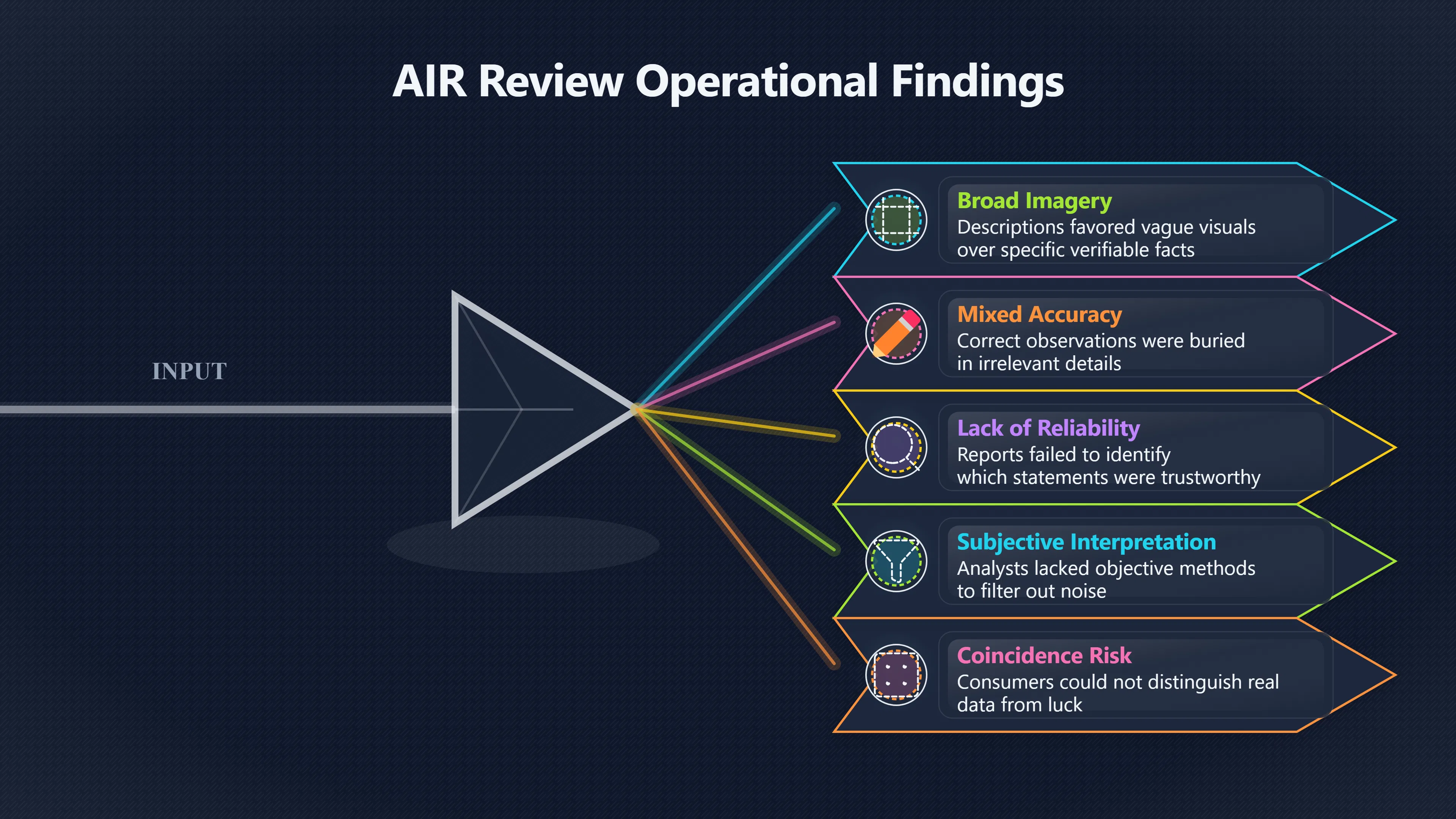
The review found several recurring characteristics of operational reports:
- Descriptions frequently consisted of broad imagery rather than specific, verifiable facts.
- Accurate observations, where present, were mixed with numerous incorrect or irrelevant details.
- Reports seldom identified which statements were likely to be reliable.
- Analysts often had no objective method for separating genuine information from imagination or noise.
- Intelligence consumers generally could not determine whether an apparently correct detail reflected real information or coincidence.[CIA]cia.govAN EVALUATION OF THE REMOTE VIEWING PROGRAMAs part of the Star Gate program, the services of remote viewers were used to support opera…
This distinction mattered because intelligence organisations require information that can guide action under uncertainty. A report containing dozens of impressions, only a few of which might later appear accurate, imposes additional analytical work rather than reducing it.
Why vague details burdened analysts
The AIR reviewers argued that operational intelligence places much higher demands on information than laboratory demonstrations. Intelligence officers must prioritise threats, allocate resources and sometimes influence policy decisions. For these purposes, information needs to be timely, sufficiently specific and consistently reliable.
Remote-viewing reports generally failed these operational requirements because they tended to present long lists of impressions without indicating confidence levels or internal consistency. A description might combine references to water, mountains, industrial structures, military activity, emotions and colours within the same session. After the true target became known, some elements could often be interpreted as meaningful, while many others were discarded.
This forced analysts into an uncomfortable position. Instead of evaluating a clearly defined intelligence report, they had to perform substantial interpretation themselves. The AIR review concluded that this process increased opportunities for subjective judgement, confirmation bias and retrospective fitting rather than producing independently useful intelligence.[CIA]cia.govAN EVALUATION OF THE REMOTE VIEWING PROGRAMAs part of the Star Gate program, the services of remote viewers were used to support opera…
The review therefore distinguished between two very different questions:
- Can a report contain some apparently correct details?
- Can the report reliably support intelligence decisions before the answer is known?
The reviewers judged that the available operational evidence supported the first possibility only weakly and failed to establish the second.[CIA]cia.govAN EVALUATION OF REMOTE VIEWINGTo assess the operational value of remote viewing in intelligence gathering, a multifaceted evaluation…
How laboratory judging problems reappeared in intelligence work
The operational findings closely mirrored the judging problems already recognised in remote-viewing experiments.
In laboratory studies, blind judging attempts to determine whether a viewer’s description matches the intended target better than alternative targets. The AIR review noted that this process is already difficult because free-response descriptions are often broad enough to fit multiple possible targets.
Operational intelligence removed even the limited structure provided by experimental judging. Instead of choosing among a small set of predefined alternatives, analysts confronted the real world, where countless possible interpretations existed. A phrase such as “large metal object near water” could correspond to a naval vessel, bridge, harbour installation, pipeline or industrial facility. Without predefined comparison targets, determining the intended referent became even more subjective.[National Security Archive]nsarchive2.gwu.eduremote viewersNational Security ArchiveAn Evaluation of Remote Viewing: Research and…by MD Mumford · 1995 · Cited by 76 — In Appendix C, the intervi…
The review therefore suggested that operational use magnified rather than solved the ambiguity already recognised in laboratory scoring. What appeared manageable inside carefully designed experiments became considerably more difficult when analysts attempted to apply similar material to genuine intelligence questions.
Why occasional successes did not change the overall assessment
Supporters of the programme pointed to individual cases in which remote-viewing reports appeared to contain strikingly accurate details. The AIR review did not deny that some reports contained information later viewed as impressive. Instead, it evaluated the operational record as a whole.
From an intelligence perspective, isolated successes were insufficient because they occurred alongside many inaccurate, incomplete or unverifiable statements. Intelligence agencies require methods that perform consistently across many cases rather than techniques whose reliability cannot be predicted in advance.
The reviewers also noted that dramatic historical examples often lacked the documentation necessary to determine precisely what information was available beforehand, how reports were interpreted at the time, or whether later accounts had benefited from hindsight. Consequently, individual anecdotes could not outweigh the broader operational evidence showing inconsistent performance.[CIA]cia.govAN EVALUATION OF THE REMOTE VIEWING PROGRAMAs part of the Star Gate program, the services of remote viewers were used to support opera…
The operational conclusion reached by AIR
The AIR panel ultimately separated two issues that had often been treated as one. One reviewer, Jessica Utts, argued that some laboratory research merited further scientific investigation, while Ray Hyman remained unconvinced that paranormal functioning had been demonstrated. Despite their disagreement over laboratory evidence, the operational review reached a much narrower practical conclusion.
The intelligence question was whether remote viewing had demonstrated value as an operational collection method. On that point, the evaluation concluded that the available evidence did not justify continued operational use. Reports were generally too vague, too inconsistent and too heavily mixed with irrelevant or erroneous information to provide dependable intelligence support. The reviewers found no documented evidence that the programme had produced operationally useful intelligence of sufficient reliability to justify its continuation. This judgement became a major factor in the CIA’s decision to terminate the programme in 1995.



eBay marketplace picks
Marketplace Samples
Live-tested eBay searches with available results related to this page.



Endnotes
1.
Source: cia.gov
Link:https://www.cia.gov/readingroom/docs/CIA-RDP96-00791R000200180006-4.pdf
Source snippet
AN EVALUATION OF REMOTE VIEWINGTo assess the operational value of remote viewing in intelligence gathering, a multifaceted evaluation...
2.
Source: nsarchive2.gwu.edu
Title: remote viewers
Link:https://nsarchive2.gwu.edu/NSAEBB/NSAEBB438/docs/doc_57.pdf
Source snippet
National Security ArchiveAn Evaluation of Remote Viewing: Research and...by MD Mumford · 1995 · Cited by 76 — In Appendix C, the intervi...
3.
Source: cia.gov
Link:https://www.cia.gov/readingroom/docs/CIA-RDP96-00791R000200180005-5.pdf
Source snippet
AN EVALUATION OF THE REMOTE VIEWING PROGRAMAs part of the [Star Gate]({{ 'star-gate/' | relative_url }}) program, the services of remote viewers were used to support opera...
4.
Source: cia.gov
Link:https://www.cia.gov/readingroom/document/cia-rdp96-00791r000200180005-5
Source snippet
AN EVALUATION OF THE REMOTE VIEWING PROGRAMThus, we conclude that continued use of remote viewing in intelligence... remote viewing phen...
5.
Source: cia.gov
Link:https://www.cia.gov/readingroom/document/cia-rdp96-00791r000200180006-4
Source snippet
AN EVALUATION OF REMOTE VIEWING: RESEARCH...A remote viewer is asked to visualize a place, location, or object being viewed by a "beacon...
6.
Source: Wikipedia
Title: Remote viewing
Link:https://en.wikipedia.org/wiki/Remote_viewing
Source snippet
Remote viewingThe program ran from 1975 to 1995 and ended after evaluators concluded that remote viewers consistently failed to produc...
7.
Source: ics.uci.edu
Link:https://www.ics.uci.edu/~jutts/air.pdf
Source snippet
In these experiments, a viewer attempts to...Read...
Additional References
8.
Source: researchgate.net
Link:https://www.researchgate.net/publication/403178755_The_Star_Gate_Archives_Reports_of_the_United_States_Government_Sponsored_Psi_Program_1972-1995_Volume_4_Operational_Remote_Viewing_Memorandums_and_Reports
Source snippet
remote viewing would seem to have tremendous potential utility for the intelligence community. Accordingly, a three-component program...
9.
Source: honestaigroup.com
Title: CI A ‘[Stargate]({{ ‘stargate/’ | relative_url }})’ — Declassified Remote-Viewing Program
Link:https://honestaigroup.com/sources/cia-stargate-report
Source snippet
review concluded the results were not useful for intelligence. PROVEN that the program was real; the claim that it produced reliable psyc...
10.
Source: medium.com
Link:https://medium.com/%40thegaijin.wolfenstein/psychic-phenomena-in-military-and-intelligence-operations-article-built-for-the-general-public-4a3248a47a11
Source snippet
provided actionable intelligence valued by operational users — No...Read more...
11.
Source: reddit.com
Link:https://www.reddit.com/r/consciousness/comments/181s71r/the_cias_experiments_with_remote_viewing_and/
Source snippet
it was cancelled in 1995 and declassified, as it had never provided a single actionable piece of intelligence in any...
12.
Source: greydynamics.com
Link:https://greydynamics.com/intelligence-past-the-tangible-world-cias-stargate-project/
Source snippet
Intelligence Past the Tangible World: CIA's Stargate Project“REMOTE VIEWING IS A HIGHLY CONTROLLED AND FORMALLY ESTABLISHED, UNIQUE INTEL...
13.
Source: Wikipedia
Title: Stargate Project (U.S. Army unit)
Link:https://en.wikipedia.org/wiki/Stargate_Project_%28U.S._Army_unit%29
Source snippet
Stargate Project (U.S. Army unit)The Stargate Project was terminated and declassified in 1995 after a commissioned review by the CIA c...
14.
Source: slideshare.net
Link:https://www.slideshare.net/slideshow/an-evaluation-of-remote-viewing-research-and-applications-air1995pdf/257460594
Source snippet
An Evaluation of Remote Viewing, Research and...Remote viewing reports provided vague and ambiguous information that was not useful for...
15.
Source: researchgate.net
Title: (PDF) Follow‐up on the U.S
Link:https://www.researchgate.net/publication/370491006_Follow-up_on_the_US_Central_Intelligence_Agency%27s_CIA_remote_viewing_experiments
Source snippet
Central Intelligence Agency's...Objectives Since 1972, the U.S. Central Intelligence Agency (CIA) commissioned several research programs...
16.
Source: beyondhaunted.com
Title: What Is Remote Viewing?
Link:https://beyondhaunted.com/blog/what-is-remote-viewing
Source snippet
History, Methods, and the Truth19 Mar 2026 — In the classic experimental setup described in the 1995 American Institutes for Research...
17.
Source: pmc.ncbi.nlm.nih.gov
Link:https://pmc.ncbi.nlm.nih.gov/articles/PMC10275521/
Source snippet
Central Intelligence Agency's (CIA...by Á Escolà‐Gascón · 2023 · Cited by 10 — U.S. Central Intelligence Agency (CIA) commissioned sever...
Topic Tree