Within Meaning
What Remote Viewers Actually Record
Remote-viewing sessions usually produce sketches, textures, shapes, moods, and partial impressions rather than clear pictures.
On this page
- Why free response differs from multiple choice
- Common types of impressions
- Why vague material is hard to score
Page outline Jump by section
Introduction
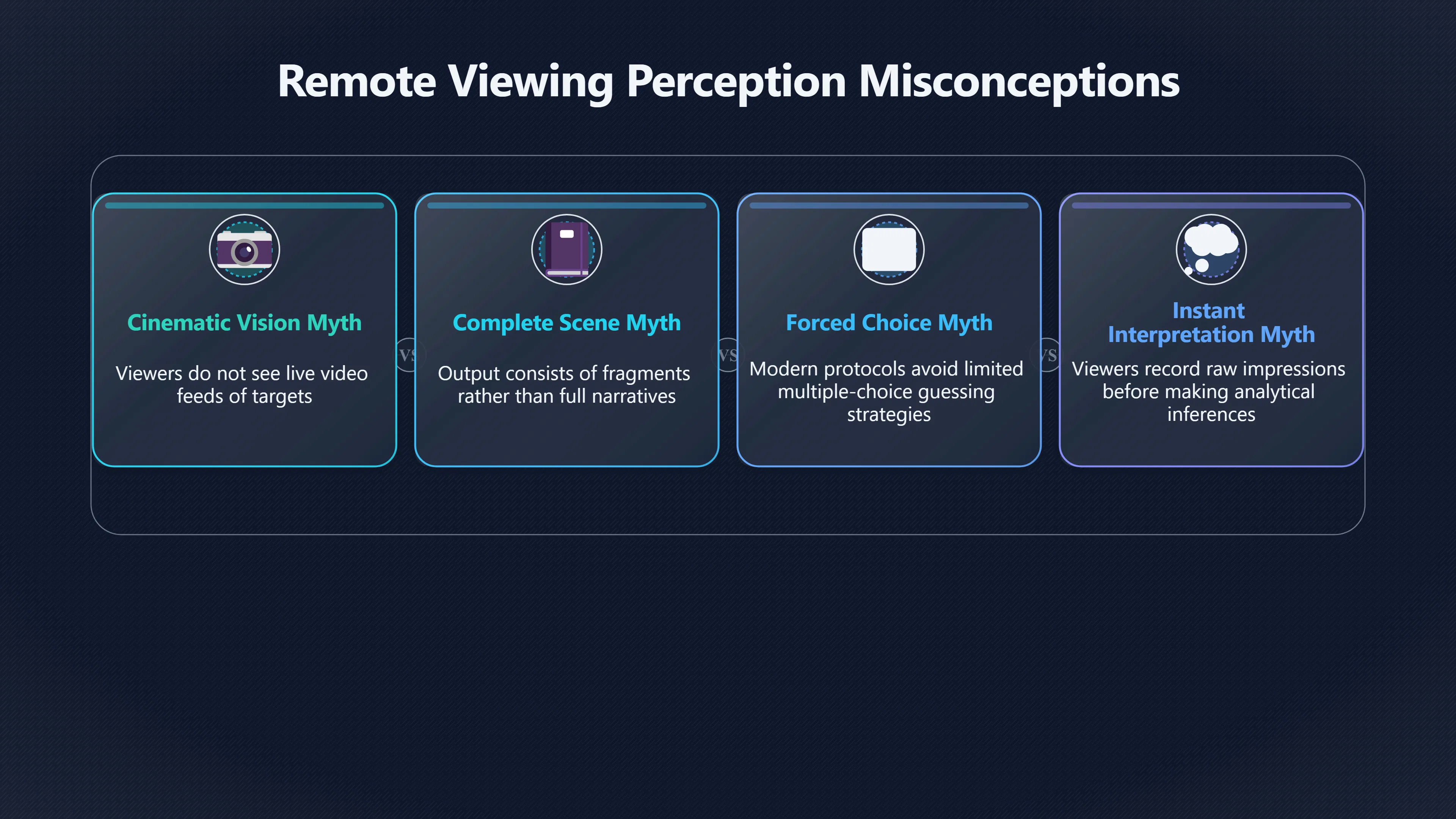
One of the most persistent misconceptions about remote viewing is that practitioners claim to see distant places as though watching a live video. That is not how research-style remote-viewing sessions are normally recorded. Instead, viewers are usually asked to produce unrestricted, or free-response, descriptions before receiving any feedback. Their notes commonly consist of disconnected sensory qualities, rough sketches, simple shapes, movement, textures, temperatures, emotional tones, or spatial relationships rather than complete scenes. This distinction is central to understanding both how remote-viewing experiments are designed and why their results are difficult to evaluate. Even supporters of remote-viewing research generally describe the output as fragmentary rather than cinematic, while critics argue that the ambiguity of such material makes objective scoring challenging.[CIA+2psi-encyclopedia.spr.ac.uk]cia.govAN EVALUATION OF REMOTE VIEWING: RESEARCH…Most anomalous cognition experiments at SRI and SAIC were of the free-response type, in w…

Why free response differs from multiple choice
Remote-viewing protocols were developed partly in reaction to older extrasensory perception (ESP) experiments that relied on forced-choice tasks, such as guessing one symbol from a fixed set of cards. Researchers argued that repeatedly choosing between a handful of alternatives encouraged boredom and guessing strategies. A free-response format instead asks participants to record whatever impressions arise without trying to fit them into predefined categories.[psi-encyclopedia.spr.ac.uk]psi-encyclopedia.spr.ac.ukRemote Viewing - Psi Encyclopedia13 Jan 2017 — Remote viewing replaced repetitive forced-choice tasks with free-response protocols design…
In practice, a session often begins with little more than a target reference or identifying code. The viewer then writes or sketches continuously while avoiding deliberate analysis. Instead of asking, “Is the target a bridge, a mountain or a ship?”, the protocol encourages observations such as:
- “Cold, metallic surface.”
- “Curved structure.”
- “Open space with water nearby.”
- “Tall vertical feature.”
- “Strong feeling of movement.”
Only after the session is complete are these notes compared with the concealed target. The intention is to reduce the influence of expectations that might arise if the participant were presented with a limited set of possible answers.[CIA]cia.govAN EVALUATION OF REMOTE VIEWING: RESEARCH…Most anomalous cognition experiments at SRI and SAIC were of the free-response type, in w…
What remote viewers actually record
Published session transcripts and training manuals generally contain much more mundane material than popular culture suggests. Rather than detailed narratives, records frequently include short descriptive fragments, repeated revisions and rough diagrams.
Common categories include:
- Basic geometry: circles, lines, angles, curves, grids or enclosed spaces.
- Sensory qualities: bright, dark, rough, smooth, metallic, wet, warm or cold.
- Spatial relationships: above, below, inside, elevated, enclosed or expansive.
- Motion: spinning, flowing, vibrating, descending or rotating.
- Scale: large, narrow, towering, compact or distant.
- Emotional or atmospheric impressions: busy, quiet, solemn, energetic or isolated.
- Simple sketches: quick outlines intended to capture overall form rather than artistic detail.
These fragments may later appear surprisingly consistent with a target—or entirely unrelated. The protocol deliberately records everything before feedback, including uncertain impressions, because selectively remembering only apparent “hits” would introduce hindsight bias.[CIA+2psi-encyclopedia.spr.ac.uk]cia.govAN EVALUATION OF REMOTE VIEWING: RESEARCH…Most anomalous cognition experiments at SRI and SAIC were of the free-response type, in w…
An important feature of many protocols is that viewers are encouraged to distinguish between a direct impression and an interpretation. For example, recording “curved metallic surface” is treated differently from concluding “this is an aircraft”. The latter is considered an analytical inference that may or may not reflect the original impression.
Why impressions are usually incomplete
Advocates of remote viewing do not generally claim that successful sessions provide complete descriptions. Instead, fragmentary output is treated as an expected characteristic of the process.
Several practical factors contribute to this:
- Participants often report fleeting impressions that disappear quickly.
- Multiple sensory qualities may appear without an obvious relationship.
- Different aspects of a target may emerge at different points in the session.
- Attempts to force a coherent interpretation are thought, within the methodology, to increase error.
As a result, a transcript may contain both accurate-seeming observations and statements that prove completely unrelated to the target. Rather than treating this mixture as unusual, many remote-viewing protocols expect it and preserve the entire record for later comparison.[CIA]cia.govAN EVALUATION OF REMOTE VIEWING: RESEARCH…Most anomalous cognition experiments at SRI and SAIC were of the free-response type, in w…
Why vague material is hard to score
The same qualities that make free-response sessions flexible also make them difficult to evaluate objectively.
Unlike a multiple-choice question with one correct answer, a free-response transcript can potentially match many different targets. A phrase such as “large open area” might plausibly describe a beach, sports stadium, airport, desert or public square. Likewise, a sketch containing a few intersecting lines could resemble numerous structures.
Because of this, many experiments have used blind judging procedures. Independent judges compare a viewer’s transcript with one correct target and several decoys, ranking which target appears to fit best. The goal is to reduce subjective interpretation after the fact rather than allowing researchers to highlight isolated similarities.[CIA]cia.govAN EVALUATION OF REMOTE VIEWING: RESEARCH…Most anomalous cognition experiments at SRI and SAIC were of the free-response type, in w…
Even with blind judging, disagreement remains over how much weight should be given to broad descriptive similarities. Supporters argue that meaningful correspondences can emerge across many independent sessions, while critics contend that sufficiently vague descriptions permit generous matching to numerous targets.[CIA+2ResearchGate]cia.govAN EVALUATION OF REMOTE VIEWING: RESEARCH…Most anomalous cognition experiments at SRI and SAIC were of the free-response type, in w…
Fragmentary records and the debate over interpretation
The fragmented nature of session notes lies at the centre of the wider scientific debate about remote viewing.
Supporters argue that free-response protocols capture information that would be impossible to express through simple forced-choice answers and that independent judging can identify genuine correspondences. Some statistical reviews have suggested that certain experiments produced results warranting further investigation.[CIA+2PMC]cia.govAN EVALUATION OF REMOTE VIEWING: RESEARCH…Most anomalous cognition experiments at SRI and SAIC were of the free-response type, in w…
Critics respond that fragmentary descriptions are especially vulnerable to subjective interpretation, confirmation bias and inadvertent cueing. David Marks and Richard Kammann’s well-known critique of early Stanford Research Institute experiments argued that some judging could be influenced by unintended clues in session materials rather than anomalous information, highlighting how ambiguous transcripts require exceptionally rigorous controls.[ResearchGate+2Wikipedia]researchgate.net15839349 Information transmission in remote viewing experimentsInformation transmission in remote viewing experiments27 May 2016 — TARG AND PUTHOFF1-3 have described investigations of an e…
For that reason, modern discussions of remote viewing generally focus less on dramatic individual anecdotes and more on whether free-response descriptions can be evaluated under conditions that prevent sensory leakage, minimise bias and permit independent replication. The fragmentary character of the session record is therefore not a side issue—it is the defining feature that shapes both the methodology and the continuing controversy surrounding remote-viewing research.[CIA]cia.govAN EVALUATION OF REMOTE VIEWING: RESEARCH…Most anomalous cognition experiments at SRI and SAIC were of the free-response type, in w…
Amazon book picks
Further Reading
Books and field guides related to What Remote Viewers Actually Record. Use these as the next step if you want deeper reading beyond the article.
Phenomena
Covers the military and intelligence context behind remote viewing and the lab-to-operations gap.
Phenomena: The Secret History of the U.S. Government's Invest...
Provides practical historical examples of sessions.
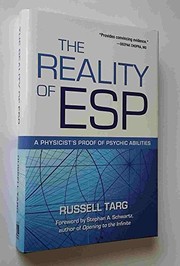
The Reality of ESP: A Physicist's Proof of Psychic Abilities
Explains how viewers produce and interpret impressions.
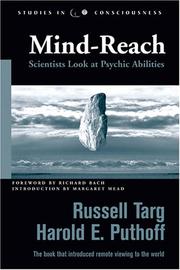
Mind-Reach: Scientists Look at Psychic Ability
Describes free-response sessions and recording methods.
eBay marketplace picks
Marketplace Samples
Live-tested eBay searches with available results related to this page.



Endnotes
1.
Source: cia.gov
Link:https://www.cia.gov/readingroom/document/cia-rdp96-00791r000200180006-4
Source snippet
AN EVALUATION OF REMOTE VIEWING: RESEARCH...Most anomalous cognition experiments at SRI and SAIC were of the free-response type, in w...
2.
Source: psi-encyclopedia.spr.ac.uk
Link:https://psi-encyclopedia.spr.ac.uk/articles/remote-viewing/
Source snippet
Remote Viewing - Psi Encyclopedia13 Jan 2017 — Remote viewing replaced repetitive forced-choice tasks with free-response protocols design...
3.
Source: researchgate.net
Title: 15839349 Information transmission in remote viewing experiments
Link:https://www.researchgate.net/publication/15839349_Information_transmission_in_remote_viewing_experiments
Source snippet
Information transmission in remote viewing experiments27 May 2016 — TARG AND PUTHOFF1-3 have described investigations of an e...
Published: May 2016
4.
Source: Wikipedia
Title: Remote viewing
Link:https://en.wikipedia.org/wiki/Remote_viewing
Source snippet
Remote viewingRemote viewing (RV) is the practice of seeking impressions about a distant or unseen subject, purportedly sensing with t...
5.
Source: pmc.ncbi.nlm.nih.gov
Title: PMCFollow‐up on the U.S
Link:https://pmc.ncbi.nlm.nih.gov/articles/PMC10275521/
Source snippet
Central Intelligence Agency's (CIA...by Á Escolà‐Gascón · 2023 · Cited by 10 — Programs addressed remote viewing (RV), that is, determin...
6.
Source: Wikipedia
Title: Sensory leakage
Link:https://en.wikipedia.org/wiki/Sensory_leakage
Additional References
7.
Source: journalofscientificexploration.org
Link:https://journalofscientificexploration.org/index.php/jse/article/view/2973/1975
Source snippet
Journal of Scientific ExplorationThe implication is that the associative mechanism can have its own failure sources independent of the ac...
8.
Source: sixthsensereader.org
Link:https://sixthsensereader.org/about-the-book/abcderium-index/remote-viewing/
Source snippet
REMOTE VIEWINGby M Mowbray — Puthoff and Targ's initial experiments involved the testing of pre-selected subjects' (or percipients') abil...
9.
Source: ciaotest.cc.columbia.edu
Link:https://ciaotest.cc.columbia.edu/olj/sa/sa_jan02srm01.html
Source snippet
Remote Viewing: The US Sponsored Psychic...This paper deals with experiments conducted in USA in which certain individuals were trained...
10.
Source: academia.edu
Link:https://www.academia.edu/36243450/REMOTE_VIEWING_OF_NATURAL_TARGETS_SRI_RUSSELL_TARG_AND_HAROLD_PUTHOFF
Source snippet
ATURAL TARGETS. SRI. RUSSELL TARG AND HAROLD PUTHOFF.Read more...
11.
Source: youtube.com
Title: Remote Viewing with Stephan A. Schwartz
Link:https://www.youtube.com/watch?v=sd5z8THGr8o
Source snippet
Controlled remote viewing training session stages Remote Viewing Training, Part One: The Initial Phases, with Paul H. Smith New Thinking...
12.
Source: youtube.com
Title: Russell Targ teaches Remote Viewing in one simple lesson
Link:https://www.youtube.com/watch?v=FI_01m-6L30
Source snippet
Remote Viewing Training, Part Two: The Advanced Phases, with Paul H. Smith...
13.
Source: youtube.com
Title: How To Do a Simple Remote Viewing
Link:https://www.youtube.com/watch?v=BIE2BClEok0
Source snippet
Russell Targ teaches Remote Viewing in one simple lesson - New Course 2025...
14.
Source: youtube.com
Title: Remote Viewing Training, Part Two: The Advanced Phases, with Paul H. Smith
Link:https://www.youtube.com/watch?v=t4uS_7q-hnE
Source snippet
Remote Viewing with Stephan A. Schwartz...
15.
Source: youtube.com
Title: Remote Viewing Training, Part One: The Initial Phases, with Paul H. Smith
Link:https://www.youtube.com/watch?v=Y2Ryc196s0I
Source snippet
How To Do a Simple Remote Viewing...
Topic Tree