Within 1995 Review
Why Lab Hits Did Not Mean Spycraft Worked
The 1995 review treated unusual lab scores and useful intelligence as separate claims, and that split changed the programme's fate.
On this page
- What the review counted as laboratory evidence
- Why intelligence targets changed the evidentiary bar
- How the split shaped the final recommendation
Page outline Jump by section
Introduction
The 1995 evaluation of the U.S. government’s remote-viewing programme became influential not because it settled whether unusual laboratory results existed, but because it separated two fundamentally different questions. One asked whether controlled experiments showed statistical effects that were difficult to explain by chance. The other asked whether those effects translated into dependable intelligence for real-world operations. The American Institutes for Research (AIR), working for the CIA, concluded that these questions required different standards of evidence. That distinction proved decisive. Even if some laboratory findings merited further scientific investigation, the review found that the operational programme had not demonstrated consistent intelligence value and therefore did not justify continued funding as an intelligence capability.[CIA+2CIA]cia.govAN EVALUATION OF THE REMOTE VIEWING PROGRAMThe information provided was inconsistent, inaccurate with regard to specifics… that co…
The separation was not merely a scientific nuance. It reflected a governance decision about how intelligence agencies evaluate tools that might produce intriguing research results without reliably supporting national security decisions.
What the review counted as laboratory evidence
The laboratory portion of the review focused on controlled experiments rather than stories of successful missions. Researchers examined studies designed to minimise ordinary information transfer, comparing participants’ descriptions with hidden targets under structured conditions. The most attention fell on later experiments conducted at Science Applications International Corporation (SAIC), which both Jessica Utts and Ray Hyman agreed were methodologically stronger than many earlier studies, even though they disagreed about what the results meant.[ResearchGate+2UC Davis]researchgate.netEvaluation of Program on 'Anomalous Mental Phenomena'PDF | Jessica Utts and I were commissioned to evaluate the research on r…
Jessica Utts argued that the accumulated statistical evidence exceeded what many scientific disciplines would normally accept as evidence of an anomalous effect. Her interpretation rested primarily on repeated departures from chance expectation across experiments rather than on spectacular individual demonstrations. In her view, the question of whether an effect existed had largely been answered, and future work should investigate its mechanisms and limitations.[UC Davis]ucdavis.edupsychic spying research produces credible evidenceUC Davis'Psychic Spying' Research Produces Credible Evidence28 Nov 1995 — " Utts and Hyman evaluated a 20-year, $20 million basic researc…
Ray Hyman accepted that some newer experiments appeared stronger than earlier parapsychology research but argued that statistical significance alone could not establish psychic functioning. He emphasised concerns about independent replication, possible methodological weaknesses, experimenter effects and the absence of an accepted theoretical framework. For Hyman, unusual statistics justified further investigation rather than firm conclusions.[ResearchGate]researchgate.netEvaluation of Program on 'Anomalous Mental Phenomena'PDF | Jessica Utts and I were commissioned to evaluate the research on r…
The key point is that both reviewers treated laboratory performance as a scientific question. The issue was whether carefully controlled experiments showed effects that exceeded chance, not whether they had already proved operational usefulness.
Why intelligence targets changed the evidentiary bar
The operational side of the review asked a different question entirely: could remote viewing help intelligence officers make decisions under real-world conditions?
That required a much higher standard than demonstrating a statistical anomaly in a laboratory. Intelligence products must be sufficiently accurate, timely, specific and independently verifiable to support analysis or action. A technique that occasionally produces intriguing correspondences but frequently generates vague, incomplete or incorrect information imposes substantial costs on analysts, who must separate useful material from noise without already knowing the correct answer.
The AIR evaluation found that operational remote-viewing reports generally failed this practical test. Information was often described as imprecise, inconsistent or lacking the detail necessary for intelligence use. Reviewers also found little evidence that the programme had produced unique intelligence that could be verified as operationally valuable or that had materially influenced intelligence decisions.[CIA]cia.govAN EVALUATION OF THE REMOTE VIEWING PROGRAMThe information provided was inconsistent, inaccurate with regard to specifics… that co…
This distinction explains why laboratory success, even if accepted, did not automatically support continued intelligence funding. A statistical tendency measured across many controlled trials is fundamentally different from delivering reliable answers to unique intelligence questions, where there is no opportunity to average results over hundreds of repetitions.

Why laboratory findings could not substitute for operational proof
The review effectively recognised that scientific and operational standards answer different questions.
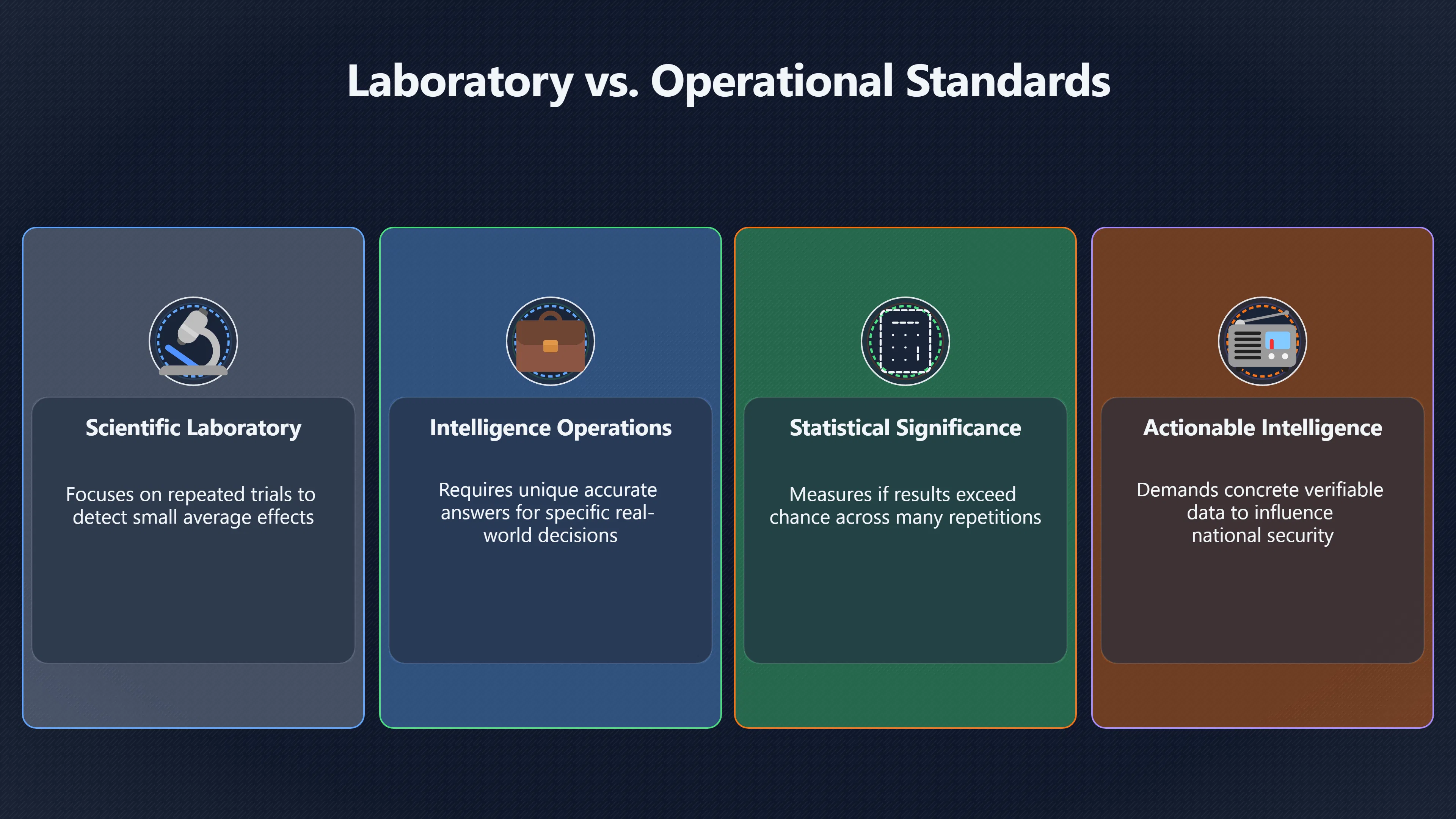
In laboratory research:
- Performance is measured across many repeated trials.
- Statistical methods can detect small average effects.
- Experimental conditions are designed to isolate a specific phenomenon.
In intelligence operations:[cia.gov]cia.govAN EVALUATION OF THE REMOTE VIEWING PROGRAMThe information provided was inconsistent, inaccurate with regard to specifics… that co…
- Each target is unique.
- Decisions often depend on a single report.
- Analysts require information that is concrete, accurate and actionable.
- False positives can consume resources or misdirect investigations.
This difference in evidentiary standards explains why even a genuine laboratory effect would not necessarily become a useful intelligence capability. A phenomenon can exist in principle yet remain too weak, inconsistent or poorly understood for operational deployment.
The AIR reviewers therefore refused to infer practical usefulness directly from experimental statistics. Instead, they evaluated laboratory evidence and operational performance independently before asking whether one justified confidence in the other.[CIA]cia.govAN EVALUATION OF THE REMOTE VIEWING PROGRAMThe information provided was inconsistent, inaccurate with regard to specifics… that co…
How the split shaped the final recommendation
The famous disagreement between Utts and Hyman has often overshadowed the broader institutional conclusion. Their debate concerned the interpretation of laboratory evidence, but the CIA’s decision depended largely on operational performance.
The AIR evaluation concluded that the programme had not demonstrated sufficient value for intelligence collection. Reports lacked the consistency and reliability needed for operational use, and documented evidence that remote viewing had contributed meaningfully to intelligence missions was judged inadequate. Consequently, the review did not recommend continuing the programme as an intelligence activity.[CIA]cia.govAN EVALUATION OF THE REMOTE VIEWING PROGRAMThe information provided was inconsistent, inaccurate with regard to specifics… that co…
This governance logic is important. Intelligence agencies routinely fund technologies that may be scientifically interesting only if they also improve operational outcomes. By separating laboratory anomalies from field performance, the review avoided treating experimental findings—whatever their interpretation—as automatic justification for maintaining an intelligence programme.
The result was a decision that acknowledged scientific disagreement while reaching a practical administrative conclusion: even if questions about anomalous laboratory results remained open, the evidence did not show that remote viewing functioned as a dependable intelligence tool.
Why this distinction is still widely misunderstood
Popular accounts often compress the 1995 review into a simple question: “Did the CIA believe in psychic spying?” The actual review addressed a more sophisticated institutional problem.
It allowed for the possibility that controlled experiments deserved scientific debate while simultaneously concluding that operational evidence failed to meet intelligence requirements. Those are compatible positions because they rely on different standards of proof.
This separation explains why later discussions continue to cite both Jessica Utts’ favourable assessment of certain laboratory findings and the CIA’s decision to end the programme. They refer to different parts of the same evaluation. The review did not claim that laboratory anomalies automatically validated intelligence operations, nor did it argue that operational failure alone disproved every laboratory result. Instead, it concluded that the evidence required to justify an intelligence capability had not been met, and that distinction ultimately determined the programme’s fate.[CIA+2UC Davis]cia.govAN EVALUATION OF THE REMOTE VIEWING PROGRAMThe information provided was inconsistent, inaccurate with regard to specifics… that co…
Amazon book picks
Further Reading
Books and field guides related to Why Lab Hits Did Not Mean Spycraft Worked. Use these as the next step if you want deeper reading beyond the article.

Parapsychology: A Handbook for the 21st Century
Provides broader scientific context for the distinction.
Endnotes
1.
Source: cia.gov
Link:https://www.cia.gov/readingroom/docs/CIA-RDP96-00791R000200180005-5.pdf
Source snippet
AN EVALUATION OF THE REMOTE VIEWING PROGRAMThe information provided was inconsistent, inaccurate with regard to specifics... that co...
2.
Source: cia.gov
Link:https://www.cia.gov/readingroom/document/cia-rdp96-00791r000200180005-5
Source snippet
reliability for use in intelligence gathering. The...Read more...
3.
Source: researchgate.net
Link:https://www.researchgate.net/publication/267978941Evaluation_of_Program_on%27Anomalous_Mental_Phenomena%27
Source snippet
Evaluation of Program on 'Anomalous Mental Phenomena'PDF | Jessica Utts and I were commissioned to evaluate the research on r...
4.
Source: cia.gov
Link:https://www.cia.gov/legacy/cia-history/
Source snippet
of CIAThe Central Intelligence Agency. The National Security Act of 1947 established CIA as an independent, civilian intelligence...
5.
Source: researchgate.net
Link:https://www.researchgate.net/publication/403178755_The_Star_Gate_Archives_Reports_of_the_United_States_Government_Sponsored_Psi_Program_1972-1995_Volume_4_Operational_Remote_Viewing_Memorandums_and_Reports
Source snippet
1995. Volume 4: Operational remote viewing: Memo-. randums and... inaccurate information”. (p. 330). Later, a request from Congressman...
6.
Source: ucdavis.edu
Title: psychic spying research produces credible evidence
Link:https://www.ucdavis.edu/news/psychic-spying-research-produces-credible-evidence
Source snippet
UC Davis'Psychic Spying' Research Produces Credible Evidence28 Nov 1995 — " Utts and Hyman evaluated a 20-year, $20 million basic researc...
7.
Source: Wikipedia
Title: Remote viewing
Link:https://en.wikipedia.org/wiki/Remote_viewing
Source snippet
Remote viewingIn 1995, the CIA hired the American Institutes for Research (AIR) to... [unreliable source?] However, statistical flaws...
8.
Source: hsdl.org
Link:https://www.hsdl.org/c/view?docid=482054
Source snippet
Transcendent and Asymmetric Warfare Implications of...28 Apr 2001 — Flame product might have appeared to be a "miss" on the part of the...
Additional References
9.
Source: skepsis.nl
Link:https://skepsis.nl/[stargate
Source snippet
CIA onderzoekt ESP / remote viewingDe skeptische psycholoog Ray Hyman van de Universiteit van Oregon was een van de twee hiervoor benader...
10.
Source: reddit.com
Link:https://www.reddit.com/r/HighStrangeness/comments/14x6pu0/the_cias_remote_viewing_documents_are_confusing/
Source snippet
The CIAs remote viewing documents are confusing as hellThe Stargate project produced zero evidence of remote viewing and that it's not re...
11.
Source: academia.edu
Title: (PDF) The Star Gate Operational Remote Viewing Program
Link:https://www.academia.edu/95285973/The_Star_Gate_Operational_Remote_Viewing_Program_A_Human_Intelligence_HUMINT_Collection_Platform
Source snippet
inaccurate assessment of the informatio from a distant spacetime point.... remote viewing reliability. As stated in Sun Streak operation...
12.
Source: governmentattic.org
Link:https://www.governmentattic.org/57docs/ThesisAnomalousHumanCognition2023.pdf
Source snippet
Thesis: Anomalous Human Cognition: A Possible Role...20 Sept 2023 — insight needed to differentiate accurate impressions from inaccurate...
13.
Source: skeptics.stackexchange.com
Title: have remote viewing tests shown a positive effect 5 15 above chance
Link:https://skeptics.stackexchange.com/questions/17741/have-remote-viewing-tests-shown-a-positive-effect-5-15-above-chance
Source snippet
Utts maintained that there had been a statistically significant positive effect, with some...Read more...
14.
Source: pmc.ncbi.nlm.nih.gov
Title: PMCFollow‐up on the U.S
Link:https://pmc.ncbi.nlm.nih.gov/articles/PMC10275521/
Source snippet
Central Intelligence Agency's (CIA...by Á Escolà‐Gascón · 2023 · Cited by 10 — Utts (1995, 1996, 2018) and Hyman (1996) both noted that...
15.
Source: popularmechanics.com
Title: cia psychic espionage secrets revealed
Link:https://www.popularmechanics.com/science/a65932697/cia-psychic-espionage-secrets-revealed/
Source snippet
The CIA Watched Him Bend Reality With Just His Mind...29 Aug 2025 — During the height of the [Cold War]({{ 'cold-war/' | relative_url }}), the CIA ran tests on people with...
16.
Source: Wikipedia
Title: Stargate Project (U.S. Army unit)
Link:https://en.wikipedia.org/wiki/Stargate_Project_%28U.S._Army_unit%29
Source snippet
Stargate Project (U.S. Army unit)The Stargate Project was terminated and declassified in 1995 after a commissioned review by the CIA c...
17.
Source: Wikipedia
Title: Central Intelligence Agency
Link:https://en.wikipedia.org/wiki/Central_Intelligence_Agency
Source snippet
Central Intelligence AgencyThe Central Intelligence Agency (CIA) /ˌsiː.aɪˈeɪ/ is a civilian foreign intelligence service of the federa...
18.
Source: facebook.com
Title: the Stargate Project
Link:https://www.facebook.com/100090372200308/posts/for-nearly-20-years-the-us-government-secretly-funded-one-of-its-strangest-intel/842493785439687/
Source snippet
The CIA and US Army trained “remote...Supporters inside the program argued that structured protocols improved reliability. In 1995, an e...
Topic Tree