Within Remote Viewing
What a Strong Remote Viewing Test Needs
A fair test needs random targets, proper blinding, stripped transcripts, pre-set scoring, and honest reporting of misses.
On this page
- Randomization and Blinding
- Scoring Before Feedback
- Reporting Misses
Page outline Jump by section
Introduction
A fair remote viewing test is not one where the descriptions sound impressive after the answer is revealed. It is one where the target is selected randomly, nobody who interacts with the viewer or judge can know the answer, transcripts are stripped of accidental clues, the scoring method is fixed before feedback, and every miss is reported alongside every hit. That matters because the strongest disputes in remote viewing are often about procedure rather than drama: a vague sketch can look meaningful once people know the target, while a leaky protocol can create “hits” without any paranormal information being involved. The cleaner test is therefore designed less to prove belief or disbelief than to prevent ordinary routes to a false positive.
The practical lesson from the history of remote viewing is clear. Early studies were criticised for cues in transcripts and target lists; later government-sponsored work adopted more formal rank-order judging and random target selection; later critics still asked whether independent judges, new target sets, and fuller reporting were enough. A strong modern test has to learn from all three stages. National Security Archive+2centerforinquiry.s3.amazonaws.com[nsarchive2.gwu.edu]nsarchive2.gwu.eduNational Security Archiveremote~1.PD FNational Security Archiveremote~1.PD F
Randomisation and Blinding
The first job of a fair remote viewing test is to make chance measurable. In a free-response experiment, a viewer may produce words, sketches, metaphors and fragments rather than a simple yes-or-no answer. That means the protocol must define the possible targets in advance and select the actual target by a known random process. The American Institutes for Research review of the U.S. remote viewing programme described this as basic to a properly conducted experiment: the target set is fixed beforehand, and the probability of each target being chosen is known.[National Security Archive]nsarchive2.gwu.eduNational Security Archiveremote~1.PD FNational Security Archiveremote~1.PD F
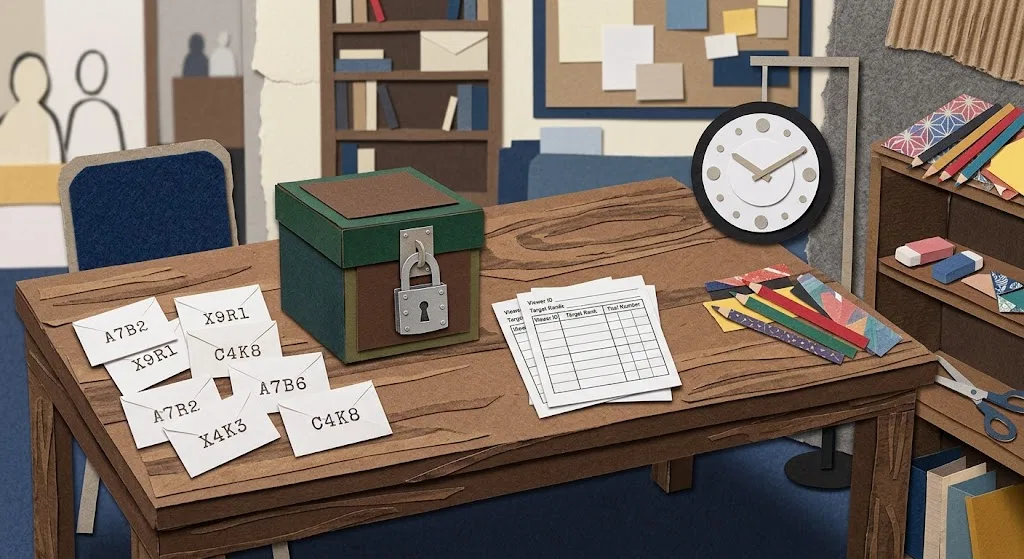
A good target system should therefore have several safeguards. The pool should be assembled before the test by someone outside the session team; the randomisation method should be recorded; the target should not be chosen by the person who interviews, prompts, scores or judges the viewer; and each possible target should have a genuine chance of being selected. The Princeton Engineering Anomalies Research protocol, for example, described remote perception trials in which target locations were selected randomly from a large pre-prepared pool, stored in sealed envelopes, and kept inaccessible to the agent or percipient.[ScienceDirect]sciencedirect.comScienceDirect Information and Uncertainty in Remote Perception ResearchScienceDirect Information and Uncertainty in Remote Perception Research
Blinding has to cover more people than beginners expect. The viewer must not know the target, but neither should the monitor who speaks to the viewer, the person handling transcripts, or the judge who compares the transcript with possible targets. If a monitor knows the target, even tiny changes in tone, follow-up questions or enthusiasm can guide the viewer. If the judge knows the answer, even unconsciously, the scoring becomes a test of expectation rather than remote viewing.
The most useful design is therefore double-blind at minimum and often triple-blind in practice. The viewer receives only a neutral trial identifier. The session monitor knows only that a trial is under way. The judge later receives anonymised response material and a set of possible targets, with no clue about which is correct. In trials using an outbound “sender” or “beacon” person, the sender must also be isolated from the viewer and monitor, and the target assignment must not be knowable through schedules, travel plans, filenames, timestamps or communications.
The old transcript-cue controversy shows why this can sound fussy but is not. David Marks argued that some early Stanford Research Institute judging materials contained extraneous clues, including the order in which targets had been used. In his re-analysis, distant judges who had not visited the sites could match transcripts using cues in the materials and target lists rather than the descriptive content. Whether one accepts every detail of that criticism or later rebuttals, it identifies the central design problem: the transcript must not carry accidental information about session order, dates, target sequence, location logistics or the experimenters’ handling.[centerforinquiry.s3.amazonaws.com]centerforinquiry.s3.amazonaws.comOpen source on amazonaws.com.
A fair protocol should therefore strip transcripts before judging. Names, dates, session numbers, page headers, references to “yesterday”, comments about previous targets, file metadata, target IDs and experimenter notes should be removed or replaced with neutral codes. The edited version must be produced by someone who is blind to the target, or by an automated system fixed in advance. If editing is subjective, it can itself become a source of bias, because a person who knows the answer may remove or retain material in a way that affects the judge.
Scoring Before Feedback
The second job of a fair test is to decide what counts as success before anyone sees the answer. Remote viewing is especially vulnerable to post-hoc matching because responses are usually rich and flexible. “Water”, “large structure”, “movement”, “grey”, “open space” and a rough sketch can be made to fit many photographs after feedback. A strong test therefore needs a scoring rule that turns a subjective comparison into a pre-set statistical question.
The standard solution in many later SRI and SAIC-style experiments was rank-order judging. After a session, a blind judge compares the viewer’s response with several possible targets: the real target and a set of decoys. The judge ranks the choices from best match to worst match. If there are five choices, each target should have an equal chance of being ranked first by chance alone; across many trials, the average rank of the correct target can be compared with the chance expectation.[National Security Archive]nsarchive2.gwu.eduNational Security Archiveremote~1.PD FNational Security Archiveremote~1.PD F
This design has an important virtue: it does not rely on the viewer or an enthusiast deciding after the fact that the result “feels right”. It also prevents the common mistake of treating any resemblance as a hit. A drawing that vaguely resembles the target must still beat the decoys under blind judging. If the actual target is ranked third out of five, it is not quietly re-described as a partial success unless the protocol already defined a secondary partial-score measure.
A strong scoring plan should state, before data collection begins:
- the number of trials;
- the number of possible targets or decoys per trial;
- who will judge the responses;
- whether there will be one judge or several independent judges;
- the primary outcome, such as first-place hit rate or mean rank;
- the statistical test and stopping rule;
- how missing, incomplete or ambiguous sessions will be handled.
This pre-specification is not a remote viewing-specific nicety. It is a general protection against choosing a favourable analysis after seeing the data. Open science guidance describes preregistration as specifying a research plan in advance and submitting it to a registry; other methodological literature notes that advance specification helps separate planned tests from exploratory interpretation.[Center for Open Science]cos.ioOpen source on cos.io.
For a controversial claim, a registered report is even stronger. In that model, the research question and methods are peer-reviewed before the results are known, and publication is not supposed to depend on whether the result is exciting. The Center for Open Science describes registered reports as peer review before results are known, while registered-report guidance in journals commonly uses in-principle acceptance for studies that pass Stage 1 review.[Center for Open Science]cos.ioOpen source on cos.io.
Feedback must also be controlled. If viewers receive target feedback trial by trial, later responses may contain echoes of earlier targets. Richard Wiseman and Julie Milton’s critical re-evaluation of one SAIC experiment discussed this problem: if responses are judged out of their original order, a judge might encounter later drawings that contain elements of previous feedback and then use those elements as cues when judging earlier trials. Their broader point was not merely that one study had disputed details, but that a fair test must make the timing of feedback, transcript handling and judging order explicit.[Koestler Unit]koestlerunit.wordpress.comKoestler Unit Microsoft WordKoestler Unit Microsoft Word
The cleanest solution is to delay target feedback until all sessions in a block have been completed and the response files have been locked. If immediate feedback is part of the hypothesis being tested, the protocol should say so, judge trials in chronological order where needed, and analyse feedback-related carryover as a possible artefact rather than ignoring it.
Reporting Misses
A remote viewing claim becomes much less informative when only the impressive cases are shown. A fair test must report all trials: clean hits, near misses, poor matches, blank sessions, unusable sessions, protocol deviations and failed replications. This is not just a matter of honesty; it is how readers estimate whether the apparent success rate is above chance.
The problem is especially sharp because free-response material is memorable. A striking coincidence can be retold for years, while dozens of weak or wrong descriptions disappear. The AIR review warned that subjective validation can generate compelling but false convictions that a description matches a target in striking ways. That is exactly why double-blind assessment and full reporting matter: they force the memorable anecdote back into the full set of attempts.[National Security Archive]nsarchive2.gwu.eduNational Security Archiveremote~1.PD FNational Security Archiveremote~1.PD F
A fair report should therefore include the denominator. “The viewer described a bridge” means little unless the reader knows how many sessions were run, how many possible targets contained bridges or bridge-like features, how many descriptions were wrong, and whether the bridge statement was made before or after any feedback. The public-facing result should not be a gallery of best cases. It should be a table of all trials, the blind rank or score for each one, the pre-set analysis, and any deviations from the protocol.
This is also where publication bias matters. Cochrane’s guidance on missing evidence explains that systematic reviews can be biased when the availability of studies or results depends on the size, direction or statistical significance of the findings. In remote viewing, the equivalent risk is obvious: successful demonstrations are easier to publicise than dull null results, and informal trials with misses may never be written up at all.[Cochrane]cochrane.orgOpen source on cochrane.org.
Recent pro-remote-viewing meta-analysis has argued that the published experimental record shows above-chance performance, including a reported average effect size of.34 across selected studies up to 2022. That claim is part of the live dispute, not a reason to relax design standards. The stronger the claimed cumulative effect, the more useful a transparent, preregistered, all-trials-reported test becomes: it can show whether the effect survives when the easiest routes to selective reporting and flexible scoring are closed.[Journal of Scientific Exploration]journalofscientificexploration.orgRemote Viewing: A 1974-2022 Systematic Review and Meta-Analysis | Journal of Scientific Exploration…
What a Strong Test Would Look Like
A strong modern remote viewing test would be fairly simple for participants and strict behind the scenes. The viewer would be given a neutral code, sit in a controlled setting, and record impressions without leading prompts. The target would be selected by a documented random process from a locked target pool. The monitor, viewer and judge would remain blind. Transcripts would be time-stamped, locked, stripped of identifying cues and passed to judges who never interact with the viewer.
The judging package would include the real target and pre-selected decoys that were eligible under the same randomisation rules. Multiple independent judges would rank the choices, and the pre-registered analysis would define how their rankings are combined. The report would publish all responses, all targets, all decoys, all scores and all exclusions, with any exploratory observations clearly separated from the planned test.
A practical protocol might use these decision points:
- Target pool: large enough to avoid repetition, prepared before the study, with targets matched for general complexity so one target does not stand out from the decoys.
- Randomisation: computer-generated or otherwise auditable, with the random seed or assignment record preserved.
- Blinding: no person who knows the target can interact with the viewer, edit transcripts or communicate with judges.
- Transcript cleaning: removal of dates, sequence clues, file metadata, casual comments and previous-target references by a blind or automated process.
- Scoring: rank-order judging or another fixed method chosen before the first session.
- Feedback: delayed until responses are locked, unless feedback timing is itself a pre-specified variable.
- Reporting: every trial included, with exclusions justified before results are inspected wherever possible.
The test should also be large enough to matter. A handful of sessions can produce intriguing coincidences, but a persuasive design needs enough trials to distinguish chance fluctuation from a repeatable effect. The stopping rule must be fixed in advance, because optional stopping — continuing until the results look good, or stopping when they do — can turn randomness into a false discovery.

What the Test Can and Cannot Settle
A fair test cannot make remote viewing true or false by definition. What it can do is remove the most common escape routes in both directions. Believers cannot rely on hand-picked hits, loose matching or after-the-fact scoring. Sceptics cannot dismiss a positive result by pointing to obvious cueing, target leakage or missing misses if the protocol really prevented them.
The AIR review captured the larger scientific challenge: beyond producing statistically significant effects, researchers would need to specify the conditions under which the alleged phenomenon should and should not appear. That is a higher bar than a dramatic session report. It means a test should not merely ask, “Can someone get a hit?” It should ask, “Under which pre-defined conditions, with which viewers, targets, judging method and feedback rules, does performance differ from chance?”[National Security Archive]nsarchive2.gwu.eduNational Security Archiveremote~1.PD FNational Security Archiveremote~1.PD F
The fairest outcome is not always a headline result. A well-designed test may show no effect, a small effect, a result limited to one judge or target type, or an apparent effect that disappears under independent replication. Each of those outcomes is more useful than an impressive but leaky demonstration. In a field where the controversy has often turned on whether ordinary information slipped through the cracks, the best remote viewing test is built around the cracks first.
Amazon book picks
Further Reading
Books and field guides related to What a Strong Remote Viewing Test Needs. Use these as the next step if you want deeper reading beyond the article.

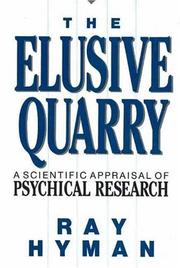
The Elusive Quarry: A Scientific Appraisal of Psychical Research
Addresses methodological safeguards directly.
Parapsychology: A Handbook for the 21st Century
Covers research methodology across the field.
eBay marketplace picks
Marketplace Samples
Live-tested eBay searches with available results related to this page.



Endnotes
1.
Source: centerforinquiry.s3.amazonaws.com
Link:https://centerforinquiry.s3.amazonaws.com/wp-content/uploads/sites/29/1982/07/22165420/p20.pdf
2.
Source: sciencedirect.com
Title: ScienceDirect Information and Uncertainty in Remote Perception Research
Link:https://www.sciencedirect.com/science/article/abs/pii/S1550830707000638
3.
Source: cochrane.org
Link:https://www.cochrane.org/authors/handbooks-and-manuals/handbook/current/chapter-13
4.
Source: journalofscientificexploration.org
Title: Journal of Scientific Exploration
Link:https://journalofscientificexploration.org/index.php/jse/article/view/2931
Source snippet
Remote Viewing: A 1974-2022 Systematic Review and Meta-Analysis | Journal of Scientific Exploration...
5.
Source: sciencedirect.com
Link:https://www.sciencedirect.com/science/article/abs/pii/S1550830718300685
6.
Source: sciencedirect.com
Link:https://www.sciencedirect.com/science/article/abs/pii/S1550830723001696
7.
Source: sciencedirect.com
Link:https://www.sciencedirect.com/science/article/pii/S0895435625004354
8.
Source: sciencedirect.com
Link:https://www.sciencedirect.com/science/article/pii/S1747938X25000156
9.
Source: sciencedirect.com
Link:https://www.sciencedirect.com/science/article/pii/S0022202X16323569
10.
Source: sciencedirect.com
Link:https://www.sciencedirect.com/science/article/abs/pii/S0165176518301277
11.
Source: cdn.centerforinquiry.org
Link:https://cdn.centerforinquiry.org/wp-content/uploads/sites/29/1988/10/22165252/p47.pdf
12.
Source: ia801403.us.archive.org
Link:https://ia801403.us.archive.org/19/items/in.ernet.dli.2015.204412/2015.204412.In-The.pdf
13.
Source: nsarchive2.gwu.edu
Title: National Security Archiveremote~1.PD F
Link:https://nsarchive2.gwu.edu/NSAEBB/NSAEBB438/docs/doc_57.pdf
14.
Source: cos.io
Link:https://www.cos.io/initiatives/prereg
15.
Source: cos.io
Title: preregistration plan not prison
Link:https://www.cos.io/blog/preregistration-plan-not-prison
16.
Source: cos.io
Link:https://www.cos.io/initiatives/registered-reports
17.
Source: koestlerunit.wordpress.com
Title: Koestler Unit Microsoft Word
Link:https://koestlerunit.wordpress.com/wp-content/uploads/2015/06/wiseman-milton-1998.pdf
18.
Source: Wikipedia
Title: Remote viewing
Link:https://en.wikipedia.org/wiki/Remote_viewing
19.
Source: journalofscientificexploration.org
Link:https://journalofscientificexploration.org/index.php/jse/article/view/3687/2559
20.
Source: ics.uci.edu
Link:https://www.ics.uci.edu/~jutts/may.pdf
21.
Source: library.hkust.edu.hk
Title: preregistration way prevent questionable research practice
Link:https://library.hkust.edu.hk/news-events/news/preregistration-way-prevent-questionable-research-practice
Additional References
22.
Source: youtube.com
Title: Edwin C. May
Link:https://www.youtube.com/watch?v=K0u0JqwQDJQ
Source snippet
How to Remote View & Increase Psychic Abilities with Telepathy Tapes Researcher...
23.
Source: youtube.com
Title: Scientific and Spiritual Implications of Psychic Abilities
Link:https://www.youtube.com/watch?v=zgyYms376Mg
Source snippet
Edwin C. May - Psychics in Space, Dream Telepathy and Remote Viewing Saturn | SRS #122...
24.
Source: cia.gov
Link:https://www.cia.gov/readingroom/document/cia-rdp96-00791r000200180006-4
25.
Source: cia.gov
Link:https://www.cia.gov/readingroom/docs/CIA-RDP96-00791R000200180006-4.pdf
26.
Source: cia.gov
Link:https://www.cia.gov/readingroom/docs/CIA-RDP96-00791R000200180005-5.pdf
27.
Source: cia.gov
Link:https://www.cia.gov/readingroom/docs/CIA-RDP96-00792R000701020002-6.pdf
28.
Source: cia.gov
Link:https://www.cia.gov/readingroom/docs/CIA-RDP96-00789R002200200001-5.pdf
29.
Source: cia.gov
Link:https://www.cia.gov/readingroom/docs/CIA-RDP96-00787R000200090017-5.pdf
30.
Source: cia.gov
Link:https://www.cia.gov/readingroom/docs/CIA-RDP96-00788R002000240029-4.pdf
31.
Source: cia.gov
Link:https://www.cia.gov/readingroom/docs/CIA-RDP96-00787R000500250015-6.pdf
Topic Tree