Within Fair Test
Who Really Needs to Be Blind?
A viewer can be blind while the test still leaks information through monitors, handlers, senders, timestamps, or logistics.
On this page
- Why viewer blinding alone is not enough
- How monitors and senders can leak cues
- Practical safeguards for session isolation
Page outline Jump by section
Introduction
Viewer blinding is only the first step in a fair remote viewing experiment. A session can remain vulnerable even when the viewer has no knowledge of the target if other people involved in the test accidentally or unconsciously pass information. Monitors, target handlers, senders, judges, scheduling staff, and even file-management practices can all create subtle information pathways that make a result appear stronger than it really is. For that reason, many researchers and methodologists have argued that robust remote viewing experiments should use a triple-blind design or an equivalent level of procedural isolation, where everyone who can influence the session is prevented from knowing the correct target until the trial has ended. This approach is intended to reduce ordinary psychological cueing so that any apparent success cannot easily be explained by information leakage rather than the claimed phenomenon.[CIA+2CIA]cia.govPROPOSED GRILL FLAME PROTOCOL (U)…This protocol contains the procedure for AMSAA-sponsored SRI Inter- national-performed remote vi…
Why viewer blinding alone is not enough
In ordinary experimental language, a blind participant does not know the correct answer. In remote viewing, however, the participant is rarely the only source of potential bias. Sessions are conversational, often involving a monitor who encourages the viewer to continue, asks follow-up questions, or decides when to move from one impression to another. If that monitor knows the target, even without intending to influence the outcome, expectations can affect the interaction.
This problem is well recognised in psychology beyond remote viewing. Humans are highly sensitive to subtle interpersonal signals such as pauses, changes in tone, facial expressions, enthusiasm, hesitation, or the amount of attention given to particular descriptions. None of these behaviours need be deliberate to influence responses. The history of experimental psychology includes many examples of observer-expectancy effects, making strict separation of knowledge and interaction an established safeguard rather than a remote-viewing-specific invention.
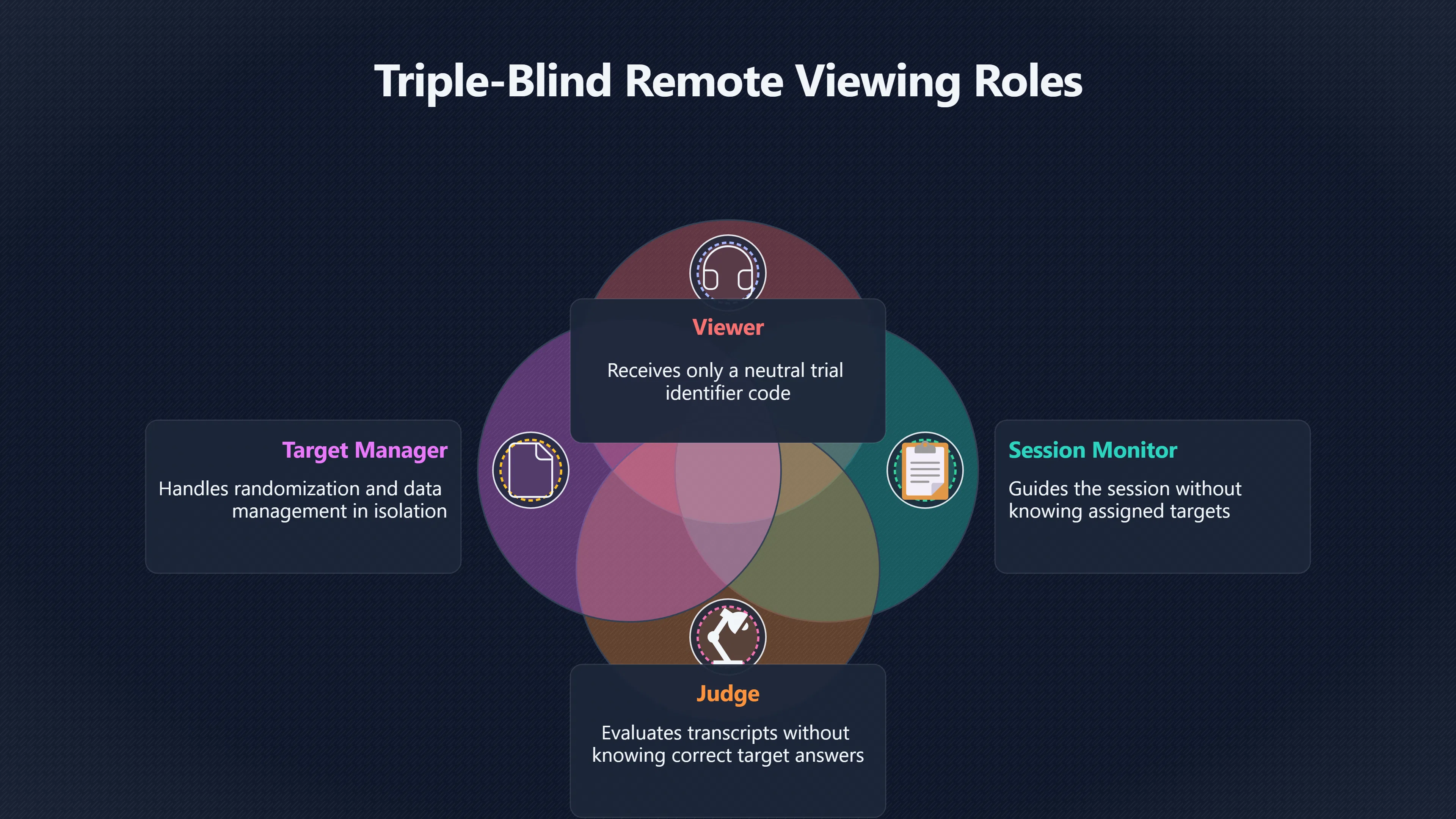
A practical triple-blind arrangement therefore separates at least three roles:
- The viewer, who receives only a neutral trial identifier.
- The session monitor, who guides the session but has no knowledge of the assigned target.
- The judge or analyst, who evaluates the transcript without knowing which target is correct.
In larger experiments, additional roles such as target preparation, randomisation and data management are likewise separated so that no individual can accidentally bridge information between stages.[CIA+2CIA]cia.govPROPOSED GRILL FLAME PROTOCOL (U)…This protocol contains the procedure for AMSAA-sponsored SRI Inter- national-performed remote vi…
How monitors and senders can leak cues
The greatest risk is not necessarily overt cheating but ordinary human communication.
Monitor expectancy
If a monitor knows the target is, for example, a bridge rather than a waterfall, seemingly harmless behaviours can become informative. The monitor might:
- encourage the viewer after bridge-related comments;
- ask for when responses appear promising;
- terminate the session earlier when the viewer seems to be drifting away from the target;
- unconsciously alter speech rhythm or emotional tone.
Because these reactions occur during the production of the transcript itself, later judges cannot easily distinguish genuine descriptions from responses shaped by interaction.
Some historical remote-viewing protocols recognised this distinction. CIA-released procedural documents describe double-blind testing phases in which monitors remained blind during data collection, contrasting these with later operational or training phases where informed feedback could be given after the formal test had concluded. The separation exists precisely because feedback during testing creates opportunities for cueing.[Scribd]scribd.comRemote Viewing Research Progress Report | PDFThe Class C protocol involves immediate feedback to the remote viewer during the sessi…
The sender problem
Some remote viewing studies have included a separate “sender” or “beacon” who observes the target while attempting to facilitate information transfer to the viewer.
Even if one accepts the theoretical rationale for a sender, the experimental design becomes more difficult. The sender must remain completely isolated from:
- the viewer;
- the monitor;
- anyone responsible for judging;
- anyone who might inadvertently reveal target-related logistics.
Otherwise the experiment no longer distinguishes between the intended hypothesis and ordinary information transfer.
Later experimental work also questioned whether a sender was necessary at all, reducing one potential source of leakage by removing the role entirely from many protocols.[Academia]academia.eduThrough Time and Space: The Evidence for Remote ViewingThis paper discusses the evolution and methodology of nonlocal perception…
The less obvious routes for information leakage
The most informative criticisms of remote viewing experiments have often concerned seemingly trivial administrative details rather than dramatic procedural failures.
David Marks and Richard Kammann’s examination of early Stanford Research Institute materials argued that judges could match transcripts using incidental clues rather than descriptive accuracy. According to their analysis, transcripts sometimes contained dates, references to previous sessions, ordering information or other contextual details that narrowed the possible targets. Marks reported being able to identify targets from these cues without visiting the locations himself, suggesting that the judging process had not fully isolated the intended information source. The original researchers disputed aspects of these criticisms, and exchanges continued in the scientific literature, but the controversy permanently highlighted the importance of removing every identifiable clue before judging.[Wikipedia+2Wikipedia]WikipediaSensory leakageSensory leakage
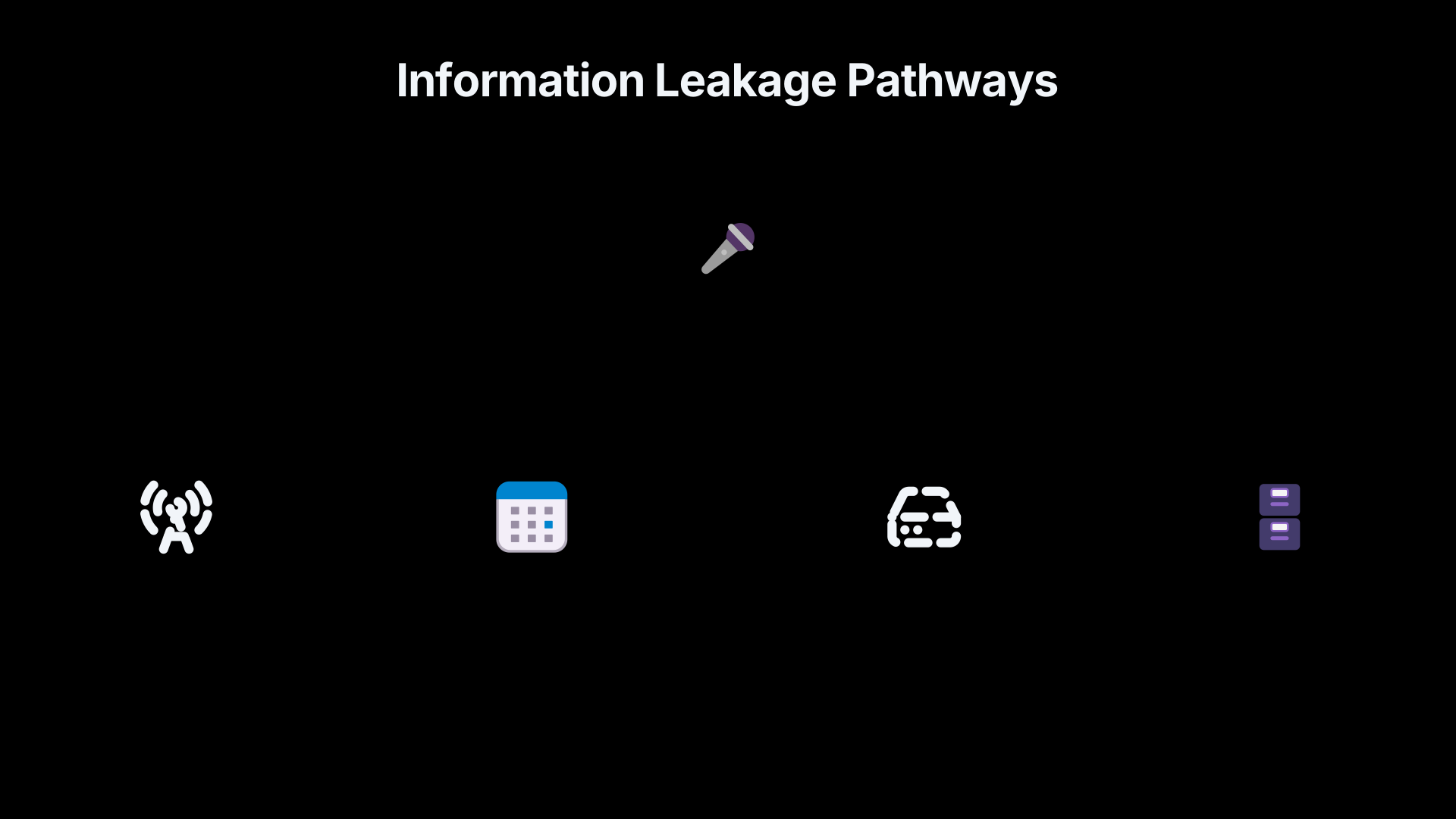
Modern concerns extend beyond handwritten notes. Digital workflows introduce additional opportunities for accidental disclosure, including:
- filenames containing target descriptions;
- timestamps revealing trial order;
- folder structures that expose sequencing;
- email subject lines;
- metadata embedded in documents or images;
- calendar invitations showing destination names;
- messaging notifications between experimenters.
None of these reveals the target directly, yet together they may provide enough context for unconscious inference.
Practical safeguards for session isolation
A rigorous triple-blind protocol attempts to eliminate every ordinary route by which information could travel.
Good practice typically includes:
- Independent target management: One individual prepares or randomises targets but never meets the viewer.
- Blind monitoring: The monitor interacts with the viewer without access to target information.
- Neutral identifiers: Trials use random codes rather than descriptive filenames or labels.
- Secure randomisation: Target assignment occurs after the target pool has been fixed and is documented for later verification.
- Transcript cleaning: Dates, session numbers, comments and administrative notes are removed before judging.
- Independent judging: Judges receive anonymised transcripts alongside decoy targets presented in random order.
- Delayed feedback: No participant learns the correct target until all responses and judging have been completed.
Each safeguard addresses a different mechanism of leakage. Collectively they reduce the likelihood that an apparent hit reflects shared information rather than whatever process the experiment is intended to test.[CIA+2CIA]cia.govPROPOSED GRILL FLAME PROTOCOL (U)…This protocol contains the procedure for AMSAA-sponsored SRI Inter- national-performed remote vi…

Why triple-blind design matters even when results are positive
Triple blinding does not establish that remote viewing is genuine. Instead, it narrows the range of conventional explanations that remain plausible if positive results are observed.
This distinction is important because methodological criticism has played a central role in debates over remote viewing for decades. Early experiments attracted criticism over judging procedures and sensory cues, while later government-sponsored work adopted stricter randomisation and blind judging in response. Even supporters of remote viewing frequently recommend keeping viewers, monitors, analysts and target managers blind wherever possible because positive findings become more persuasive when ordinary information channels have been systematically closed.[Scribd+2CIA]scribd.comEvaluation of Remote Viewing Program | PDFThe document provides an executiveEvaluation of Remote Viewing Program | PDFThe document provides an executive summary of a review conducted by the American Institut…
Seen this way, triple-blind design is less about demonstrating extraordinary perception than about ensuring that an experiment genuinely tests the intended hypothesis. If the protocol allows monitors, handlers or logistics to transmit information, the experiment cannot distinguish a paranormal claim from conventional cueing, regardless of how impressive individual sessions may appear.
Amazon book picks
Further Reading
Books and field guides related to Who Really Needs to Be Blind?. Use these as the next step if you want deeper reading beyond the article.
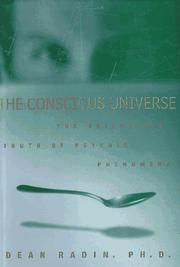
The conscious universe
Contrasts laboratory evidence with practical application questions.

eBay marketplace picks
Marketplace Samples
Live-tested eBay searches with available results related to this page.



Endnotes
1.
Source: cia.gov
Link:https://www.cia.gov/readingroom/document/cia-rdp96-00788r001300070003-9
Source snippet
PROPOSED GRILL FLAME PROTOCOL (U)...This protocol contains the procedure for AMSAA-sponsored SRI Inter- national-performed remote vi...
2.
Source: cia.gov
Link:https://www.cia.gov/readingroom/docs/CIA-RDP96-00788R002000240029-4.pdf
Source snippet
ribed, The resulting transcripts are then edited only to the...
3.
Source: scribd.com
Title: Evaluation of Remote Viewing Program | PDFThe document provides an executive
Link:https://www.scribd.com/doc/92017954/Air-Report
Source snippet
Evaluation of Remote Viewing Program | PDFThe document provides an executive summary of a review conducted by the American Institut...
4.
Source: scribd.com
Link:https://www.scribd.com/document/727470570/CIA-RDP96-00788R001300140003-1-text
Source snippet
Remote Viewing Research Progress Report | PDFThe Class C protocol involves immediate feedback to the remote viewer during the sessi...
5.
Source: academia.edu
Link:https://www.academia.edu/9540484/Through_Time_and_Space_The_Evidence_for_Remote_Viewing
Source snippet
Through Time and Space: The Evidence for Remote ViewingThis paper discusses the evolution and methodology of nonlocal perception...
6.
Source: Wikipedia
Title: Sensory leakage
Link:https://en.wikipedia.org/wiki/Sensory_leakage
7.
Source: Wikipedia
Title: Parapsychology research at SRI
Link:https://en.wikipedia.org/wiki/Parapsychology_research_at_SRI
Additional References
8.
Source: researchgate.net
Title: 374881423 Remote Viewing A 1974 2022 Systematic Review and [Meta Analysis]({{ ‘meta-analysis/’ | relative_url }})
Link:https://www.researchgate.net/publication/374881423_Remote_Viewing_A_1974-2022_Systematic_Review_and_Meta-Analysis
Source snippet
(PDF) Remote Viewing: A 1974-2022 Systematic Review...26 Oct 2023 — This is the first meta-analysis of all studies related to remote-vie...
9.
Source: reddit.com
Link:https://www.reddit.com/r/remoteviewing/comments/1501do7/the_complete_skeptics_guide_to_remote_viewing_how/
Source snippet
nd what the field needs to address in order to be legitimized.Read more...
10.
Source: researchgate.net
Title: 403180890 Experts’ Remote Viewing Guidelines
Link:https://www.researchgate.net/publication/403180890_Experts%27_Remote_Viewing_Guidelines
Source snippet
(PDF) Experts' Remote Viewing Guidelines31 Mar 2026 — Experts also agreed on the importance of blinding procedures to. Judges and analyst...
11.
Source: youtube.com
Link:https://www.youtube.com/watch?v=iEAhfDYlxME
Source snippet
CONTROLLED REMOTE VIEWING - Lori Williams #32...
12.
Source: youtube.com
Title: Remote Viewing Experiment! (Outbounder Protocol)
Link:https://www.youtube.com/watch?v=IPjhUUuqT0Q
Source snippet
The Science of Magic - Dean Radin | Being Human...
13.
Source: youtube.com
Title: Organizing Remote Viewing Projects with Lori Williams
Link:https://www.youtube.com/watch?v=EZ9crJeFQDA
Source snippet
Remote Viewing Experiment! (Outbounder Protocol) - Jimmy Akin's Mysterious World...
14.
Source: youtube.com
Title: The Science of Magic
Link:https://www.youtube.com/watch?v=mJxzxYdigAg
Source snippet
Scientist Explains: How to Use PROVEN Magic to Create Your Dream Life | Dr Dean Radin...
15.
Source: youtube.com
Title: CONTROLLED REMOTE VIEWING
Link:https://www.youtube.com/watch?v=wWqldsr_zIg
Topic Tree