Within Read Files
Which Details Can Actually Be Checked?
The safest reading method separates vague impressions from details that can be independently checked against the target.
On this page
- Specific, broad, ambiguous and wrong claims
- Why vivid language can inflate apparent hits
- A practical marking system for transcripts
Page outline Jump by section
Introduction
When reading declassified remote viewing documents, the single most useful habit is to separate broad impressions from specific, checkable claims. Session transcripts often contain a mixture of sensory fragments, guesses, sketches and interpretations. Some statements could, in principle, be tested against the target; others are so general that they could appear to fit many different locations or events. Learning to distinguish between those categories makes it easier to evaluate what a transcript actually contains rather than what later readers imagine it contains.
This approach also mirrors how remote viewing research was intended to be evaluated. Rather than treating every apparent similarity as equally meaningful, formal judging methods compared complete transcripts against known targets and asked whether distinctive details consistently matched better than chance. The distinction between vague description and independently verifiable information is therefore central to reading the archive carefully rather than simply looking for impressive-sounding passages.[CIA]cia.govAN EVALUATION OF THE REMOTE VIEWING PROGRAMTypically, the remote viewers described the results of their experiences in written reports…
Which details can actually be checked?
A useful question to ask of every statement in a transcript is simple: could someone verify this without interpreting it?
Some descriptions are concrete enough to permit an objective comparison. Others depend almost entirely on hindsight.
A practical classification is:
CategoryExampleCan it be checked?Specific claim“A circular building beside a river.”Usually yes.Quantifiable claim“Three tall towers.”Yes, if the target is known.Relational claim“A bridge connects two land masses.”Yes.Broad impression“Feels industrial.”Only loosely.Emotional impression“Busy”, “tense”, “important.”Difficult to verify objectively.Interpretation“This is a missile base.”Depends entirely on whether earlier observations justify that conclusion.
Notice that specificity is not the same as correctness. A detailed statement can still be completely wrong. The point is that it is possible to determine whether it is wrong.
By contrast, a phrase such as “large structure near water” could fit ports, reservoirs, dams, islands, coastal cities, industrial plants and many military installations. Such statements often remain plausible regardless of the actual target.
Specific, broad, ambiguous and wrong claims
Most remote viewing transcripts contain all four categories simultaneously.
A disciplined reading separates them instead of asking whether the session “worked.”
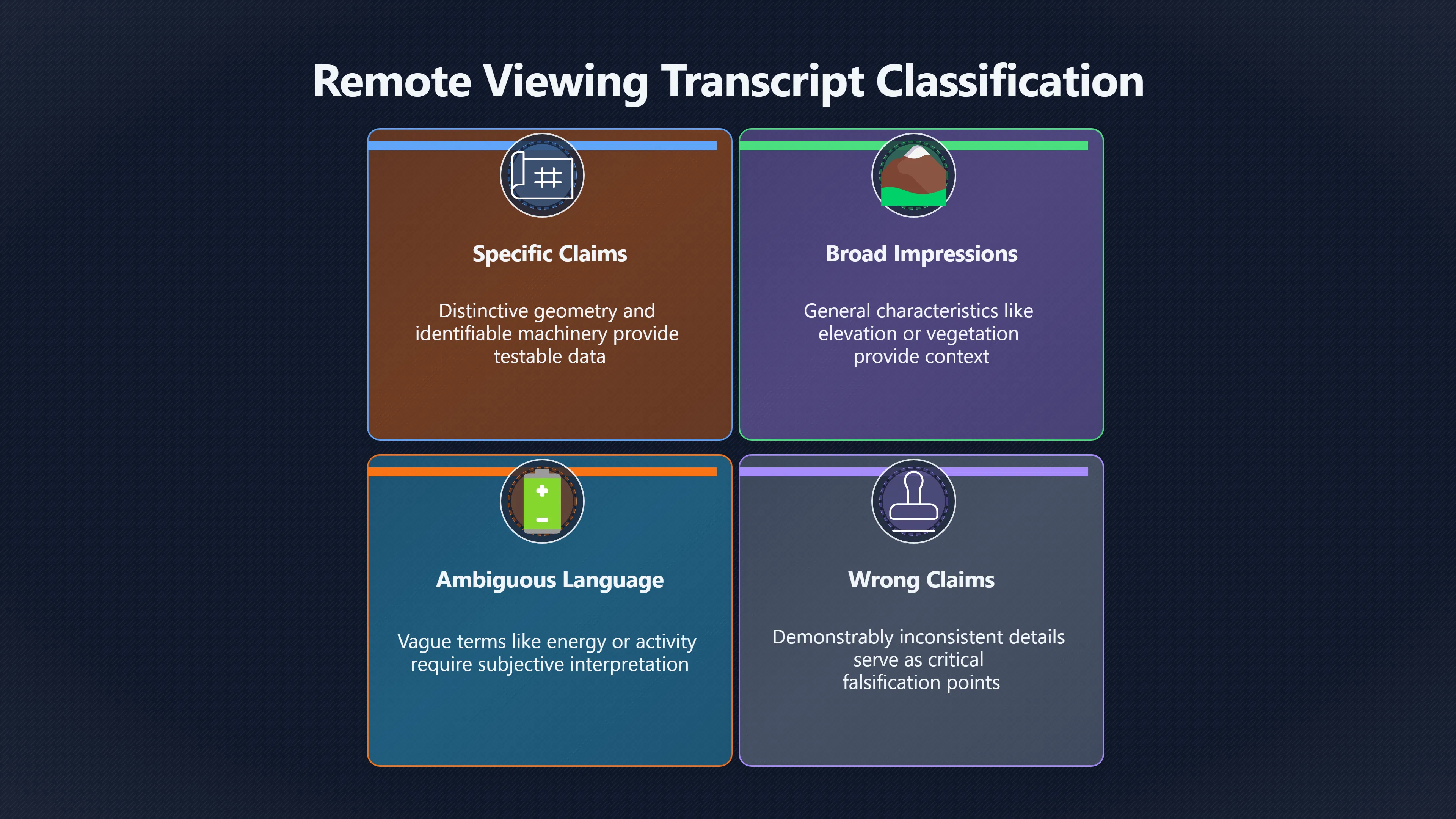
Specific claims deserve the greatest attention because they create genuine opportunities for confirmation or falsification. Examples include distinctive geometry, unusual layouts, identifiable machinery or relationships between objects.
Broad claims describe general characteristics such as openness, elevation, movement or vegetation. These may contribute context but usually cannot support strong conclusions on their own.
Ambiguous claims contain language that changes meaning depending on interpretation. Words such as “energy”, “communication”, “facility” or “activity” often require readers to supply missing details themselves.
Wrong claims are equally important. Readers naturally remember apparent successes but overlook unmistakable failures. A transcript containing ten incorrect distinctive statements should not be evaluated solely by highlighting the two that seem compatible with the target.
This balance matters because human judgement tends to favour memorable matches while discounting mismatches, a tendency well documented in psychological research on confirmation bias and pattern recognition. Careful judging procedures therefore attempt to compare complete transcripts rather than isolated highlights.[CIA]cia.govAN EVALUATION OF THE REMOTE VIEWING PROGRAMTypically, the remote viewers described the results of their experiences in written reports…
Why vivid language can inflate apparent hits
Remote viewing records are often compelling because they contain rich sensory language.
Descriptions such as “gleaming metal,” “intense heat,” “towering shapes,” or “powerful movement” create vivid mental images. The problem is not the language itself but what readers do with it afterwards.
Once the target is known, people naturally reconstruct a coherent narrative:
- Metallic becomes aircraft.
- Circular becomes radar.
- Water becomes submarine base.
- Heat becomes rocket launch.
- Crowd becomes military personnel.
Each step seems reasonable in isolation, but together they can transform a collection of loose impressions into an apparently precise description that never actually appeared in the original transcript.
This process resembles what psychologists call retrospective fitting: interpreting ambiguous information after the answer is already available. It becomes increasingly difficult to distinguish what the viewer originally reported from what later readers inferred.
For that reason, experienced evaluators generally recommend reading the transcript first, making notes, and only then comparing it with the target documentation.
Distinguish observation from interpretation
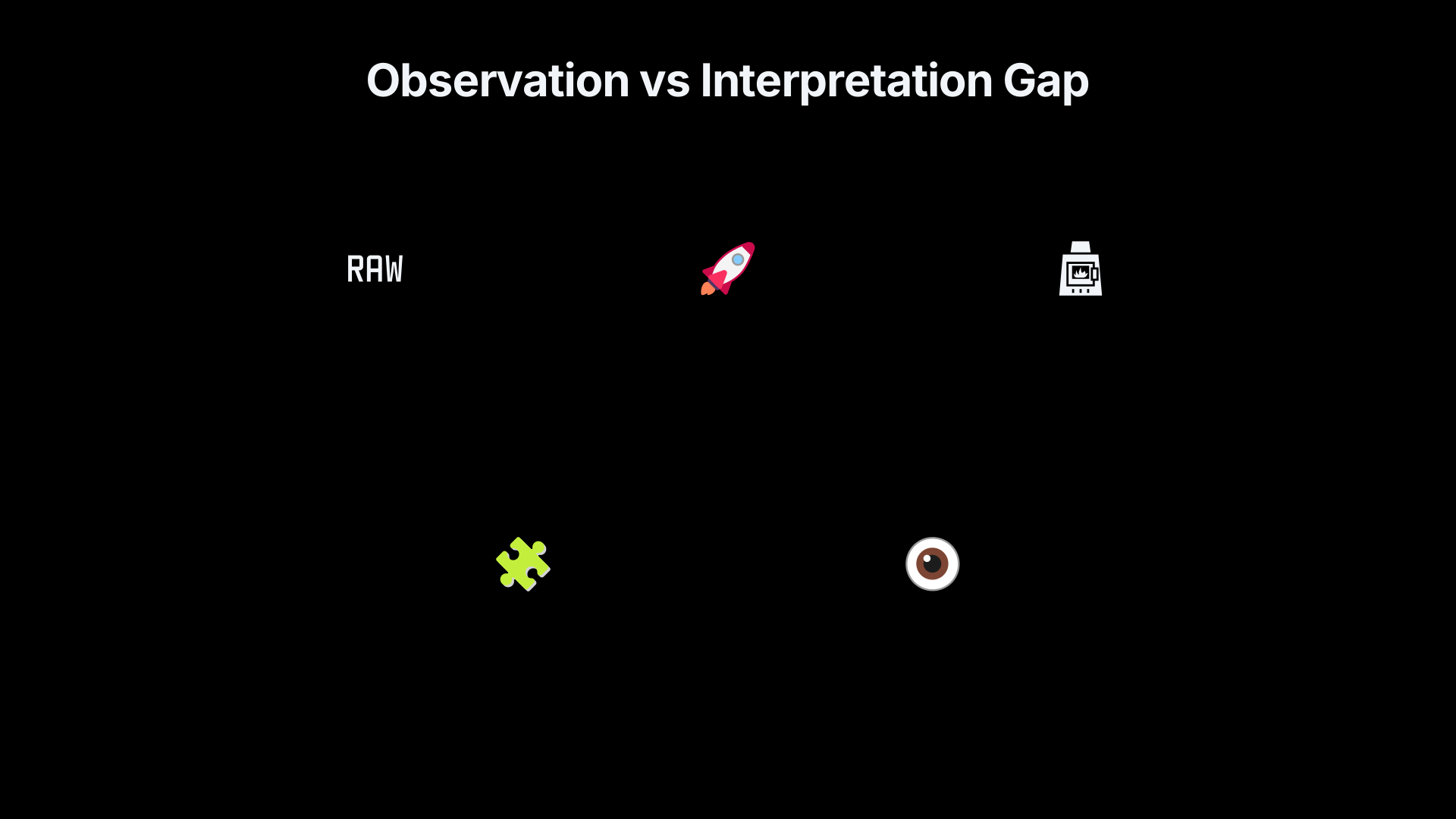
Another useful habit is to separate observations from conclusions.
Consider these examples.
Observation
- “Vertical objects.”
- “Strong vibration.”
- “Open area.”
Interpretation
- “Launch complex.”
- “Missile test.”
- “Military installation.”
The second list may eventually prove correct, but it contains an extra layer of reasoning that was not necessarily present in the initial observations.
Many remote viewing protocols attempted to discourage viewers from making premature identifications because naming a target could encourage imagination to replace description. Training materials frequently distinguished raw perceptual impressions from analytical overlay—the tendency to interpret impressions too quickly rather than continue describing them.[CIA]cia.govAN EVALUATION OF THE REMOTE VIEWING PROGRAMTypically, the remote viewers described the results of their experiences in written reports…
A practical marking system for transcripts
A simple annotation system can make even lengthy session records easier to evaluate.
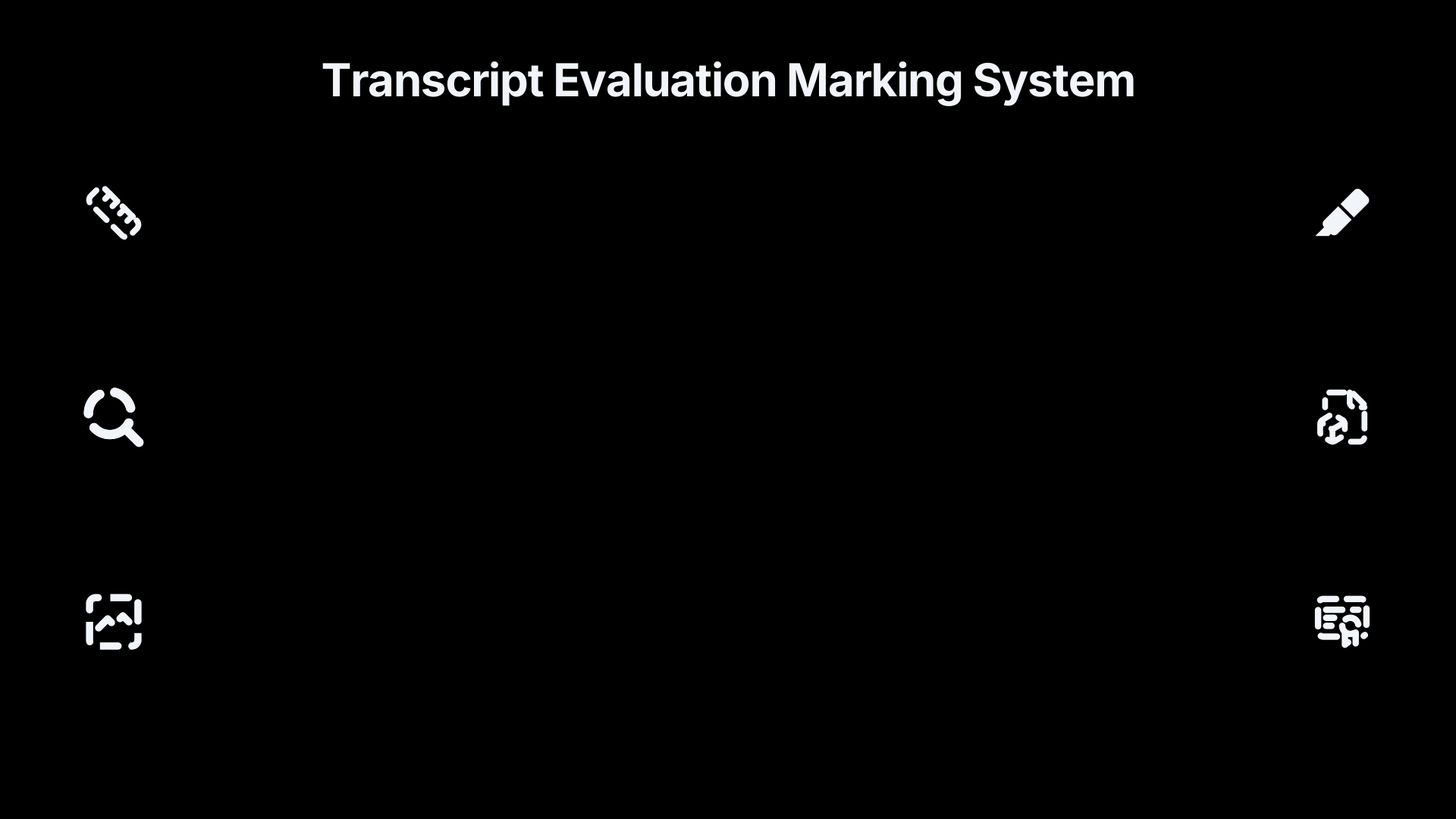
Assign each statement one of the following labels while reading:
- S – Specific: distinctive, independently checkable detail.
- B – Broad: general description shared by many possible targets.
- A – Ambiguous: wording that requires interpretation.
- I – Interpretation: inferred identity rather than direct description.
- W – Wrong: demonstrably inconsistent with the known target.
For example:
“Large rectangular structure.” → S
“Feels important.” → B
“Communication centre.” → I
“Near mountains.” (target is flat coastline) → W
After marking an entire transcript, review the distribution rather than focusing on memorable passages. A session dominated by broad and ambiguous statements may appear striking on first reading but contain relatively few genuinely testable claims.
Why this distinction matters
Separating broad impressions from specific checkable claims does not settle the broader debate about remote viewing. Instead, it improves the quality of reading regardless of one’s conclusions.
The declassified archive contains documents ranging from raw session notes to formal programme evaluations. Independent reviews of the programme concluded that operational reports had not demonstrated intelligence value sufficient for continued use, even while acknowledging that some laboratory findings remained subjects of scientific disagreement. Those assessments reinforced the need for rigorous judging methods rather than relying on selective examples or vivid anecdotes.[CIA]cia.govAN EVALUATION OF THE REMOTE VIEWING PROGRAMTypically, the remote viewers described the results of their experiences in written reports…
A careful reader therefore asks not, “Does this sound impressive?” but, “Which statements were specific enough to be tested, how many proved correct, how many were wrong, and how much interpretation was required to create the apparent match?” That shift in perspective turns an engaging narrative into a more reliable evaluation of what the document actually records.
Amazon book picks
Further Reading
Books and field guides related to Which Details Can Actually Be Checked?. Use these as the next step if you want deeper reading beyond the article.


Paranormality: Why We See What Isn't There
Explains hindsight bias and subjective matching.
eBay marketplace picks
Marketplace Samples
Live-tested eBay searches with available results related to this page.



Endnotes
1.
Source: cia.gov
Link:https://www.cia.gov/readingroom/docs/CIA-RDP96-00791R000200180005-5.pdf
Source snippet
AN EVALUATION OF THE REMOTE VIEWING PROGRAMTypically, the remote viewers described the results of their experiences in written reports...
2.
Source: cia.gov
Link:https://www.cia.gov/readingroom/collection/crest-25-year-program-archive
Source snippet
CREST: 25-Year Program ArchiveThe CREST system is the publicly accessible repository of the subset of CIA records reviewed under the 25-y...
3.
Source: Wikipedia
Title: Remote viewing
Link:https://en.wikipedia.org/wiki/Remote_viewing
Source snippet
Remote viewingThe program ran from 1975 to 1995 and ended after evaluators concluded that remote viewers consistently failed to produc...
Additional References
4.
Source: archives.gov
Link:https://www.archives.gov/research/intelligence/cia
Source snippet
Described below are records digitized by the National Archives and the CIA's system for making records...Read more...
5.
Source: pmc.ncbi.nlm.nih.gov
Title: PMCFollow‐up on the U.S
Link:https://pmc.ncbi.nlm.nih.gov/articles/PMC10275521/
Source snippet
Central Intelligence Agency's (CIA...by Á Escolà‐Gascón · 2023 · Cited by 10 — Since 1972, the U.S. Central Intelligence Agency (CIA) co...
6.
Source: facebook.com
Link:https://www.facebook.com/AskImtinan/posts/project-[stargate
Source snippet
ran for over two decades and cost millions of dollars in taxpayer...Read more...
7.
Source: reddit.com
Link:https://www.reddit.com/r/Meditation/comments/1504nd6/analysis_and_assessment_of_gateway_process_cia/
Source snippet
ANALYSIS AND ASSESSMENT OF gateway process - CIAThe document is about Gateway, which is an at home or in person course at The Monroe Inst...
8.
Source: facebook.com
Link:https://www.facebook.com/100090372200308/posts/during-the-cold-war-the-cia-funded-research-into-what-they-called-remote-viewing/937678002587931/
Source snippet
During the Cold War, the CIA funded research into what...The final AIR report concluded that no remote viewing report ever provided acti...
9.
Source: youtube.com
Title: Remote Viewing Training, Part One: The Initial Phases, with Paul H. Smith
Link:http://www.youtube.com/watch?v=Y2Ryc196s0I
Source snippet
Remote Viewing Applications Survey | Debra Lynne Katz...
10.
Source: youtube.com
Title: Remote Viewing Esoteric Targets with Dr. Paul H. Smith (Episode 114)
Link:http://www.youtube.com/watch?v=fxGAj5Tji08
Source snippet
On Being a Remote Viewing Student with Paul H. Smith...
11.
Source: youtube.com
Title: Remote Viewing Applications Survey | Debra Lynne Katz
Link:http://www.youtube.com/watch?v=9O8YL5cfh1I
Source snippet
Remote Viewing Esoteric Targets with Dr. Paul H. Smith (Episode 114)...
12.
Source: ciaotest.cc.columbia.edu
Title: sa jan02srm01
Link:https://ciaotest.cc.columbia.edu/olj/sa/sa_jan02srm01.html
Source snippet
Remote Viewing: The US Sponsored Psychic...This paper deals with experiments conducted in USA in which certain individuals were trained...
13.
Source: youtube.com
Title: How To Do a Simple Remote Viewing
Link:http://www.youtube.com/watch?v=BIE2BClEok0
Source snippet
Remote Viewing Training, Part One: The Initial Phases, with Paul H. Smith...
Topic Tree