Within Future Targets
Can a Future Target Anchor an Earlier Session?
Future-selected targets ask whether a later random choice can match impressions recorded before the target existed.
On this page
- How future selected target trials work
- Why target timing changes the claim
- What stronger controls have to lock down
Page outline Jump by section
Introduction
Future-selected target experiments are designed to test one of the strongest forms of the remote-viewing claim: whether a person can produce a meaningful description before the target itself has been selected. Instead of asking whether information can be perceived across distance, these studies ask whether information can apparently be acquired across time. If the target is chosen only after the viewing session has ended, then conventional explanations based on present-time sensory access or knowledge of the target become much harder to invoke.[CIA]cia.govCIACIA-RDP96-00789R002200210001-4In a third experiment designed to explore the role of feedback upon remote viewing quality, two of four…
Because the claim is stronger, the experimental requirements are also much stricter. Researchers must show not only that the target was genuinely unknown during the session, but also that every stage of target selection, randomisation, judging, feedback, and statistical analysis was fixed in advance. The debate over future-selected targets therefore centres as much on experimental timing as on the reported results themselves.[ResearchGate+2PMC]researchgate.netResearchGate(PDF) Remote viewing as applied to futures studiesThis paper reviews the most common protocols for remote viewing — including…
How future-selected target trials work
The defining feature of a future-target trial is the sequence of events rather than the viewing method itself.
A typical protocol follows this order:
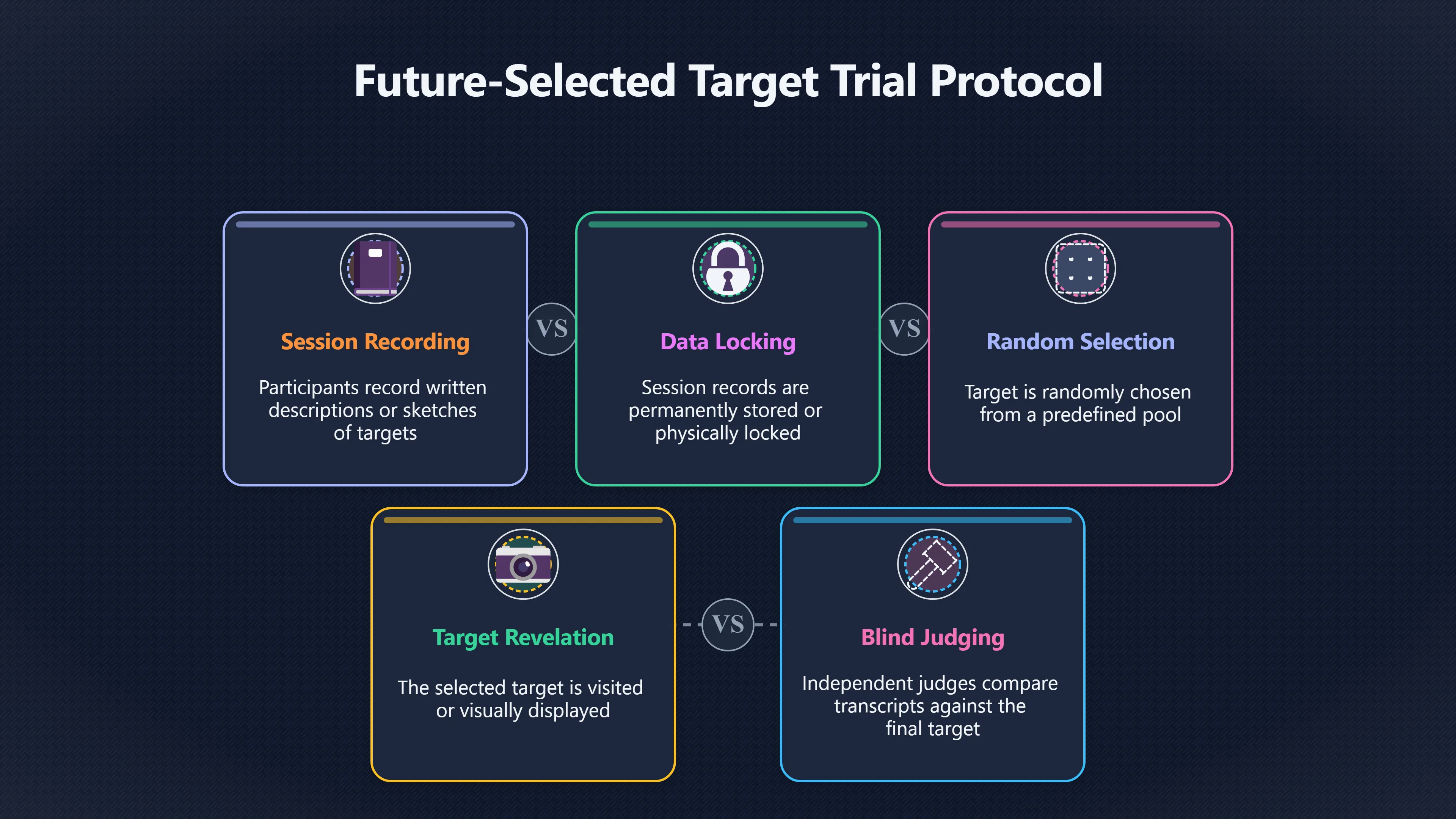
- The participant records written descriptions, sketches, or verbal impressions.
- The session record is permanently stored or otherwise locked so it cannot be altered.
- Only after the session has ended is the target randomly selected from a predefined pool.
- The selected target is then visited, displayed, or otherwise revealed.
- Independent judges compare the earlier session transcript with the eventual target and with decoy targets using a predetermined scoring method. CIA
The timing is the crucial experimental variable. In a conventional outbound remote-viewing experiment, a target location already exists while the participant is making observations. In a future-selected design, the target does not yet exist as an experimental fact. Supporters therefore argue that any successful matching cannot be explained simply as perception of a hidden present-day location.
One influential early example was the 1979 study by Brenda Dunne and John Bisaha. Participants attempted to describe a location before the destination was randomly determined. The investigators reported above-chance matching by independent judges and presented the work as a replication with methodological improvements over earlier Stanford Research Institute experiments. ResearchGate
Why target timing changes the claim
Changing the order of target selection fundamentally changes what the experiment is supposed to demonstrate.
If a participant successfully describes a location that already exists and is already occupied by another person, believers may interpret this as evidence for remote perception. Once the target is selected only after the viewing session, however, the hypothesis shifts towards some form of precognition or retrocausal information transfer. The experiment is no longer asking whether distance can be overcome, but whether future events can somehow correspond to earlier mental impressions. CIA
This distinction explains why future-target studies receive particular attention within parapsychology. A protocol that genuinely removes all present-time access to the target appears, in principle, to eliminate many ordinary information pathways. At the same time, critics argue that extraordinary timing claims require correspondingly stronger safeguards because subtle methodological weaknesses become more consequential when the claimed mechanism itself challenges conventional ideas of causality. PMC+2Wikipedia
What stronger controls have to lock down
Future-selected target experiments depend on procedural integrity. A small weakness at any stage can create alternative explanations that have nothing to do with precognition.
The strongest protocols attempt to secure several elements before data collection begins.
- Target pool definition. The complete list of possible targets should be fixed before any viewing session starts so that researchers cannot later substitute more favourable comparisons.
- Random target selection. The eventual target should be chosen using an unpredictable random process after the participant has finished recording impressions.
- Response locking. Session notes, drawings, and recordings should be time-stamped or otherwise preserved before target selection so that they cannot be revised.
- Blind judging. Judges should not know which target is correct, who produced the transcript, or the experiment’s desired outcome.
- Predefined scoring. Ranking procedures and statistical tests should be specified before analysis rather than selected after seeing the data.
- Controlled feedback. The timing and content of participant feedback should be standardised because repeated exposure to previous targets could influence later sessions independently of any paranormal process. CIA+2ResearchGate
These controls are intended to distinguish genuine predictive success from ordinary psychological effects such as hindsight bias, flexible interpretation, selective reporting, or unconscious cueing.
Why judging remains a central challenge
Unlike many laboratory measurements, remote-viewing transcripts are usually descriptive rather than numerical. Participants often produce broad impressions such as “water”, “metal”, “curved”, or “open space”, which may plausibly resemble several different targets.
This creates an important methodological problem. If judges know the correct answer, or if scoring rules are not fixed beforehand, there is considerable scope for subjective interpretation. Even independent judges may differ substantially in how they weigh symbolic descriptions against literal ones.
The Dunne and Bisaha replication explicitly modified the judging procedure by using separate independent judges rather than relying on a single judge to rank every transcript, an attempt to reduce statistical dependence and strengthen the design. Nevertheless, critics have continued to argue that subjective matching remains one of the hardest issues to eliminate completely in free-response remote-viewing research. Semantic Scholar
What the evidence currently suggests
Future-selected target experiments occupy a distinctive position within the wider remote-viewing literature because they test the temporal dimension of the claim more directly than standard hidden-target studies.
Supporters point to repeated reports of above-chance results across several decades and argue that future-target protocols remove many conventional information pathways while preserving statistically significant effects under controlled conditions. Reviews within the parapsychology literature have continued to treat precognitive remote viewing as an area worthy of further investigation, while acknowledging that the reported effects are generally modest and variable. ResearchGate
Mainstream scientific assessments reach a different conclusion. Reviews commissioned for the U.S. government and broader evaluations of the evidence have argued that reported successes have not produced reliable, independently reproducible demonstrations suitable for practical use, and that methodological concerns—including judging, feedback, statistical flexibility, and experimental design—remain sufficient to prevent acceptance of precognitive remote viewing as an established phenomenon. PMC




eBay marketplace picks
Marketplace Samples
Live-tested eBay searches with available results related to this page.



Endnotes
2.
Source: researchgate.net
Link:https://www.researchgate.net/publication/248497861_Remote_viewing_as_applied_to_futures_studies
Source snippet
ResearchGate(PDF) Remote viewing as applied to futures studiesThis paper reviews the most common protocols for remote viewing — including...
3.
Source: pmc.ncbi.nlm.nih.gov
Title: PMCFollow‐up on the U.S
Link:https://pmc.ncbi.nlm.nih.gov/articles/PMC10275521/
Source snippet
Central Intelligence Agency's (CIA...by Á Escolà‐Gascón · 2023 · Cited by 10 — Since 1972, the U.S. Central Intelligence Agency (CIA) co...
4.
Source: Wikipedia
Title: Remote viewing
Link:https://en.wikipedia.org/wiki/Remote_viewing
Source snippet
Remote viewingRemote viewing (RV) is the practice of seeking impressions about a distant or unseen subject, purportedly sensing with t...
5.
Source: Wikipedia
Link:https://en.wikipedia.org/wiki/Precognition
6.
Source: semanticscholar.org
Link:https://www.semanticscholar.org/paper/Precognitive-Remote-Perception%3A-Replication-of-Nelson-Dunne/9ba750c832f62ac70943368be8977d7551934d92
Source snippet
State, Trait, and Target Parameters Associated with Accuracy in Two Online Tests of Precognitive Remote Viewing.Read more...
Additional References
7.
Source: scribd.com
Link:https://www.scribd.com/document/851583682/1979-precognitive-remote-viewing-stanford
Source snippet
Precognitive Remote Viewing Study | PDF | Fringe ScienceThe study investigates precognitive remote viewing, where untrained individuals d...
8.
Source: youtube.com
Title: Remote Viewing, Demystified with Dick Allgire from the Future Forecasting Group
Link:https://www.youtube.com/watch?v=1Q1D4oeQNPg
Source snippet
These videos provide relevant context on associative remote viewing protocols and future-target experimentation, which are central to tes...
9.
Source: scispace.com
Link:https://scispace.com/pdf/remote-viewing-the-future-with-a-[tasking
Source snippet
Abstract—This study uses remote viewing in a predictive manner within the context of a novel experimental design to describe 11 target ev...
10.
Source: youtube.com
Title: Consciousness-Related Anomalies at Princeton with Brenda Dunne
Link:https://www.youtube.com/watch?v=D-jgZBlyOek
Source snippet
Remote Viewing, Demystified with Dick Allgire from the Future Forecasting Group...
11.
Source: youtube.com
Title: Remote Viewing the Lottery, Plus Karl Marx and Psi with Jon Knowles
Link:https://www.youtube.com/watch?v=3WiGjqbQujU
Source snippet
SSE Talks - Remote viewing the Stock Market - Christopher Carson Smith...
12.
Source: youtube.com
Title: SSE Talks
Link:https://www.youtube.com/watch?v=K3x5QHD7Ewo
Source snippet
Consciousness-Related Anomalies at Princeton with Brenda Dunne...
13.
Source: ciaotest.cc.columbia.edu
Title: sa jan02srm01
Link:https://ciaotest.cc.columbia.edu/olj/sa/sa_jan02srm01.html
Source snippet
Remote Viewing: The US Sponsored Psychic...This paper deals with experiments conducted in USA in which certain individuals were trained...
14.
Source: acadintuition.com
Link:https://acadintuition.com/wp-content/uploads/2018/07/Applications.pdf
Source snippet
Bisaha and Dunne, a series of precognitive remote viewing trials were conducted between northern. Wisconsin and various sites in Eastern...
15.
Source: youtube.com
Title: Associative Remote Viewing with Debra Lynne Katz
Link:https://www.youtube.com/watch?v=IgF-CRXuAqA
Source snippet
Remote Viewing the Lottery, Plus Karl Marx and Psi with Jon Knowles...
Topic Tree