Within Intel Value
Did Background Clues Create Better Hits?
Some impressive results became less convincing when viewers may have had target context that ordinary analysts already knew.
On this page
- Why independence mattered
- How prior context could shape impressions
- Why dramatic anecdotes needed caution
Page outline Jump by section
Introduction
One of the central questions in evaluating remote viewing as an intelligence tool was whether its apparent successes were genuinely independent. Intelligence agencies were not interested in broad descriptions that happened to resemble known facts after the event. They needed information that could not reasonably have come from existing knowledge, informed guesswork or subtle cues. This distinction became increasingly important as reviewers examined some of the programme’s most publicised successes. While certain reports appeared impressive in retrospect, official evaluations concluded that some of these cases may have been influenced by background information already available to the viewer or by contextual clues embedded in the tasking process rather than by an independent paranormal source.[National Security Archive]nsarchive2.gwu.eduNational Security ArchiveAn Evaluation of Remote Viewing: Research and…March 13, 2015 — by MD Mumford · 1995 · Cited by 76 — During St…
Why Independence Mattered
For any intelligence source, independence is a basic requirement. If a report merely reflects what analysts already know—or what a viewer could plausibly infer—it adds little operational value.
Remote viewing was often presented as a way to obtain information unavailable through conventional intelligence collection. That claim could only be tested if viewers had no meaningful prior knowledge of the target and if the resulting descriptions contained specific, verifiable details beyond what ordinary reasoning could produce.
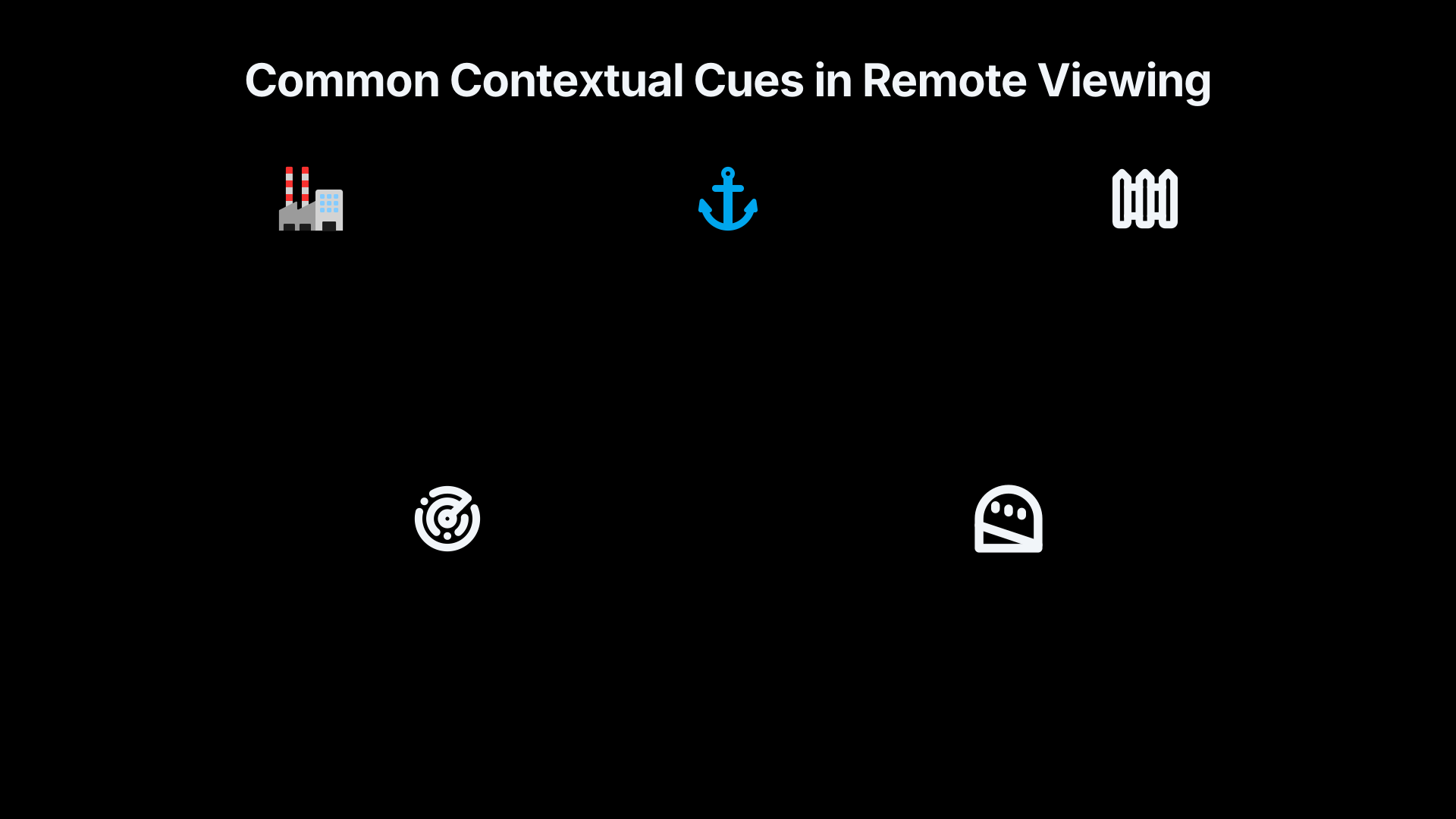
This was especially important because many intelligence targets already came with substantial background context. A viewer might know that the target involved a Soviet naval installation, a hostage situation or a missing aircraft. Even without exact knowledge, such information narrows the range of plausible descriptions. References to military equipment, water, industrial structures or underground facilities might therefore sound striking while remaining statistically unsurprising.
The 1995 American Institutes for Research (AIR) evaluation stressed that operational usefulness depended on obtaining genuinely new information. It concluded that reports generally failed to provide sufficiently specific intelligence beyond what conventional methods already supplied.[National Security Archive]nsarchive2.gwu.eduNational Security ArchiveAn Evaluation of Remote Viewing: Research and…March 13, 2015 — by MD Mumford · 1995 · Cited by 76 — During St…
How Prior Context Could Shape Impressions
Background information could influence remote-viewing sessions through several mechanisms without deliberate fraud.
Expectations and informed inference
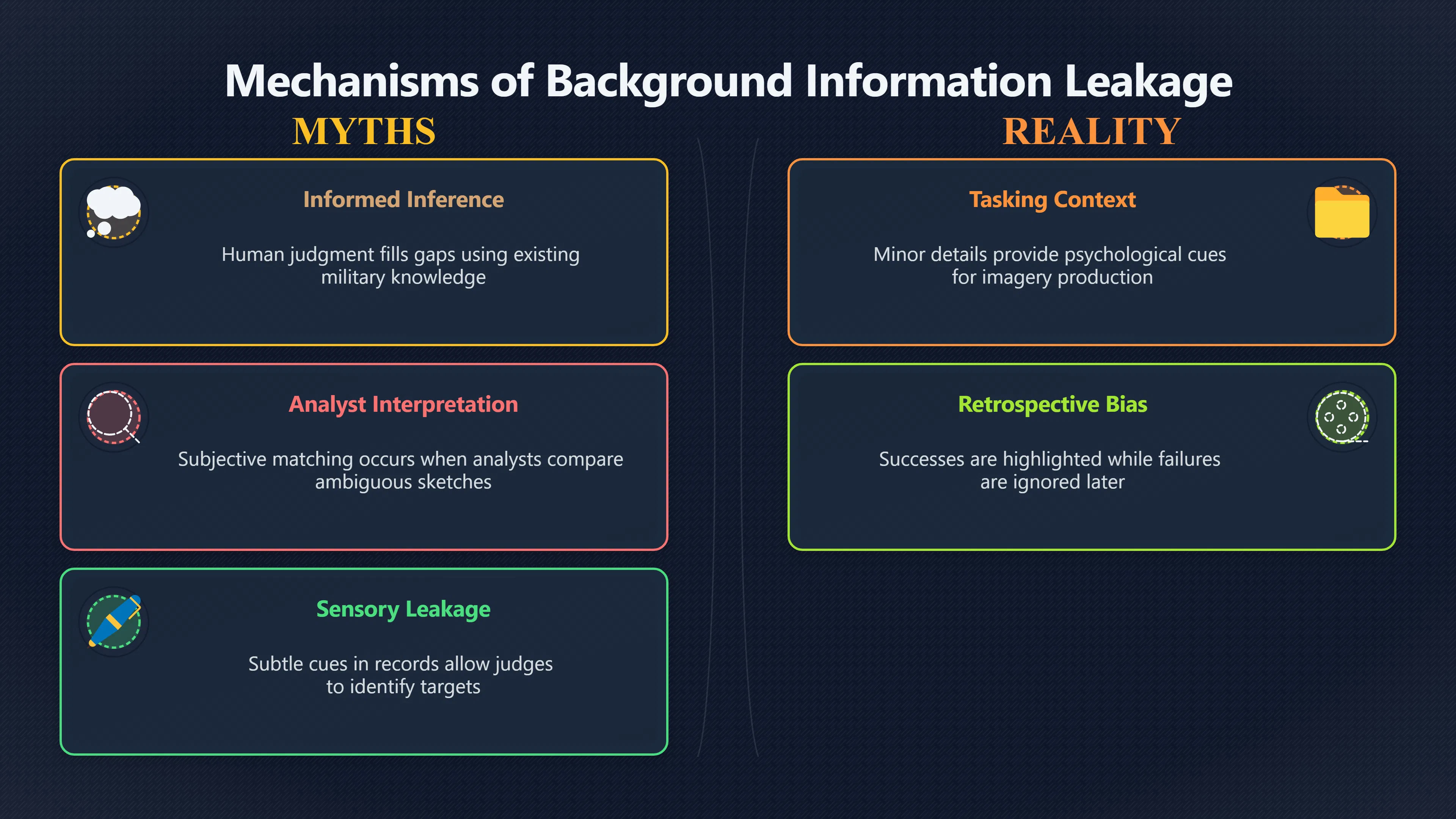
Human judgement naturally fills gaps using existing knowledge. If viewers knew they were working on Cold War military targets, they might unconsciously generate descriptions consistent with typical military environments.
Descriptions such as:
- reinforced concrete structures
- radar equipment
- security fencing
- underground facilities
- aircraft or submarines
might sound impressive because many strategic sites shared those characteristics. Without a precise prediction made before independent verification, it becomes difficult to separate genuine anomalous information from informed inference.
Tasking information
Even apparently minor details supplied by taskers could unintentionally shape expectations.
Knowing that a target involved:
- a foreign weapons programme,
- a missing intelligence asset,
- an aircraft crash, or
- a naval installation
provided psychological context that could influence the imagery produced during a session. Modern experimental protocols therefore attempt to minimise such information through stronger blinding procedures, but operational intelligence work often cannot eliminate contextual knowledge completely.
Analyst interpretation
Remote-viewing reports were usually composed of sketches, isolated words and symbolic impressions rather than straightforward factual statements.
Analysts interpreting these reports frequently knew much more about the operational problem than the viewers themselves. This created opportunities for subjective matching. Ambiguous statements could acquire apparent significance once analysts compared them with information already in the intelligence file.
The AIR review found that reports often required considerable interpretation before they appeared meaningful, reducing their value as independent evidence.[National Security Archive]nsarchive2.gwu.eduNational Security ArchiveAn Evaluation of Remote Viewing: Research and…March 13, 2015 — by MD Mumford · 1995 · Cited by 76 — During St…

Why Dramatic Anecdotes Needed Caution
Many famous remote-viewing stories involve retrospective accounts of unusually successful sessions. Such cases attracted attention because they appeared dramatically accurate.
The difficulty is that anecdotes rarely preserve the full operational context.
Important questions include:
- How much did the viewer already know?
- How many unsuccessful sessions preceded the reported success?
- Were unsuccessful details ignored afterwards?
- Were descriptions edited before publication?
- Were multiple possible interpretations available before the outcome became known?
Without complete documentation, impressive narratives can exaggerate evidential strength.
The AIR reviewers noted “reason to suspect” that in some well-publicised examples remote viewers may have possessed substantially more background information than was immediately apparent. This observation did not prove intentional contamination, but it weakened claims that those cases demonstrated independent paranormal collection.[National Security Archive]nsarchive2.gwu.eduNational Security ArchiveAn Evaluation of Remote Viewing: Research and…March 13, 2015 — by MD Mumford · 1995 · Cited by 76 — During St…
Earlier Experimental Lessons About Information Leakage
Concerns about background knowledge were reinforced by earlier laboratory controversies.
Psychologists David Marks and Richard Kammann re-examined influential remote-viewing experiments conducted at the Stanford Research Institute during the 1970s. They argued that judges could identify correct targets through ordinary cues contained in transcripts, including dates, sequencing information and references left unintentionally in the records. When such cues were removed in later testing, reported success rates declined substantially according to their analyses.[Wikipedia]WikipediaSensory leakageSensory leakage
Although proponents disputed aspects of these criticisms and later introduced stricter protocols, the controversy established an important methodological principle: even subtle information leakage can create convincing but misleading “hits”.
This lesson extended naturally into operational intelligence. If laboratory experiments required rigorous blinding to prevent cueing, intelligence cases—where participants often possessed varying amounts of classified background knowledge—presented an even greater challenge.
Why Broad Accuracy Was Not Enough
The AIR evaluation distinguished between recognising broad characteristics and producing operationally useful intelligence.
Reviewers accepted that some reports occasionally appeared to contain generally correct impressions. However, these broad similarities rarely translated into independent discoveries that changed decisions.
For example, correctly describing a target as involving water, industrial activity or military personnel might seem accurate without identifying:
- the precise location,
- the object sought,
- the timing of an event,
- or the specific action intelligence officers should take.
In intelligence work, partial background consistency has much lower value than a previously unknown fact that can be verified independently. This explains why reports sometimes appeared persuasive during retrospective discussion while contributing little to real-time operations.[National Security Archive]nsarchive2.gwu.eduNational Security ArchiveAn Evaluation of Remote Viewing: Research and…March 13, 2015 — by MD Mumford · 1995 · Cited by 76 — During St…
What This Failure Mode Revealed
The issue of background leakage illustrates a broader challenge in evaluating extraordinary intelligence claims. Humans naturally notice successful correspondences while overlooking the role of prior knowledge, ambiguous language and retrospective interpretation.
Remote viewing therefore faced a demanding evidential standard. A convincing operational success required not merely an impressive description but a demonstrably independent one—produced without informative cues, specific enough to distinguish itself from educated guessing and valuable enough to alter an intelligence decision before conventional methods supplied the answer.
Official reviews concluded that this standard was rarely, if ever, met consistently enough for remote viewing to become a dependable operational intelligence capability.[National Security Archive]nsarchive2.gwu.eduNational Security ArchiveAn Evaluation of Remote Viewing: Research and…March 13, 2015 — by MD Mumford · 1995 · Cited by 76 — During St…

eBay marketplace picks
Marketplace Samples
Example marketplace items related to this page. Use the search link to explore similar finds on eBay.

Endnotes
1.
Source: Wikipedia
Title: [Stargate]({{ ‘stargate/’ | relative_url }}) Project (U.S. Army unit)
Link:https://en.wikipedia.org/wiki/Stargate_Project_%28U.S._Army_unit%29
Source snippet
Stargate Project (U.S. Army unit)The Stargate Project's work primarily involved remote viewing, the purported ability to psychically "...
2.
Source: Wikipedia
Title: Sensory leakage
Link:https://en.wikipedia.org/wiki/Sensory_leakage
3.
Source: Wikipedia
Title: Remote viewing
Link:https://en.wikipedia.org/wiki/Remote_viewing
Source snippet
Remote viewingRemote viewing (RV) is the practice of seeking impressions about a distant or unseen subject, purportedly sensing with t...
4.
Source: nsarchive2.gwu.edu
Link:https://nsarchive2.gwu.edu/NSAEBB/NSAEBB438/docs/doc_57.pdf
Source snippet
National Security ArchiveAn Evaluation of Remote Viewing: Research and...March 13, 2015 — by MD Mumford · 1995 · Cited by 76 — During St...
Published: March 13, 2015
Additional References
5.
Source: facebook.com
Link:https://www.facebook.com/100090372200308/posts/during-the-cold-war-the-cia-funded-research-into-what-they-called-remote-viewing/937678002587931/
Source snippet
During the Cold War, the CIA funded research into what...STARGATE program, which explored parapsychological phenomena like remote viewin...
6.
Source: researchgate.net
Title: 369604750 Remote Viewing a 1974 2022 systematic review and [meta analysis]({{ ‘meta-analysis/’ | relative_url }})
Link:https://www.researchgate.net/publication/369604750_Remote_Viewing_a_1974-2022_systematic_review_and_meta-analysis
Source snippet
(PDF) Remote Viewing: a 1974-2022 systematic review...This is the first meta-analysis of all studies related to remote viewing tasks con...
7.
Source: academia.edu
Link:https://www.academia.edu/95285973/The_Star_Gate_Operational_Remote_Viewing_Program_A_Human_Intelligence_HUMINT_Collection_Platform
Source snippet
ts, as a visiting scientist at SRI and a co-author on the 1989 meta-analysis...Read more...
8.
Source: cia.gov
Link:https://www.cia.gov/readingroom/docs/CIA-RDP96-00791R000200180005-5.pdf
Source snippet
d on their review. In this review, they were to cover four...
9.
Source: reddit.com
Link:https://www.reddit.com/r/remoteviewing/comments/1t2z7xa/found_something_interesting_in_the_declassified/
Source snippet
ch did actually largely stop due to operational issues...
10.
Source: youtube.com
Title: Edwin May, [Psychic Spying]({{ ‘psychic-spying/’ | relative_url }}) (Remote Viewing, Star Gate Program)
Link:https://www.youtube.com/watch?v=EPvrOsEXBbE
Source snippet
U.S. Army's Psychic Intelligence: Stargate Project...
11.
Source: youtube.com
Title: Training Anomalous Cognition with Edwin C. May
Link:https://www.youtube.com/watch?v=MAnEiItzEXk
Source snippet
Edwin May, Psychic Spying (Remote Viewing, Star Gate Program) - Jimmy Akin's Mysterious World...
12.
Source: youtube.com
Title: The CIA Filed a 9-Page Report Describing Pyramids on Mars. Then Classified It
Link:https://www.youtube.com/watch?v=lGenw1l8rjk
Source snippet
Inside The Military's Secret Psychic Unit...
13.
Source: facebook.com
Link:https://www.facebook.com/AskImtinan/posts/project-stargate-the-cias-search-for-tabut-e-sakinahin-1972-the-cia-secretly-fun/1575907587435890/
Source snippet
ctionable intelligence information...
14.
Source: youtube.com
Title: Inside The Military’s Secret Psychic Unit
Link:https://www.youtube.com/watch?v=9nY3hu76SyU
Source snippet
Training Anomalous Cognition with Edwin C. May...
Topic Tree